
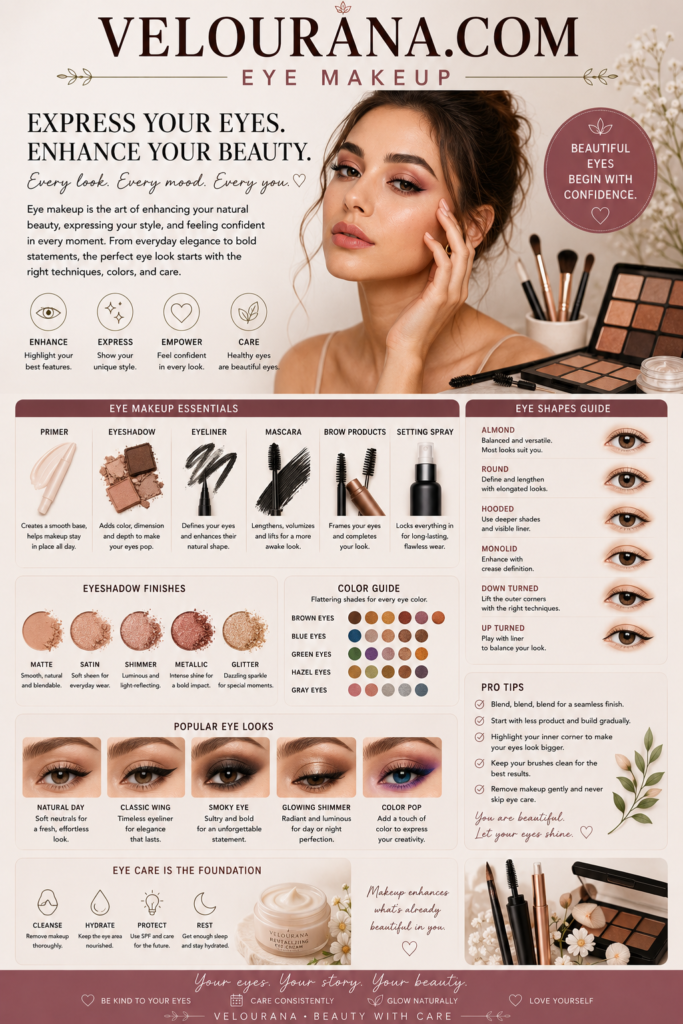
CATEGORY: Glitter Eyeshadow
Glitter eyeshadow has moved far beyond the idea of occasional party makeup. Modern formulations and changing beauty aesthetics have made reflective texture part of everyday neutral looks, polished evening eyes, graphic editorial work and highly experimental color stories. The glitter itself may be almost microscopic or intentionally large, transparent or opaque, monochromatic or capable of shifting through several colors under different light.
What unites these variations is the way glitter changes the surface of the eyelid.
Traditional eyeshadow is largely understood through pigment. Glitter adds another visual language: reflection. The color may remain relatively simple, yet the eye appears complex because illumination is constantly changing across the particles.
This is why even a single glitter shade can create a complete eye look. A bronze sparkle over bare or softly tinted lids may provide enough warmth and movement to replace several conventional shadows. A silver glitter pressed over black can create instant drama. A translucent iridescent formula over neutral makeup may appear almost invisible until the head turns.
Modern glitter is therefore less about one specific aesthetic and more about manipulating the relationship between color, texture and light.
The Difference Between Sparkle and Saturation
Not all glitter eyeshadow is visually intense.
A sheer formula may contain highly reflective particles while depositing very little base color. The effect is sparkle without substantial saturation.
This can be extremely useful.
A transparent gold glitter can be placed over brown, green, burgundy or even blue shadow without dramatically changing the underlying color. It adds light while allowing the original makeup to remain recognizable.
Opaque glitter formulas behave differently.
They may combine dense base pigment with reflective particles, creating a surface in which both color and sparkle are strong.
A cobalt glitter shadow, for example, can appear as a fully saturated blue lid with additional flashes of light rather than a transparent glitter veil.
The choice between these effects determines whether glitter functions as a topper or as the primary eyeshadow.
Glitter Toppers and the Transformation of Existing Makeup
A glitter topper is one of the most versatile reflective products because it changes the finish of shadow already on the eye.
A neutral matte eye can become luminous through a thin layer of champagne glitter.
A deep smoky eye can gain dimension from silver, bronze or multicolored particles.
A colored eye can be transformed by choosing a glitter that either harmonizes or contrasts with the base.
Rose glitter over plum maintains warmth and color cohesion. Gold over olive creates richness. Blue-green iridescence over black introduces a dramatically shifting finish.
Because the base remains visible, the final result is layered rather than flat.
The same glitter topper can also produce very different results over different colors.
This makes reflective products unusually flexible.
The Beauty of Transparent Glitter
Transparent or nearly colorless glitter can be particularly sophisticated because the eye does not appear covered by another obvious pigment.
The reflective particles seem to sit directly over the makeup or skin.
On a bare-looking lid, this creates a delicate wet-sparkle effect.
Over neutral shadow, it introduces movement without disrupting the color palette.
Iridescent versions can shift subtly between pink, blue, green or gold depending on the angle.
The effect is especially beautiful when the surrounding makeup is restrained because the changing light becomes the central detail.
Gold Glitter and Warm Glamour
Gold remains one of the most enduring glitter colors because it works naturally with many warm and neutral palettes.
Against brown, gold produces classic richness.
Over bronze, it intensifies reflection without introducing a dramatically new hue.
Beside burgundy or plum, gold can create luxurious contrast.
The character of gold changes according to tone.
Pale champagne-gold feels brighter and more delicate. Yellow gold is more obvious and traditional. Antique gold contains greater depth and can appear especially sophisticated beside olive, brown and black.
Coppery gold introduces warmth, while green-gold can create a more unusual, almost jewel-like effect.
The surrounding shadow determines whether the glitter feels romantic, glamorous or editorial.
Silver Glitter and Cooler Drama
Silver produces a very different atmosphere.
Its cool reflectivity can make eye makeup feel sharper, more futuristic or more nocturnal.
Over charcoal or black, silver becomes intensely dramatic.
Over taupe or gray, it can remain sophisticated and controlled.
Against blue, violet or cool green, silver reinforces the cooler palette without necessarily becoming the only focal point.
A small silver accent at the center of a smoky eye can create enough contrast to prevent the makeup from appearing completely flat.
Full silver coverage, by comparison, becomes much more graphic.
The same material can therefore move from subtle highlight to major statement according to scale.
Bronze and Copper Glitter
Bronze and copper sit between neutral and decorative color.
Their warmth makes them easy to integrate with brown, terracotta, plum, olive and warm neutral makeup.
Bronze tends to feel deeper and more muted than bright gold.
Copper introduces stronger orange-red warmth and can become particularly vivid under evening lighting.
These colors are useful for people who want obvious reflection without the stark contrast of silver or the brightness of yellow gold.
They also work beautifully in monochromatic makeup.
A matte brown crease, bronze metallic lid and copper glitter accent can create several levels of warmth while remaining within one cohesive family.
Jewel-Toned Glitter
Emerald, sapphire, amethyst and ruby-inspired glitter bring saturated color into reflective eye makeup.
These shades become especially dramatic over dark bases.
Emerald over black or forest green appears intensely jewel-like. Blue glitter over navy creates depth without the sharp contrast of silver. Violet over plum can look rich and multidimensional.
The particles may also contain several tones.
A purple glitter can flash blue or pink. Green may shift toward gold. Blue may reveal turquoise under stronger light.
This complexity makes jewel glitter capable of carrying an entire eye look with relatively little surrounding color.
Multichrome and Iridescent Glitter
Some of the most visually complex glitter formulas change color according to the viewing angle.
A shade may appear green when seen directly, shift to blue as the head turns and reveal violet under another light.
These transformations make the eyelid appear almost fluid.
Because the effect is already complex, the base underneath often benefits from simplicity.
Black can intensify the color shift, while neutral tones create a softer result.
A transparent base allows the natural eyelid to influence the finish.
The eye becomes a moving surface rather than a fixed color block.
Glitter Within Minimal Makeup
One of the most modern ways to wear glitter is to remove much of the traditional surrounding eye makeup.
A sheer reflective lid paired with mascara can feel cleaner and more contemporary than a heavily blended multi-shadow look.
The glitter becomes texture rather than decoration.
Brows may remain natural, skin luminous and lips understated.
This creates an interesting contrast because glitter is traditionally associated with excess, yet the overall makeup can be extremely minimal.
The sophistication comes from giving the reflective surface enough visual space.
Glitter and Bare Skin
Glitter can be particularly striking when applied over an eyelid that retains some natural skin tone.
Instead of hiding the lid beneath several layers of pigment, the makeup allows freckles, veins and natural color variation to remain visible around or beneath the sparkle.
This produces a more organic finish.
Transparent glitter is especially effective for this style because it enhances rather than replaces the skin.
The result can feel editorial without being heavy.
Glitter and Smoky Shadow
The relationship between glitter and smoke depends on opposition.
Smoky shadow absorbs light and creates depth. Glitter reflects light and creates movement.
Placed together, each makes the other more obvious.
A charcoal eye becomes more dimensional when silver glitter interrupts the darkness.
A brown smoky eye becomes richer with gold or copper.
Plum can be intensified by rose or violet glitter.
The reflective placement can remain concentrated rather than covering the entire smoke.
This allows the shadow structure to remain visible.
Full-Lid Glitter
Covering the complete mobile lid creates maximum visual impact.
The success of this approach depends on keeping the surrounding areas controlled.
A defined crease can provide structure around the glitter, while a clean brow area prevents the reflection from spreading visually too far.
The lash line may be strengthened with eyeliner or mascara to anchor the eye.
Full-lid glitter can be monochromatic or multicolored.
Neutral gold and bronze feel glamorous. Silver becomes more graphic. Jewel tones create saturated drama.
The base beneath the glitter determines how dense the finished color appears.
Glitter Halo Eyes
A halo eye places the brightest reflective area through the center while maintaining greater depth on both the inner and outer lid.
Glitter is especially effective in this structure because its reflection exaggerates the center.
The eye appears more dimensional as the center catches light.
Gold glitter surrounded by brown creates warmth. Silver framed by charcoal produces dramatic contrast. Rose glitter within plum creates a romantic variation.
The glitter area can be narrow or broad depending on the desired intensity.
Glitter and Cut-Crease Structure
Glitter can emphasize the geometry of a defined crease because reflective texture creates a strong distinction from surrounding matte shadow.
A clean glittered lid beneath a deeper crease can produce a polished, structured eye.
The contrast between edges becomes part of the design.
This technique can range from subtle champagne glitter beneath neutral brown to saturated jewel glitter beneath dark graphic shadow.
The more defined the boundaries, the more formal and constructed the eye appears.
Diffused Glitter Edges
Not every glitter look requires a hard boundary.
Allowing the particles to become progressively sparse toward the edges creates a softer finish.
The densest reflection may remain at the center of the lid while only occasional particles extend toward the crease.
This creates a gradient of texture rather than color.
The effect can appear particularly sophisticated with transparent or neutral glitter.
Instead of seeing where the glitter begins and ends, the viewer perceives a field of light that gradually disappears.
Graphic Glitter Placement
Glitter can move beyond conventional eyeshadow entirely.
Reflective pigment may be arranged in a deliberate wing, concentrated above the crease or used to create a geometric block.
In such makeup, the glitter itself becomes the line or shape.
The contrast between irregular particle reflection and precise placement can be especially compelling.
A sharp glitter wing, for example, combines textured material with strict geometry.
This is less about natural enhancement and more about visual design.
Glitter and Eyeliner Balance
When glitter is intense, eyeliner needs a clear role.
A substantial black wing can create enough contrast to remain visible against strong reflection.
A fine line may become lost, particularly over dense dark glitter.
Alternatively, eyeliner can be omitted entirely and mascara used to anchor the lashes.
Colored liner can create more experimental combinations.
Burgundy with gold, navy with silver or green with copper can introduce additional depth without defaulting to black.
The surrounding color story determines whether the liner should support or compete with the glitter.
Mascara and Glitter
Mascara becomes especially important when glitter is pale or bright.
Dark lashes provide visual structure against the reflective lid.
Without sufficient lash definition, very bright glitter can sometimes make the eye appear less anchored.
Black mascara creates maximum contrast.
Brown may suit softer neutral glitter looks.
Colored mascara can produce a more editorial relationship when intentionally coordinated or contrasted with the glitter.
Glitter and False Lashes
False lashes can support dramatic glitter because their density balances the strength of the reflective surface.
Outer-heavy lashes create horizontal movement, while evenly dense lashes produce a more traditionally glamorous frame.
Very large lashes can partially obscure glitter on the mobile lid, especially when the eyes are open.
The scale of the lashes should therefore be considered in relation to the amount of visible glitter.
The reflective surface should still have enough space to perform visually.
Cream and Liquid Glitter Formulas
Cream and liquid glitter shadows offer a more integrated base than loose glitter.
The reflective particles are already suspended within a cosmetic medium, which can make application more controlled.
Some formulas remain flexible and glossy. Others dry into thin films.
The setting time influences technique.
Fast-setting products need to be blended or positioned promptly. Slower formulas allow more manipulation but may remain mobile for longer.
The final finish can range from transparent sparkle to dense metallic glitter.
These formulas are particularly useful when convenience and reduced fallout are priorities.
Pressed Glitter Formulas
Pressed glitter provides the appearance of loose reflective particles in a more compact form.
Depending on formulation, it may contain enough binder for direct application or may still benefit from an appropriate cosmetic glitter base.
Manufacturer instructions should guide use.
The particles can often be pressed onto the lid with a fingertip or flat brush.
Pressing rather than sweeping helps maintain density and reduces unnecessary movement.
Loose Cosmetic Glitter
Loose glitter offers maximum flexibility because the particles are not already combined with a fixed base.
It can be layered over different colors and concentrated exactly where desired.
However, it requires greater control.
Only loose glitter specifically intended for cosmetic eye-area use should be considered for eyelid application.
An appropriate eye-safe adhesive or glitter base can help secure it.
This is not an area for improvised materials.
The proximity of the product to the eye makes appropriate formulation essential.
Safety Around the Eye Area
Glitter eye makeup requires particular attention because particles can migrate.
Products should be explicitly intended for cosmetic use around the eyes.
Craft glitter and decorative materials designed for non-cosmetic purposes should not be substituted.
Manufacturer guidance regarding placement should be followed.
If a product causes significant irritation, burning or persistent discomfort, it should be removed rather than tolerated for the sake of the look.
Contact lens wearers may need additional care because individual tolerance varies.
Cosmetic artistry does not override eye comfort.
Glitter and Contact With the Waterline
Glitter should not automatically be placed on the waterline merely because another eye product can be used there.
The waterline is a particularly sensitive location.
Only products specifically intended by their manufacturer for that placement should ever be considered.
In most glitter looks, the reflective effect can be achieved beautifully on the lid or around the lash area without bringing particles onto the inner rim.
Preventing Unwanted Migration
Controlled application begins with quantity.
A small amount is easier to place securely than a large quantity scattered across the lid.
Pressing glitter onto an appropriate base reduces movement.
Completing glitter work before complexion makeup can make cleanup easier when the formula is prone to fallout.
The exact method is less important than maintaining control and avoiding unnecessary rubbing around the eye.
Glitter Through Different Ages and Aesthetics
Glitter does not belong to one age group or one style.
Fine neutral sparkle can appear refined and understated.
Larger particles can create deliberate editorial texture.
The choice depends on the desired effect rather than an arbitrary rule about who should wear reflection.
On textured eyelids, particle scale and placement can be adjusted according to preference.
A concentrated glitter center can introduce light while leaving surrounding areas matte.
A sheer glitter veil can create luminosity without opaque coverage.
Glitter and Photography
Reflective eye makeup can behave unpredictably in photographs because lighting changes the intensity dramatically.
Direct flash may make glitter appear brighter than it does in ambient light.
Soft lighting can reduce the visible reflection.
Dense metallic glitter can photograph almost like foil, while transparent micro-glitter may appear as scattered points.
This variability is part of the medium.
Testing the makeup under similar lighting to the intended environment can help reveal how strong the final effect will appear.
Glitter in Daylight
Natural daylight often reveals the actual color of glitter more clearly than dim artificial lighting.
Fine particles may appear softer.
Multichrome shifts can become more obvious as the face moves.
Neutral glitter can look particularly elegant because the reflection is less concentrated than under direct evening light.
This makes subtle glitter suitable for daytime when the density is controlled.
Glitter at Night
Artificial evening lighting often intensifies sparkle.
Point-source lights create stronger flashes across individual particles.
A glitter eye that seems moderate in daylight may become dramatically reflective at night.
This is one reason glitter remains closely associated with evening beauty.
The environment amplifies its defining quality.
Removal as Part of the Technique
Glitter makeup is not complete until it has been removed carefully.
A suitable eye-makeup remover can soften the cosmetic base and allow particles to lift more easily.
Pressing rather than rubbing reduces friction.
Persistent particles can be removed gradually rather than aggressively.
The delicate eye area benefits from patience.
Removal should never become a struggle simply because the original makeup was designed for long wear.
Why Glitter Does Not Need to Be Perfect
The irregularity of glitter is part of its beauty.
Individual particles do not reflect identically.
Some catch light while others disappear.
This randomness creates movement that perfectly uniform metallic pigment cannot reproduce.
A glitter eye can therefore remain sophisticated without every reflective point being distributed mathematically evenly.
What matters is the larger composition.
The density should appear intentional. The placement should support the design. The surrounding eye should feel balanced.
Small variations within the reflective surface make it alive.
Glitter as a Modern Texture Rather Than a Special-Occasion Product
The most important change in the way glitter is used today is perhaps conceptual.
It no longer needs to signal a particular occasion.
A few particles over neutral eyeshadow can belong to ordinary daytime beauty.
A sheer glitter veil can accompany minimal makeup.
A dramatic full-lid glitter eye can still create exceptional evening impact.
The texture has become flexible enough to move between these worlds.
That flexibility allows glitter to be treated like any other finish.
It can be chosen according to mood, placement and intensity rather than saved automatically for rare events.
The Beauty of Controlled Reflection
Glitter eyeshadow becomes most compelling when the reflection serves the eye rather than overwhelming it without purpose.
Sometimes that means one small concentration of light at the center of the lid.
Sometimes it means a complete field of silver or gold.
Sometimes the glitter is almost invisible until movement reveals it.
The possibilities depend on how the reflective texture is balanced against shadow, liner, lashes and bare skin.
Glitter has an unusual ability to make eye makeup feel alive because its appearance never remains completely fixed.
Every blink changes the relationship between particle and light.
Every turn of the head reveals another reflection.
That is what separates glitter from ordinary color.
It does not simply decorate the eyelid.
It gives the eyelid movement through light.
THE END VELOURANA
 Discover More From Our Family of Websites
 ZodiacBearing (Astrology, Tarot, Numerology, Angel Numbers & Spiritual Guidance)
 Velourana (Beauty, Makeup, Hair Care, Skincare & Beauty Tips)
 HavenBearing (Home, Living, Organization, Décor & Everyday Inspiration)
 PawBearing (Pet Care, Dog Breeds, Animal Health, Training & Pet Products)
 PsyCatherine (Notes From the Journal of a Psychologist on Real Life)

