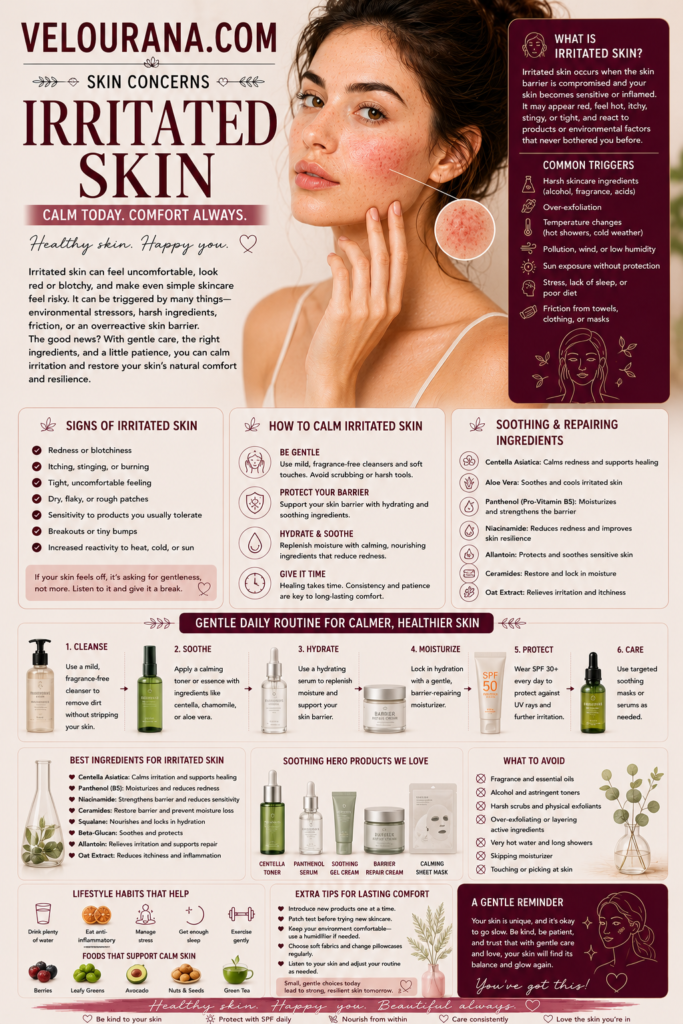
CATEGORY: Irritated Skin
A single episode of irritated skin can usually be explained away.
The weather changed. A new serum was too strong. Exfoliation went too far. A cleanser felt harsher than expected. The skin became red, tight, itchy, or uncomfortable, the routine was simplified, and eventually everything settled.
The more difficult situation is recurrence.
The irritation disappears, only to return several weeks later. Then again after a holiday. Then again during winter. Then after introducing a new active ingredient. The pattern begins to feel random, even though it rarely is.
Recurrent irritation is often not one problem repeating itself identically. It is a threshold problem. The skin reaches a point beyond which it can no longer comfortably tolerate the total combination of products, weather, friction, heat, cleansing, active ingredients, and environmental stress being imposed upon it.
That threshold is not fixed.
It can rise and fall depending on season, age, routine, underlying skin conditions, medication, hormonal changes, and exposure. A regimen that works effortlessly during humid summer months may become too aggressive during a cold, dry winter. A retinoid tolerated three times weekly may become irritating when combined with a new exfoliating acid. A cleanser that once felt comfortable may become too stripping after several weeks of over-treatment.
This is why the long-term management of irritated skin is less about finding a single perfect product and more about understanding the conditions under which irritation develops.
The goal is not to create skin that never reacts to anything.
The goal is to recognize the early signals, reduce unnecessary stress before a flare becomes severe, and build a routine with enough flexibility to adapt when the skin's tolerance changes.
Recurrent Irritation Usually Has a Pattern
When irritation happens repeatedly, memory can be unreliable.
People remember the dramatic moment—the evening moisturizer burned, the cheeks turned red, the skin suddenly became flaky—but often forget what happened in the days leading up to it.
A new exfoliant may have been added.
A retinoid frequency may have increased.
The weather may have become colder.
More makeup may have been worn and removed.
The person may have travelled, slept in heavily air-conditioned rooms, exercised more frequently, or spent more time in the sun.
One individual exposure may not appear significant.
Together, they can create a pattern.
This is why long-term prevention begins with retrospective observation.
What was different before each episode?
Did irritation tend to appear after several consecutive active-treatment nights?
Did it coincide with winter?
Did it happen after shaving?
Did it follow extended sun exposure?
Was the skin consistently comfortable until a particular product was introduced?
Did redness appear in exactly the same area each time?
Pattern recognition turns vague sensitivity into usable information.
Without it, every flare appears mysterious.
With it, irritation often becomes much more predictable.
The Difference Between a Trigger and a Background Condition
It is useful to separate immediate triggers from the condition of the skin before the trigger occurred.
Imagine two people applying the same exfoliating acid.
The first has comfortable, well-moisturized skin and uses no other strong actives. The product is tolerated easily.
The second has recently increased retinoid use, spent several days outdoors in cold wind, and has been cleansing more aggressively because of heavier makeup. The same exfoliating acid produces significant burning.
The acid may be the immediate trigger.
But it is not the entire explanation.
The background condition lowered tolerance.
This distinction matters because focusing only on triggers can lead to unnecessary avoidance. Someone may permanently abandon a product that was perfectly compatible under normal circumstances when the real problem was timing.
Likewise, focusing only on background condition can lead to repeated exposure to something genuinely irritating.
The useful question is not simply, “What touched my skin last?”
It is, “What condition was my skin in when it happened?”
Prevention Begins Before the Skin Turns Red
Most people react to irritation after it becomes visible.
Prevention requires acting earlier.
The first signs are often sensory rather than visual.
The face feels slightly tighter after cleansing.
A familiar serum tingles more than usual.
The cheeks become warm for a few minutes after applying moisturizer.
Tiny flakes appear around the mouth.
The skin feels rougher even though it still looks relatively normal.
These are not always emergencies.
But they are useful warnings.
A person who notices them early can reduce active frequency, stop exfoliation temporarily, use gentler cleansing, and increase moisturization before the skin becomes significantly inflamed.
This is one of the most important long-term habits for reactive complexions.
Do not wait for the flare.
Respond to declining tolerance.
Routine Intensity Should Be Adjustable
Many people build skincare routines as though they were fixed schedules.
Retinoid Monday, Wednesday, Friday.
Acid Tuesday and Saturday.
Mask Sunday.
Vitamin C every morning.
The schedule becomes a rule.
But skin does not always respect calendars.
An intelligent routine should have a stable structure but flexible intensity.
If the skin feels completely comfortable, treatment may proceed normally.
If it becomes dry or unusually reactive, treatment frequency can decrease.
If the climate becomes harsher, moisturization can increase.
If a new product is being introduced, other variables can remain stable.
This flexibility prevents the routine from continuing aggressively simply because the calendar says it should.
Skincare should respond to the skin.
Not the spreadsheet.
The Importance of a Baseline Routine
People with recurrent irritation benefit enormously from having a reliable baseline routine.
This is the routine that remains when everything non-essential is removed.
A gentle cleanser.
A dependable moisturizer.
A well-tolerated sunscreen.
Perhaps one additional product if it has been consistently compatible.
The value of a baseline routine is not minimalism for its own sake.
It is stability.
When irritation begins, the person knows exactly what to return to.
There is no need to search desperately for a “barrier rescue” collection.
No need to introduce four new soothing products.
No need to guess which cleanser will be gentle enough.
The baseline has already been tested.
This also provides diagnostic clarity.
If the skin becomes comfortable when the routine returns to baseline, the problem is more likely to lie among the treatments, techniques, or environmental changes that were removed.
A good baseline acts like a control condition.
It gives the routine a home.
Exfoliation Should Be Earned by Tolerance
Exfoliation is one of the most common contributors to recurrent irritation because it produces immediate visible rewards.
Skin can look smoother, brighter, and more refined after exfoliation.
This encourages frequency.
If once weekly is good, perhaps twice weekly is better.
If a mild acid works, perhaps a stronger one will work faster.
If a toner exfoliates, perhaps adding peel pads will improve the effect.
The difficulty is that tolerance does not necessarily increase alongside ambition.
For reactive skin, exfoliation should be earned by continued comfort.
If the skin remains calm at one application per week for several weeks, frequency can be reconsidered.
If irritation appears, frequency should decrease.
There is no benefit in using an exfoliant more often than the skin can tolerate.
The true measure of success is not how smooth the skin looks the next morning.
It is whether the routine remains sustainable over months.
Retinoids Require the Same Discipline
Retinoids are among the most widely discussed active ingredients in modern skincare because of their relevance to acne, texture, pigmentation, and visible signs of aging.
They can also be irritating.
This does not mean they are unsuitable for reactive skin.
It means they should be introduced intelligently.
Frequency can be increased gradually.
Other potentially irritating actives can be limited during the adjustment period.
Moisturization can be prioritized.
Application to already irritated or freshly exfoliated skin can be avoided unless directed otherwise in a medical treatment plan.
The important principle is that adaptation should not be forced.
Persistent burning, severe peeling, or ongoing redness are not necessary milestones.
If irritation repeatedly appears at a particular frequency, that frequency may simply be too high.
Effective skincare is not defined by maximum use.
It is defined by maximum benefit within tolerable limits.
Fragrance Can Be a Variable Rather Than a Verdict
People with reactive skin are often advised to avoid fragrance entirely.
For some, that is appropriate.
For others, fragrance may be tolerated without difficulty.
The important point is not to turn fragrance into an ideological issue.
It is a variable.
If recurrent irritation is unexplained, reducing fragrance exposure can simplify the investigation.
If symptoms improve consistently with fragrance-free products and return with fragranced formulas, that pattern becomes meaningful.
If fragranced products are tolerated for years without difficulty, they may not be central to the problem.
The same logic applies to essential oils, botanical extracts, alcohol-containing products, and other ingredients frequently discussed online.
Individual history matters more than general reputation.
Cleansing Frequency Is Part of the Irritation Load
A person who cleanses twice daily may perform more than seven hundred facial cleansing sessions per year.
Small differences matter when repeated that often.
A slightly harsh cleanser may not create obvious irritation after one use.
Repeated hundreds of times, the effect can become more significant.
This is why cleansing is often the first step worth optimizing in recurrently irritated skin.
The formula should remove what needs to be removed.
The water should be comfortably warm rather than very hot.
The technique should avoid unnecessary friction.
People who do not need a full cleanse in the morning may prefer a lighter approach, depending on their skin and routine.
Those wearing makeup or water-resistant sunscreen may need double cleansing, but both steps should still be gentle.
The objective is not to minimize cleansing at all costs.
It is to avoid turning cleansing into chronic barrier stress.
Seasonal Skincare Is Not Optional for Some Complexions
Reactive skin often behaves differently across seasons.
Winter can bring cold air, wind, low humidity, and indoor heating.
Summer brings heat, sweat, stronger sun exposure, more frequent washing, and heavier sunscreen use.
Spring and autumn can produce sudden temperature changes.
A fixed routine may not suit all of these conditions equally.
During colder months, richer moisturizers may become useful.
Active frequency may need to decrease.
Hot showers may become more tempting and therefore more relevant.
In summer, lighter formulas may be more comfortable while sun protection becomes even more important.
Seasonal adjustment does not require rebuilding the entire routine.
It means recognizing that the environment changes the skin's tolerance.
The same product can feel completely different in January and July.
Travel Can Reveal Hidden Weaknesses in a Routine
Travel frequently disrupts skin because several variables change simultaneously.
Climate.
Humidity.
Water.
Sleep.
Diet.
Sun exposure.
Air conditioning.
Flight cabins.
Product decanting.
More frequent makeup.
Less consistent cleansing.
A routine that works perfectly at home may become uncomfortable abroad.
This does not necessarily mean the destination is “bad for the skin.”
It means the skin is experiencing a new environment while the routine remains unchanged.
People with recurrent irritation can reduce this risk by travelling with familiar baseline products rather than introducing new formulas during the trip.
Active treatments can be reduced temporarily if the skin begins feeling dry or reactive.
The objective during travel is often maintenance rather than maximal treatment.
A holiday is not the ideal time to test an aggressive peel.
Shaving Changes the Surface Condition
Shaving deserves special attention because it combines mechanical friction with removal of surface material.
Immediately afterward, skin may be more vulnerable to stinging.
Applying strong acids, fragranced aftershaves, or other potentially irritating products immediately after shaving can create unnecessary discomfort.
Some people find it useful to separate shaving and aggressive active treatments.
Others reduce exfoliation on shaving days.
The exact strategy is individual.
What matters is recognizing shaving as part of the total irritation load rather than treating it as unrelated grooming.
Makeup Removal Can Undo a Gentle Routine
A person may use a perfectly mild morning routine and then aggressively remove makeup every evening.
The overall routine is still aggressive.
Long-wear foundation, waterproof mascara, sunscreen, and multiple layers of complexion products can require effective removal.
But effectiveness does not demand force.
Oil-based cleansers, balms, micellar products, or gentle second cleansers may make removal easier depending on individual preference.
The technique matters.
Repeated wiping, scrubbing, rubbing around the eyes, or using rough reusable cloths can contribute to irritation.
If redness consistently appears after makeup removal rather than after makeup application, the removal process itself deserves investigation.
Heat Can Trigger a Flare Without Any Product Changing
One of the most confusing experiences in reactive skin is developing redness despite using exactly the same products.
Heat is a common missing variable.
Hot weather.
Hot showers.
Saunas.
Steam rooms.
Intense exercise.
Overheated bedrooms.
Cooking near strong heat.
Very hot beverages in some people with flushing tendencies.
For individuals prone to rosacea, heat is a particularly relevant trigger.
But even without diagnosed rosacea, already irritated skin can become more uncomfortable under thermal stress.
This does not require avoiding normal life.
It requires recognizing whether heat consistently changes the skin's behaviour.
Patterns matter more than isolated incidents.
Stress Does Not Mean the Problem Is Imaginary
Stress is often mentioned in discussions of skin, sometimes so casually that it becomes meaningless.
Stress does not mean irritation is psychological.
Its effects can be indirect and behavioural.
Stress may increase scratching or picking.
It may disrupt sleep.
It may change skincare consistency.
Someone may cleanse more aggressively because they are wearing more makeup at work.
They may skip moisturization when rushed.
They may introduce new treatments in response to stress-related breakouts.
For people with inflammatory conditions, stress may also coincide with worsening symptoms.
The point is not to blame stress for everything.
It is to include lifestyle changes in the wider pattern when recurrent irritation is being investigated.
Product Introductions Should Be Slow Enough to Teach You Something
Trying one product at a time sounds unnecessarily cautious until a reaction occurs.
Then it becomes extremely useful.
If a new serum is introduced while everything else remains stable and irritation appears shortly afterward, the relationship is easier to evaluate.
If five products are introduced during the same weekend, the information is lost.
This matters even more for people with recurrent sensitivity because identifying personal triggers has long-term value.
Patience during introduction can prevent months of confusion later.
The Same Product Can Become Irritating Through Overuse
A product does not need to be new to cause problems.
Frequency can change its behaviour.
A retinoid used twice weekly may be comfortable.
The same product used every night may cause persistent irritation.
An exfoliating cleanser used occasionally may work well.
Used twice daily, it may become too drying.
A clay mask once every two weeks may be fine.
Used several times per week, it may become excessive.
This is why product blame can be misleading.
Sometimes the correct product is simply being used incorrectly for the individual.
Irritation Can Coexist With Oiliness
People with oily skin often hesitate to reduce cleansing or use richer moisturizer because they fear worsening shine or breakouts.
But oily skin can still become irritated.
Sebum production and barrier integrity are not the same thing.
A complexion can produce substantial oil while also feeling tight, flaky, or reactive.
Over-cleansing oily skin may therefore create the unusual combination of shine and discomfort.
The presence of oil does not automatically mean the skin is well hydrated or resilient.
This is particularly relevant in acne-prone routines, where strong cleansers and multiple active treatments can accumulate quickly.
Irritation Can Coexist With Acne
Acne creates one of the hardest balancing acts in skincare.
Breakouts invite treatment.
Treatment can cause irritation.
Irritation can make consistent treatment difficult.
The solution is not necessarily to abandon acne care.
It is to distinguish essential treatment from unnecessary intensity.
A dermatologist-guided acne regimen may contain active ingredients that cause some adjustment, but persistent severe irritation should be discussed rather than simply endured.
For non-prescription routines, reducing redundant exfoliation, harsh cleansers, and aggressive spot treatments can sometimes improve tolerance while maintaining a more focused acne strategy.
The skin does not benefit from being attacked from every direction.
Irritation Can Coexist With Aging Concerns
People interested in anti-aging are particularly vulnerable to over-treatment because the category contains so many potential interventions.
Retinoids.
Acids.
Antioxidants.
Pigmentation treatments.
Peptides.
Resurfacing masks.
Devices.
Firming treatments.
The desire to address every visible sign at once can exceed the skin's tolerance.
A better long-term strategy is prioritization.
Choose the interventions with the greatest relevance.
Use them consistently.
Allow the routine enough simplicity to remain comfortable.
A product cannot deliver long-term benefits if irritation repeatedly forces it to be discontinued.
The Role of Professional Diagnosis
Some recurrent irritation cannot be solved through better cosmetic scheduling.
Rosacea, eczema, allergic contact dermatitis, seborrheic dermatitis, perioral dermatitis, and other conditions can all produce repeated redness or discomfort.
Persistent symptoms deserve proper assessment.
This is particularly important when irritation occurs despite a very simple routine, follows a consistent anatomical pattern, involves the eyes, produces significant itching or swelling, or repeatedly returns without an obvious trigger.
A dermatologist can identify patterns that cosmetic experimentation cannot.
Patch testing may be appropriate in suspected allergic contact dermatitis.
Prescription treatment may be needed for inflammatory conditions.
The earlier an underlying condition is recognized, the less time is spent trying to treat it with cosmetics alone.
Prevention Is Not About Avoiding Everything
Once someone has experienced several episodes of irritation, it is easy to become overly cautious.
Every active ingredient seems dangerous.
Every fragrance seems suspicious.
Every new product feels risky.
This can turn skincare into an anxiety-producing exercise.
Prevention should not mean avoiding everything.
It means controlling variables intelligently.
Use products that are useful.
Introduce them gradually.
Adjust frequency when tolerance changes.
Maintain a reliable baseline.
Reduce friction.
Respond early to dryness or stinging.
Seek medical advice when symptoms suggest something more than temporary cosmetic irritation.
This approach allows skincare to remain enjoyable without becoming reckless.
A Useful Routine Has Margins
One of the best ways to prevent recurrent irritation is to leave the routine some margin.
If the skin can tolerate a retinoid four nights per week, using it three nights may provide almost the same practical benefit with more room for weather changes, shaving, travel, or unexpected dryness.
If an acid feels comfortable twice weekly but occasionally causes tightness, once weekly may be more sustainable.
The most aggressive tolerable schedule is not necessarily the best schedule.
A margin protects consistency.
And consistency often matters more than intensity.
The Value of Skincare Days Off
The idea of a “rest day” can be useful, not because skin literally requires a scheduled holiday, but because treatment-free evenings reduce cumulative intensity.
A rest evening might involve only cleansing and moisturizer.
For people using several active treatments, these simpler periods can improve comfort and make it easier to distinguish treatment effects from baseline skin behaviour.
There is no universal number of rest days.
The concept is simply another way of respecting tolerance.
What to Do When the First Warning Signs Return
A recurrently irritated complexion benefits from a predetermined response.
When early tightness, unusual stinging, or minor flaking appears, reduce the factors most likely to intensify it.
Pause exfoliation.
Decrease active frequency.
Use the baseline routine.
Avoid unnecessary friction.
Protect from excessive heat and sun.
Observe.
If the skin settles quickly, treatments can be reintroduced gradually.
If symptoms worsen or persist, continued self-treatment becomes less appropriate.
Having this response planned prevents panic shopping and random routine changes.
Why Recovery Should Be Followed by Reflection
Once irritation resolves, the easiest thing is to forget it.
The skin feels normal again, so the full routine returns.
Then several weeks later the same problem repeats.
A better habit is to briefly review what happened.
What changed before the flare?
What improved it?
How long did recovery take?
Which products were reintroduced successfully?
Which one seemed to bring symptoms back?
This does not require keeping a complicated skincare diary.
A simple mental or written record can reveal patterns over time.
Repeated experiences become data.
Long-Term Skin Calm Is Built, Not Bought
The beauty industry naturally focuses on products because products are what can be purchased.
But recurrent irritation is often managed through behaviour as much as formulation.
Using less pressure while cleansing.
Applying actives less frequently.
Avoiding very hot water.
Changing routine intensity with the seasons.
Not introducing multiple products simultaneously.
Recognizing that roughness is not always a request for exfoliation.
Returning to a baseline routine early.
These actions cost nothing.
Yet they may have more long-term value than adding another calming serum to an already crowded routine.
The Goal Is Resilience, Not Invulnerability
Resilient skin is not skin that tolerates unlimited treatment.
It is skin supported by a routine that respects its limits.
Even healthy skin can become irritated under enough stress.
The objective is therefore not to eliminate every possible reaction.
It is to reduce unnecessary ones.
A resilient routine allows room for changing weather, occasional travel, hormonal fluctuations, shaving, makeup, and normal life.
It does not operate permanently at the edge of irritation.
That margin is what makes long-term consistency possible.
Learning Your Skin's Language
Skin rarely speaks dramatically at first.
It whispers.
A little tightness.
A slight increase in warmth.
A moisturizer that suddenly tingles.
Tiny flakes around the mouth.
A cleanser that feels less comfortable than usual.
Learning to notice these changes is one of the most sophisticated skincare skills because it allows intervention before damage becomes obvious.
It also changes the relationship with skincare.
Instead of forcing the skin through a predetermined routine, the routine becomes responsive.
From Flare to Balance
Recurrent irritation can make skin feel unpredictable.
In reality, many flares become understandable once the wider pattern is visible.
Products matter.
Frequency matters.
Layering matters.
Climate matters.
Friction matters.
Heat matters.
Cleansing matters.
Underlying dermatological conditions matter.
And timing connects all of them.
The long-term strategy is therefore not to search endlessly for one miraculous product that makes the skin impossible to irritate.
It is to create a system that notices when tolerance is declining and adjusts before the skin reaches its limit.
Maintain a dependable baseline.
Introduce changes slowly.
Keep active treatments within sustainable frequencies.
Adapt to seasons and circumstances.
Respect early warning signs.
Avoid unnecessary friction and over-cleansing.
And seek professional assessment when recurrent symptoms no longer behave like ordinary cosmetic irritation.
Calm skin is rarely the result of doing absolutely nothing.
But neither is it the result of doing everything.
It is the result of finding the level of care at which treatment, protection, environment, and recovery remain in balance.
That balance will not look identical for everyone.
And it may not look identical every month.
The most successful routine is the one flexible enough to recognize that.
The End Velourana
 Discover More From Our Family of Websites
 ZodiacBearing (Astrology, Tarot, Numerology, Angel Numbers & Spiritual Guidance)
 Velourana (Beauty, Makeup, Hair Care, Skincare & Beauty Tips)
 HavenBearing (Home, Living, Organization, Décor & Everyday Inspiration)
 PawBearing (Pet Care, Dog Breeds, Animal Health, Training & Pet Products)
 PsyCatherine (Notes From the Journal of a Psychologist on Real Life)