
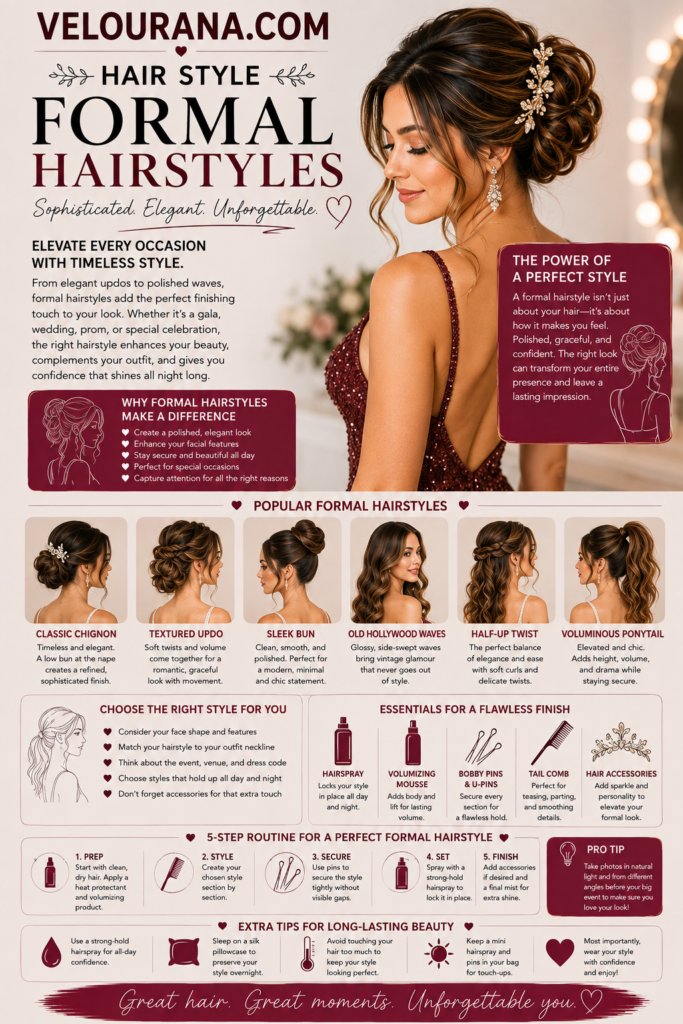
CATEGORY: Formal Hairstyles
Formal hairstyles occupy an interesting place between everyday polish and the elaborate styling associated with weddings, red carpets or highly ceremonial occasions. The hair needs to look intentional enough to complement an elegant outfit, yet the strongest formal styles rarely succeed because they contain the greatest number of curls, pins, braids or decorative details.
They succeed because everything feels balanced.
A formal hairstyle can be as simple as a beautifully executed low ponytail. It can be a sleek bun with a precise center part, polished waves worn over one shoulder, a sculptural updo, natural curls arranged into a controlled silhouette or coily hair shaped into an elegant high style. What makes these hairstyles formal is not one particular texture or technique. It is the level of consideration given to shape, finish, proportion and the relationship between the hair and the rest of the appearance.
That distinction is important because formal hair can easily become overworked.
When every section is curled, twisted, braided, pinned and decorated, the hairstyle may begin competing with the face, clothing and jewelry. A simpler style with a strong silhouette can often create considerably more impact.
The occasion matters too.
Hair for a formal dinner may need a different degree of structure from hair for a gala. A graduation ceremony introduces practical considerations such as a cap. A black-tie event may support greater drama. A formal work function may call for something elegant but restrained. An evening celebration may allow more movement and glamour.
The hairstyle should therefore respond to the event rather than to the word formal alone.
The most useful starting point is not asking which hairstyle is the fanciest.
It is deciding what kind of elegance the complete look needs.
Formal Hair Begins With the Silhouette
Before individual curls, pins or accessories are considered, the overall shape of the hairstyle determines its character.
Hair worn close to the head creates a cleaner, more controlled silhouette. Volume through the crown introduces height and softness. A low bun places visual weight at the nape. A high updo draws the eye upward. Loose waves extend the silhouette around the shoulders, while a sleek ponytail creates a long, narrow line.
These shapes interact directly with clothing.
A dress with a highly detailed neckline may benefit from hair that is lifted away from it. An open neckline can support either loose hair or an updo depending on the desired effect. A high-necked outfit often looks clearer when the hair does not compete with the collar. A minimalist dress can provide room for a more sculptural hairstyle.
The person's proportions matter as well.
A very large hairstyle can dominate delicate features. A tiny, tightly controlled bun may feel visually insignificant beside an extremely dramatic outfit. Height through the crown can change the profile, while width around the sides can alter the apparent proportions of the face.
This is why formal styling should be evaluated from a distance as well as close up.
The details may be beautiful, but the silhouette needs to work first.
Once the shape feels balanced, texture and finishing can enhance it rather than trying to rescue it.
The Low Bun Remains One of the Most Versatile Formal Hairstyles
Few hairstyles move as easily between different formal settings as the low bun.
It can be minimalist, romantic, architectural or softly textured depending on how it is constructed.
A sleek low bun with a precise center part creates a clean, contemporary appearance. The surface can remain controlled while the bun itself forms a compact shape at the nape. This version works particularly well with strong earrings, structured clothing and simple necklines.
A side part changes the character immediately.
The asymmetry creates movement through the front and can make the style feel softer without sacrificing polish.
A textured low bun moves further toward romance. Instead of smoothing every section into complete uniformity, the hair can retain gentle movement through the crown and sides. The bun may be created from overlapping sections or twists, allowing visible dimension.
The key is ensuring that texture remains intentional.
A formal textured bun should not look as though the hairstyle is gradually coming apart. The underlying structure needs to remain secure even when the visible surface is soft.
Hair density influences the shape considerably.
Fine hair may naturally create a smaller bun. That can look extremely elegant when the proportions are accepted rather than forcing an oversized result.
Dense or very long hair may create substantial bulk. In this case, distributing the hair across a wider shape can prevent the bun from becoming excessively heavy or projecting too far from the head.
The best bun is not the largest.
It is the one that belongs naturally to the complete silhouette.
A Sleek Bun Creates Impact Through Restraint
Sleek formal hair proves that complexity is not required for drama.
When the hair is controlled closely around the head, the face, makeup, earrings and neckline become more visible. The hairstyle provides structure without occupying unnecessary visual space.
The part becomes especially important.
A center part creates symmetry and a modern, graphic quality.
A deep side part introduces stronger direction.
The hair can also be brushed backward without a visible part for a different type of clean finish.
The bun may sit low, in the middle or higher depending on the desired silhouette.
A low placement feels understated and sophisticated.
A higher position creates more lift and can make the style feel stronger.
Because sleek styles expose the surface of the hair so clearly, the finish matters. The objective is controlled shine and smoothness rather than a stiff appearance.
The hair should look like hair.
It can have polish without appearing coated or immovable.
This balance is particularly important around the hairline, where excessive product can become more noticeable than it is through the lengths.
A sleek bun is most effective when every decision has a purpose.
There is nowhere for unnecessary detail to hide, which is precisely why the style can look so sophisticated.
The Formal Ponytail Can Be as Elegant as an Updo
A ponytail is sometimes treated as an everyday hairstyle, but placement and finish can transform it completely.
A low formal ponytail can look exceptionally refined.
The upper hair can be sleek with a center or side part. The fastening can be concealed or integrated into an accessory. The lengths can remain straight, softly waved or curled depending on the outfit.
A mid-height ponytail creates more movement and a slightly more energetic silhouette.
A high ponytail creates greater drama, particularly when the lengths have significant volume.
The crown determines much of the character.
A completely smooth crown creates a cleaner look.
A little controlled lift introduces softness.
Natural texture can also become central to the ponytail rather than being straightened first.
Curly hair can create a full formal ponytail with enormous movement.
Coily hair can produce a dramatic puff or structured ponytail shape while preserving its natural texture.
The important difference between an ordinary ponytail and a formal one is intention.
The placement has been chosen carefully.
The front is finished.
The fastening belongs to the design.
The lengths have a coherent shape.
Nothing requires excessive complexity.
The structure itself creates the elegance.
Polished Waves Bring Glamour Without Requiring an Updo
Formal hair does not have to be secured.
Polished waves remain one of the most recognizable evening styles because they combine movement with a clear visual pattern.
The size and finish of the wave determine the mood.
Large, smooth waves can create classic glamour.
Softer waves feel romantic.
More separated movement can create a modern, relaxed interpretation.
The part changes the style significantly.
A deep side part can create a dramatic sweep.
A center part produces more symmetry and can make the waves feel contemporary.
One side can be tucked behind the ear to reveal jewelry and create asymmetry without changing the entire hairstyle.
The waves should work with the hair's length and density.
Very long hair may naturally pull the pattern downward over time. Medium hair can retain more bounce because there is less weight. Fine hair may benefit from movement that creates visual body. Dense hair can produce substantial volume and may need more deliberate shaping around the sides.
The goal is not necessarily identical waves.
Formal polish comes from the overall rhythm.
The hair should look connected from one section to the next rather than as though every curl was created independently.
Straight Hair Can Look Exceptionally Formal
Curls and waves are not prerequisites for formal styling.
Straight hair can create some of the most elegant evening looks because its simplicity emphasizes shape and shine.
Long straight hair can be worn with a clean center part and controlled movement through the ends.
A side part can create a more dramatic front.
One side can be tucked behind the ear.
The ends can remain completely straight or curve slightly inward.
A straight ponytail can create a strong, elongated silhouette.
A sleek straight bob can look particularly sophisticated because the haircut itself provides the architecture.
The challenge is ensuring that straight formal hair looks deliberate rather than simply unstylized.
The part should be clear.
The perimeter should look considered.
The front should frame the face intentionally.
The surface should appear polished.
Those details create the distinction.
Formal styling is not defined by how much the hair has been transformed.
Sometimes the most elegant decision is allowing a naturally simple texture to remain simple.
Soft Updos Create Elegance Without Rigidity
A formal updo can retain softness while still looking secure.
The hair may have movement through the crown.
The sides can be swept rather than tightly flattened.
The back can contain twists, loops or overlapping sections.
A few selected pieces can frame the face.
The effect is often more romantic than a sleek bun, but the internal construction still matters.
A soft-looking updo should not be structurally loose everywhere.
If the hairstyle depends on weak tension and randomly placed pins, it may continue loosening throughout the event.
A stronger internal foundation allows the visible hair to remain relaxed.
This is the same principle used in successful bridal styling, but a formal updo may be simpler because it does not necessarily need to support a veil or survive an entire wedding day.
The amount of softness should suit the outfit.
A highly structured dress may look beautiful against a softer hairstyle.
A flowing romantic dress can also work with soft hair, although some contrast may be useful so that the entire appearance does not become visually undefined.
Balance remains more important than matching every element exactly.
High Updos Change the Presence of the Complete Look
Moving the hairstyle upward creates immediate impact.
A high bun exposes the neck and draws the eye toward the face.
A sculptural updo adds height and can make a simple outfit feel more dramatic.
Natural curls and coils can create especially striking high formal styles because their texture produces volume and dimension naturally.
The position should still feel proportional.
A high style does not need to become enormous to be noticeable.
The shape can remain narrow and vertical or expand outward depending on the desired effect.
Comfort is important because the hair may remain in this position for several hours.
Very long or dense hair can become heavy when concentrated too high on the head. Distributing the weight through a broader foundation can make the style more comfortable.
The front also needs to connect with the height.
A completely flat crown leading abruptly into a very large high bun can look disconnected. Some transition through shape or direction often creates better balance.
High formal hairstyles work best when the elevation feels like part of the design rather than an attempt to create drama simply through size.
Half-Up Formal Hair Offers Both Structure and Movement
The half-up style is ideal for someone who wants the elegance of a structured hairstyle without giving up the movement of loose lengths.
The upper sections can be gathered smoothly or with texture.
The crown can have gentle volume.
The sides can be twisted.
A decorative fastening can create a focal point.
The lower hair can remain straight, waved, curled or naturally textured.
This creates a versatile formal style because the level of detail can be adjusted easily.
A clean half-up style with straight lengths can look modern and restrained.
Soft waves and twists create a more romantic result.
Natural curls can remain full while the upper sections open the face.
Coily hair can combine a structured crown with expressive volume below.
The proportion is important.
If too much hair is taken upward, the style can begin to resemble an unfinished updo. If too little is secured, there may not be enough visible structure to distinguish the hairstyle from ordinary loose hair.
The upper and lower sections should feel connected.
The hairstyle should read as one complete design.
Braids Can Add Formal Detail Without Dominating the Hairstyle
Braids can be beautiful in formal hair when they are used with restraint.
A narrow braid can travel into a low bun.
Two side braids can meet inside a half-up style.
A larger braid can become the main structural element of an updo.
Braided sections can also work naturally with curly or coily textures.
The key is deciding whether the braid is the focal point or supporting detail.
If the hairstyle already contains substantial curls, twists, accessories and volume, adding several elaborate braids can make the result visually crowded.
One clear braided element is often more effective.
Its texture creates contrast against smoother sections.
The scale should suit the density of the hair.
A very large widened braid may overwhelm fine hair. A tiny braid can disappear within extremely dense hair.
Formal styling becomes more sophisticated when details are edited rather than accumulated.
Natural Curls Can Create Formal Hair Without Losing Their Identity
Curly hair already contains much of what formal styling often tries to create: movement, dimension and volume.
The objective does not need to be changing the texture.
It can be shaping it.
Loose curls can be arranged into a balanced silhouette.
One side can be pinned back.
The crown can be lifted or controlled.
A half-up style can create structure around the face.
A high ponytail can showcase volume.
A low updo can incorporate individual curls without smoothing them away.
The front can retain selected curls according to personal preference.
Formal curly hair succeeds when the pattern looks intentional as a whole.
Every curl does not need identical definition.
Natural variation can remain.
The silhouette, placement and relationship to the outfit create the formality.
This allows the wearer to look elevated while remaining recognizably herself.
Coily Hair Offers Exceptional Possibilities for Sculptural Formal Styling
Coily hair can create striking formal shapes because it naturally holds visual volume.
A high puff can become elegant through deliberate placement and a refined front.
A low bun can create a strong contained silhouette.
Twists can become architectural elements.
Braids can form part of an updo.
A half-up arrangement can combine structure and volume.
The natural texture itself can create the focal point.
There is no requirement for formal coily hair to be straightened or flattened.
In fact, preserving texture can make the hairstyle more distinctive.
Accessories can be integrated into the shape rather than simply placed on its surface.
Pearls can sit between textured sections.
Decorative pins can create points of light.
A headband can establish a strong line around the front.
A single statement accessory can contrast beautifully against natural volume.
The hairstyle should celebrate the qualities of the hair rather than treating them as obstacles to formality.
Fine Hair Can Look Formal Without Artificially Enormous Volume
Fine hair is sometimes approached as though every formal hairstyle needs to make it look dramatically thicker.
That is unnecessary.
A compact sleek bun can look sophisticated.
A low ponytail can create a clean line.
A straight bob can look architectural.
Soft waves can create visual body without becoming oversized.
A half-up style can preserve the density of the lower lengths.
The proportions should respect the hair.
Taking too much into a half-up section can make the lower hair appear sparse. Creating excessive volume at the crown can make the lengths look comparatively thin. Heavy accessories can overwhelm a delicate hairstyle.
A smaller, beautifully finished shape often looks more expensive and refined than one that has been enlarged beyond natural proportion.
Texture can still be used strategically.
Waves create space between strands.
Twists can make a bun appear more dimensional.
A side part can create apparent lift.
The objective is balance rather than imitation of another hair density.
Dense Hair Can Turn Its Natural Fullness Into Formal Architecture
Dense hair offers abundant styling material, but formal styling needs to manage its weight as well as its volume.
A large bun can become uncomfortable if all of the hair is concentrated in one point.
A high ponytail may feel heavy if the base is too tight.
Loose hair can become visually overwhelming if the outfit already contains substantial detail.
The solution is not necessarily reducing the volume.
It is organizing it.
A wider low updo can distribute weight.
A half-up style can remove some fullness from the sides.
A braid can control long lengths.
A ponytail can turn density into movement.
Loose hair can be shaped so that the volume sits where it contributes most to the silhouette.
Dense hair can support larger accessories, but scale should still be considered carefully.
The hair itself already creates visual presence.
An accessory should enhance that presence rather than compete with it.
Short Hair Can Be Formal Through Precision and Shape
Short hair demonstrates particularly clearly that formal styling does not depend on length.
A sleek bob can look exceptionally elegant.
A pixie can be sculpted through the crown.
A side part can create dramatic direction.
One side can be tucked behind the ear.
A fringe can be styled smoothly or given more movement.
The ends can be controlled carefully to emphasize the haircut.
Accessories can have greater impact because there is less hair surrounding them.
A decorative clip can become a focal point.
A headband can transform the silhouette.
Statement earrings can become more visible.
The strongest formal short hairstyles usually rely on precision.
The haircut already provides the architecture.
Styling simply emphasizes it.
The Neckline Should Influence Whether the Hair Goes Up or Stays Down
Formal clothing and formal hair should be considered together.
A high neckline can become visually crowded when very long hair covers it completely.
An intricate back may disappear beneath loose lengths.
An open neckline can support flowing hair beautifully.
A strapless or off-the-shoulder design can look striking with an updo because the shoulders and collarbones remain visible.
These are not strict rules.
Contrast can create equally beautiful results.
Long loose waves can soften a highly structured outfit. A sleek bun can provide restraint beside a romantic dress.
The important point is awareness.
The hairstyle occupies physical and visual space.
The outfit does too.
They should not accidentally obscure one another.
Photographs from the front, side and back can reveal relationships that are difficult to judge in a mirror.
This is particularly useful when the clothing has significant detail behind the shoulders.
Jewelry Changes the Balance of Formal Hair
Earrings become more visible when the hair is secured.
A necklace occupies space around the neckline.
A decorative hairpiece introduces another focal point.
Formal styling can quickly become crowded when all of these elements are treated independently.
If the earrings are large and dramatic, the hair may not need an equally dominant accessory.
If the necklace is highly detailed, lifting the hair can reveal it while keeping the hairstyle relatively restrained.
If the outfit is minimal, the hair or jewelry can carry more of the visual interest.
This is where editing becomes important.
Elegance often comes from allowing one or two elements to lead while the others provide support.
The hairstyle does not need to win a competition for attention.
It needs to complete the appearance.
Hair Accessories Should Look Integrated Rather Than Added at the End
A formal accessory works best when its placement has been considered as part of the hairstyle.
A comb can sit above a low bun.
Decorative pins can follow the shape of an updo.
A barrette can become the fastening point of a half-up style.
A headband can define the front.
A bow can create a fashion-focused statement.
The accessory should suit both the scale of the hairstyle and the formality of the event.
A delicate pin may disappear in dense textured hair.
A very large crystal piece can overwhelm a compact fine-hair bun.
Placement affects balance as much as size.
An asymmetric accessory can create movement.
A centered piece creates more formality and symmetry.
The hairstyle should still look complete without excessive decoration.
The accessory is an enhancement, not structural camouflage.
Comfort Is Essential When Formal Hair Will Be Worn for Hours
Formal events often last longer than expected.
There may be dinner, speeches, standing, dancing, photographs and travel between locations.
A hairstyle that begins hurting after an hour becomes difficult to enjoy.
Tension should therefore be distributed.
Pins should secure without pressing painfully.
Heavy accessories should have appropriate support.
Very long hair should not be concentrated into a structure that feels increasingly heavy.
The wearer should be able to turn the head naturally.
A high style should not feel as though it is pulling backward.
A low bun should not interfere uncomfortably with a chair or headrest during travel.
Comfort is not separate from appearance.
An uncomfortable hairstyle is touched, adjusted and eventually changed.
A comfortable one has a much better chance of remaining polished.
Weather Should Be Part of the Styling Decision
Formal events do not always happen inside climate-controlled rooms.
Outdoor ceremonies, garden parties, evening terraces and summer celebrations introduce humidity, heat and wind.
A hairstyle that works with the expected conditions may remain elegant far longer than one that requires the environment to cooperate.
Textured updos can tolerate small changes gracefully.
Braids keep long hair controlled in wind.
Half-up styles secure the front while preserving movement.
Natural curls and coils can be styled in ways that allow their texture to respond naturally rather than depending on complete suppression.
Loose polished waves may require more consideration in humid conditions, particularly when the hair naturally wants to return to another texture.
The objective is not to eliminate every environmental effect.
It is to choose a hairstyle that remains coherent when the environment interacts with it.
Formal Hair Should Look Beautiful From More Than One Angle
Everyday hairstyles are often judged primarily from the front.
Formal hair is more likely to be photographed from many directions.
The side profile matters.
The back matters.
The crown matters.
An updo may be the dominant feature in photographs taken from behind. A half-up style should have a clear fastening area. A ponytail needs a balanced base. Loose waves should create an attractive silhouette across the back rather than appearing polished only around the face.
This is why checking the hairstyle with photographs can be useful.
A mirror provides one perspective.
A photograph reveals another.
The style should feel connected from every angle.
That does not mean every side needs equal detail.
It means no angle should look accidental.
Formal Hairstyles Last Better When They Are Designed to Soften Gracefully
Hair moves during an event.
Waves relax.
The crown may settle.
A few shorter pieces may become softer.
Natural texture responds to humidity.
A textured updo can become slightly less precise.
This is normal.
A successful formal hairstyle anticipates these changes.
Loose waves can begin with enough structure to remain attractive when they soften.
An updo can rely on secure internal construction rather than surface stiffness.
A ponytail can retain its base while the lengths gain movement.
Curly and coily hair can be shaped so that small changes remain part of the texture.
The goal is not preserving every strand in exactly the same position.
It is preserving the identity of the hairstyle.
A low bun should still look like an elegant low bun.
A formal ponytail should remain balanced.
Waves should retain movement.
The complete silhouette should continue to feel intentional.
That is a more realistic standard for longevity than absolute immobility.
Formal Does Not Have to Mean Complicated
Some of the most memorable formal hairstyles are extremely simple.
A precise low bun.
A glossy straight bob.
A high natural puff.
A low ponytail with a deep side part.
Large polished waves.
A sculptural bun.
A clean half-up style.
Their impact comes from execution rather than the number of techniques involved.
Complexity can be beautiful when it serves the design, but complexity alone does not create sophistication.
In fact, removing one unnecessary element can often improve the hairstyle.
Perhaps the braid is not needed.
Perhaps the accessory is enough.
Perhaps the curls should remain larger and simpler.
Perhaps the bun should be smaller.
Perhaps the natural texture already provides all the visual interest required.
Formal styling benefits from editing because the hair exists within a complete appearance.
The face, makeup, outfit, jewelry, shoes and accessories are already contributing.
Hair does not need to do everything.
The Best Formal Hairstyle Looks Elevated but Still Recognizable
The strongest formal hairstyle does not necessarily transform someone beyond recognition.
It takes familiar characteristics and refines them.
Someone who normally wears straight hair may feel most confident in an exceptionally polished straight style.
Someone who loves ponytails can choose a formal version rather than an unfamiliar updo.
Someone who wears natural curls can keep the curls central.
Someone with coily hair can build the style around natural volume.
A person who prefers hair away from the face may feel better in a bun than in loose waves, regardless of what is currently fashionable.
This connection matters because confidence affects the complete appearance.
A technically beautiful hairstyle can feel wrong if the wearer spends the event feeling disguised by it.
Formal styling should create elevation without erasing personality.
The part can become cleaner.
The silhouette can become stronger.
The finish can become more polished.
The accessory can become more refined.
The structure can become more deliberate.
Those changes are enough.
Elegance does not require abandoning the way someone naturally likes to look.
Formal Hair Is Most Successful When Every Element Has a Reason to Be There
A formal hairstyle becomes coherent when each decision contributes to the complete design.
The height of the bun complements the neckline.
The part balances the face.
The crown creates the right profile.
The texture suits the hair.
The accessory occupies a deliberate position.
The jewelry remains visible.
The hairstyle stays comfortable.
The structure can survive the event.
Nothing has been added merely because formal hair is expected to contain detail.
This is where simplicity becomes powerful.
A single beautiful shape can carry the entire hairstyle.
The shine of straight hair can be enough.
Natural curls can be enough.
A sculptural coily updo can be enough.
One braid can be enough.
One accessory can be enough.
Formal hairstyling becomes more sophisticated when the question changes from “What else can be added?” to “Is anything else actually necessary?”
That question protects the hairstyle from becoming overworked.
It also keeps the wearer visible.
The hair frames the face instead of overwhelming it. It complements the clothing instead of covering it. It works with the jewelry rather than competing with it.
The final result feels complete because the elements relate to one another.
That is what gives formal hair its elegance.
Not the number of pins.
Not the amount of hairspray.
Not the complexity of the technique.
Elegance comes from proportion, control, texture, comfort and intention.
When those qualities are present, even the simplest hairstyle can feel entirely appropriate for a formal occasion.
And when the hairstyle still looks like it belongs naturally to the person wearing it, the result becomes more than polished.
It becomes convincing.
The End
Velourana.
 Discover More From Our Family of Websites
 ZodiacBearing (Astrology, Tarot, Numerology, Angel Numbers & Spiritual Guidance)
 Velourana (Beauty, Makeup, Hair Care, Skincare & Beauty Tips)
 HavenBearing (Home, Living, Organization, Décor & Everyday Inspiration)
 PawBearing (Pet Care, Dog Breeds, Animal Health, Training & Pet Products)
 PsyCatherine (Notes From the Journal of a Psychologist on Real Life)

