
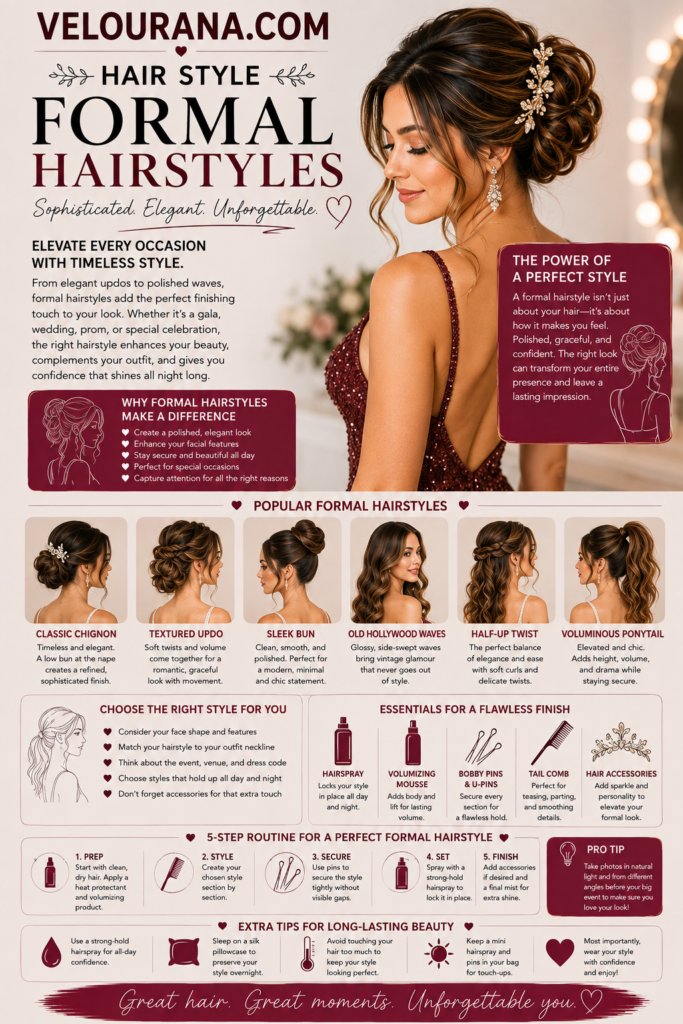
CATEGORY: Formal Hairstyles
Long hair offers enormous freedom for formal styling. It can be worn sleek, waved, braided, twisted, gathered into a ponytail or transformed into an updo. It provides enough length to create movement, enough material to build structure and enough visual presence to become a major part of an evening look.
That abundance is also what makes formal styling more complicated.
The longer the hair, the more weight it carries. A large bun can become uncomfortable. A high ponytail can pull at the scalp. Loose curls can gradually stretch under the weight of the lengths. Very elaborate updos can become visually heavy simply because there is so much hair available to incorporate.
The best formal hairstyles for long hair therefore do not attempt to use every possible technique at once.
They edit.
They decide where volume should sit, which sections should move, how much of the length should remain visible and whether the hairstyle should reveal or cover the shoulders and back. They use the hair's length as an advantage without allowing the length to dictate the entire design.
This is an important distinction.
Long hair does not automatically need an enormous updo because there is enough hair to create one. It does not need dozens of curls simply because the length allows them. It does not need several braids, twists and accessories layered together.
Sometimes the most elegant use of long hair is a simple low ponytail.
Sometimes it is a smooth bun.
Sometimes it is one side tucked behind the ear while polished waves fall over the opposite shoulder.
Sometimes the hair remains almost completely straight.
Formal styling succeeds when the length becomes part of the visual composition rather than the only thing anyone notices.
Long Hair Changes the Proportions of a Formal Hairstyle
Length creates a vertical line.
When long hair is worn loose, that line can extend from the crown to the middle of the back or beyond. When the hair is gathered, all of that material has to be redirected somewhere else.
This changes the visual proportions dramatically.
A low ponytail preserves the length while narrowing the silhouette.
A high ponytail lifts the visual weight upward and creates more movement behind the head.
A bun removes the vertical length almost entirely and replaces it with a concentrated shape.
A half-up hairstyle keeps the lower length visible while creating more control around the crown and face.
A braid reorganizes the length into a stronger linear structure.
The choice therefore affects not only the hair but the complete outfit.
A dress with a detailed back may be hidden by very long loose hair.
A high neckline can become visually crowded when long hair falls over it.
A simple sleeveless dress may look beautiful with cascading waves because the hair provides softness and movement.
A tailored or architectural outfit may benefit from a low bun because the absence of loose lengths allows the clothing's structure to remain clear.
The hairstyle and clothing should occupy the available visual space intentionally.
Long hair is too prominent to be treated as an afterthought.
Polished Loose Waves Let the Length Become the Feature
Loose waves are one of the most natural formal choices for long hair because they allow the length to remain visible.
The hair moves.
The surface reflects light.
Layers become easier to see.
The ends contribute to the complete silhouette rather than disappearing into an updo.
The scale of the wave matters.
Large, broad waves can make long hair look glamorous without turning it into a mass of curls. The movement can begin around the middle lengths and continue downward, leaving the crown relatively controlled.
Stronger movement through the front can create a more dramatic frame.
A deep side part can make the style feel especially formal because the hair sweeps across one side before falling into the lengths.
A center part creates a cleaner, more symmetrical effect.
The main challenge is weight.
Very long hair naturally pulls curls and waves downward.
This means the initial shape may need enough structure to survive some relaxation. The final hairstyle should be judged not only in the first ten minutes but in how it will look several hours later.
A broad curl that gradually becomes a softer wave can still look elegant.
The goal is not to stop the hair from changing.
It is to create a pattern that changes beautifully.
One-Sided Waves Can Create Drama Without a Complicated Hairstyle
Moving most of the hair toward one side is one of the easiest ways to make long loose hair feel more formal.
The asymmetry creates drama immediately.
One shoulder and side of the neck become more visible.
The opposite side gains the visual weight of the lengths.
This can work beautifully with statement earrings, asymmetrical dresses or necklines that benefit from more open space.
The side with less hair can be tucked behind the ear, pinned discreetly or smoothed back.
The heavier side can remain waved, curled or relatively straight.
The difference in placement is enough to create a formal silhouette even when the styling through the lengths remains simple.
This is a useful example of how long hair can be transformed through structure rather than complexity.
The hair itself has not changed dramatically.
The direction has.
Straight Long Hair Can Look Exceptionally Sophisticated
Long formal hair does not need curls.
A clean straight finish can look extremely elegant when the proportions are right.
The part becomes important because it creates the main structure.
A center part can make long straight hair feel modern and minimal.
A side part introduces more movement through the front.
The crown should retain enough shape that the length does not visually pull the entire hairstyle downward.
The ends need a clear finish.
They can remain completely straight for a sharp appearance.
A very subtle inward movement creates softness.
Long layers can be directed slightly away from the face without turning the hairstyle into waves.
The surface should look polished, but the hair should still move.
Long straight hair becomes formal through precision.
The lengths fall coherently.
The front frames the face intentionally.
The ends look finished.
Nothing else is required.
This style can be particularly effective with highly detailed clothing because the hair provides a calm visual counterpoint.
It also works well for someone who naturally prefers straight hair and does not want formal styling to feel like a completely different identity.
The Low Ponytail Uses Length Without Hiding It
A low ponytail is one of the strongest formal options for long hair because it preserves the visual impact of the length while making the hairstyle much more controlled.
The hair remains visible down the back.
It can move naturally.
Yet the front, sides and crown become clearly structured.
This makes the style more deliberate than fully loose hair without the complexity of an updo.
The front can be sleek with a center part.
A side part can create a softer effect.
The crown can remain smooth or retain a little lift.
The ponytail itself can stay straight, form broad waves or carry curls depending on the desired mood.
A section of hair can conceal the fastening when a cleaner finish is wanted.
The ponytail can also be positioned slightly away from the neck to prevent very long lengths from feeling visually heavy at the base.
The important point is that the hair does not need to become smaller simply because it is formal.
The ponytail organizes the length rather than removing it.
A Mid-Height Ponytail Creates More Movement and Presence
Moving the ponytail higher changes the energy of the hairstyle.
The lengths fall from a higher point, so they swing more visibly.
The crown gains lift.
The complete silhouette becomes more dynamic.
This can work particularly well when the hair has waves or curls because the movement becomes one of the main features of the look.
A mid-height ponytail can still feel elegant when the front remains controlled.
The crown does not need excessive volume.
The fastening can be discreet.
The length itself provides enough visual interest.
Dense long hair can create a particularly impressive result because the ponytail retains substantial fullness.
Fine long hair may benefit from softer waves or movement through the ends so that the ponytail appears more dimensional.
The placement should still remain comfortable.
Very long hair has weight, and that weight becomes more noticeable as the ponytail moves higher.
A formal hairstyle should never require the wearer to tolerate constant pulling simply for the sake of appearance.
The High Ponytail Can Be Glamorous, but Weight Must Be Managed
A high ponytail is dramatic because it shifts the entire visual center of the hairstyle upward.
The face becomes more exposed.
The crown appears taller.
The length gains maximum movement.
This can create a striking formal look, particularly with clean necklines and statement earrings.
The challenge is physical.
Long hair can become heavy when all of it is suspended high on the head.
If the base is excessively tight, discomfort may develop quickly.
The style needs enough support to remain secure without creating unnecessary tension.
The amount of movement in the ponytail should also be considered.
Very full curls create more visual volume.
Straighter lengths produce a cleaner, more graphic line.
Soft waves sit between the two.
A high ponytail is already a strong silhouette.
It rarely needs additional complexity to look formal.
The Low Bun Is Elegant Because It Removes the Length From the Competition
When long hair is gathered into a low bun, the entire visual balance changes.
The neckline becomes visible.
The back of the dress becomes visible.
The shoulders become more prominent.
The hairstyle itself becomes a compact focal point.
This can be especially useful when the outfit already contains significant detail.
The challenge is preventing the bun from becoming too large or heavy simply because there is so much hair.
Very long lengths do not always need to be wrapped repeatedly around one small center.
The hair can be distributed across a wider shape.
Sections can overlap.
The bun can become flatter and broader rather than projecting outward.
This often looks more elegant and feels more comfortable.
The surface can remain sleek or textured depending on the desired style.
A clean center part creates a modern result.
A softer side part and gentle crown texture create more romance.
The bun should look proportional to the head rather than impressive only because it contains a great deal of hair.
A Wide Chignon Can Be Better Than a Large Round Bun
Long hair creates enough material for substantial formal shapes, but the direction of that volume matters.
A round bun concentrates the hair into depth.
A wider chignon spreads it horizontally.
For very long or dense hair, the second option can often produce a more balanced result.
The chignon can sit across the nape rather than projecting far away from the head.
This distributes visual weight.
It can also distribute physical weight, which improves comfort.
The shape can remain smooth or contain overlapping sections.
Long layers can be incorporated gradually.
The hairstyle can look intricate without becoming oversized.
This is a useful example of adapting the updo to the hair instead of forcing the hair into a predetermined form.
The quantity of hair becomes a design advantage.
It allows a broader structure to exist naturally.
The French Twist Uses Long Hair Vertically Rather Than Circularly
The French twist offers another solution for substantial length.
Instead of wrapping the hair around itself into a bun, the style directs it vertically.
This creates an elongated shape through the back of the head.
The result can look extremely elegant with formal dresses, tailored evening clothing and classic accessories.
Very long hair may require careful internal folding so that the excess length remains concealed without creating a bulky center.
The twist can be smooth and traditional or slightly softer with more crown texture.
A decorative comb can follow the vertical line.
The front can remain clean or include selected face-framing sections.
The hairstyle is especially effective when the wearer wants the neck visible but does not want a rounded bun.
The vertical structure changes the entire personality of the formal look.
Half-Up Styles Allow Long Hair to Remain Long
Some people choose long hair precisely because they enjoy seeing and feeling the length.
A complete updo can therefore feel like hiding one of the main features of the hair.
Half-up styling solves this.
The upper sections become controlled.
The face opens.
The crown can gain structure.
The lower lengths remain completely visible.
This creates an ideal balance for formal occasions where loose hair feels desirable but a more deliberate silhouette is needed.
The upper sections can be smooth.
They can be twisted.
A braid can be incorporated.
A decorative barrette can create the focal point.
The lower hair can remain straight, waved or curled.
Long hair gives the style dramatic movement through the back, while the secured upper section prevents the front from feeling casual.
The proportion should be considered carefully.
Taking too much hair upward can make the remaining lengths look thinner.
Taking too little may not create enough visible structure.
The strongest version preserves the richness of the length while clearly changing the upper silhouette.
Braids Can Organize Long Hair Without Making It Disappear
Long hair is naturally suited to braiding because the length allows the pattern to develop fully.
For formal styling, the braid can become the hairstyle or simply a structural element.
A long low braid can look elegant when the front and crown are refined.
A side braid creates asymmetry.
A braided ponytail produces a strong linear silhouette.
A braid can also be wrapped into a bun or used as part of a half-up arrangement.
The scale should remain appropriate.
Very wide braids can become visually dominant.
This may be desirable when the outfit is simple, but it can become excessive beside highly embellished clothing.
A smaller braid can add enough texture without taking over.
Long hair encourages experimentation, but formal styling benefits from editing.
One beautiful braid often creates more sophistication than several competing braided elements.
A Braided Bun Can Manage Length Beautifully
One practical challenge with long hair is containing the ends inside an updo.
Braiding before creating the bun can organize the length.
The hair becomes easier to wrap.
The braid also creates visible texture in the final shape.
This can produce a formal bun that looks more dimensional without requiring many separate styling techniques.
The braid may remain visible or become almost completely hidden depending on how the bun is formed.
The result can feel classic, romantic or modern depending on the front and finish.
This is particularly useful for dense hair because the braid consolidates the lengths before they are secured.
Again, the technique serves both appearance and structure.
That is usually where formal styling becomes strongest.
Long Layered Hair Should Let the Layers Participate
Long layers create movement naturally.
Formal styling should not always force them into complete uniformity.
When the hair is worn loose, shorter layers can carry stronger movement around the face and crown.
When the hair is in a ponytail, layers can create dimension through the lengths.
In an updo, some shorter pieces can remain as deliberate face framing rather than being forced backward.
The haircut should still be visible where possible.
This makes the hairstyle feel personal.
The person does not suddenly appear to have one uniform length simply because the occasion is formal.
Long curtain bangs, cheekbone layers and shorter front sections can become important parts of the complete design.
Their direction should be chosen carefully.
A broad outward sweep can soften the face.
A sleek backward direction creates a cleaner frame.
The strongest formal hairstyle uses the haircut as material rather than treating it as something that must be hidden.
Fine Long Hair Needs Volume in the Right Places
Fine long hair carries a particular challenge because the length can pull the roots downward while the amount of hair may not naturally create a large ponytail or bun.
The answer is not necessarily creating maximum volume everywhere.
Strategic volume is more effective.
A little crown lift can prevent the style from looking flat.
Broad waves can make the lengths appear fuller by creating space between strands.
A low ponytail can look elegant without needing enormous density.
A compact bun can look sophisticated when it remains proportional.
A half-up style should avoid taking too much hair away from the lower lengths.
This is especially important with accessories.
A very large clip or comb can overwhelm fine hair visually.
A smaller decorative element may create more balance.
Fine long hair often looks most formal when the style accepts refinement over scale.
The hair does not need to appear dramatically thicker.
It needs to appear deliberate.
Dense Long Hair Needs Weight Distribution More Than Added Volume
Dense long hair already contains significant visual and physical volume.
Formal styling should often focus on controlling and distributing it.
A half-up hairstyle can remove some bulk from the sides while keeping the length visible.
A low ponytail can organize the hair without creating an enormous structure.
A braid can prevent tangling and reduce visual spread.
A wide chignon can distribute the weight of an updo.
A French twist can redirect the length vertically.
The crown may need less additional lift than fine hair because the natural density already creates presence.
The goal is not to make the hairstyle smaller.
It is to place the volume where it contributes most.
This is what turns abundance into architecture.
Naturally Wavy Long Hair Can Create Formal Movement With Less Reconstruction
Long wavy hair already contains movement, which can be useful for formal styling.
The natural pattern may not be perfectly uniform, but complete uniformity is not always necessary.
The front can be refined.
The crown can be shaped.
Visible irregularities can be corrected.
The lower lengths can retain some natural variation.
This can create a softer and more believable formal finish than rebuilding every wave from the beginning.
A half-up style works particularly well because the upper sections become more controlled while the natural movement remains below.
A low ponytail can turn the waves into a flowing shape.
A textured bun can use the pattern naturally.
Wavy hair does not need to become straight before it can look polished.
The movement itself can provide the formality when the silhouette is controlled.
Curly Long Hair Can Remain Curly and Still Become Highly Formal
Long curls already provide dramatic movement.
Formal styling can organize that movement rather than replacing it.
Loose curls can be shaped around a deliberate part.
One side can be pinned back.
The crown can gain controlled volume.
A half-up style can create structure while the curls remain visible.
A ponytail can create a full, expressive silhouette.
An updo can gather the curls without smoothing them completely.
The curl pattern itself becomes part of the formal design.
This can be particularly striking because long curls create depth from every angle.
The front should be shaped according to comfort and preference.
Selected curls can frame the face.
Others can be directed backward.
The hairstyle should remain recognizably curly.
Formal does not require the texture to disappear.
Coily Long Hair Can Create Dramatic Formal Architecture
Long coily hair offers extraordinary possibilities because texture and volume are already present.
A high puff can create a strong formal silhouette.
A low textured bun can create control.
Twists can form architectural sections.
Braids can be incorporated into ponytails or updos.
Half-up styles can preserve natural volume while opening the face.
The hair does not need to be flattened before it can look refined.
Its volume can become the central design feature.
This is particularly useful with simple evening clothing where the hairstyle itself can provide more visual drama.
When the outfit is already elaborate, a more contained coily updo can create balance.
The texture remains visible.
The shape changes according to the occasion.
The Front Should Be Designed Separately From the Length
Long hair attracts attention through the back and ends, but the front still determines how the hairstyle interacts with the face.
This area should not be treated as an afterthought.
A center part can create symmetry.
A deep side part adds glamour.
Curtain bangs can remain soft.
Long face-framing layers can be directed backward.
One side can be tucked behind the ear.
These changes often have more influence on the perceived formality of the hairstyle than additional work through the lower lengths.
This is valuable because long hair can tempt the stylist to spend most of the time concentrating on the back.
The person wearing the hairstyle sees the front.
Other people see it during conversation.
Photographs emphasize it repeatedly.
Formal long hair should therefore be balanced from both directions.
The Ends Need a Clear Role in Loose Formal Hair
When long hair remains down, the ends become highly visible.
They should therefore look intentional.
Straight ends create a clean finish.
Soft inward movement creates polish.
Broad waves can continue through the tips.
Some modern styles leave the final centimeters slightly straighter, creating contrast with the movement above.
Any of these can work.
The important point is consistency with the overall design.
If the style is highly polished, irregular ends can make the finish feel incomplete.
If the hairstyle is deliberately soft and textured, some variation may look natural.
The ends should participate in the style without becoming overworked.
Their job is to complete the line of the hair.
Accessories Should Respect the Scale of Long Hair
Long hair can visually absorb small accessories, particularly when it is dense or textured.
A delicate pin that looks substantial in the hand may almost disappear once placed into a large updo.
The opposite can happen with fine long hair. A very large accessory may dominate the hairstyle.
Scale therefore matters.
A decorative comb can work beautifully above a low bun.
A barrette can create a clear focal point in a half-up style.
Metallic pins can follow a braid or twist.
A headband can shape the front while the length remains loose.
One strong accessory is often enough.
Long hair already provides visual drama.
Decoration should contribute rather than compete.
Formal Long Hair Must Be Comfortable Enough to Wear for Hours
Weight is one of the most important practical issues in long-hair styling.
A hairstyle may feel perfectly secure when first completed and become uncomfortable later.
High ponytails can pull.
Large buns can create pressure.
Many pins concentrated in one area can become painful.
The solution is good distribution.
The hair should be supported across enough of the head that one small area is not carrying the entire weight.
A low ponytail may feel more comfortable than a high one.
A broad updo may distribute weight better than a compact knot.
A half-up style may provide the right compromise between control and freedom.
Comfort should be tested before an important event whenever possible.
A formal hairstyle should not require endurance.
Weather Can Influence Whether Long Hair Should Remain Loose
Long loose hair interacts strongly with the environment.
Wind can move it across the face.
Humidity can alter the texture.
Heat can make the length feel uncomfortable against the neck and shoulders.
These conditions should influence styling decisions.
A formal braid can control the length in wind.
A ponytail keeps the front more organized.
A half-up style provides some control while preserving movement.
An updo can be particularly practical in hot weather.
This does not mean long hair should automatically be secured outdoors.
It simply means the environment should be part of the decision.
The strongest formal hairstyle is one that remains attractive in the conditions where it will actually be worn.
Long Hair Can Be Formal Without Showing All of Its Length
There is sometimes a sense that long hair should remain visible simply because so much effort has gone into growing it.
That is not necessary.
An updo can be beautiful precisely because it transforms familiar length into a completely different shape.
A low bun reveals the neckline.
A French twist creates a vertical structure.
A sculptural updo changes the profile.
The length has not disappeared.
It has been converted into architecture.
This can make formal styling feel especially transformative without requiring any permanent change to the hair.
The following day, the long lengths return.
For one evening, they become something else.
The Most Elegant Long-Hair Styles Know When to Stop
Long hair provides enough material to keep adding detail almost indefinitely.
Another curl.
Another braid.
Another twist.
Another accessory.
More crown volume.
More face framing.
More texture through the bun.
The ability to add is not the same as the need to add.
Formal elegance often improves when the hairstyle is edited.
If the waves are already beautiful, perhaps an accessory is unnecessary.
If the braid is the focal point, additional twists may weaken its impact.
If the bun already has significant texture, pulling out many more pieces may make it look less refined.
If the outfit is dramatic, a simple hairstyle may create better balance.
This restraint is particularly important with long hair because the length itself already provides visual presence.
The hairstyle does not need to prove that the hair is long.
That is already obvious.
The Best Formal Long Hair Makes Length Feel Intentional
The greatest advantage of long hair is choice.
It can remain visible.
It can be gathered.
It can move.
It can become architecture.
It can be sleek or textured.
It can remain natural or be transformed.
The challenge is choosing rather than trying to use every possibility at once.
The strongest formal style begins with a clear silhouette.
Perhaps the hair will remain long and flowing.
Perhaps the back of the outfit should remain visible.
Perhaps the neckline needs space.
Perhaps the wearer feels most confident with hair around the shoulders.
Perhaps a ponytail provides the ideal balance.
Perhaps a bun creates the elegance the complete look needs.
Once that direction is clear, the remaining decisions become easier.
Fine hair can use strategic volume.
Dense hair can distribute its weight.
Wavy hair can preserve natural movement.
Curly hair can remain curly.
Coily hair can use texture as architecture.
Layers can remain visible.
The front can be designed around the face.
Accessories can be added only when they contribute something meaningful.
Most importantly, the hairstyle should remain comfortable enough that the wearer can forget about it once the event begins.
That is one of the clearest signs that long formal hair has been designed successfully.
The length is present, but it is not burdensome.
The hairstyle is polished, but it is not overworked.
The movement is controlled, but the hair does not feel rigid.
Every section has a visual purpose.
And when the complete look is seen from the front, side and back, the hair feels connected to the person and the occasion rather than existing as a separate display of styling technique.
Long hair can create extraordinary formal hairstyles.
Its elegance, however, comes not from how much can be done with it.
It comes from knowing exactly how much needs to be done.
The End
Velourana.
 Discover More From Our Family of Websites
 ZodiacBearing (Astrology, Tarot, Numerology, Angel Numbers & Spiritual Guidance)
 Velourana (Beauty, Makeup, Hair Care, Skincare & Beauty Tips)
 HavenBearing (Home, Living, Organization, Décor & Everyday Inspiration)
 PawBearing (Pet Care, Dog Breeds, Animal Health, Training & Pet Products)
 PsyCatherine (Notes From the Journal of a Psychologist on Real Life)

