
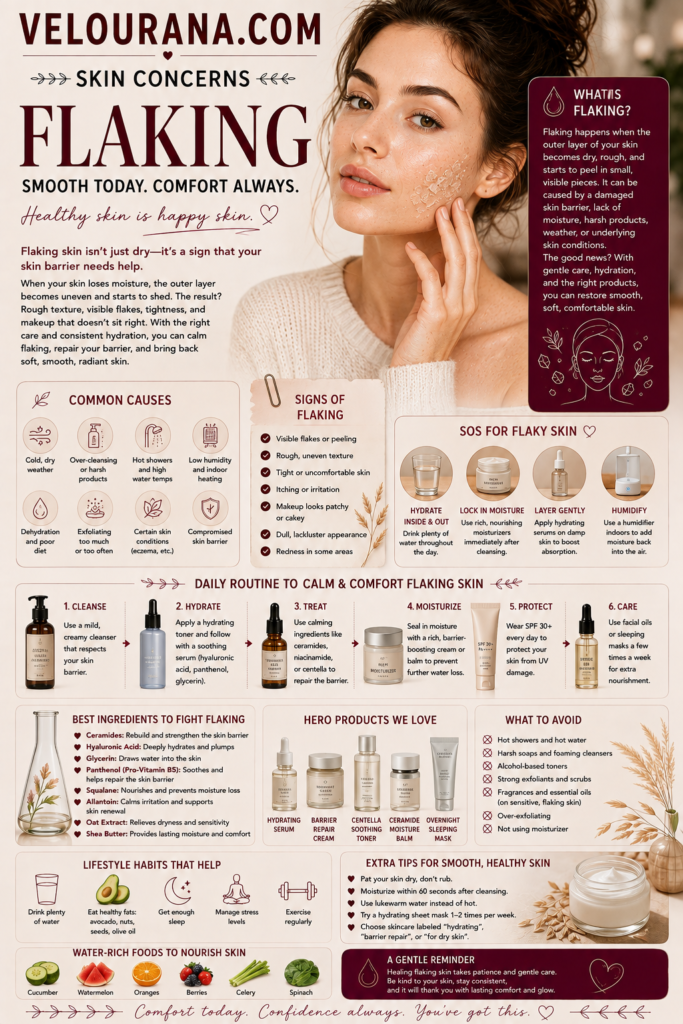
CATEGORY: Flaking
Flaking rarely chooses the face evenly.
For many people, the cheeks remain relatively smooth while the sides of the nose begin to scale. The forehead may feel normal, yet a pale dry crescent appears beneath the lower lip. The chin becomes rough, the corners of the mouth feel tight, or a stubborn patch returns beside one nostril no matter how carefully the rest of the face is moisturized.
This unevenness can be confusing. If the problem were simply “dry skin,” it would seem logical that the entire face should become dry at roughly the same time.
Skin does not behave so uniformly.
Different areas of the face experience different amounts of movement, friction, oil production, cleansing, moisture evaporation, contact with saliva and other substances, and exposure to skincare products. Facial anatomy creates folds and creases where products can collect. Everyday habits repeatedly disturb certain regions while barely touching others.
The result is that localized flaking often develops where several small stresses overlap.
This makes the location of a dry patch useful information.
A flake beside the nose is not automatically caused by the same thing as a flake across the cheek. Scaling at the corners of the mouth may have a different context from peeling across the forehead. A recurring patch deserves to be observed as part of a pattern rather than simply scrubbed away whenever it appears.
Understanding where flaking occurs can therefore be as important as understanding what flaking is.
The Face Is Not One Uniform Piece of Skin
We often speak about “facial skin” as though it were a single biological surface with identical characteristics from forehead to jaw.
It is not.
Sebaceous glands are more concentrated in some areas than others. The central forehead, nose and chin often produce more sebum than the outer cheeks. Thickness varies. Hair follicles differ in density. Certain areas bend constantly with speech and expression, while others remain comparatively still.
The environment surrounding each region also varies dramatically.
The skin beneath the nose is repeatedly exposed to breathing, tissues and nasal secretions. The area around the mouth encounters saliva, food, toothpaste and frequent movement. The chin may be touched unconsciously throughout the day. The eye area experiences rubbing and makeup removal. The hairline can be exposed to shampoos, styling products and sweat.
This means that a person can simultaneously have an oily nose and flaky skin beside it.
There is no contradiction.
Oil production and adequate barrier hydration are not identical phenomena. Sebum can exist on the surface while the stratum corneum beneath is irritated, dehydrated or shedding abnormally.
This is one reason aggressive cleansing of the central face can backfire. Someone notices oil around the nose, uses stronger cleansing or exfoliation there, then develops scaling. The presence of flakes is interpreted as clogged dead skin and the area is exfoliated again.
What began as an attempt to control oil can become a barrier problem.
Localized flaking often makes sense only when each area is considered on its own terms.
Why the Sides of the Nose Flake So Easily
The narrow creases beside the nostrils are among the most common places for visible scaling.
Several factors make them vulnerable.
First, the area contains natural folds. Cleansers, acids, retinoids, makeup and other products can accumulate within those creases instead of spreading as evenly as they do across flatter parts of the face.
Second, the nose is frequently touched.
It is wiped after cleansing, rubbed during allergies, pressed with tissues during colds, squeezed during attempts to remove blackheads, and repeatedly manipulated during makeup application.
Third, the nose often receives disproportionately aggressive skincare because it is associated with visible pores and congestion.
A person may use pore strips, scrubs, clay masks, exfoliating acids or cleansing tools primarily across the nose. Each intervention may appear modest on its own. Together, they can produce considerably more stress in that small region than the cheeks receive.
Then there is the contradiction of oil.
Because the nose can appear shiny, people are sometimes reluctant to moisturize it adequately. Moisturizer is carefully applied everywhere else but used sparingly around the nostrils.
The result can be a region that is both oilier and more irritated than surrounding skin.
This distinction is important because visible scale beside the nostrils is not necessarily evidence that oil has disappeared. It may simply mean the surface cells are no longer shedding normally.
Treating every flaky nose as though it requires stronger oil removal can therefore prolong the problem.
Tissue Friction Can Become a Significant Skin Stress
A cold or allergy episode can transform normally comfortable skin around the nose within a few days.
The mechanism is not mysterious.
A tissue touches the same small area repeatedly, perhaps dozens of times a day. Each contact creates friction. Moisture from nasal discharge repeatedly wets the surface and is then wiped away. The region may also be cleansed more frequently because it feels uncomfortable.
What would be insignificant once becomes substantial through repetition.
The skin may first become pink.
Then it feels tender.
Eventually the surface begins peeling.
Once this happens, continuing to wipe with the same pressure can maintain the irritation even after the original illness begins improving.
A protective approach is often more useful than trying to exfoliate the damaged surface smooth.
Gentle blotting rather than vigorous wiping reduces friction. A bland moisturizer can support the area, and some people find a thin layer of a simple occlusive product useful as a protective film when the skin is repeatedly exposed to tissues.
The underlying principle extends far beyond colds.
Small mechanical stresses become important when they happen hundreds of times.
This is why identifying habitual contact is valuable whenever flaking is unusually localized.
The Mouth Is Surrounded by Constant Movement
Few areas of facial skin move as frequently as the region surrounding the mouth.
Speaking, eating, drinking, smiling, yawning and countless subtle expressions repeatedly stretch and compress it. If the surface is dry, this movement can make tightness more noticeable and can encourage already-fragile flakes to separate.
But movement is only one part of the story.
The mouth area also comes into contact with substances that the cheeks rarely encounter.
Saliva is one.
Although it seems intuitive that licking dry skin should moisturize it, repeated licking can worsen dryness around the lips. Saliva evaporates, and its enzymes are not designed to function as skincare ingredients. The wet-dry cycle can contribute to irritation, particularly when the habit becomes frequent.
Food residue is another.
Acidic, spicy or salty foods may irritate already vulnerable skin when they repeatedly contact the corners of the mouth or surrounding tissue.
Then there is toothpaste.
Toothpaste contains cleansing, flavoring and other ingredients intended for teeth and oral hygiene rather than facial moisturization. Residue left around the mouth can become relevant when a person is prone to irritation.
This does not mean toothpaste should automatically be blamed for every dry patch near the lips.
It means the mouth area exists in a very different daily environment from the rest of the face.
That environment should be considered when flaking repeatedly develops there.
The Difference Between Dry Lips and Flaking Skin Around the Lips
Dry lips and dry perioral skin are often treated as the same problem.
They are not exactly the same.
The lips themselves have a different surface structure from typical facial skin and contain fewer of the protective features found elsewhere. They therefore tend to lose moisture readily and can become chapped even when surrounding facial skin remains comfortable.
The skin immediately around the lips, however, behaves more like other facial skin and may react to cleansing, saliva, skincare products, cosmetics and friction.
This distinction can help explain why lip balm sometimes solves only part of the problem.
A balm may improve the lips while the skin beneath the lower lip remains rough. Someone then extends lip balm increasingly far beyond the lip border, but the surrounding irritation continues because the cause is not simply insufficient lip occlusion.
The opposite can happen as well.
A rich facial moisturizer may make the surrounding skin comfortable while the lips remain chronically chapped because they require more direct protection.
Treating the two regions according to their different needs often makes more sense than assuming one product should solve both.
Why Flaking Beneath the Lower Lip Can Become Persistent
The shallow area between the lower lip and chin is particularly prone to recurring dryness in some people.
Its position helps explain why.
Saliva can collect there.
Toothpaste foam may reach it during brushing.
Drinks can run over it.
Food residue may be wiped away repeatedly.
Lip products can migrate beyond the lip itself.
The region also bends whenever the lower lip moves.
If retinoids or exfoliating acids are applied across the entire face without attention to sensitive areas, they may reach this zone repeatedly as well.
This creates an environment in which small irritations accumulate.
The response is often to attack the visible texture.
A scrub is used.
A peeling product is applied.
The skin briefly feels smoother, but the underlying irritation remains.
Several days later the flakes return.
This is a classic example of why location-specific observation is more useful than generic exfoliation.
If the same half-centimetre patch repeatedly becomes dry, asking what repeatedly touches that exact area may provide more information than searching for another exfoliator.
The Corners of the Mouth Deserve Particular Attention
The corners of the mouth are small but biologically busy spaces.
They stretch during eating and speaking and can retain moisture. Saliva may accumulate there, particularly overnight or in people who lick their lips frequently.
Minor cracking can become painful because every smile reopens the area.
At this point, the issue moves beyond ordinary cosmetic roughness.
Persistent cracking or inflammation at the corners of the mouth can have several possible causes and should not simply be assumed to be routine dry skin. When an area repeatedly splits, becomes painful, remains red or fails to improve with gentle care, professional assessment is more appropriate than ongoing cosmetic experimentation.
This principle applies throughout skincare.
Location can suggest possibilities, but appearance alone cannot establish a diagnosis.
The goal of good skincare information is not to turn every reader into a dermatologist.
It is to help people recognize the boundary between a common, manageable barrier disturbance and something that deserves proper examination.
Why the Chin Can Become Rough Even When It Is Oily
The chin occupies another complicated position.
It can be oily, acne-prone, frequently touched and heavily treated.
Someone experiencing breakouts on the chin may apply acne treatments more aggressively there than elsewhere. Salicylic acid, benzoyl peroxide, retinoids and other treatments can be extremely useful when appropriate, but they can also increase dryness and irritation.
This creates a difficult cosmetic combination: blemishes beneath a visibly flaky surface.
The instinct may be to choose between treating acne and moisturizing.
In reality, barrier support and acne treatment are not natural enemies.
A tolerable acne routine often works better when the skin is adequately moisturized because irritation can otherwise limit how consistently treatment can be used.
The problem is frequently intensity rather than the existence of treatment itself.
If the chin is being cleansed aggressively, exfoliated, treated with multiple acne actives and then left relatively unmoisturized out of fear of clogging pores, flaking is hardly surprising.
Moisturizers designed for acne-prone skin can provide hydration and barrier support without necessarily feeling heavy or greasy.
The objective is balance.
Treat the concern without making the surrounding skin so uncomfortable that the treatment routine becomes unsustainable.
Retinoids Often Reveal the Face's Weakest Areas First
Retinoids are among the most effective and widely discussed active ingredients in skincare, but they can also produce dryness and peeling, particularly when first introduced or used too aggressively.
Interestingly, irritation does not always appear evenly.
The corners of the nose, mouth and eyes may become uncomfortable before broader facial areas do.
These regions often have thinner, more mobile or more easily exposed skin, and products may migrate into creases.
Someone can therefore believe that the entire face tolerates a retinoid because the cheeks and forehead look excellent while small patches around the nostrils are peeling continuously.
That localized response still matters.
Application technique can sometimes make a considerable difference. Avoiding unnecessary proximity to vulnerable creases, using an appropriate quantity rather than assuming more will produce faster results, moisturizing adequately and adjusting frequency when irritation appears can all influence tolerance.
The lesson is larger than retinoids.
A product does not need to cause universal facial irritation to be too much for one particular region.
Skincare can be geographically selective.
Acids Can Follow the Same Pattern
Exfoliating acids are often applied with cotton pads or watery toners.
This makes migration easy.
A liquid product can gather beside the nostrils, beneath the lower lip or in other facial folds. Those small areas may therefore receive more product than flatter parts of the face.
The person applying it may not realize this is happening.
Later, when the crease begins flaking, the assumption is that the area needs additional exfoliation.
This is precisely the opposite conclusion.
When a product designed to increase surface shedding is followed by unusual localized peeling, irritation should be considered before assuming the treatment has uncovered some stubborn reservoir of dead skin.
Technique becomes important.
More liquid is not necessarily better.
Soaking a cotton pad until product drips from it does not guarantee superior results.
Neither does repeatedly passing over the same region.
Controlled application often produces more predictable skincare than maximal application.
Makeup Can Turn Minor Flaking Into a Major Visual Problem
Dry patches around the nose and mouth become particularly frustrating once makeup is applied.
Foundation may settle beautifully across most of the face and then gather along one dry crease. Concealer can magnify tiny flakes around the mouth. Powder may transform barely visible roughness into an obvious pale patch.
The immediate temptation is to correct the makeup.
More foundation is pressed over the area.
Then powder is added to set it.
The patch becomes increasingly textured.
The problem is architectural rather than chromatic.
Makeup changes color and optical appearance, but it cannot force a partially detached surface cell to lie perfectly flat.
In fact, the more opaque the makeup, the more clearly it may reveal irregular surface texture.
Preparation is therefore more important than additional coverage.
Moisturizing the area well before makeup, allowing the product time to settle, and using lighter amounts of complexion product over flaky regions can often produce a better visual result than trying to completely conceal every dry fragment.
Highly matte products may be less forgiving on active flaking because they absorb oil and emphasize texture. More flexible formulations can sometimes sit more naturally over dry areas.
This does not mean everyone with dry skin must wear luminous foundation.
It means product finish should be chosen with the current condition of the surface in mind.
Constant Makeup Correction Can Make the Problem Worse
There is another less obvious issue.
Once makeup begins breaking apart over a flaky patch, people often touch that area repeatedly throughout the day.
A finger smooths it.
A sponge presses over it.
A brush applies more powder.
A tissue removes excess product.
Another layer goes on.
The skin beneath the makeup may already be irritated, and this repeated manipulation adds friction.
By evening, the patch can be more uncomfortable than it was that morning.
This illustrates a recurring theme in localized flaking: frequency matters.
One gentle touch is rarely important.
Thirty corrective touches can be.
When an area is actively peeling, accepting a slightly less perfect cosmetic finish for a day or two may actually help it recover more quickly than continually forcing makeup to behave on an unstable surface.
Beard and Shaving Areas Create Their Own Form of Stress
The lower face can experience additional mechanical stress through shaving.
A razor passes directly across the skin, removing hair while simultaneously creating friction and disturbing part of the surface.
When shaving technique, blade condition or aftercare is poorly matched to the skin, dryness and flaking can follow.
The jawline, upper lip and chin may then become rough despite the rest of the face remaining comfortable.
The solution is not necessarily to stop shaving.
It is to examine the process.
Repeated passes over the same spot, shaving without adequate lubrication, using a dull blade or applying strongly irritating products immediately afterward can all increase stress.
A bland moisturizer applied after shaving may help support the barrier, while heavily fragranced or alcohol-rich formulas may feel uncomfortable on already sensitive skin.
Again, individual tolerance varies.
What matters is recognizing shaving as part of skincare rather than treating it as an unrelated grooming event.
Hair Removal Around the Face Can Also Trigger Temporary Flaking
Waxing, threading, depilatory products and other forms of facial hair removal can alter the skin surface temporarily.
Waxing in particular can remove superficial corneocytes along with hair, leaving the area more sensitive to products that would normally feel comfortable.
Applying strong acids or retinoids too close to a waxing session may therefore increase irritation.
Someone who routinely develops peeling above the lip after hair removal may incorrectly conclude that the region is chronically dry.
Timing may be the more relevant factor.
The skin was mechanically or chemically challenged and then exposed to additional actives before it fully recovered.
Planning skincare around these procedures can reduce unnecessary cycles of irritation.
Toothpaste Is Worth Observing, Not Automatically Blaming
Toothpaste is frequently blamed online for virtually every problem around the mouth.
That is too simplistic.
Most people use toothpaste daily without developing facial irritation.
However, toothpaste contains ingredients designed for cleaning teeth, creating foam, controlling flavor and preserving the formulation. For some individuals, repeated residue on surrounding skin may contribute to irritation.
The practical response is observation rather than fear.
Rinse the skin around the mouth after brushing.
Avoid leaving visible foam on the chin.
Notice whether the location of recurring irritation corresponds precisely with where toothpaste tends to collect.
If symptoms continue despite basic precautions, then the issue may have another cause entirely.
This restrained approach is preferable to automatically replacing every oral-care product whenever a dry patch appears.
Saliva Creates a Wet-Dry Cycle That Can Be Deceptive
Licking dry skin feels soothing for seconds.
That immediate relief explains why the habit becomes repetitive.
But saliva is temporary moisture.
As it evaporates, the area dries again. The person licks it again.
Each cycle creates another transition from wet to dry, while the skin remains exposed to salivary enzymes and repeated tongue friction.
This is particularly relevant to dry lips and the skin immediately surrounding them.
Children commonly develop obvious irritation from lip licking, but adults can perform the same behavior almost unconsciously.
The answer is not simply greater willpower.
Keeping the lips and surrounding skin comfortable with appropriate moisturizing products can reduce the sensory trigger that encourages licking in the first place.
Behavior and barrier care support each other.
Seasonal Weather Magnifies Local Weak Points
Cold weather often reveals which areas of the face were already closest to their tolerance threshold.
A routine may seem perfectly adequate during humid months. Then winter arrives and only the nose and mouth begin flaking.
Why those places?
Because they may already experience the greatest friction and product exposure.
Lower humidity does not need to create an entirely new weakness. It only needs to push a borderline area past the point at which visible scaling begins.
Indoor heating adds to the challenge.
So does cold wind.
The lips become drier.
The nose is wiped more often.
Hot showers become more appealing.
Suddenly, localized flaking seems to appear everywhere it has appeared before.
This is why prevention works particularly well for seasonal dry patches.
If the same regions become flaky every winter, there is no need to wait until the first obvious scales appear before changing the routine.
A richer moisturizer can be introduced earlier.
Exfoliation can be moderated.
Lip protection can become more consistent.
The skin can be supported before environmental stress becomes visible.
Summer Does Not Guarantee Freedom From Flaking
Flaking is often associated with winter, but localized dryness can occur during warmer months as well.
Air conditioning lowers indoor humidity.
Swimming exposes skin to salt water or chlorine.
Sweat can encourage more frequent cleansing.
Sunscreen is reapplied and removed more often.
Travel increases environmental variation.
Sun exposure can also lead to peeling when the skin is burned, which is fundamentally different from ordinary dry-skin flaking and should be treated as skin injury rather than a cosmetic texture problem.
The point is that season alone does not define skin condition.
A person living in a hot climate can still spend most of the day in heavily air-conditioned environments.
Another may swim daily.
Someone else may cleanse three times more frequently during summer because of sweat.
The routine must match actual exposure rather than assumptions about the weather.
When One Flaky Patch Keeps Returning in Exactly the Same Place
A recurring patch deserves more attention than a random one.
If the same region flakes repeatedly despite otherwise comfortable skin, there may be a consistent local trigger.
The possibilities range from very ordinary habits to dermatological conditions.
The useful first step is to notice patterns.
Does the patch appear after a particular active product?
After shaving?
After waxing?
After a cold?
During winter?
After introducing a new toothpaste?
When wearing a specific makeup product?
Does it itch?
Is it red before it flakes?
Does it clear completely and then return?
Is the scalp affected at the same time?
These observations can make professional evaluation far more informative if it becomes necessary.
What is less useful is repeatedly removing the scale without examining why that precise area keeps producing it.
Not All Flaking Beside the Nose Is Simple Dryness
Certain facial locations are associated with conditions that can resemble straightforward dry skin.
Scaling around the sides of the nose, eyebrows and scalp, for example, can occur with seborrheic dermatitis. Other inflammatory conditions can also produce scale.
A person cannot reliably identify the cause based solely on the presence of flakes.
This is why persistence matters.
If a gentle routine and adequate moisturization consistently fail to improve a recurring area, the assumption that it merely needs more cream becomes weaker.
The same is true when scaling is accompanied by significant redness, itching, burning or inflammation.
At that point, a dermatologist can distinguish between ordinary barrier dryness and conditions requiring more specific management.
Knowing when skincare stops being enough is part of good skincare.
Simplifying the Routine Can Reveal the Trigger
When localized flaking becomes confusing, reducing the number of variables can help.
Imagine a routine containing a cleanser, exfoliating toner, vitamin C serum, acne treatment, retinoid, moisturizer, facial oil, primer and several makeup products.
If the sides of the nose suddenly begin peeling, identifying the cause becomes difficult.
Was the exfoliating toner too frequent?
Did the retinoid migrate?
Is the cleanser too aggressive?
Is the primer irritating?
Is makeup being removed too vigorously?
Adding another “repair” serum introduces yet another variable.
A temporary return to essential, well-tolerated products can make the situation easier to interpret.
Once the skin settles, other steps can be reintroduced gradually.
This does not prove causation scientifically, but it is far more informative than changing five products simultaneously.
Moisturizer Should Follow the Geography of the Face
There is no requirement that the same quantity of moisturizer be applied everywhere.
Skincare can be customized regionally.
A lightweight amount may feel appropriate through an oily forehead while a richer layer is applied around a dry mouth.
A particularly flaky patch can receive additional moisturizer without coating the entire face in the same quantity.
This approach is sometimes called zone-based skincare, but the underlying idea is simply common sense.
Different regions have different needs.
The same logic can apply to active treatments.
An exfoliating product does not necessarily need to be applied aggressively to areas that are already dry simply because it is being used elsewhere.
A retinoid can be kept away from creases that repeatedly become irritated.
An acne treatment can be directed toward areas that need it rather than indiscriminately layered over every dry patch.
Precision often improves tolerance.
Occlusive Protection Can Be Useful in Selected Areas
Some localized dry regions benefit from a more protective final layer.
Occlusive ingredients reduce evaporation by creating a film over the skin. Petrolatum is the classic example.
This can be particularly useful for small areas repeatedly exposed to friction or environmental drying, such as around the nostrils during a cold or severely chapped lips.
The principle is straightforward.
Moisturizer helps hydrate and soften.
An occlusive layer can help slow the loss of that moisture.
However, occlusion is not appropriate in every situation.
If the area is reacting to an underlying product, sealing that product beneath an occlusive layer may increase exposure. If there is an undiagnosed inflammatory or infectious problem, repeatedly covering it without understanding the cause may not address the actual issue.
As always, context matters more than technique alone.
Stop Treating Every Flake as Something That Must Be Removed Today
Localized flaking becomes psychologically difficult because it is visually precise.
A person may be able to ignore slightly dry cheeks but find one pale scale beside the mouth almost impossible to leave alone.
The fingers move toward it automatically.
The edge is pulled.
A larger fragment comes away.
For a few moments the skin looks smoother.
Then the exposed area becomes red.
The temptation to remove flakes is understandable, especially before an event or while applying makeup. Yet peeling away material that is not fully detached can disturb healthier surface cells beneath.
The result may be more sensitivity and a larger irregular patch.
Recovery often requires allowing the surface to look slightly imperfect temporarily.
That can be difficult in a beauty culture organized around instant correction.
But skin biology does not become faster because an important dinner starts in two hours.
Prevention Is Mostly About Recognizing Repetition
The face provides clues through recurrence.
The same nose crease becomes dry after every cold.
The same patch beneath the mouth appears whenever exfoliation increases.
The same chin area peels after combining two acne products.
The same lip border cracks every winter.
Once a pattern becomes visible, prevention becomes much easier.
A moisturizer can be increased before the cold weather arrives.
The vulnerable crease can be avoided when applying strong actives.
A gentler shaving method can be adopted before irritation develops.
Tissues can be used more carefully from the first day of an allergy episode.
These are small changes.
But localized flaking is often created by small stresses in the first place.
Removing one repeated source of irritation can therefore accomplish more than adding several new products.
The Location Is Part of the Message
Flaking is not merely a texture.
It is information about how a particular part of the skin is coping with its environment.
The nose may be telling a story about cleansing, tissues and aggressive pore care.
The mouth may reflect saliva, movement and product contact.
The chin may reveal the cumulative burden of acne treatments.
The upper lip may react to hair removal.
A crease may simply be collecting more active product than the rest of the face.
And sometimes a stubborn, recurring patch may be signalling something that cannot be solved through ordinary cosmetic moisturization at all.
The value of paying attention to location is that it replaces reflex with observation.
Instead of asking only how to erase the flakes, we begin asking why this particular patch keeps becoming flaky.
That question is far more useful.
Because once the repeated stress is identified, skincare stops becoming an endless process of repairing the same visible damage.
The goal shifts toward creating conditions in which the damage no longer needs to recur.
And that is the real difference between temporarily smoothing flaky skin and genuinely understanding it.
The End Velourana
 Discover More From Our Family of Websites
 ZodiacBearing (Astrology, Tarot, Numerology, Angel Numbers & Spiritual Guidance)
 Velourana (Beauty, Makeup, Hair Care, Skincare & Beauty Tips)
 HavenBearing (Home, Living, Organization, Décor & Everyday Inspiration)
 PawBearing (Pet Care, Dog Breeds, Animal Health, Training & Pet Products)
 PsyCatherine (Notes From the Journal of a Psychologist on Real Life)

