
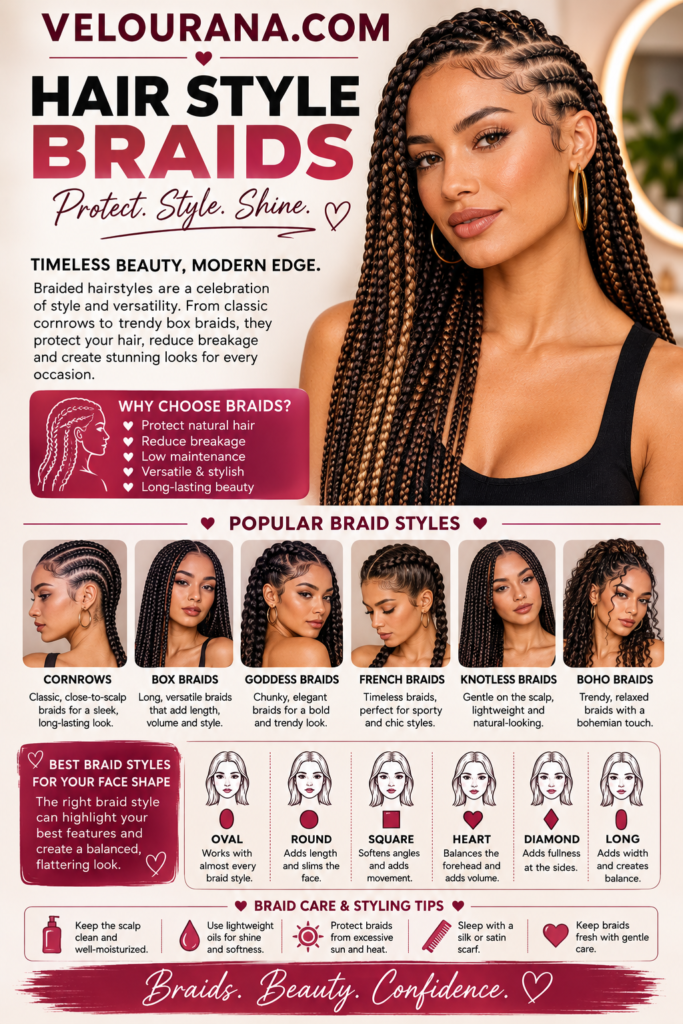
CATEGORY: Braids
The fishtail braid has a distinctive appearance because it creates detail through repetition rather than through a large number of sections. At first glance, the pattern can look intricate enough to seem technically difficult. In reality, the basic idea is simple: two main sections of hair are used, and small pieces are repeatedly transferred from one side to the other.
What makes the fishtail braid visually impressive is not complexity for its own sake.
It is the accumulation of many small crossings.
As the braid develops, those crossings create the narrow, interwoven pattern that gives the style its recognizable texture. When the sections are small and consistent, the result can look highly detailed and almost architectural. When larger pieces are used, the braid becomes looser, broader and more relaxed.
This makes the fishtail one of the most adaptable braided hairstyles.
It can be worn as one long braid down the back, moved over one shoulder, divided into two braids, incorporated into a ponytail or used only as a small decorative section. It can remain sleek and controlled or be gently loosened after completion until it looks soft and expansive.
Straight hair shows the woven pattern clearly. Waves make the braid feel softer. Curly hair adds texture and dimension. Fine hair can produce delicate detail, while dense hair can create a large, highly visible structure.
The technique is the same.
The personality changes according to section size, tension, placement and finish.
Why Two Sections Can Create Such an Intricate Pattern
A conventional braid usually begins with three sections. The fishtail starts with two.
The hair is divided into two main groups. A small piece is taken from the outside of one group and moved across to join the inside of the opposite group. The process is then repeated from the other side.
The alternating transfers gradually lock the two main sections together.
Because the pieces being moved are relatively small, the braid develops a fine, repeated pattern rather than the larger crossings seen in a traditional braid.
The visual effect becomes more detailed as the sections become smaller.
This is one reason the hairstyle can appear much more complicated than the technique actually is.
The challenge lies less in understanding the pattern and more in maintaining control and consistency over many repetitions.
Small Sections Create a Refined Fishtail
When very small pieces are transferred from side to side, the pattern becomes tight and detailed.
Each crossing is narrow.
The braid looks finely woven.
This version can feel polished and deliberate, particularly when the upper hair is smooth and the tension remains even.
It works especially well on long hair because there is enough length for the repeated pattern to develop fully.
The trade-off is time.
Smaller sections require more crossings.
A highly detailed fishtail can therefore take considerably longer than a relaxed version using larger pieces.
The result, however, can look exceptionally refined.
Larger Sections Create a Softer Braid
Using larger pieces changes the appearance immediately.
The pattern becomes easier to construct and visually broader.
The braid feels less intricate and more relaxed.
This version works well when the objective is softness rather than precision.
It can also suit naturally textured hair because the larger sections allow waves and curls to remain visible within the braid.
The distinction between a polished and relaxed fishtail often begins with nothing more complicated than the size of the pieces being transferred.
A Low Fishtail Can Feel Simple and Elegant
Beginning the braid near the nape creates one of the easiest and most wearable versions.
The upper hair remains relatively simple.
The fishtail starts low and becomes the main detail through the length.
This can work with a center part, side part or no strongly visible part at all.
The roots can remain sleek or retain natural volume.
A polished low fishtail can feel refined without requiring an elaborate updo.
Loosen the upper sections and braid and the same hairstyle becomes softer and more casual.
The fundamental structure remains unchanged.
A Side Fishtail Brings the Detail Forward
A braid hanging down the back is not always visible from the front.
Moving it over one shoulder changes that.
The woven pattern becomes part of the front view.
The hairstyle gains asymmetry.
Face-framing pieces can remain loose on the opposite side.
A side part can reinforce the direction.
The result can feel more romantic or relaxed depending on how tightly the braid is constructed.
The side position also makes the braid easier to see while styling, which can be useful when working on one's own hair.
A High Fishtail Ponytail Creates a Different Kind of Shape
The fishtail can begin from a ponytail rather than directly at the nape.
Gathering the hair first creates a strong base.
The braid then becomes the textured length of the ponytail.
A high placement creates more movement and visibility.
A low ponytail produces a calmer silhouette.
This combination is useful because the roots can remain smooth and secure while the braid itself becomes decorative.
The elastic at the base can remain visible or be concealed with a small section of hair.
A Half-Up Fishtail Keeps Most of the Hair Loose
The technique can also be used on only part of the hair.
Small side sections can be brought toward the back and joined into a fishtail.
The remaining lengths stay loose.
This creates a subtle woven detail while preserving the movement of the majority of the hair.
Waves beneath the braid can make the contrast particularly attractive.
Straight hair creates a cleaner relationship between the structured upper section and free lower lengths.
The style is useful when someone wants the visual interest of a fishtail without containing the whole hairstyle.
Two Fishtail Braids Create Symmetry
Dividing the hair into two sections and creating one fishtail on each side changes the silhouette completely.
The style becomes balanced and more youthful in appearance.
The braids can remain compact or be widened.
The parting can be precise or softer.
Dense hair can create substantial braids on both sides, while fine hair produces a more delicate result.
The same technique that looks elegant in one low braid can feel entirely different when duplicated.
A Small Fishtail Can Work as Decoration
The braid does not need to involve much hair.
A narrow fishtail near the temple can create a delicate detail.
One can be incorporated into loose waves.
Several small fishtails can appear throughout a longer hairstyle.
Because the pattern is distinctive, even a small section can remain noticeable.
This allows the technique to function almost like an accessory made from the hair itself.
Loosening the Braid Can Make It Look Much Fuller
One of the most effective ways to change a fishtail is to gently pull the outer edges after the braid is secured.
The structure widens.
The narrow woven pattern becomes more visible.
The braid can appear substantially larger.
This is particularly useful for fine hair, where the finished braid may initially look narrower than desired.
The process should be gradual.
Pulling too aggressively can weaken the structure or release shorter pieces.
Careful widening creates softness while preserving the integrity of the braid.
A Fishtail Does Not Need to Remain Uniform From Top to Bottom
Some of the most attractive fishtails change slightly as they descend.
The upper section may remain more compact.
The lower braid can gradually become looser.
The width can increase.
Small irregularities can create a natural effect.
Perfect consistency is useful for a very polished style, but it is not required for every version.
A softer braid can benefit from controlled variation.
Fine Hair Can Make the Pattern Look Delicate
Fine hair may produce a narrower braid, but that can suit the fishtail technique beautifully.
The repeated crossings remain visible even at a smaller scale.
A delicate braid can appear refined.
If greater fullness is wanted, loosening the sections afterward can create more width.
Root volume can also help balance the overall hairstyle.
Fine hair does not need to imitate the size of a braid created from exceptionally dense hair.
Proportion matters more than scale.
Thick Hair Creates a Bold Fishtail
Dense hair gives the braid substantial presence.
The pattern becomes larger.
The braid may remain wide even without loosening.
On very long thick hair, the finished fishtail can be visually dramatic.
The physical weight should still be considered.
A very tight braid involving all the hair can feel heavy.
A lower starting position or slightly looser finish may improve comfort.
The hairstyle should remain secure without creating unnecessary pulling at the roots.
Straight Hair Shows the Pattern With Maximum Clarity
Straight hair makes the narrow crossings easy to see.
The surface of each section remains smooth.
The repeated transfer from side to side creates a precise pattern.
This can make a sleek fishtail especially striking.
Very smooth hair may feel slippery while braiding, so section control becomes important.
Once completed, however, the clean surface allows the structure to stand out clearly.
Wavy Hair Makes the Braid Softer
Natural waves introduce texture into the sections before they are woven.
The braid may appear less polished but more relaxed.
Small bends remain visible.
Loose pieces around the face develop movement.
This can make a side fishtail particularly attractive because the entire hairstyle shares the same soft character.
There is no need to straighten wavy hair before braiding unless a very sleek result is specifically desired.
Curly Hair Adds Dimension to the Weave
Curly hair gives the fishtail a richer surface.
The sections may not lie perfectly smooth, but the existing texture creates depth.
A few curls can remain loose around the face.
The roots can retain natural volume.
The braid organizes the length while allowing the natural character of the hair to remain visible.
Careful detangling beforehand can make the repeated transfers easier without over-manipulating the curls.
Coily Hair Can Create Highly Structured Fishtail Variations
Coily and tightly textured hair can hold woven structures with strong definition.
The fishtail technique can be adapted according to length, density and desired finish.
The texture can give the braid substantial visual presence even when the sections are relatively small.
As with all braided styles, tension should remain comfortable.
A secure result does not require painful pulling.
The scalp and hairline should remain part of the styling decision, not something ignored in pursuit of a tighter braid.
Tension Determines the Character
A very tight fishtail looks compact and precise.
A looser version appears broader and softer.
The difference is not only aesthetic.
Tension also influences comfort and how easily the braid can be adjusted afterward.
A braid intended to be widened should still have enough stability to maintain its structure, but it does not need to be excessively tight.
Consistent control is more useful than force.
The Hairline Can Stay Soft
A fishtail usually begins away from the scalp unless it is combined with another braiding technique.
This makes it easy to leave the front relatively relaxed.
Curtain bangs can remain free.
Face-framing layers can fall naturally.
A few small pieces can be released around the temples.
This creates contrast between the structured braid and softer front.
A sleek version can instead gather everything neatly toward the braid.
Both are possible.
Bangs Can Remain Completely Independent
A full fringe does not need to participate in the braid.
The hairstyle can begin behind it.
Curtain bangs can frame the face while the braid sits lower.
Longer side bangs can blend into the gathered hair or remain loose.
This allows the braid to work with many different haircuts.
The fringe and braid simply need to feel visually compatible.
The Upper Hair Can Be Smooth or Voluminous
Because the braid itself usually begins lower, the upper silhouette becomes an independent styling choice.
Smooth roots create a polished finish.
Volume at the crown makes the hairstyle softer.
A side part introduces direction.
A center part creates balance.
The same fishtail can therefore support several different overall appearances.
A Fishtail Can Be Combined With French Braiding
One technique can transition into another.
The hair can begin in a French braid through the scalp and then change into a fishtail once the braid reaches the nape.
This creates two different textures within the same hairstyle.
The French braid controls the upper hair.
The fishtail creates intricate detail through the length.
The transition can be subtle or deliberately visible.
Dutch Braiding Can Also Lead Into a Fishtail
A raised Dutch braid can travel across the scalp before changing into a fishtail.
This creates even greater contrast.
The upper section appears dimensional and bold.
The lower length becomes finer and more detailed.
Combining techniques allows the hairstyle to become more complex without requiring entirely new principles.
Fishtail Braids Can Feed Into Buns
The braid does not need to remain hanging.
Once completed, it can be wrapped into a bun.
The woven pattern remains partially visible inside the compact shape.
A low fishtail bun can appear elegant.
A side bun creates asymmetry.
Several smaller fishtails can be combined into a larger updo.
The braid becomes building material rather than the final form.
A Fishtail Can Wrap Around the Head
Long enough hair can be used to create a fishtail crown or partial halo.
The detailed pattern becomes visible around the head rather than descending vertically.
This changes the style from flowing to sculptural.
The braid can remain neat or be loosened for softness.
The directional change demonstrates how adaptable the technique becomes once the basic weaving is comfortable.
Hair Color Becomes Highly Visible Inside the Pattern
Because small pieces repeatedly cross from one side to the other, fishtail braids can showcase dimensional color beautifully.
Highlights move through the weave.
Balayage creates changing brightness.
Natural gray strands become visible against darker sections.
Color that looked subtle in loose hair can become much more noticeable once reorganized.
The fine pattern creates repeated opportunities for contrast.
Multitone Hair Can Make the Braid Look More Intricate
Even when the technique is simple, tonal variation can make the structure appear more complex.
Light sections crossing dark ones emphasize every movement.
This can make a relatively loose fishtail look highly detailed.
The visual complexity comes from the interaction between color and structure rather than from adding more braiding steps.
Preparation Influences How Easy the Braid Feels
Hair that is heavily tangled makes fishtail braiding difficult because small pieces need to be separated repeatedly.
Gentle detangling beforehand makes the process smoother.
Very slippery straight hair may require more careful control.
Textured hair may provide natural grip.
The objective is not one universal preparation routine.
It is simply to make the hair manageable enough for repeated sectioning.
Freshly Washed Hair Can Be Slippery
Very clean, silky hair may slide during braiding.
This can make small sections harder to control.
It does not mean hair needs to be dirty.
It simply means the texture of the strands affects hand control.
A slightly more relaxed braid can sometimes be easier than attempting an extremely tight, fine fishtail on very slippery hair.
Damp Hair Can Create a Different Result Afterward
Braiding slightly damp hair can leave visible texture after the braid is removed.
The smaller repeated sections can create irregular waves.
The effect depends on braid size, natural texture and how dry the hair becomes before release.
Hair should still be handled gently when damp because it can be more vulnerable to stretching and breakage.
The braid should not rely on unnecessary tension.
Removing the Braid Can Create Soft Waves
Even when the hair was dry when braided, wearing a fishtail for several hours can leave some movement behind.
Straight hair may develop subtle bends.
Wavy hair may gain additional definition.
The effect can be useful as a second hairstyle after the braid itself has been worn.
The hair changes twice from one styling session.
The Fishtail Can Become Softer Throughout the Day
A freshly made braid may appear compact.
As the wearer moves, the structure can relax slightly.
Small pieces may escape.
The braid may widen.
For casual styles, this can improve the appearance.
The braid begins looking less constructed and more natural.
A formal version requires greater initial precision if the exact shape needs to remain unchanged for longer.
Short Layers May Escape Naturally
Because the fishtail usually begins lower than French or Dutch braids, short layers around the crown and face may not reach the structure.
This is not necessarily a problem.
Those sections can become intentional face framing.
Small pins can control them when a cleaner result is needed.
The hairstyle should not require aggressive pulling simply to force every short strand into the braid.
Longer Layers Add Texture to the Braid
Layers that do reach the fishtail may begin escaping farther down the length.
This creates natural softness.
For a relaxed braid, those pieces can enhance the style.
For a highly polished braid, they may require more control.
The haircut therefore influences the final character of the braid even when the same technique is used.
Accessories Can Emphasize the Pattern
Small decorative elements can be placed within the fishtail.
A ribbon can be incorporated.
The elastic at the end can be hidden.
Hair jewelry can follow selected crossings.
Because the braid itself is already detailed, excessive decoration may compete with the structure.
A few carefully placed elements are often enough.
A Ribbon Can Become Part of the Weave
Introducing a ribbon creates an additional line moving through the braid.
The contrast can make the pattern even more visible.
The ribbon can match the hair for subtle detail or provide stronger contrast.
The technique still depends on the same alternating transfers.
The accessory simply becomes part of the visual rhythm.
The Ends Can Be Left Soft
The fishtail does not need to continue until almost no loose hair remains.
Stopping slightly earlier can leave a small section of unbraided ends.
This creates a softer finish.
The amount left free influences the appearance.
A short clean tail looks polished.
A longer loose section feels more relaxed.
The decision is part of the styling rather than a technical requirement.
The Elastic Can Disappear
A small elastic can be concealed with a narrow section of hair wrapped around it.
This allows the braid itself to remain the main visible element.
For casual styles, a visible tie may be perfectly suitable.
The finishing detail should match the overall level of polish.
Fishtail Braiding Rewards Patience More Than Strength
The technique does not require aggressive hand tension.
It requires repetition.
The pattern develops because small pieces continue moving from side to side.
The greatest challenge is often simply maintaining the sequence long enough to complete the braid.
Once the movement becomes familiar, the process becomes rhythmic.
Consistency Becomes Easier With Practice
At first, section sizes may vary significantly.
One crossing may be small.
The next may be large.
The braid still works, but the pattern becomes less regular.
With practice, the hands begin estimating section size naturally.
The resulting weave becomes more consistent without conscious measurement.
The Technique Is Easier to Learn When the Sections Stay Organized
Because only two main sections are used, the braid can become confusing if loose strands migrate between them unpredictably.
Keeping the two sides distinct makes the process much easier.
Each small piece has a clear destination.
This basic organization matters more than working quickly.
A Mirror Can Make Self-Braiding More Difficult at First
Watching every hand movement in a mirror can occasionally reverse the visual information and make the process confusing.
Some people find it easier to learn the hand sequence by feel.
A side fishtail can also be easier to practice than one directly down the back because the braid remains visible without complicated mirror positioning.
Once the hand pattern becomes automatic, placement becomes easier.
The Fishtail Is Ideal for Long Hair but Not Limited to It
Long hair gives the pattern more space to develop, which is why fishtails are frequently associated with long lengths.
Medium hair can still support the technique.
The braid is simply shorter.
Half-up versions work particularly well when there is not enough length for a dramatic full braid.
Small decorative fishtails can be used at even shorter lengths.
The technique can therefore adapt to the available hair.
Extensions Can Change Scale but Are Not Necessary
Some extremely large fishtail styles seen in editorial or social imagery use additional hair to create dramatic width or length.
That does not mean the technique requires extensions.
Natural hair can produce a beautiful braid at its own scale.
The relevant question is whether the desired result is a realistic match for the density and length available.
Adapting the proportions usually creates a more convincing hairstyle than chasing an artificial standard of size.
The Braid Can Be Highly Polished or Intentionally Imperfect
A precise fishtail uses consistent sections and controlled tension.
A relaxed one allows variation.
The edges may be widened.
Some pieces may remain loose.
The braid can curve slightly instead of hanging perfectly straight.
Both can be successful.
The difference lies in whether the irregularity is controlled.
Why the Fishtail Looks More Complicated Than It Is
The braid's visual complexity comes from the number of repetitions.
Each individual movement is simple.
One small piece crosses.
Then another.
The pattern gradually emerges.
This is why the fishtail is an excellent example of how a relatively basic technique can produce a sophisticated result.
The hair itself creates the complexity through accumulation.
A Braid Built From Rhythm
The fishtail becomes easiest to understand when it stops feeling like a sequence of separate instructions and starts feeling rhythmic.
Take from one side.
Cross.
Take from the other.
Cross.
The movement repeats until the length is woven.
This rhythm is what makes the technique increasingly natural with practice.
When Fine Detail Becomes the Main Feature
Unlike some braids that gain their drama from size or raised structure, the fishtail often gains its beauty from detail.
The eye follows the repeated narrow crossings.
The pattern becomes the decoration.
A sleek version can look highly refined.
A widened version can look soft and romantic.
A side braid can make the detail part of the front view.
A half-up version can turn it into a subtle accent.
Fine hair gives the pattern delicacy. Thick hair gives it scale. Straight hair makes the weave precise, while waves and curls soften it.
The same two-section technique adapts to all of them.
Why the Fishtail Remains Distinctive
Many braids can be recognized by their overall silhouette.
The fishtail is recognized by its surface.
Its repeated, narrow crossings create a texture unlike the larger sections of a conventional braid.
That makes it valuable even when used in small amounts.
A narrow section can become a focal detail.
A full braid can turn long hair into an intricate woven structure.
It can remain sleek, be widened dramatically, move over one shoulder, disappear into a bun or sit above loose waves.
The technique is simple enough to repeat and flexible enough to reinterpret endlessly.
And that is the central appeal of the fishtail: two sections of hair, one repeated movement, and a finished pattern that looks far more elaborate than the method used to create it.
The End
Velourana.
 Discover More From Our Family of Websites
 ZodiacBearing (Astrology, Tarot, Numerology, Angel Numbers & Spiritual Guidance)
 Velourana (Beauty, Makeup, Hair Care, Skincare & Beauty Tips)
 HavenBearing (Home, Living, Organization, Décor & Everyday Inspiration)
 PawBearing (Pet Care, Dog Breeds, Animal Health, Training & Pet Products)
 PsyCatherine (Notes From the Journal of a Psychologist on Real Life)

