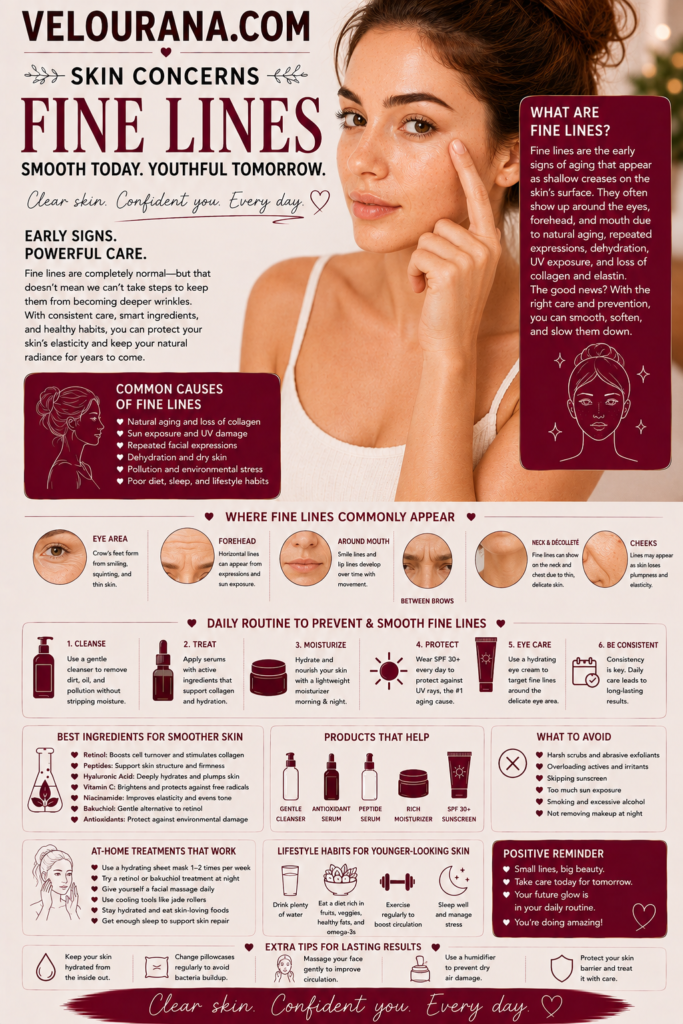
CATEGORY: Fine Lines
Fine lines are often treated as the opening chapter of visible skin aging: the first delicate creases around the eyes, the faint horizontal traces across the forehead, the subtle lines that remain beside the mouth after an expression has disappeared. Because they can seem small, the beauty industry frequently presents them as a simple surface problem, something to be erased with a sufficiently powerful cream or corrected by discovering one exceptional ingredient. Skin biology tells a more interesting story.
A fine line is not merely a mark sitting on top of the skin. It is the visible expression of changes taking place across several levels of tissue at once. Water content influences how sharply a line appears. The condition of the skin barrier affects smoothness and flexibility. Collagen and elastin contribute to the support beneath the surface. Repeated facial movement creates predictable folding patterns. Ultraviolet radiation gradually alters the structures responsible for resilience. Intrinsic aging changes the pace at which skin renews and repairs itself. Even the way light reflects from a dry or uneven surface can make very shallow lines appear considerably stronger.
Understanding this distinction changes the entire approach to fine lines. Instead of asking how to make every line disappear, a more useful question is what is making those lines visible and which parts of that process can realistically be influenced.
The answer is encouraging but requires perspective. Fine lines can often be softened. Their progression can be influenced, particularly where environmental exposure is involved. Hydrated skin can look noticeably smoother. Certain topical ingredients can improve aspects of photoaged skin over time. Professional treatments can produce changes beyond those achievable with ordinary cosmetics. Yet healthy adult skin is not supposed to remain permanently unlined. Movement, expression and biological aging are part of its architecture.
The most intelligent approach to fine lines therefore lies somewhere between resignation and an endless campaign against age. It begins by understanding what a line actually represents.
The Difference Between a Fine Line and a Wrinkle
The language surrounding aging skin is surprisingly imprecise. Fine lines and wrinkles are commonly discussed as though they were interchangeable, yet they can represent different degrees and combinations of structural change.
Fine lines tend to be shallow. They may become particularly noticeable when skin is dehydrated, when the surface is rough or when facial expressions repeatedly fold the same area. Under different lighting, after moisturizing or when the skin is well rested, some of these lines may appear substantially less pronounced.
Deeper wrinkles are generally more established. The folding pattern has become more structurally embedded, and changes beneath the surface contribute increasingly to what is visible above it. A moisturizer may improve the appearance of the surrounding skin, but it cannot simply reconstruct lost dermal architecture.
This distinction explains one of the most common experiences in skincare: a product appears to transform fine lines almost immediately, only for them to return later.
That does not necessarily mean the product did nothing. Moisturizers can temporarily make fine lines less conspicuous by improving hydration and surface smoothness. Dermatological guidance from both the American Academy of Dermatology and Mayo Clinic recognizes this visual effect. What has changed quickly is predominantly the appearance and condition of the surface, not the entire biological structure responsible for aging.
Imagine a piece of supple fabric compared with the same material after it has become dry and stiff. Existing folds become much more obvious when flexibility is lost. Restoring moisture can soften their appearance, but it does not mean that every underlying fold has ceased to exist.
Skin behaves far more intricately than fabric, of course, but the comparison illustrates why hydration matters without turning hydration into a claim of structural rejuvenation.
Fine lines should therefore be interpreted in context. Some are predominantly expressions of temporary surface dehydration. Others represent early structural aging. Most are influenced by several processes simultaneously.
Why Skin Begins to Hold a Line
Young skin is remarkably capable of accommodating movement. Smiling, squinting, raising the eyebrows and speaking repeatedly fold particular regions of the face, yet the surface tends to return readily toward its resting position.
Over time, that recovery becomes less complete.
Intrinsic aging gradually changes the properties of the skin regardless of lifestyle. Skin commonly becomes thinner and drier, and visible lines naturally increase with age. Genetics influence the timing and character of these changes.
The dermis beneath the visible epidermis is particularly important because it contains much of the structural framework associated with firmness and resilience. Collagen provides tensile support, while elastic components contribute to the ability of tissue to deform and recover. The extracellular environment surrounding these structures also influences hydration and mechanical behavior.
Aging does not simply mean that one component suddenly disappears. It involves a gradual alteration of a living system: synthesis changes, degradation accumulates, repair becomes different and the organization of supporting structures evolves.
This is why the familiar phrase "collagen loss" is useful but incomplete. Fine lines cannot be understood as though the skin were a mattress slowly losing a single type of stuffing.
The epidermis matters. The dermis matters. The barrier matters. Hydration matters. Facial anatomy matters. Repeated movement matters. Environmental exposure matters.
As these influences accumulate, areas repeatedly folded during expression can begin retaining traces of those movements while the face is at rest. What was once entirely dynamic becomes increasingly visible as a resting line.
The location of early fine lines is therefore not random. The eye area is constantly involved in blinking, smiling and squinting. The forehead moves when the brows rise. The region around the mouth participates in speech and countless expressions. These are highly active anatomical zones.
Yet movement itself should not be regarded as an enemy. A motionless face is not the biological standard against which healthy skin should be measured. Expression helps determine where lines emerge, but environmental and structural factors strongly influence how quickly those expression patterns become permanently visible.
Photoaging Changes the Equation
Among the external influences on visible skin aging, ultraviolet radiation deserves exceptional attention.
Intrinsic aging would occur even in a hypothetical life without significant environmental exposure. Photoaging is different. It describes the additional changes associated with accumulated ultraviolet exposure, and chronic UV exposure is a major driver of premature visible aging. Research on photoaged skin describes changes involving collagen, elastic structures and other components of dermal organization, alongside visible wrinkling, altered pigmentation and laxity.
This matters because intrinsic aging cannot be prevented. Photoaging, however, is at least partly modifiable.
The distinction also explains why chronological age alone is a poor predictor of how lined someone's skin will appear. Two people of the same age can have very different histories of sun exposure, tanning, outdoor work, sunscreen use, smoking, skin characteristics and genetics. Their faces may therefore show very different patterns of visible aging.
Ultraviolet exposure does not have to produce an obvious sunburn each time to matter. Aging reflects cumulative exposure, which is why everyday protection has a different purpose from merely avoiding a painful day at the beach.
For someone concerned about fine lines, this leads to an important reversal in priorities. It makes little sense to focus exclusively on repairing visible photodamage while continuing to accumulate unnecessary ultraviolet exposure.
Daily broad-spectrum sunscreen is consequently one of the foundations of an evidence-conscious approach to premature aging. The American Academy of Dermatology recommends broad-spectrum SPF 30 or higher as part of protecting skin from accelerated aging.
Sunscreen should not be imagined as a cosmetic eraser. Its principal anti-aging value is preventive. It reduces exposure to a major environmental force that contributes to the deterioration one is simultaneously trying to improve.
This makes sun protection less glamorous than a dramatic "wrinkle treatment," but biologically more fundamental.
Dehydration Can Make Age Look More Advanced Than It Is
There is an important reason fine lines sometimes appear dramatically different from one day to another.
Structural aging does not reverse overnight. Hydration can.
The outermost layers of skin rely on an effective barrier to regulate water loss and maintain a relatively smooth, flexible surface. When that surface becomes dry, its texture becomes more irregular and shallow lines can appear sharper. The face may suddenly seem tired, creased or older even though the underlying dermal architecture has obviously not transformed during the previous twenty-four hours.
This is where moisturizers earn a legitimate place in fine-line care.
Moisturizing can increase the appearance of smoothness and temporarily reduce the visibility of some fine lines by improving hydration. This effect should neither be dismissed as meaningless nor exaggerated into permanent wrinkle reversal.
Appearance matters. If improving hydration makes skin look smoother, feel more comfortable and reflect light more evenly, the product is doing something valuable.
The mistake occurs when temporary optical and hydration effects are presented as evidence that a cosmetic has rebuilt years of structural change.
A useful routine therefore respects the barrier rather than continually challenging it. Aggressive cleansing, excessive exfoliation or layering multiple irritating active products can produce precisely the dryness and inflammation that make fine texture look worse.
This creates one of skincare's great paradoxes. In attempting to make skin look younger as quickly as possible, people can sometimes make it temporarily appear more lined.
More treatment is not automatically more rejuvenation.
A well-functioning barrier provides the environment in which a sophisticated routine can be tolerated. Without it, even potentially useful active ingredients may become difficult to use consistently.
Retinoids and the Importance of Distinguishing Evidence from Reputation
Few skincare ingredients are as closely associated with fine lines as retinoids, the family of vitamin A derivatives that includes prescription medicines and cosmetic ingredients.
They also provide an excellent example of why ingredient discussions require precision.
"Retinoid," "tretinoin" and "retinol" should not be treated as interchangeable terms. Tretinoin is retinoic acid and is used medically; retinol is a cosmetic vitamin A derivative that must undergo conversion within the skin. Different compounds, formulations and concentrations can therefore produce different levels of evidence, activity, stability and irritation.
For photodamaged facial skin, prescription tretinoin has considerably stronger clinical support than the vague reputation surrounding the word "retinol." A systematic review and meta-analysis of randomized controlled trials found significant improvements in fine and coarse facial wrinkles associated with photodamage among people treated with topical tretinoin compared with vehicle treatments.
Over-the-counter retinol is more complicated.
A systematic review specifically examining controlled trials of cosmetic retinol products found that the evidence available at the time was much weaker than marketing enthusiasm might suggest, with methodological problems affecting positive studies. More recent comparative research has nevertheless found improvement in fine wrinkles with retinol among evaluated topical interventions.
These findings are not necessarily contradictory. They illustrate how evidence evolves and why broad statements such as "retinol is scientifically proven" can conceal substantial differences between individual formulations, studies and outcomes.
For the consumer, the practical lesson is not that cosmetic retinoids are useless. It is that expectations should be proportionate.
Retinoids are among the more scientifically serious categories in topical aging care, but a cosmetic bottle cannot be evaluated merely because the front label contains a fashionable ingredient name. Formulation, concentration, stability, tolerability and consistent use all influence the real-world result.
Retinoids can also irritate. Dryness, peeling, sensitivity and redness can undermine adherence, particularly when someone begins aggressively or combines several irritating products simultaneously. Dermatological guidance recommends considering individual skin characteristics, and people with substantial dryness, redness or inflammatory skin conditions may require professional advice before using them.
The most powerful routine is not the routine that looks most impressive on a bathroom shelf. It is the one the skin can tolerate consistently enough to provide a benefit.
The Seduction of the Single Miracle Ingredient
Fine-line marketing often depends on a compelling narrative: aging has one principal cause, and a particular ingredient is the missing solution.
Skin does not cooperate with narratives this simple.
Peptides, vitamin C, niacinamide, hyaluronic acid, alpha-hydroxy acids, ceramides, botanical antioxidants and numerous proprietary complexes may all appear in products positioned toward aging skin. Some have plausible mechanisms and varying degrees of supporting evidence. Others rely heavily on laboratory findings, ingredient-level research or marketing extrapolation that does not necessarily demonstrate a visible transformation when used in a finished consumer formulation.
This does not mean every product outside the strongest evidence categories is worthless. It means the magnitude and certainty of its benefit should not be assumed from advertising vocabulary.
Hyaluronic acid illustrates the distinction particularly well. Because of its association with water and skin hydration, it can be useful in moisturizing formulations. But topical hydration and injectable dermal filling are fundamentally different interventions. The presence of "hyaluronic acid" on a serum does not mean the serum reproduces the structural effects of an injectable filler.
Likewise, a topical cosmetic containing collagen should not automatically be imagined as delivering new structural collagen directly into the dermis. Cosmetic terminology often encourages consumers to mentally connect an ingredient's name with the biological structure they wish to restore, even when the relationship is far more complicated.
Vitamin C has antioxidant functions and has attracted considerable interest in photoaging, but stability, formulation and delivery matter. Acids can improve surface texture and, depending on the compound and formulation, contribute to a smoother appearance, but aggressive exfoliation can also compromise tolerance.
The broader lesson is that ingredient literacy should progress beyond memorizing fashionable names.
Ask what the ingredient is intended to do. Ask whether that effect is primarily hydration, exfoliation, pigmentation management or structural remodeling. Ask how strong the human evidence is. Ask whether the concentration and formulation are meaningful. Ask whether the skin can tolerate it.
This way of thinking is less exciting than the promise of discovering a miracle serum. It is considerably more useful.
Why a Simple Routine Can Be More Sophisticated
A fine-line routine does not need to contain ten active treatments.
In fact, complexity can make it harder to determine what is helping.
At its most rational, everyday care can be built around a few biological objectives: cleanse without unnecessarily stripping the skin, maintain hydration and barrier comfort, reduce avoidable ultraviolet exposure, and introduce well-chosen active treatment when appropriate.
Everything else should justify its place.
This principle matters because the skincare market encourages accumulation. A person concerned about fine lines may buy an exfoliating toner, vitamin C serum, peptide serum, retinol, eye cream, acid treatment, overnight mask and several moisturizers, then attempt to use most of them within the same routine.
The resulting irritation may be interpreted as evidence that the products are "working."
It is not.
Burning, persistent redness and uncontrolled peeling are signs of irritation, not measurements of collagen production.
Skin does not award extra credit for suffering.
A more measured routine allows active ingredients to be introduced gradually and evaluated over meaningful periods. It also recognizes that the visible aging process took years to develop. Expecting profound reversal after several nights encourages unnecessary product switching and overuse.
Consistency becomes especially important with preventive measures. Sunscreen used sporadically before holidays is different from sun protection integrated into ordinary daily life. Moisturizer used only after the skin becomes painfully dry is different from maintaining comfortable barrier function. An active product used intensely for one week and abandoned because of irritation is unlikely to offer the same opportunity for benefit as a tolerable regimen sustained over time.
Sophistication in skincare is therefore not measured by the number of bottles involved. It is measured by whether each step has a coherent purpose.
Expression Lines Are Not Evidence That Skincare Has Failed
The cultural discussion surrounding fine lines often creates an impossible standard: skin should move naturally but never retain evidence that it has moved.
This expectation deserves examination.
A smile repeatedly folds the skin around the eyes and mouth. Raising the eyebrows folds the forehead. Squinting contracts the muscles around the eyes. These movements are inseparable from communication and expression.
Early in life, the skin generally recovers rapidly after movement. As tissue properties change, repeated folding contributes increasingly to lines that remain visible at rest.
Topical skincare can improve surface quality and address some components of photoaging, but it cannot prevent facial muscles from moving beneath the skin. This is one reason certain expression-related lines respond differently to topical products than they do to medical procedures designed to alter muscular activity.
Recognizing this prevents an endless escalation of cosmetics in pursuit of a result they were never capable of producing.
It also allows fine lines to be evaluated more intelligently. A shallow dehydration line, a resting wrinkle associated with photodamage and a dynamic line created during expression may look superficially similar in a mirror, yet they are not identical problems.
No single cream should be expected to solve all three through the same mechanism.
This distinction becomes especially important around the eyes, where people often assume that a separate eye product is automatically necessary. The eye area is thinner and can be more sensitive, so formulation and tolerability certainly matter. But the words "eye cream" do not themselves confer a unique biological ability to remove crow's-feet.
The quality of the formulation and what it actually accomplishes matter more than the marketing category printed on the packaging.
Lifestyle Is Part of the Skin's History
Skincare routines operate within a much larger biological environment.
Sun exposure is the most obvious external contributor to photoaging, but visible skin condition is also influenced by behaviors and environmental factors accumulated over time. Smoking, for example, is associated with premature skin aging. Repeated tanning dramatically increases ultraviolet exposure. Poorly managed dryness can exaggerate surface texture.
Sleep, nutrition and general health are frequently incorporated into beauty discussions as well, although this is another area where sensible principles can quickly become exaggerated into unsupported promises.
There is no particular food that erases a forehead line. Drinking excessive quantities of water does not function like injecting moisture directly into the skin. A weekend of perfect sleep cannot rebuild years of accumulated photodamage.
Yet it would be equally misguided to treat the skin as an isolated sheet disconnected from the rest of the body.
Skin is living tissue. Overall health matters. Adequate nutrition matters. Smoking avoidance matters. Sensible sun behavior matters. Sleep can influence how rested or fatigued the face appears, even if it is not a wrinkle treatment.
The key is to distinguish supportive health behavior from cosmetic mythology.
A healthy lifestyle provides favorable conditions for the body and skin. It should not be marketed as a secret mechanism for making chronological aging disappear.
When Cosmetics Reach Their Natural Limit
One of the most valuable realizations in fine-line care is understanding what skincare cannot reasonably do.
Cosmetics work primarily from the outside. Some active ingredients can influence biological processes within the skin, but the degree of change remains constrained by the ingredient, formulation, penetration, individual response and depth of the structural issue being treated.
Once lines become deeper or are strongly influenced by facial movement, volume changes, tissue laxity or substantial photodamage, topical products may improve the surrounding skin without producing the transformation someone expects.
This is not a failure of skincare.
It is a mismatch between the tool and the objective.
Dermatology offers a broader range of approaches to visible aging, including prescription topical therapy and professional procedures. Depending on the concern, clinicians may use combinations of treatments because different signs of aging arise through different mechanisms.
Professional treatment is particularly worth considering when someone wants a degree of correction that cosmetics cannot realistically provide, when pigmentation or a changing skin lesion is being mistaken for ordinary aging, or when persistent redness, dermatitis or sensitivity makes self-directed active skincare difficult.
The distinction between cosmetic and medical care should remain clear. A beauty routine can support the appearance and condition of healthy skin. It should not be expected to diagnose lesions, treat disease or substitute for medical assessment.
This becomes increasingly important with accumulated sun exposure. Rough, persistent or changing areas of skin should not simply be categorized as another sign of aging and covered with stronger cosmetic products. Sun damage can produce medically significant lesions as well as cosmetic changes.
Knowing when not to add another serum is part of intelligent skincare.
The Goal Is Better-Functioning Skin, Not Timeless Skin
Fine lines occupy an unusual place in beauty because they are simultaneously ordinary and emotionally powerful.
They are ordinary because skin changes with time. They are powerful because the first lines can feel like visible evidence that aging has moved from an abstract future into the present.
That emotional response has created an enormous market for certainty.
Products promise renewal, reversal, correction, lifting, resurfacing, restoration and youth. Before-and-after photographs compress months into seconds. Ingredient percentages become status symbols. The language becomes increasingly aggressive toward something that is, fundamentally, part of normal human biology.
A more useful philosophy does not require abandoning aesthetic goals.
There is nothing irrational about wanting smoother skin. There is nothing superficial about enjoying skincare or wanting to preserve the appearance of one's complexion. The problem arises when success is defined as maintaining skin that shows no evidence of time, movement or life.
Fine-line care works better when the objective becomes improvement rather than impossibility.
Protect skin from unnecessary ultraviolet exposure. Maintain hydration and barrier comfort. Choose active ingredients according to evidence rather than fashion. Introduce potentially irritating treatments thoughtfully. Allow sufficient time to judge results. Seek professional guidance when the desired correction exceeds what cosmetics can reasonably achieve.
Most importantly, learn to distinguish temporary smoothness from structural change and prevention from treatment.
A moisturizer may make fine lines look softer today. That is useful.
Sunscreen may help reduce additional photoaging over years. That is useful in a completely different way.
A retinoid may gradually improve particular features of photodamaged skin. That represents another category of benefit.
A professional procedure may address a structural or dynamic concern beyond the practical reach of ordinary skincare.
These approaches should not compete for the same promise because they do not perform the same job.
Fine lines ultimately reveal something more interesting than the simple fact that skin is aging. They reveal the accumulated relationship between biology, movement, environment, care and time. Some elements of that relationship can be changed; others cannot and need not be treated as defects.
The most effective approach is therefore neither to ignore skin aging nor to wage war against every line. It is to understand the architecture beneath what the mirror shows and respond proportionately.
When that understanding replaces the search for miracle correction, skincare becomes quieter but considerably more intelligent. The objective is no longer to make the face appear untouched by time. It is to help the skin remain protected, comfortable, resilient and as healthy-looking as its biology reasonably allows.
The End Velourana
 Discover More From Our Family of Websites
 ZodiacBearing (Astrology, Tarot, Numerology, Angel Numbers & Spiritual Guidance)
 Velourana (Beauty, Makeup, Hair Care, Skincare & Beauty Tips)
 HavenBearing (Home, Living, Organization, Décor & Everyday Inspiration)
 PawBearing (Pet Care, Dog Breeds, Animal Health, Training & Pet Products)
 PsyCatherine (Notes From the Journal of a Psychologist on Real Life)