
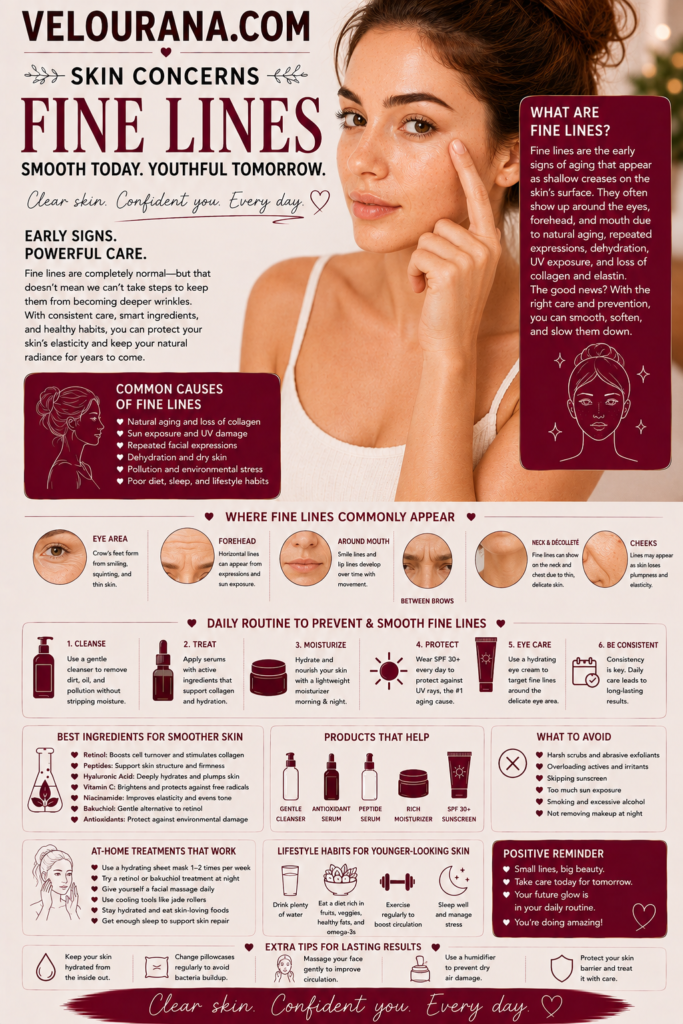
CATEGORY: Fine Lines
Fine lines are often discussed as though they belong to one moment in life: the point at which someone first notices them. In reality, the processes behind them begin much earlier and continue evolving for decades.
The skin visible at forty is partly the result of what happened at twenty. The skin visible at sixty reflects intrinsic aging, years of expression, environmental exposure, hormonal change, genetics and the accumulated effects of daily care. Yet this does not mean the future of the face is predetermined in youth. Skin remains biologically active throughout adulthood, and sensible care can still improve its condition long after the first lines appear.
The more useful way to understand fine lines is therefore not to divide people into those who "have wrinkles" and those who do not. It is to see aging as a continuum.
At one stage, lines exist almost entirely during expression. Later, the same folds linger briefly after the face relaxes. Eventually some become visible at rest. Surface dryness may exaggerate them. Photodamage may deepen them. Changes in support beneath the skin may alter their shape. Hormonal transitions can change hydration and resilience. By mature age, the visible pattern reflects several decades of interacting influences rather than one isolated cause.
This chronological perspective matters because skincare needs also change.
The aggressive routine appropriate for established photoaging may be unnecessary for someone whose skin is still highly resilient. Conversely, the lightweight moisturizer that felt perfect at twenty-five may no longer provide adequate comfort at fifty-five.
Skin aging is not a single problem requiring one permanent routine.
It is an evolving biological context.
Understanding how fine lines typically change across adulthood allows skincare to adapt intelligently rather than react anxiously.
Early Adulthood: When Lines Belong Mostly to Expression
During early adulthood, most visible facial lines are dynamic.
Smile, and the outer corners of the eyes fold.
Raise the eyebrows, and the forehead forms horizontal creases.
Concentrate intensely, and vertical lines may appear between the brows.
Relax the face, and these folds usually disappear almost completely.
This is ordinary facial mechanics rather than evidence of premature deterioration.
Young adult skin generally contains a relatively robust structural network, efficient barrier function and strong capacity to recover after deformation. Individual differences are substantial, but the characteristic pattern is one of resilience.
At this stage, the greatest anti-aging opportunity is not correction.
It is preservation.
This distinction matters because marketing increasingly encourages very young consumers to treat aging before meaningful aging has occurred. Social media can transform normal expression folds into supposed defects. A forehead line that exists only while raising the eyebrows may suddenly be interpreted as something requiring acids, retinol, peptides, lifting masks and specialized devices.
That response can create more problems than it solves.
Young skin is not immune to irritation.
Using multiple exfoliating acids, strong retinoids and harsh cleansers unnecessarily can disrupt the barrier, create dryness and make temporary lines more visible.
The irony is obvious: a routine designed to prevent fine lines can produce a dry, irritated surface that appears more finely lined.
For younger adults, the most important long-term intervention is usually less dramatic.
Consistent sun protection matters because ultraviolet exposure accumulates. A person may see little consequence from years of intermittent tanning or unprotected sun in their twenties, yet the structural effects can become increasingly visible later.
Gentle cleansing and appropriate moisturization establish another useful foundation.
Everything else should be added according to an actual need, not fear of future aging.
The objective is not to keep twenty-year-old skin permanently unchanged.
It is to avoid accelerating the transition unnecessarily.
The Late Twenties and Early Thirties: The First Persistent Traces
For many people, the late twenties or early thirties are when the relationship with fine lines changes.
The face still appears recognizably youthful, yet certain folds begin to linger.
A smile line may remain faintly visible after the smile disappears.
The forehead may retain a shallow horizontal trace.
Under-eye concealer may begin settling into creases that previously went unnoticed.
These changes often appear inconsistent because the lines are still strongly influenced by hydration, fatigue, lighting and expression.
One morning they seem obvious.
A week later they appear almost absent.
This variability can create unnecessary anxiety because people assume a fluctuating line represents rapidly accelerating aging.
Usually, the explanation is less dramatic.
Surface hydration changes daily. Environmental conditions change. Air conditioning, central heating, cold weather and low humidity can increase dryness. Sleep deprivation can affect facial appearance. Makeup can emphasize texture. Side lighting can transform a shallow depression into a visible shadow.
At the same time, the earliest structural changes are beginning beneath the surface.
Collagen metabolism changes gradually with age. The cumulative effects of ultraviolet radiation begin to matter increasingly. The skin may not rebound after repeated folding quite as effortlessly as it once did.
This is a useful stage for establishing a coherent long-term routine.
Sun protection becomes non-negotiable if preventing avoidable photoaging is a priority. Moisturization should be sufficient to maintain comfort. If a retinoid or other targeted active is appropriate, it can be introduced thoughtfully rather than through an aggressive multi-product overhaul.
The key is restraint.
Someone beginning at this stage does not need every ingredient associated with aging skin simultaneously.
The skin is changing, but it is not collapsing.
A routine built for decades should feel sustainable.
The Thirties: When Fine Lines Become Part of the Resting Face
Through the thirties, dynamic lines often begin transitioning more clearly into resting lines.
This does not happen uniformly.
Someone with expressive forehead movement may notice lines there first. Another person may show greater changes around the eyes. Someone else may retain a relatively smooth upper face while developing fine texture around the mouth.
The map depends heavily on anatomy, expression patterns, sun exposure and genetics.
This is why chronological age is an unreliable cosmetic predictor.
Two people who are both thirty-eight can have dramatically different levels of visible wrinkling without either being abnormal.
One may have worked outdoors for years.
Another may have spent most of adult life indoors.
One may naturally squint strongly when smiling.
Another may have minimal periocular folding.
One may smoke.
Another may never have smoked.
One may have naturally dry skin.
Another may have an oilier complexion that masks fine surface texture.
The visual result reflects the entire history rather than the birth certificate alone.
During this period, fine lines often become more resistant to quick cosmetic improvement.
Moisturizer may still soften them significantly, but it no longer makes every line disappear.
This can be the moment when people begin seeking stronger treatments.
That instinct is understandable, but escalation should remain selective.
If photodamage and fine wrinkling are becoming concerns, evidence-supported topical approaches may be appropriate. Retinoids can play an important role. Antioxidant formulations, exfoliating treatments or other actives may provide additional benefit depending on the individual.
But tolerance remains central.
There is little advantage in constructing an impressive anti-aging routine that leaves the skin chronically inflamed.
The thirties are often the decade when patience begins producing more value than intensity.
The Forties: Fine Lines Become Part of a Larger Structural Picture
By the forties, fine lines rarely exist as an isolated feature.
Other changes increasingly influence how they appear.
Skin may become drier. Elastic recovery changes. Pigmentation irregularities from accumulated sun exposure may become more apparent. Facial volume distribution can begin changing. The contours around the eyes and mouth can subtly shift.
A line that once looked like a simple crease may therefore become part of a more complex topography.
This matters because the same topical routine cannot address every component.
A moisturizer can improve dryness.
A retinoid may improve certain features of photoaging.
Sunscreen can reduce further ultraviolet damage.
But topical skincare cannot restore every anatomical change occurring beneath the surface.
This is the stage at which many people become frustrated with cosmetics because expectations remain based on what worked ten years earlier.
A serum that once produced a dramatic visible improvement in dehydration lines may now create only moderate softening.
The serum has not necessarily become worse.
The underlying concern has become deeper and more multidimensional.
Recognizing that distinction can prevent endless product switching.
The objective should shift from searching for one increasingly powerful cream toward building a layered strategy.
Surface quality can be optimized.
Barrier comfort can be maintained.
Photoaging can be addressed.
Professional treatment can be considered for concerns that clearly exceed topical capabilities.
This is not surrender.
It is precision.
Why Fine Lines Often Seem to Accelerate in Midlife
Many people describe aging as gradual until suddenly it is not.
For years, the face changes slowly.
Then somewhere in midlife, fine lines appear to multiply.
The impression can be genuine even though there is rarely one single cause.
Several processes may converge.
Intrinsic aging continues.
Cumulative ultraviolet damage becomes increasingly visible.
The skin can become drier.
Hormonal changes may alter hydration and structural characteristics.
Changes in facial fat, muscle and bone influence the overlying surface.
Repeated expression has now occurred for several additional decades.
Each factor alone may be subtle.
Together, they can create the perception of sudden acceleration.
For women, the menopausal transition can be particularly significant because estrogen decline affects multiple aspects of skin physiology. Dryness may increase. Collagen-related changes can become more pronounced. Skin may feel thinner or less resilient.
This does not mean menopause causes the face to age overnight.
It means the biological environment shifts enough that pre-existing aging processes can become more visible.
This is also why products that previously felt sufficient may stop providing the same level of comfort.
A lightweight gel moisturizer suitable for an oilier complexion in the thirties may feel inadequate later. A strong exfoliating routine once tolerated comfortably may become irritating.
Adapting the routine is therefore sensible.
Aging skincare should evolve with the skin rather than remain loyal to products chosen for a younger version of it.
The Fifties: Fine Lines, Dryness and Changes in Support
By the fifties, the distinction between surface lines and deeper wrinkles becomes increasingly important.
Fine lines may still be present, especially around the eyes and mouth, but they often coexist with more established folds and broader changes in facial structure.
The skin itself may feel drier and more delicate.
This increases the importance of barrier care.
One of the most common mistakes at this stage is assuming that stronger exfoliation is required because the skin looks dull or textured.
Sometimes the opposite is true.
A compromised, dry surface can make mature skin appear more creased and less luminous. Continually removing the outer layers may worsen the very appearance the routine is intended to improve.
Restoring moisture and reducing unnecessary irritation can create a surprisingly substantial cosmetic improvement.
This does not reverse age.
It allows the surface to function and reflect light more effectively.
Active treatment still has a place.
Retinoids may remain valuable when tolerated. Other evidence-based ingredients can complement the routine. Professional procedures may be appropriate depending on the individual's goals.
But the foundation becomes increasingly important.
Mature skin often rewards consistency more than aggression.
A comfortable barrier supports long-term active treatment.
Chronically irritated skin does not.
The Sixties and Beyond: Fine Lines Become Part of Texture, Not a Separate Problem
Later in life, fine lines are usually better understood as part of overall skin texture than as isolated imperfections.
The surface may show a network of shallow creases alongside deeper wrinkles, areas of pigmentation, reduced elasticity and changes in thickness.
At this stage, attempting to eliminate every line through cosmetics becomes particularly unrealistic.
That does not make skincare irrelevant.
Quite the opposite.
Hydration can produce significant visual improvement in mature skin because dryness often contributes strongly to rough texture.
Sun protection remains important because ultraviolet exposure continues to cause damage regardless of age.
Gentle cleansing becomes valuable because mature skin may tolerate aggressive detergents poorly.
Targeted topical treatments can still improve certain concerns.
Professional dermatological care may address medically significant sun damage as well as cosmetic issues.
The purpose of skincare simply changes.
The objective becomes less about preventing the first line and more about maintaining comfort, resilience, evenness and healthy appearance.
This shift can be profoundly positive.
Instead of judging the skin according to whether it resembles the skin of a much younger person, it can be judged according to whether it looks well cared for at its present age.
That is a far more realistic and often more beautiful standard.
Chronological Age Is Only One Clock
The decade-by-decade model is useful, but it should never become rigid.
Skin does not read calendars.
A thirty-year-old can have extensive photodamage.
A fifty-year-old can have relatively little visible wrinkling.
Genetics, pigmentation, anatomy, sun exposure, smoking history, environmental conditions and skincare habits all influence the timeline.
This is why the concept of biological or apparent skin age differs from chronological age.
Two people born on the same day can have very different skin histories.
One may have lived in a high-ultraviolet environment and rarely used protection.
Another may have practiced consistent sun avoidance.
One may have smoked for decades.
Another may not.
One may naturally have a thicker, oilier skin type.
Another may have thin, dry skin.
These differences accumulate.
The result is not a moral judgment.
It is biology interacting with environment.
This perspective is important because age-based skincare marketing often implies that every person needs a particular category of product once they reach a certain birthday.
"Skin over forty" becomes a retail segment.
"50+" becomes another.
But the skin's actual needs may not follow those divisions.
A sixty-year-old with comfortable, resilient skin may not require an extremely rich cream.
A thirty-five-year-old with severe dryness may.
Routine design should follow condition before chronology.
Prevention Changes with Age, but It Never Becomes Meaningless
There is a common misconception that preventive skincare only matters before signs of aging appear.
Once lines exist, some people assume the opportunity has been lost.
This is incorrect.
Prevention remains relevant at every age because additional damage can always accumulate.
Someone beginning daily sun protection at fifty will not erase the ultraviolet exposure accumulated during previous decades.
But future exposure can still be reduced.
Someone who stops smoking later in life cannot undo every previous effect immediately, yet discontinuing exposure remains beneficial for overall health and removes an ongoing contributor.
Someone who begins caring properly for chronically dry skin at sixty can still improve comfort and surface appearance.
There is no age at which sensible care becomes pointless.
The objective simply changes.
At twenty, prevention may mean protecting highly resilient skin from avoidable future damage.
At forty, it may mean slowing further photoaging while improving existing fine lines.
At sixty, it may mean protecting increasingly delicate skin while managing dryness and established damage.
The principle is continuous even though the details evolve.
The Problem with Starting "Anti-Aging" Too Early
Because preventive care is useful, it is easy to push the logic too far.
If sunscreen at twenty is beneficial, perhaps retinoids should begin at sixteen.
If one antioxidant is good, perhaps five are better.
If occasional exfoliation smooths texture, perhaps daily resurfacing will preserve youth indefinitely.
This is where prevention becomes anxiety.
Young skin does not need to be treated as though aging is a disease already underway.
Every active ingredient has a cost in complexity, tolerance and potential irritation.
The goal should be proportionate intervention.
For someone with acne, a retinoid may be prescribed or recommended for reasons unrelated to aging.
For someone with healthy, unproblematic young skin, there may be no compelling reason to construct an elaborate anti-aging regimen.
Sun protection offers long-term value with a strong rationale.
Moisturization supports the barrier when needed.
Beyond that, treatment should be guided by actual skin concerns.
Beginning earlier is not automatically better if the treatment is unnecessary.
The best long-term skincare habit may simply be avoiding damage rather than attempting to stimulate constant change.
The Problem with Starting "Too Late"
At the opposite extreme lies another unhelpful belief: once fine lines become visible, skincare is no longer worth beginning.
This idea confuses prevention with perfection.
No topical routine can restore a mature face to adolescent biology.
But meaningful improvement remains possible.
Dryness can be reduced.
Texture can become smoother.
Certain signs of photoaging can respond to evidence-based treatment.
Further ultraviolet damage can be minimized.
The skin can become more comfortable and luminous.
Professional interventions can produce additional improvement when appropriate.
The fact that complete reversal is impossible does not make partial improvement worthless.
This principle is important because anti-aging culture tends to create binary expectations.
Either a product "reverses aging" or it does nothing.
Real biology operates between those extremes.
A 20 percent improvement in texture may be visually meaningful.
Less dryness may dramatically improve makeup application.
Reducing further photodamage has long-term value even if existing lines remain.
The goal does not need to be complete correction for care to matter.
How Product Priorities Change Over Time
A sensible fine-line routine can therefore be thought of as an evolving hierarchy.
In younger adulthood, protection and basic barrier maintenance dominate.
As fine lines become persistent, targeted treatment can be introduced.
As dryness increases, moisturization may require greater attention.
As structural changes deepen, expectations for topical correction should become more realistic.
At no stage does the need for sun protection disappear.
At no stage does more complexity automatically equal better care.
This creates a useful continuity across decades.
The routine may gain or lose products, but the logic remains stable.
Protect.
Support.
Treat selectively.
Observe.
Adjust.
Professional advice becomes increasingly relevant when concerns are significant, when active products cause persistent irritation, when skin lesions change or when the desired degree of correction exceeds what cosmetics can reasonably achieve.
The routine should mature with the person.
Fine Lines and the Changing Relationship with Makeup
The way fine lines interact with makeup also evolves over time.
In early adulthood, heavy powder or matte foundation may sit relatively evenly because the skin surface is smooth and often more naturally hydrated or oily.
As fine texture develops, the same products can begin emphasizing the surface.
Foundation settles into forehead lines.
Concealer gathers beneath the eyes.
Powder collects around the mouth.
The immediate temptation is often to search for stronger coverage.
Yet stronger coverage can worsen the problem.
A thick cosmetic layer moves differently from bare skin. Each facial expression compresses the product into existing folds. The more material present, the more visible that accumulation can become.
This is why makeup for finely lined skin often benefits from a change in philosophy.
Instead of attempting to create an entirely flat, opaque surface, the goal becomes evenness without excess thickness.
Good skin preparation matters.
Moisturizer should provide comfort without leaving an incompatible film.
Foundation can be applied strategically rather than uniformly heavily.
Powder can be concentrated where needed rather than applied indiscriminately.
Concealer can correct discoloration without attempting to fill every crease.
The face looks smoother not because lines cease to exist, but because makeup is no longer emphasizing them.
Aging Skin Requires More Observation, Not More Rules
The internet is full of age-based skincare instructions.
Use this at twenty-five.
Begin retinol at thirty.
Switch moisturizer at forty.
Add eye cream at fifty.
These timelines are convenient but biologically crude.
A better approach is observation.
Does the skin feel tight after cleansing?
Does moisturizer keep it comfortable throughout the day?
Are fine lines dramatically worse when the weather becomes dry?
Is an active product producing persistent irritation?
Has pigmentation increased?
Are particular lines visible only during expression or constantly at rest?
Does sunscreen integrate well enough into the routine to be used consistently?
These questions reveal more than a birthday.
Skin gives continuous information.
A routine should respond to that information rather than conform to a generic age bracket.
The Decades Should Change Expectations, Not Self-Worth
Perhaps the hardest part of fine-line care has little to do with ingredients.
It is the changing emotional relationship with the face.
The first line can feel disproportionately significant because it challenges the unconscious expectation that familiar features will remain unchanged.
Later, the accumulation of lines can create the feeling that each year is taking something away.
Beauty marketing often intensifies this anxiety because dissatisfaction creates demand.
If every new line is framed as damage, correction becomes urgent.
But a line is not automatically damage.
Some fine lines reflect photodamage.
Others largely reflect normal movement and intrinsic aging.
Many represent both.
The distinction matters.
Preventable environmental damage deserves prevention.
Normal aging does not require shame.
These two ideas can coexist.
A person can care deeply about appearance, use sophisticated skincare and pursue professional treatments while still recognizing that mature skin is not failed young skin.
It is mature skin.
The Most Valuable Change Is Often the One That Happens Slowly
Fine-line care is unusually vulnerable to impatience.
Hydration can create immediate visual improvement, so people begin expecting every product to behave similarly.
But the most meaningful structural changes usually develop slowly.
Prevention is slower still because its success may not become obvious for years.
This makes consistency difficult to appreciate.
Applying sunscreen every morning does not feel transformative.
Using a tolerable retinoid for months lacks the drama of a peel that produces visible shedding.
Maintaining a simple moisturizer rarely creates the excitement of trying a newly launched anti-aging serum.
Yet skincare accumulates in the same way aging accumulates: gradually.
The repeated everyday choices become the long-term result.
This is why the decade perspective is so useful.
It reminds us that no single night created the fine lines.
No single night will erase them either.
Aging Well Means Allowing the Strategy to Age Too
The most successful fine-line routine is not the routine that remains unchanged for thirty years.
It is the routine that adapts.
Young skin may need little beyond protection and support.
Early fine lines may justify targeted treatment.
Increasing dryness may require richer barrier care.
Established structural changes may make professional treatments more relevant.
Mature skin may prioritize comfort, resilience and luminosity over aggressive resurfacing.
At every stage, expectations should match biology.
This is what aging well in skincare actually means.
Not freezing the face at one moment.
Not collecting increasingly expensive products.
Not treating every crease as an emergency.
It means understanding what the skin is doing now and responding proportionately.
Fine lines are among the clearest visual records of this evolution. They begin as movements, become traces, develop into resting patterns and eventually merge into the broader texture of mature skin.
Their progression cannot be completely prevented.
But it can be influenced.
Ultraviolet damage can be reduced.
Dryness can be controlled.
Barrier function can be supported.
Evidence-based treatments can improve selected signs of photoaging.
Professional care can address concerns beyond the reach of cosmetics.
And throughout the process, the skin can remain healthy-looking without remaining eternally young.
The decades do not represent a countdown toward deterioration.
They represent changing conditions.
A skincare routine becomes genuinely sophisticated when it understands the difference.
The End Velourana
 Discover More From Our Family of Websites
 ZodiacBearing (Astrology, Tarot, Numerology, Angel Numbers & Spiritual Guidance)
 Velourana (Beauty, Makeup, Hair Care, Skincare & Beauty Tips)
 HavenBearing (Home, Living, Organization, Décor & Everyday Inspiration)
 PawBearing (Pet Care, Dog Breeds, Animal Health, Training & Pet Products)
 PsyCatherine (Notes From the Journal of a Psychologist on Real Life)

