CATEGORY: Makeup Techniques
Face powder has been an essential part of beauty routines for centuries, yet it remains one of the most misunderstood makeup products. Many people use the terms “setting powder” and “finishing powder” interchangeably, even though they serve completely different purposes.
Choosing the right powder—and knowing when and how to apply it—can transform your makeup from average to professional. The correct powder helps control shine, locks makeup in place, softens the skin’s appearance, and creates a smooth, long-lasting finish.
This comprehensive guide explains everything you need to know about face powders, including the different types, formulas, finishes, application techniques, and how to select the best powder for your skin type.
—
What Is Face Powder?
Face powder is a cosmetic product designed to improve the appearance and durability of makeup.
Depending on its formula, face powder may:
- Set foundation.
- Reduce shine.
- Blur pores.
- Smooth skin texture.
- Increase makeup longevity.
- Brighten the complexion.
- Minimize creasing.
- Create a soft-focus finish.
Modern face powders are available in numerous formulations, each designed for specific makeup goals.
—
Why Use Face Powder?
Although some people skip powder altogether, it offers several valuable benefits.
Face powder can:
- Prevent foundation from moving.
- Reduce excess oil.
- Improve the longevity of concealer.
- Minimize shine.
- Create smoother-looking skin.
- Help blush and bronzer blend more evenly.
- Produce a more polished makeup finish.
Not every skin type requires heavy powder application, but understanding its purpose helps you decide when it is beneficial.
—
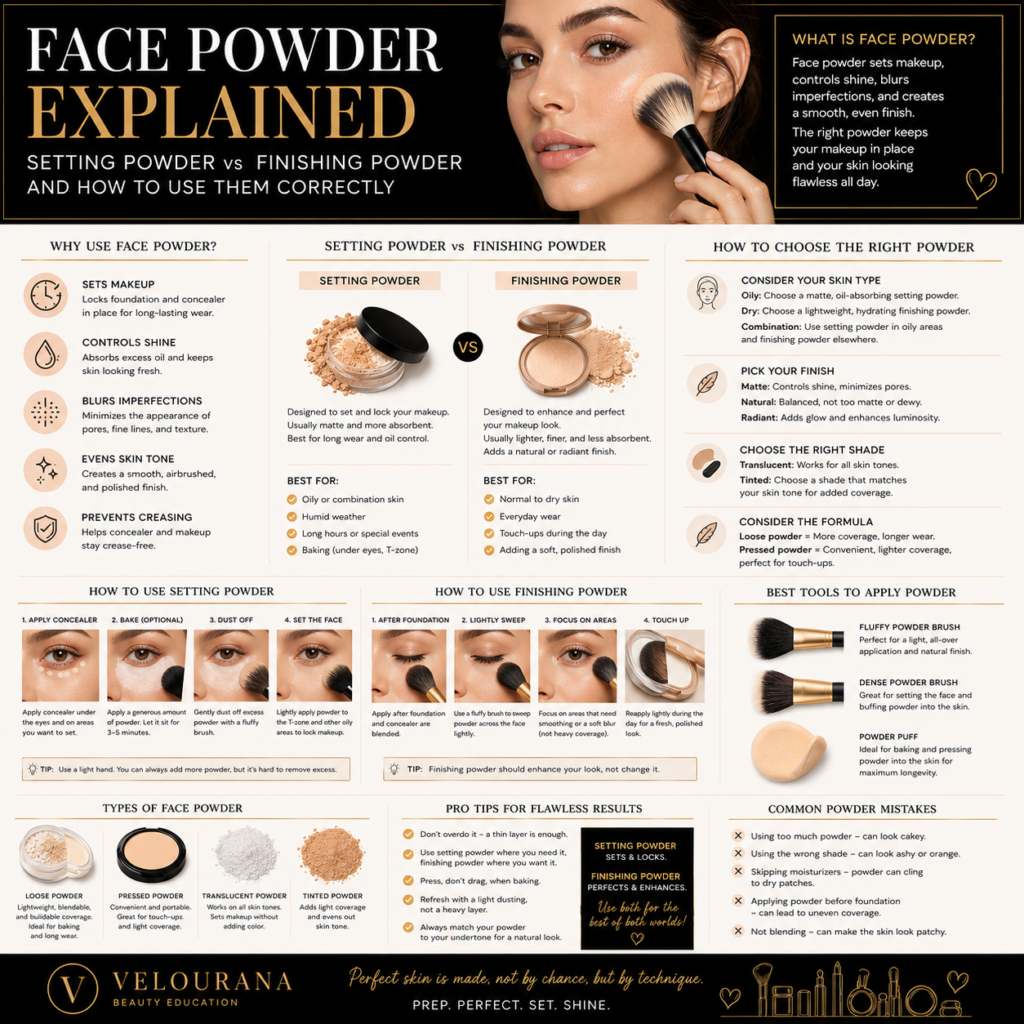
Understanding the Difference Between Setting Powder and Finishing Powder
One of the biggest misconceptions in makeup is assuming these two products perform the same function.
They do not.
—
What Is Setting Powder?
Setting powder is applied immediately after foundation and concealer.
Its primary job is to lock cream and liquid products into place.
Benefits include:
- Preventing movement.
- Reducing creasing.
- Controlling oil.
- Improving makeup wear time.
- Creating a stable base for powder products.
Without setting powder, foundation may slide, crease, or fade more quickly, particularly on oily skin.
—
What Is Finishing Powder?
Finishing powder is applied at the very end of the makeup routine.
Instead of setting makeup, it perfects the overall appearance.
Its purpose includes:
- Softening texture.
- Blurring pores.
- Diffusing light.
- Creating an airbrushed effect.
- Smoothing visible imperfections.
Finishing powder usually contains ultra-fine particles that create a soft-focus appearance rather than additional coverage.
—
Types of Face Powder
Several different powder formulations exist, each offering unique advantages.
—
Loose Powder
Loose powder consists of finely milled particles.
Advantages include:
- Lightweight application.
- Smooth blending.
- Excellent setting ability.
- Natural finish.
Professional makeup artists frequently choose loose powder because it distributes evenly and provides exceptional control.
—
Pressed Powder
Pressed powder is compact and portable.
Benefits include:
- Convenient touch-ups.
- Less mess.
- Easy travel.
- Quick application.
Pressed powders often contain slightly more binding ingredients than loose powders, making them ideal for carrying throughout the day.
—
Translucent Powder
Translucent powders contain little or no visible pigment.
Their purpose is not to change skin color but to set makeup while maintaining the existing foundation shade.
Suitable for:
- Most skin tones.
- Natural makeup.
- Everyday wear.
- Professional photography.
Modern translucent powders are available in multiple undertone variations to suit different complexions.
—
Tinted Powder
Tinted powders contain pigment that adds extra coverage.
They can:
- Even skin tone.
- Cover mild redness.
- Refresh fading foundation.
- Enhance complexion.
Some people use tinted powder alone for light everyday makeup.
—
Mineral Powder
Mineral powders contain naturally derived mineral ingredients.
They are often chosen by people with:
- Sensitive skin.
- Acne-prone skin.
- Oily skin.
Many mineral powders provide buildable coverage while allowing the skin to breathe comfortably.
—
HD (High Definition) Powder
HD powders are specifically formulated for high-resolution photography and video.
Their ultra-fine particles blur imperfections while remaining virtually invisible to the camera.
However, some older HD powders containing high concentrations of silica became known for causing flashback in photography when overapplied.
Modern formulations have greatly reduced this issue.
—
Understanding Powder Finishes
Different powders create different visual effects.
—
Matte Finish
Designed to eliminate shine.
Ideal for:
- Oily skin.
- Humid climates.
- Long workdays.
—
Natural Finish
Balances shine control while maintaining healthy-looking skin.
Suitable for nearly all skin types.
—
Radiant Finish
Contains subtle light-reflecting particles.
Adds freshness and glow without appearing glittery.
Often preferred for dry or mature skin.
—
Choosing Powder According to Skin Type
Dry Skin
Dry skin usually requires only light powder application.
Hydrating loose powders work particularly well.
Applying excessive powder may emphasize dryness and flaking.
—
Oily Skin
Oily skin often benefits from:
- Oil-control loose powders.
- Matte pressed powders.
- Long-wear setting powders.
Concentrating powder in the T-zone usually provides the best balance.
—
Combination Skin
Combination skin may require powder only on oily areas while leaving drier areas untouched.
This approach preserves a natural complexion.
—
Mature Skin
Lightweight, finely milled powders generally produce the most flattering finish.
Heavy powders may settle into fine lines.
Applying only minimal amounts usually creates smoother-looking skin.
—
How to Apply Setting Powder
A simple technique helps maximize effectiveness.
Step 1
Complete foundation and concealer application.
—
Step 2
Pick up a small amount of powder using a fluffy brush or powder puff.
—
Step 3
Press the powder gently into areas that tend to crease or become oily.
Common areas include:
- Under the eyes.
- Nose.
- Forehead.
- Chin.
—
Step 4
Dust away any excess using a clean fluffy brush.
This prevents heavy buildup.
—
What Is Baking?
Baking is a makeup technique popularized by professional artists and later embraced through social media.
The process involves:
- Applying a generous layer of loose powder over concealer.
- Allowing it to remain for several minutes.
- Brushing away the excess.
The warmth of the skin helps the concealer set firmly underneath.
Although baking creates dramatic long-lasting makeup, it is not necessary for everyday wear and may appear heavy on dry or mature skin.
—
Applying Finishing Powder
Finishing powder should be applied only after all makeup products have been completed.
Use a large fluffy brush to lightly dust the powder across the face.
The goal is subtle perfection—not visible coverage.
—
Common Powder Mistakes
Many makeup users unknowingly reduce the quality of their makeup by making simple errors.
Common mistakes include:
- Applying excessive powder.
- Choosing the wrong shade.
- Using powder before foundation has fully blended.
- Applying heavy powder to dry skin.
- Using finishing powder instead of setting powder.
- Neglecting to remove excess product.
Using smaller amounts almost always produces a more natural result.
—
Do You Need Powder Every Day?
Not necessarily.
Some people with dry or very balanced skin may prefer skipping powder entirely.
Others only powder the T-zone while leaving the rest of the face untouched.
Your decision should depend on:
- Skin type.
- Climate.
- Makeup style.
- Wear time.
- Personal preference.
There is no universal rule.
—
How Long Does Face Powder Last?
Most face powders remain usable for approximately two to three years when stored properly.
Replace powder if you notice:
- Changes in texture.
- Unusual odor.
- Hard pan formation that cannot be removed.
- Signs of contamination.
Keeping brushes and powder puffs clean also helps maintain product quality.
—
Building a Practical Powder Collection
Many makeup enthusiasts eventually keep more than one powder.
A useful collection might include:
- Loose translucent setting powder for daily makeup.
- Pressed powder for touch-ups.
- Finely milled finishing powder for special occasions.
- Lightweight mineral powder for natural makeup days.
This combination covers nearly every makeup situation without unnecessary duplication.
—
Final Thoughts
Face powder is one of the most valuable products in a makeup routine when used correctly. Understanding the difference between setting powder and finishing powder allows you to choose the right product for each step of your makeup application. Setting powder helps secure foundation and concealer, while finishing powder refines the final appearance by creating a smoother, softer-looking complexion.
By selecting the appropriate powder for your skin type, applying only the amount you need, and using the correct techniques, you can achieve makeup that looks fresh, comfortable, and beautifully polished throughout the day.
The End,
Velourana
 Discover More From Our Family of Websites
 ZodiacBearing (Astrology, Tarot, Numerology, Angel Numbers & Spiritual Guidance)
 Velourana (Beauty, Makeup, Hair Care, Skincare & Beauty Tips)
 HavenBearing (Home, Living, Organization, Décor & Everyday Inspiration)
 PawBearing (Pet Care, Dog Breeds, Animal Health, Training & Pet Products)
 PsyCatherine (Notes From the Journal of a Psychologist on Real Life)