
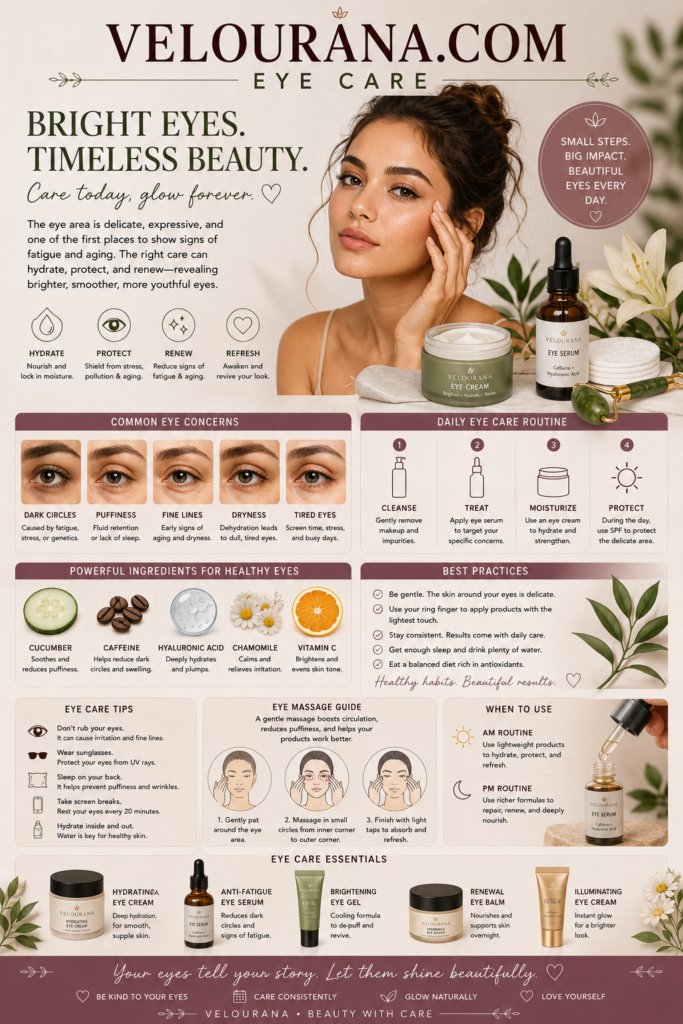
CATEGORY: Eye Serums
The eye area has always occupied an unusual place in skincare. It is small in surface area yet disproportionately influential in how rested, bright, smooth, or fatigued the face appears. A little dehydration beneath the eyes can make fine lines suddenly more visible. A shadow caused by facial anatomy can resemble pigmentation. Morning fluid retention may create temporary puffiness, while years of facial movement gradually establish permanent expression lines. Because several concerns can exist simultaneously, treating the eye contour as though it has one universal problem rarely produces a sophisticated routine.
Eye serums emerged from this complexity. Rather than simply surrounding the eye with a richer layer of moisture, they bring the serum philosophy of lightweight delivery and targeted formulation into the periorbital area. Their textures are generally thinner than conventional eye creams, and many are designed around combinations of humectants, peptides, caffeine, antioxidants, niacinamide, retinoid derivatives, or other carefully selected ingredients. The attraction is precision: a serum can be chosen according to what the eye area actually needs rather than according to the assumption that every eye concern is fundamentally dryness.
That distinction matters because the skin surrounding the eyes is unusually demanding. It is exposed to facial movement every time we blink, smile, squint, laugh, or concentrate. It sits beside the ocular surface, making careless application particularly undesirable. It can also react quickly when an unsuitable cosmetic migrates into the area. Research into ingredients commonly used in eye products suggests potential benefits from several established skincare families, including retinoids, peptides, hyaluronic acid, caffeine, niacinamide, ceramides, and antioxidant vitamins, although the amount and quality of clinical evidence specifically involving finished eye formulations varies considerably.
Understanding eye serums therefore requires more than memorizing fashionable ingredients. Their value lies in the relationship between formulation, texture, tolerance, layering, and the biological or optical reason an eye concern is visible in the first place.
Why the Eye Contour Requires a More Considered Approach
The phrase "delicate eye area" appears so frequently in beauty language that it can lose its meaning. Yet there are practical reasons for treating this region carefully. Periorbital skin is thin, highly mobile, and vulnerable to irritation. Dermatological literature also recognizes allergic and irritant contact dermatitis around the eyes, with cosmetics among the possible exposures. A product that performs beautifully elsewhere on the face is therefore not automatically an ideal candidate for unrestricted application close to the eyes.
The eye contour is also visually unforgiving. On the cheeks or forehead, slight dehydration may be relatively inconspicuous. Beneath the eyes, it can emphasize texture almost immediately. Foundation and concealer may settle differently over dehydrated skin, making cosmetic texture more obvious. Conversely, a very rich treatment can create too much slip for makeup or feel uncomfortable on someone whose eye area does not need substantial occlusion.
This is one reason serum textures have become attractive. A well-designed eye serum can introduce hydration or targeted ingredients without automatically producing the weight associated with a dense cream. That does not make serum inherently superior. It simply gives the routine another degree of control.
The visible condition of the eye area is also influenced by factors that skincare cannot entirely change. Bone structure, orbital anatomy, genetics, natural pigmentation, vascular visibility, allergies, sleep patterns, sun exposure, facial expressions, and age can all affect its appearance. A hollow beneath the eye may create a shadow regardless of how carefully the skin is moisturized. Persistent bags related to anatomical fat distribution cannot realistically be erased by a cosmetic serum. Genetically determined pigmentation may improve only modestly with topical care.
A credible eye routine begins by acknowledging these limits. The purpose of an eye serum is not to transform anatomy. It is to improve aspects of skin appearance and condition that topical skincare can reasonably influence.
The Difference Between an Eye Serum and an Eye Cream
The boundary between serum and cream is not regulated by a universal cosmetic definition, so names alone should never be treated as guarantees of performance. In practice, however, eye serums tend to emphasize lighter textures and targeted active systems, while eye creams generally place greater emphasis on emollience, comfort, and moisture retention.
A serum may disappear into the skin quickly, leaving little residue. This can make it appealing in the morning, particularly beneath concealer or sunscreen. Someone with dry, mature, or barrier-compromised skin may subsequently apply an eye cream over it. Someone with comfortable skin may find the serum alone sufficient.
Cream performs a different role. Oils, emollients, fatty components, silicones, ceramides, and occlusive materials can reduce the feeling of dryness and create a smoother surface. For an eye area that feels tight or becomes flaky, this richer support can be more important than adding another highly active serum.
The useful question is therefore not whether serum or cream is "better." It is whether a particular formula fills a missing role.
Consider a person whose primary concern is morning puffiness but whose skin is otherwise comfortable. A lightweight caffeine-containing serum may fit naturally into that routine. Another person may have pronounced dryness and fine dehydration lines. A humectant-rich serum followed by a suitable cream could make more sense. Someone primarily concerned with long-term photoaging may choose a carefully formulated eye treatment containing a retinoid, but tolerance becomes particularly important.
Texture and ingredients should consequently be evaluated together. A sophisticated ingredient list inside a formula that repeatedly stings or irritates the eyelids is not sophisticated skincare for that individual.
Hydration Is More Complex Than Making Skin Feel Wet
Many eye serums are built around hydration because dehydration can dramatically alter the appearance of the under-eye surface. Humectants such as glycerin and hyaluronic acid attract and hold water within the superficial layers of skin. When hydration improves, fine dehydration lines may appear softened and the surface can look more supple.
Hyaluronic acid has become particularly familiar because of its strong association with water binding. In an eye serum, its most realistic cosmetic contribution is not structural lifting but improved hydration and temporary surface plumping. That difference is important. Hydrated skin can look smoother, yet topical hyaluronic acid should not be confused with injectable hyaluronic-acid filler, which works through an entirely different mechanism and location.
The formulation surrounding the humectant matters as much as the fashionable name on the label. Glycerin, propanediol, panthenol, beta-glucan, amino acids, and various polysaccharides may all contribute to a hydration system. Multiple humectants can create an elegant reservoir of moisture without requiring an oily finish.
Yet humectants are only one part of barrier comfort. Very dry skin may need lipids or an occlusive layer to reduce water loss. This explains why some people apply an eye serum and initially enjoy the hydration but later feel dry again. The serum supplied water-binding ingredients but did not provide enough surface protection for that skin.
In such cases, layering becomes functional rather than ceremonial. The serum delivers a light hydrating stage; the cream supplies emollience and moisture retention. When both are compatible, the result can be more comfortable than forcing one product to perform every possible role.
Peptides and the Search for Firmer-Looking Skin
Peptides have become central to contemporary eye-serum formulation. They are short chains of amino acids, and different peptide families are incorporated into cosmetics for different proposed functions. Their popularity is understandable because loss of firmness and increasingly visible expression lines are among the most common concerns around the eyes.
The science should nevertheless be interpreted carefully. "Contains peptides" is not a complete efficacy statement. Different peptides have different structures, concentrations, stability characteristics, delivery requirements, and supporting evidence. A formula containing one peptide cannot automatically inherit every claim ever associated with peptide research.
Reviews of commonly used eye-product ingredients have found promising evidence for peptides in areas such as hydration and collagen-related skin support, while also noting an important limitation: there are fewer high-quality clinical trials specifically evaluating many finished periorbital cosmetic formulations than marketing language might suggest.
This does not make peptides meaningless. It means expectations should remain proportional to the evidence.
Within a well-formulated eye serum, peptides can be attractive because they often coexist comfortably with humectants and barrier-supporting ingredients. Unlike aggressive exfoliation, they do not necessarily require the user to tolerate obvious peeling or redness in pursuit of improvement. That can be especially valuable around the eyes, where irritation can make the area look worse rather than better.
The most sensible way to view a peptide eye serum is as part of sustained skin conditioning. Improvements in smoothness, hydration, and the appearance of fine lines are gradual objectives. A peptide serum should not be evaluated as though it were a topical substitute for procedures that alter muscle activity, replace volume, or physically reposition tissue.
Good skincare and aesthetic procedures operate on different scales. Confusing them creates disappointment that no cosmetic formulation could reasonably prevent.
Caffeine, Puffiness, and the Appearance of Tired Eyes
Caffeine is another ingredient closely associated with eye serums, especially products marketed for tired-looking eyes. Its presence is particularly common in lightweight morning formulas designed for the under-eye area.
Puffiness, however, is not a single phenomenon. Temporary morning swelling associated with fluid accumulation is different from persistent lower-eyelid bags associated with anatomy and tissue changes. A topical product may help the appearance of transient puffiness, particularly when combined with cooling application and hydration, but it cannot permanently restructure the orbital area.
This distinction changes how caffeine serums should be judged. If the under-eye area looks slightly swollen after waking and improves naturally as the morning progresses, a lightweight caffeine product may complement that process cosmetically. If prominent bags remain essentially unchanged throughout the day and have been present for years, expecting a serum to remove them is unrealistic.
Caffeine is also frequently discussed in relation to dark circles. Here again, the cause determines the likely response. Dark circles can result from pigmentation, visible vasculature through thin skin, shadowing caused by hollows, post-inflammatory changes, or combinations of these factors. One bottle cannot address all of those mechanisms equally.
The consumer who understands the origin of the concern is therefore in a much stronger position than the consumer who buys according to the words "dark circle serum" alone.
Brightening Without Treating Every Shadow as Pigmentation
Darkness beneath the eyes is one of the most frequently misunderstood skincare concerns. The visual effect may be brown, purple, blue, grey, or simply shadowed. Each appearance suggests different contributing factors, although professional assessment may be necessary when the cause is uncertain.
Brightening ingredients are most logically relevant when uneven pigment contributes to the appearance. Niacinamide and vitamin C derivatives are examples frequently incorporated into eye formulations. Antioxidants can also contribute to broader protection against environmental oxidative stress.
Niacinamide is particularly versatile because it is associated with barrier support as well as improvements in uneven-looking tone. That dual role can suit the eye contour, where aggressive brightening strategies may be poorly tolerated. A thoughtfully formulated product can aim for gradual improvement without turning the routine into a cycle of irritation and recovery.
Vitamin C is more complicated because "vitamin C" describes a family of formulation approaches rather than one uniform cosmetic experience. Ascorbic acid and its derivatives differ in stability, formulation requirements, and tolerability. A product specifically designed for the eye area may therefore be preferable to improvising with a strong facial acid serum close to the eyelids.
There is also a visual lesson here. When darkness is primarily produced by a tear-trough shadow, brightening the skin cannot remove the underlying hollow. Hydration may improve surface quality and concealer may alter the optical impression, but skincare cannot fill skeletal or soft-tissue volume loss.
Recognizing what a serum cannot do prevents unnecessary escalation to increasingly aggressive products.
Retinoids: Powerful Ingredients With a Narrower Margin for Error
Few topical skincare ingredient families have as substantial a reputation in photoaging as retinoids. Their ability to influence skin renewal and collagen-related processes makes them appealing for fine lines around the eyes. Research on periorbital formulations has reported improvements in wrinkles and other visible characteristics with certain retinoid-containing eye products.
The same family is also associated with irritation, which matters considerably in the eye area. Dermatological literature has documented periorbital dermatitis associated with topical retinoic acid, and reviews of periorbital rejuvenation emphasize irritation as an important limiting factor.
This is where product design becomes critical. A retinoid eye treatment formulated specifically for the area may use a concentration, delivery system, texture, and supporting ingredients intended to improve tolerability. That does not guarantee universal comfort, but it is a more rational starting point than assuming that the strongest facial retinoid available should simply be spread beneath the eyes.
Retinoid use around the eye contour should be conservative. More product does not accelerate the biology in a useful way. Applying too much may instead produce dryness, burning, scaling, or redness. Once irritation develops, fine lines can temporarily appear more pronounced because the surface has become dehydrated and inflamed.
The pursuit of smoother skin should not destroy the comfort of the barrier intended to become smoother.
For people who already use retinoids elsewhere on the face, adding a dedicated eye serum also requires attention to overlap. Skincare routines are cumulative. A retinoid treatment, exfoliating acid, strong vitamin C product, acne medication, and active eye serum may each seem reasonable separately but become excessive when concentrated within the same small region.
The most refined routines often succeed because they edit rather than accumulate.
Application Is Part of the Formula's Performance
Eye serums are usually used in tiny quantities. The objective is to create a thin, even layer over the intended skin rather than saturating the area. Because formulas differ, the manufacturer's directions deserve priority regarding frequency, placement, and whether the product is intended for the upper eye area as well as beneath the eyes.
Application should be gentle. Rubbing vigorously does not force active ingredients into the skin and can create unnecessary mechanical stress. A small amount distributed with light fingertip pressure is generally enough. The mobile eyelid and immediate lash line require particular caution unless a product explicitly states that it is suitable there.
Migration is another reason restraint matters. Skincare can move after application because of facial movement, body heat, subsequent products, sweat, or simply excessive quantity. A serum placed extremely close to the eye may eventually reach somewhere it was never intended to be.
The order of application is less mysterious than beauty routines sometimes make it appear. Lightweight water-based treatments generally sit comfortably before richer creams and sunscreen. If an eye serum is followed by eye cream, allowing the serum to settle briefly can reduce mixing and pilling. In the morning, sunscreen remains essential on exposed surrounding skin because sophisticated anti-aging skincare makes little sense without photoprotection.
Makeup compatibility also deserves attention. An eye serum that leaves a tacky film may interact poorly with certain concealers. A very slippery formula may encourage makeup movement. A well-matched morning serum should ideally improve surface comfort without making subsequent products unstable.
This practical compatibility can be more valuable than an impressive ingredient count.
Sensitivity Changes the Definition of a Good Eye Serum
The best eye serum for sensitive skin is not necessarily the one with the fewest ingredients, nor is "natural" automatically synonymous with gentle. Sensitivity is individual, and both botanical and synthetic ingredients can cause reactions in susceptible people.
Fragrance may be undesirable for some users around the eyes, particularly when they have a history of sensitivity. Essential oils and strongly aromatic plant extracts are not automatically preferable merely because they originate from plants. Preservatives, although necessary for the safety of many water-based cosmetics, can also be relevant in individual cases of contact allergy.
Persistent redness, itching, swelling, burning, scaling, or dermatitis should not be treated as evidence that an eye serum is "working." Continuing an irritating product in the hope that the skin will surrender to it can intensify the problem.
This is particularly important because eyelid dermatitis can have many causes beyond the eye product itself. Cosmetics, hair products, nail products transferred by the fingers, fragrances, airborne allergens, ophthalmic preparations, and other exposures can contribute. Recurrent or significant symptoms deserve appropriate medical evaluation rather than endless cosmetic experimentation.
A sophisticated beauty routine knows where beauty advice ends.
Building an Eye Routine Around the Actual Concern
Eye serums become easiest to understand when they are treated as targeted modules rather than mandatory products.
For an under-eye area that is predominantly dehydrated, hydration and barrier support may matter more than aggressive age-focused ingredients. For temporary morning puffiness, a lightweight caffeine-containing formula may be more relevant. For visible fine lines associated with photoaging, peptides or an appropriately formulated retinoid treatment may deserve consideration. For uneven-looking tone, niacinamide, antioxidant systems, or other carefully selected brightening ingredients may fit the objective.
Many people have more than one concern, but that does not mean they need several eye serums. Multifunctional formulations exist precisely because hydration, antioxidant support, peptides, and tone-focused ingredients can often coexist in one product.
The routine should also respond to time of day. Morning skincare has practical demands: it needs to sit well beneath sunscreen and makeup and should not make the eyes uncomfortable during the day. Evening routines can accommodate richer textures or treatments that are better suited to nighttime use.
Season and environment can change what works. A light serum that feels perfect during a humid summer may need a cream layered over it during cold, dry weather. Air conditioning, heating, travel, and changes in cleansing habits can alter the eye area's comfort without the underlying skin type having fundamentally changed.
The routine should therefore be adjustable rather than doctrinal.
What Consistency Can Achieve
Eye serums occupy an interesting position between immediate cosmetic gratification and gradual skincare improvement.
Hydration can alter the appearance of the surface relatively quickly. Cooling can temporarily make the area feel refreshed. A smooth serum can help makeup sit more elegantly. These effects may be noticeable soon after application.
Changes involving uneven-looking tone, fine lines, or broader skin quality generally require considerably more patience. Clinical investigations of periorbital treatments commonly evaluate results over weeks rather than days. This is consistent with a fundamental truth of skincare: biological remodeling does not operate according to the speed of advertising.
Photography can also distort perception. Lighting, facial expression, camera angle, hydration, makeup, and sleep can dramatically change how the eye area appears. Anyone seriously evaluating a product should compare the area under similar conditions rather than relying on casual mirror impressions.
Consistency also means resisting unnecessary switching. Replacing a serum every week makes it difficult to know which product is helping, which is irritating, and which simply has not been given sufficient time.
The exception is adverse reaction. Persistence is useful when waiting for gradual benefits; it is not a virtue when a product repeatedly causes discomfort.
The Modern Role of Eye Serums
Eye serums represent a broader change in beauty culture. Eye care is moving away from the assumption that one heavy cream should address every concern and toward more differentiated formulation. Hydration, barrier support, pigmentation, transient puffiness, texture, and photoaging can be approached according to their individual mechanisms.
This makes the category more intelligent, but also more complicated. The consumer encounters peptides, caffeine, hyaluronic acid, niacinamide, vitamin C derivatives, retinoids, antioxidants, botanical extracts, ferments, growth-factor language, and proprietary complexes, often accompanied by dramatic promises.
The way through that complexity is not to memorize every ingredient trend. It is to begin with the skin.
What is actually visible? Is the problem temporary or persistent? Does the area feel dry? Is darkness caused by pigment or shadow? Is puffiness present only in the morning? Does the skin tolerate active ingredients? Is the existing facial routine already delivering some of the same actives?
Once those questions are answered, an eye serum becomes easier to choose and easier to judge.
The finest eye skincare is rarely the routine with the greatest number of bottles. It is the one in which every product has a reason to be there. A serum earns its place when its texture, ingredients, and tolerability solve a genuine need without creating another problem.
Around an area as expressive as the eyes, precision is ultimately more valuable than excess.
THE END VELOURANA
 Discover More From Our Family of Websites
 ZodiacBearing (Astrology, Tarot, Numerology, Angel Numbers & Spiritual Guidance)
 Velourana (Beauty, Makeup, Hair Care, Skincare & Beauty Tips)
 HavenBearing (Home, Living, Organization, Décor & Everyday Inspiration)
 PawBearing (Pet Care, Dog Breeds, Animal Health, Training & Pet Products)
 PsyCatherine (Notes From the Journal of a Psychologist on Real Life)

