
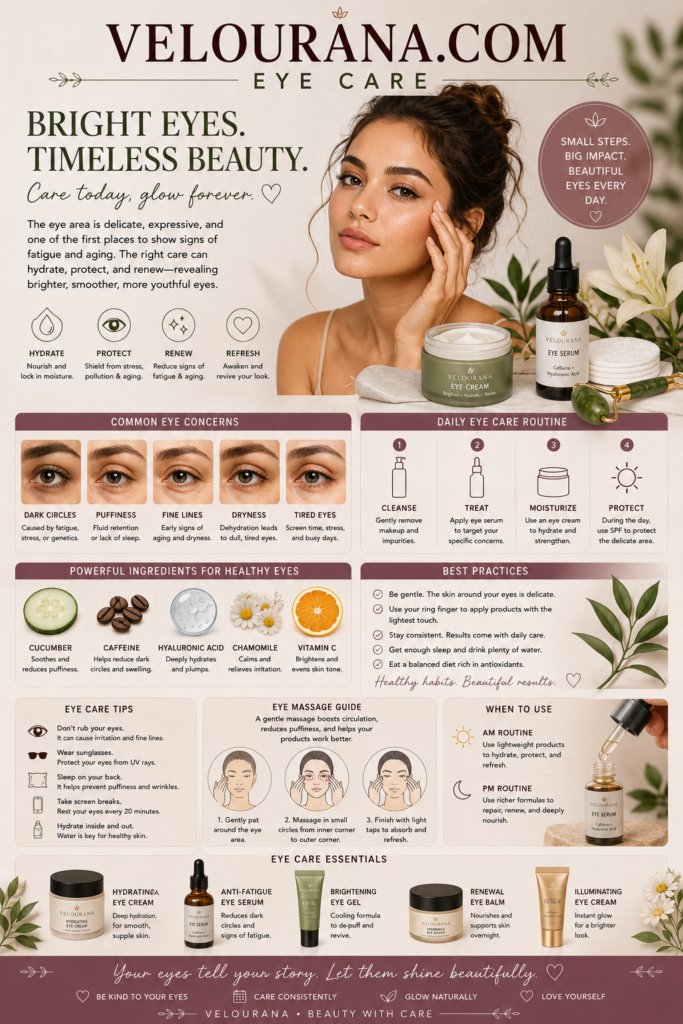
CATEGORY: Eye Massage
There is a particular intimacy to caring for the eye area. Unlike cleansing, which can be brisk and practical, or sunscreen application, which is fundamentally protective, eye massage asks for slowness. The fingertips move across only a small territory, pressure must remain controlled, and the person performing the massage inevitably becomes aware of tension that might otherwise pass unnoticed: a contracted brow, tight temples, a clenched jaw, or the lingering heaviness of a long day.
This is partly why eye massage has survived countless shifts in beauty culture. Tools change, products become more sophisticated, and new terminology appears, yet the underlying ritual remains remarkably simple. Human hands, a small amount of slip, and a few minutes of gentle contact can transform the experience of applying skincare.
Its appeal has expanded in an era defined by screens and visual concentration. The modern face spends hours responding to close-up displays, bright interfaces, small text, deadlines, and constant notifications. We squint without noticing. We hold expressions of concentration for longer than we realize. By evening, the upper face may feel as tired as the mind.
Eye massage cannot solve every cause of tired-looking eyes, and it should never be confused with treatment for an ocular or medical condition. Its beauty lies elsewhere. It is a cosmetic and sensory practice that can temporarily soften the appearance of ordinary puffiness, distribute skincare gently, and create a feeling of release around the brows and temples.
To understand why the ritual works best when it is subtle, it helps to stop thinking of the eye area as a flat patch of skin and begin thinking of it as a delicate three-dimensional landscape.
The Architecture Behind a Tired-Looking Eye Area
The appearance of the eyes is shaped by anatomy long before skincare enters the picture. Bone structure determines the depth and shape of the orbital region. Fat compartments contribute volume and contour. Muscles create movement. Skin thickness affects how underlying colors and structures are perceived. Genetics influence pigmentation, facial proportions, and tendencies toward under-eye fullness or hollowness.
This complexity explains why two people can both describe themselves as having “tired eyes” while displaying entirely different characteristics.
One may wake with temporary swelling beneath the eyes that decreases throughout the morning. Another may have naturally deep tear troughs that create shadows even after excellent sleep. Someone else may have brown pigmentation around the eyes, while another person's darkness appears blue or purple because vascular structures are more visible through thin skin. With age, changes in collagen, elasticity, fat distribution, and facial structure can introduce still more variation.
Massage affects only part of this picture.
Light physical contact may temporarily influence superficial fluid distribution and create a refreshed appearance when puffiness is transient. It may also make the surrounding tissues feel relaxed. What it cannot do is redesign the orbital skeleton, permanently remove hereditary pigmentation, replace lost volume, or eliminate structural under-eye bags.
This is not a disappointing limitation. It is simply the difference between skincare and anatomy.
Once that distinction is understood, massage becomes easier to evaluate on its genuine merits rather than on exaggerated before-and-after promises.
Morning Eyes Behave Differently From Evening Eyes
One of the most useful ways to think about eye massage is not as a single fixed technique but as a ritual that changes according to the time of day.
Morning eyes often present with fluid-related puffiness. Hours spent lying horizontally can influence the distribution of fluid in facial tissues, and the effect may be more obvious after certain meals, poor sleep, alcohol consumption, seasonal allergies, or simply an individual's natural physiology. As the body becomes upright and active, much of this appearance may gradually resolve on its own.
A morning massage therefore benefits from lightness and freshness rather than intensity. Cool skincare can feel especially pleasant at this time. The fingertips can move gently around the orbital contour, working across the upper cheek and toward the temples without pushing into the eyeball or stretching the lower eyelid.
Evening presents a different landscape. The concern may be less about visible swelling and more about tension. Hours of concentration can leave the forehead contracted and the temples uncomfortable. The brows may have spent much of the day subtly drawing together. In this context, slow stationary pressure along the brow bone and gentle circular movements at the temples may feel more appropriate than repeated under-eye strokes.
This difference is important because beauty rituals become more intelligent when they respond to the face rather than forcing the face through a predetermined routine.
There is no reason to perform every possible massage movement twice a day. The morning may call for a brief cooling ritual; the evening may call for stillness and release.
The Under-Eye Area Rewards Restraint
The lower eye is where enthusiasm most often becomes counterproductive. Because puffiness and dark circles are visible there, it is tempting to work harder, press more deeply, or repeatedly sweep the skin in the hope of producing a faster transformation.
The anatomy does not reward that approach.
The under-eye region has less of the substantial soft-tissue cushioning found in areas such as the cheeks. Repeated dragging can create unnecessary mechanical stress and irritation, particularly when the skin is dry or sensitized. A good massage should therefore appear almost understated.
Rather than pulling directly beneath the lash line, the fingertips can follow the orbital rim, where the bone provides a natural boundary. A thin layer of eye cream or moisturizer can reduce friction. The fingers then glide with minimal pressure, allowing the product and touch to move together.
Speed also matters. Rapid rubbing generates more friction and makes pressure harder to control. Slow movements give the hands time to register the contours of the face. They also make it easier to notice tenderness, dryness, or irritation before the skin is overworked.
The skin should not be dramatically displaced. If the lower eyelid is being pulled downward or sideways with each movement, the massage is too forceful.
This principle is worth emphasizing because many beauty techniques are marketed through visible action. A dramatic scraping motion photographs well. Deep pressure looks purposeful. Fast repetitive movements create the impression that something substantial is happening.
Eye massage is one of those rare beauty practices in which sophistication often looks like doing less.
Brows and Temples: The Overlooked Half of Eye Massage
Under-eye puffiness receives most of the attention, but the brows and temples can be the most satisfying parts of the ritual.
The brow region participates constantly in expression. Concentration, surprise, worry, bright light, and visual effort all change the position of the eyebrows and engage surrounding muscles. People who spend long periods working at screens may become particularly aware of tension between the brows or across the forehead.
Massage here can remain simple. Fingertips can rest along the brow bone and apply gentle, comfortable contact without pressing on the eye. Slowly moving from the inner brow toward the outer brow allows the massage to follow the natural architecture of the orbital rim.
The temples offer a broader surface and often tolerate gentle circular movements comfortably. This can create a sense of release that seems to extend beyond the immediate eye area. Because jaw tension and facial tension frequently coexist, relaxing the temples may also make a person notice how tightly they have been holding the rest of the face.
This is where eye massage becomes less about a cosmetic target and more about body awareness.
A person may begin the ritual because of puffiness but discover that its most valuable effect is recognizing habitual tension. The massage does not magically erase the causes of that tension, but awareness can interrupt the pattern. The brow can soften. The jaw can unclench. The shoulders can drop.
These are small changes, but they alter the experience of the ritual considerably.
The Question of Lymphatic Drainage
Few terms have become as closely associated with contemporary facial massage as “lymphatic drainage.” The phrase appears in tutorials, product descriptions, spa menus, and social media demonstrations, often applied broadly to almost any outward sweeping movement across the face.
The lymphatic system genuinely plays an important role in maintaining fluid balance and immune function. Specialized manual lymphatic drainage also exists as a therapeutic technique performed for particular indications. Everyday cosmetic facial massage, however, should not automatically be presented as equivalent to professional lymphatic therapy.
For the eye area, a more measured description is useful. Very light massage may help redistribute temporary superficial fluid and can make morning puffiness appear reduced in some people. The pressure required is gentle because superficial lymphatic structures do not call for deep muscular kneading.
The beauty industry sometimes creates the opposite impression, showing tools pressed firmly into the face in an effort to force fluid outward. More force does not necessarily create more effective drainage, and around the orbital area it can simply increase discomfort and mechanical stress.
This is another reason the fingertips are useful. They make subtle pressure easier to perceive. Rather than trying to “push out” puffiness, the massage can be imagined as encouraging light movement across the surface.
If swelling is persistent, pronounced, painful, sudden, or unexplained, it should not be assumed to be a lymphatic beauty issue. The appropriate response is to investigate the cause rather than intensify massage.
Cosmetic language is most useful when it knows where its authority ends.
Temperature Changes the Experience
Cooling has an almost immediate psychological association with refreshed eyes. A chilled spoon has been a home beauty trick for generations; modern routines have simply transformed the concept into cooling globes, metal applicators, refrigerated rollers, gel masks, and specialized eye tools.
There is a reason the sensation is appealing. Comfortable cooling can make warm or puffy skin feel calmer and may temporarily reduce the visible prominence of ordinary swelling. It can also make the massage feel more invigorating in the morning.
But temperature should remain moderate.
Direct ice is unnecessarily extreme for the delicate eye area. Very cold objects can become uncomfortable quickly, and prolonged direct exposure can injure skin. A cosmetic tool does not need to be frozen to provide a cooling sensation. Often ordinary refrigeration or naturally cool metal is more than sufficient, assuming the product or device is intended to be stored that way.
Warmth has a different role and requires different caution. Warm compresses may be recommended by eye-care professionals for certain eyelid conditions, but that belongs to ocular care rather than casual beauty experimentation. Anyone treating a specific eye condition should follow professional instructions about temperature, duration, and technique instead of substituting a cosmetic massage routine.
For ordinary skincare, temperature is best treated as an optional sensory enhancement. The massage itself should remain comfortable whether the tool is cool or at room temperature.
The ritual succeeds through consistency and gentleness, not through extremes.
Choosing Products That Allow the Hands to Move
The best massage technique can become uncomfortable when paired with the wrong texture. Dry fingers moving repeatedly across dry under-eye skin create friction, while an excessively rich product may migrate toward the eyes.
The ideal balance is a thin layer of slip.
A familiar eye cream can work well if it remains comfortable during movement. Gel-creams provide a lighter option, particularly in the morning or for people who dislike rich textures. A well-tolerated facial moisturizer can also be sufficient; there is no universal requirement that massage must involve a dedicated eye product.
Formula tolerance matters more than prestige. Fragrance, botanical extracts, strong actives, or other ingredients that irritate an individual's eye area are poor choices regardless of how luxurious the product feels elsewhere on the face.
The amount applied should also remain modest. Massage spreads products efficiently. Starting with too much can leave a thick film that migrates into the lashes or causes makeup to sit poorly afterward.
Eye massage should not become an excuse to force products into the skin. Skincare does not need to be aggressively “worked in” to function. The massage is primarily a method of gentle distribution and sensory care.
Even the most elegant cream benefits from clean hands. Fingers come close to the lashes, and reusable applicators repeatedly encounter both skin and product. Hygiene is therefore integral to the ritual rather than an optional finishing detail.
A clean, smooth surface and a compatible product allow the hands to concentrate on pressure instead of overcoming friction.
Tools Can Refine the Ritual but Cannot Rescue Poor Technique
Beauty tools can make eye massage feel ceremonial. A smooth stone placed beside skincare on a dressing table turns a two-minute routine into something visually intentional. A cool metal roller can provide an immediate refreshing sensation. An applicator built into an eye serum can make the process convenient enough to become habitual.
These are meaningful advantages because enjoyment influences consistency.
Yet no tool possesses an independent ability to determine safe pressure. That remains the user's responsibility.
A rigid tool pressed firmly beneath the eye can apply more concentrated force than a fingertip. Edges and narrow surfaces require particular caution. The tool should glide rather than scrape, and the skin should not be repeatedly stretched in pursuit of a lifted appearance.
The same principle applies to facial stones used in broader massage traditions. Their shape may fit beautifully around the brow or cheekbone, but the orbital area still demands a lighter approach than the jaw or fleshy portion of the cheek.
Rollers offer a different sensation because the moving head reduces direct dragging. They can be particularly pleasant when cool, although the mechanical effect should not be exaggerated. A roller does not permanently tighten skin or eliminate structural under-eye bags simply because it produces a temporary refreshed appearance.
Cleanliness becomes especially important with tools. Residual cream and skin oils can collect on surfaces, handles, and moving components. Proper cleaning preserves both hygiene and the smooth movement necessary for comfortable use.
The most sophisticated tool is ultimately the one that encourages better technique rather than more aggressive technique.
Dark Circles Need a More Nuanced Conversation
Eye massage is frequently marketed alongside promises of brighter under-eyes, but dark circles are not a single condition.
Pigmentation can create brown or gray-brown darkness, particularly in people genetically predisposed to greater pigment around the eyes. Vascular visibility can contribute blue, violet, or reddish tones. Thin skin can make underlying structures more apparent. Hollowness can cast shadows that change dramatically depending on lighting. Allergies may contribute to rubbing, swelling, and discoloration. Several of these factors can exist simultaneously.
Massage does not address all of them.
When temporary swelling contributes to shadowing, reducing that swelling may make the eye area look brighter. Hydrating products used during massage can also improve surface smoothness, changing the way light reflects from the skin. The relaxed appearance after a cooling massage may therefore be genuinely noticeable.
But this should not be confused with removing pigmentation or permanently changing facial contours.
For pigmentation-related darkness, sun protection and appropriately chosen skincare may be more relevant. For structural hollowness, topical products and massage have obvious limitations. For allergy-associated symptoms, addressing the underlying allergy is more logical than repeatedly manipulating irritated skin.
The distinction matters because unrealistic expectations often encourage increasingly aggressive routines. When a gentle massage fails to eliminate hereditary dark circles, someone may assume they need greater pressure or longer sessions.
They do not.
The technique has simply reached the boundary of what it can reasonably influence.
Aging Eyes and the Temptation to Pull Against Time
The eye area is one of the first places where many people notice visible signs of aging. Fine lines appear through expression and changes in skin structure. The upper eyelid may become more hooded. Under-eye contours can shift as facial tissues change. Skin may feel drier and less resilient than it did years earlier.
Massage can be pleasant throughout these changes, but it should not become a physical battle against them.
Mature skin often benefits particularly from adequate slip and controlled pressure. A nourishing moisturizer can make the massage more comfortable and temporarily soften the appearance of dehydration-related texture. Slow movements can also avoid unnecessary pulling of skin that has become thinner or more delicate.
What massage cannot do is mechanically iron wrinkles out of the face. Repeatedly stretching a line does not erase the biological processes that created it. Nor can massage permanently reposition significantly lax tissue.
This does not make the ritual irrelevant to mature skin. In fact, it may make the ritual more meaningful. Beauty care can evolve from an attempt to prevent every visible change into a practice that supports comfort, hydration, protection, and the best appearance of the skin as it exists now.
The eye area carries decades of expression. Smiling, concentrating, laughing, squinting, and reacting all leave their visual history. Massage can care for that skin without treating every sign of movement as damage.
This gentler philosophy is particularly appropriate around the eyes, where forceful correction has little place.
Knowing When Massage Is Not Beauty Care
Because eye massage is simple and non-invasive, it can seem harmless in every circumstance. It is not appropriate when the area is actively unwell.
Significant redness, infection, broken skin, painful swelling, discharge, recent injury, or unexplained tenderness should not be repeatedly massaged. Sudden visual changes, severe eye pain, or dramatic swelling are medical concerns rather than cosmetic ones.
People who have recently undergone procedures around the eyes or face also need individualized guidance. Surgery, injectables, lasers, chemical procedures, and other treatments can temporarily change what kinds of pressure or manipulation are appropriate. The clinician responsible for the procedure should determine when massage can safely resume.
Even ordinary skincare irritation deserves respect. If the eye area is burning after an active product, adding friction is unlikely to improve the situation. The priority should be removing the irritant when appropriate and allowing the skin barrier to settle.
Massage should also stop when it simply feels wrong. Pain is not evidence that the technique is working. Neither is prolonged redness.
A cosmetic ritual should leave the eye area feeling comfortable, not challenged.
The Most Effective Routine May Be the Shortest
There is a tendency in beauty culture to turn simple practices into increasingly complicated systems. Once eye massage becomes popular, one movement becomes five, five become fifteen, and soon a ritual that originally required two minutes seems to demand a specialized tool, a diagram, and a quarter of an hour.
Complexity is not inherently superior.
A short morning sequence performed with light pressure can be entirely sufficient for someone interested in temporary de-puffing. A few slow movements around the brows and temples may be all that is wanted after work. Another person may enjoy a longer ritual because the sensory experience itself is relaxing.
Duration should follow comfort rather than ambition.
The same applies to frequency. Daily massage is not compulsory. Some people enjoy it every morning; others use it only when the eye area feels puffy or when they want a moment of relaxation. Sensitive skin may prefer less frequent manipulation.
What matters is the quality of the contact. Clean hands, suitable slip, light pressure, attention to the orbital boundary, and realistic expectations provide the foundation. Everything else is optional refinement.
This simplicity also makes eye massage unusually accessible. It does not depend on expensive technology or a cabinet full of products. A familiar moisturizer and clean fingertips can provide the essential experience.
In an industry frequently driven by acquisition, there is something appealing about a technique whose most important ingredient cannot be purchased: restraint.
Eye Massage as a Moment of Attention
The strongest argument for eye massage may ultimately have little to do with dramatic cosmetic transformation.
The ritual requires someone to stop. Screens are put aside. The eyes may close. Fingers move slowly across an area that has spent the entire day blinking, focusing, squinting, and expressing. For a short period, skincare becomes tactile rather than visual.
That experience has value even when the visible result is modest.
A cool morning massage may make temporary puffiness appear softer. An evening brow massage may make facial tension feel less pronounced. A moisturizer may spread more comfortably. The eye area may look fresher because the skin is hydrated and the face itself is more relaxed.
None of these outcomes requires claims of permanent lifting, detoxification, wrinkle removal, or structural transformation.
In fact, removing those promises makes the practice more elegant. Eye massage no longer needs to prove that it can reverse anatomy. It can simply occupy its appropriate place within beauty care: a gentle technique that complements skincare, encourages controlled touch, and makes an often-scrutinized part of the face feel cared for.
The eyes will continue to show expression, fatigue, age, genetics, and the architecture of the individual face. Massage does not need to erase those things to be worthwhile.
It only needs to respect them.
THE END VELOURANA
 Discover More From Our Family of Websites
 ZodiacBearing (Astrology, Tarot, Numerology, Angel Numbers & Spiritual Guidance)
 Velourana (Beauty, Makeup, Hair Care, Skincare & Beauty Tips)
 HavenBearing (Home, Living, Organization, Décor & Everyday Inspiration)
 PawBearing (Pet Care, Dog Breeds, Animal Health, Training & Pet Products)
 PsyCatherine (Notes From the Journal of a Psychologist on Real Life)

