
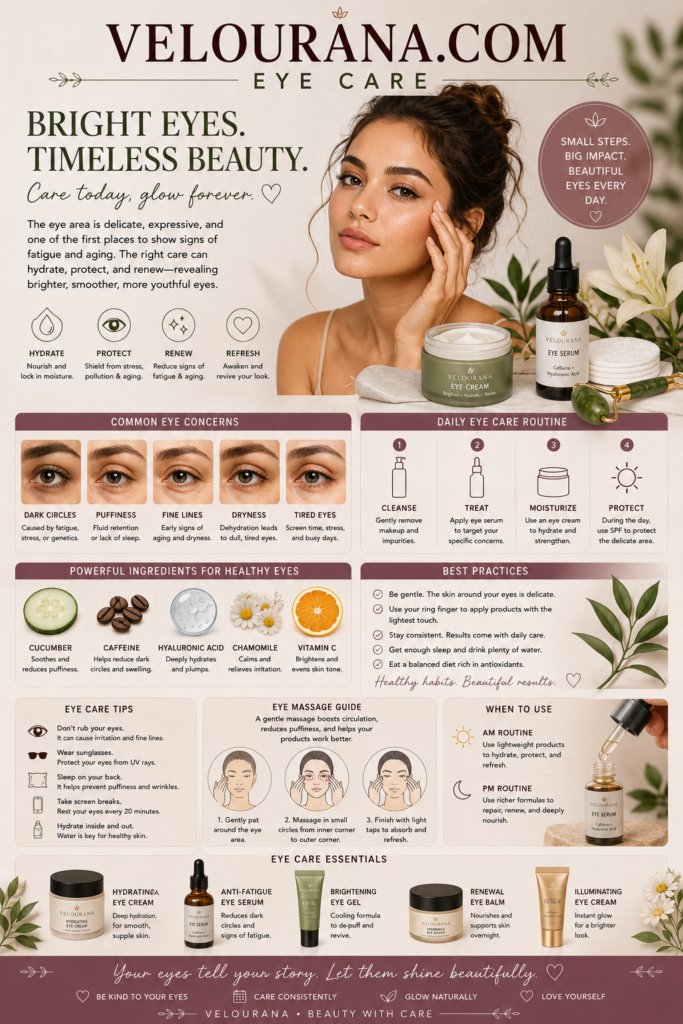
CATEGORY: Eye Creams
The skin around the eyes occupies remarkably little space, yet it attracts an extraordinary amount of attention in skincare. A hint of dryness can make the area appear textured, a short night can leave it looking shadowed or swollen, and expressions repeated thousands of times eventually become visible as fine lines. Because the eyes are central to facial expression, relatively subtle changes around them can influence how rested, bright, or refreshed the entire face appears.
Eye creams developed around this particular combination of visibility and vulnerability. They are often described simply as moisturizers made for the eye area, but that description is incomplete. A well-designed eye cream has to negotiate several competing demands. It needs enough emollience to soften delicate skin without feeling excessively heavy, enough hydration to improve suppleness without encouraging an uncomfortable coated sensation, and active ingredients at concentrations that the surrounding skin can reasonably tolerate. It must also behave well beneath sunscreen and makeup, remain comfortable near the eyes, and deliver benefits without relying on unrealistic promises.
Understanding eye creams therefore begins not with marketing claims but with the biology and behavior of the skin they are intended to support. Once that foundation is clear, it becomes much easier to judge what an eye cream can accomplish, what ingredients may be useful, and when a separate eye product genuinely earns its place in a skincare routine.
Why the Eye Area Behaves Differently
The skin surrounding the eyes shares the same fundamental architecture as skin elsewhere on the face, but its characteristics make changes particularly noticeable. It is comparatively thin, contains fewer sebaceous glands than oilier facial regions, and is constantly involved in movement. Blinking alone occurs thousands of times every day, while smiling, squinting, concentrating, and other expressions repeatedly fold and stretch the surrounding tissue.
This combination helps explain why dehydration and fine surface lines can become obvious around the eyes even when the rest of the complexion feels comfortable. When the outermost layers of skin lose water, the surface becomes less smooth and flexible. Tiny lines can look sharper, particularly when concealer or foundation settles into them. Restoring hydration does not erase structural wrinkles, but it can temporarily soften their appearance by improving the way the surface reflects light and moves.
The eye contour is also influenced by structures beneath the skin. Blood vessels, pigmentation, facial anatomy, fat distribution, fluid accumulation, and natural hollows can all affect its appearance. This is especially important when considering dark circles and puffiness. A cream applied to the surface cannot fundamentally alter every anatomical cause of either concern.
Darkness, for example, may arise from increased pigmentation, visible underlying vessels, shadows created by tear troughs, or a mixture of these factors. Puffiness may reflect temporary fluid accumulation, allergies, sleep patterns, irritation, or changes in the tissues around the eyes. Recognizing these distinctions prevents an eye cream from being judged against problems that topical skincare cannot reasonably solve.
The area is also more vulnerable to irritation. Products applied too close to the eyes can migrate, particularly as facial warmth softens creams and natural movement distributes them. A formula that is perfectly comfortable on the cheeks may sting when it reaches the eye itself. For this reason, eye care is not simply about selecting powerful ingredients. Formulation elegance, concentration, placement, and tolerance matter just as much.
The Architecture of a Good Eye Cream
Most effective eye creams are built around the same basic principles that govern good moisturizers: humectants attract or help retain water, emollients soften the skin, and occlusive ingredients reduce excessive water loss. The distinction lies in how these components are balanced and how additional ingredients are incorporated.
Humectants are particularly valuable around the eyes because dehydration can exaggerate surface texture. Glycerin, hyaluronic acid, sodium hyaluronate, panthenol, urea at appropriate concentrations, and various glycols can contribute to a more hydrated environment within the outer layers of the skin. Hyaluronic acid has become especially prominent in eye-care marketing, although it should not be interpreted as a permanent filler when used topically. Its principal cosmetic role is hydration. By helping the skin hold water, it can create a smoother and somewhat plumper surface appearance.
Emollients provide a different kind of benefit. Ingredients such as squalane, certain plant-derived oils, fatty alcohols, esters, and silicones help fill microscopic irregularities between surface cells and make the skin feel softer. Silicones can be particularly useful in eye creams because they provide slip and create a smooth finish without necessarily producing the weight associated with richer oils and waxes. This can improve the way makeup sits over the area.
Occlusive components help slow transepidermal water loss. Petrolatum is exceptionally effective in this role, although not every eye cream needs to be highly occlusive. Some people enjoy rich balms around the eyes, especially when dryness is significant, while others find lighter emulsions more comfortable. The ideal texture depends partly on the skin and partly on the rest of the routine.
Barrier-supportive ingredients add another dimension. Ceramides, cholesterol, fatty acids, niacinamide, and soothing agents can help support a healthy skin barrier. This matters because a compromised barrier loses water more readily and becomes more reactive to environmental and cosmetic stressors. Eye creams that focus on barrier quality rather than dramatic transformation can therefore be among the most practically useful formulas.
Texture is not merely a sensory consideration. An eye cream that is excessively rich may interfere with makeup or migrate toward the eye, while one that dries too quickly can create friction during application. The best formula is one that allows a small quantity to spread comfortably and settle into the skin without requiring repeated rubbing.
Active Ingredients and the Difference Between Hydration and Treatment
Eye creams occupy an unusual position between moisturizers and treatment products. Some formulas are designed primarily to hydrate, while others include ingredients intended to address visible signs associated with aging, uneven tone, or temporary puffiness. The distinction is important because expectations should correspond to the formula.
Retinoids are among the most established topical ingredients for improving visible signs of photoaging. Retinol and related cosmetic retinoids can support processes associated with smoother-looking skin and improved appearance of fine lines over time. Around the eyes, however, tolerance becomes especially important. A concentration that works comfortably elsewhere on the face may produce dryness or irritation when used close to the eyes.
This is one reason dedicated retinol eye products can make sense. Rather than assuming the eye area requires an entirely different molecule, manufacturers can formulate retinoids in textures and concentrations intended for gradual use in this more sensitive region. Even then, more is not better. Persistent irritation can leave the eye area looking drier and more textured, undermining the reason the product was introduced.
Peptides are another popular category. They are short chains of amino acids and appear in many formulations marketed for firmness or wrinkle care. The term "peptide" covers numerous compounds, so products containing peptides should not automatically be treated as equivalent. Their usefulness depends on the specific ingredient, formulation, stability, and supporting evidence. They can be appealing additions to a well-constructed eye cream, but their presence does not replace the importance of hydration and sun protection.
Niacinamide offers a broader set of cosmetic advantages. It can support barrier function and may contribute to a more even-looking complexion. In an eye cream intended for dryness and uneven tone, it can therefore serve several purposes at once. Vitamin C derivatives and other antioxidant ingredients may also be incorporated into formulas intended to brighten the appearance of the eye contour, although stability and tolerability vary considerably among formulations.
Caffeine has become strongly associated with eye products designed for tired-looking or puffy eyes. Applied topically, it may temporarily improve the appearance of some forms of puffiness or darkness, but it should not be expected to remodel anatomical under-eye bags or eliminate genetically determined dark circles. Its most convincing role is as a supportive cosmetic ingredient rather than a permanent structural solution.
Soothing ingredients can be just as valuable as headline actives. Panthenol, allantoin, beta-glucan, colloidal oatmeal components, centella-derived compounds, and similar ingredients may help formulas feel more comfortable on easily irritated skin. An eye cream does not need to create tingling or other sensations to demonstrate activity. In fact, repeated stinging is usually a reason to reconsider the product rather than evidence that it is working.
Eye Creams for Fine Lines, Dryness and a Changing Eye Contour
Fine lines around the eyes do not all have the same origin. Some become more noticeable because the skin is temporarily dehydrated. Others are expression lines created by repeated muscular movement, while deeper wrinkles develop through longer-term changes involving collagen, elastin, sun exposure, and intrinsic aging.
Hydrating eye creams are most immediately effective against the first category. When the stratum corneum contains adequate water and the surface is softened by emollients, tiny dehydration lines often appear less pronounced. The effect can be cosmetically meaningful, particularly beneath makeup, but it is not equivalent to reversing a wrinkle.
Longer-term treatment requires a different perspective. Retinoids, consistent broad-spectrum sun protection, and an overall routine that supports the skin barrier are more relevant to visible photoaging than repeated switching between fashionable eye products. Even excellent skincare works gradually. Changes in established fine lines should be assessed over months rather than days.
Sun protection deserves particular emphasis because ultraviolet exposure contributes substantially to premature skin aging. An expensive night eye cream cannot compensate for repeated unprotected exposure during the day. Sunscreen that is comfortable around the eyes, along with sunglasses and sensible physical protection, forms part of meaningful eye-area skincare even though it may not carry the label "eye cream."
Dryness often requires a simpler approach. A fragrance-free formula rich in humectants and emollients may accomplish more than a complex treatment containing numerous potentially irritating actives. The temptation to treat every visible line as an aging problem can lead to overuse of exfoliating acids or retinoids, creating a cycle in which irritation increases dryness and dryness makes lines look more prominent.
Mature skin may benefit from richer textures because sebum production and barrier characteristics can change with age. Yet age alone does not determine texture preference. Some mature complexions remain comfortable with lightweight formulas, while younger skin can be naturally dry. The condition of the skin is a better guide than the age printed on a marketing campaign.
The Complicated Reality of Dark Circles and Puffiness
Few eye concerns generate more ambitious claims than dark circles. The phrase itself describes an appearance rather than a single condition. Two people can have equally visible under-eye darkness for completely different reasons, which means the same eye cream may perform very differently for each.
Pigmented dark circles involve excess melanin or uneven pigmentation. Ingredients that support a more even-looking skin tone may gradually help some cases, particularly when sun protection is consistent. Darkness caused by visible vascular structures beneath thin skin is different. A topical cream may improve hydration and surface quality, but it cannot simply conceal underlying anatomy from within.
Shadowing presents another challenge. A pronounced tear trough creates a contour that catches light unevenly, producing darkness even when the skin itself is not especially pigmented. No moisturizer can physically remove that hollow. Hydration may make the surface look healthier, but expectations need to remain tied to what topical skincare can reach.
Puffiness is similarly diverse. Temporary morning swelling can be influenced by fluid distribution and may improve as the day progresses. Cooling products, caffeine-containing formulas, and gentle application can make the area appear more refreshed. Persistent bags associated with structural changes in orbital fat and supporting tissues are much less responsive to cosmetics.
This does not make eye creams useless. It makes accurate diagnosis of the visible concern more important. A hydrating, light-reflecting eye cream can noticeably improve the cosmetic appearance of a shadowed or tired eye area even without changing the underlying anatomy. The distinction between improving appearance and permanently correcting structure is essential to responsible skincare expectations.
Lifestyle and health factors can also affect the eye contour. Allergies may contribute to swelling or rubbing, while inadequate sleep can alter how rested the face appears. Persistent or sudden swelling, pain, significant redness, visual changes, or unusual symptoms should not be treated as cosmetic problems. Skincare has boundaries, and eye health belongs within medical care when symptoms suggest more than ordinary cosmetic variation.
Does Everyone Need a Separate Eye Cream?
One of the most persistent debates in skincare is whether eye cream is necessary at all. The most accurate answer is that it depends on the person, the facial moisturizer, and the desired treatment.
A gentle facial moisturizer can often be used around the orbital area if its formulation is comfortable there and the manufacturer does not advise otherwise. Skin does not suddenly become biologically unrelated at an invisible boundary beneath the eye. For someone with a simple routine and no particular eye-area concerns, a separate cream may add little.
There are nevertheless good reasons to choose one. A facial moisturizer may be too rich beneath concealer, too fragranced for sensitive eyes, or formulated with actives that are uncomfortable in the eye contour. A dedicated eye cream can provide a lighter texture in the morning and a richer treatment at night. It can also make controlled use of ingredients such as retinol easier.
Personal behavior matters as well. Some people instinctively apply facial products very close to the eyes and tolerate them perfectly. Others experience watering or stinging from products that cause no problems elsewhere. For the latter group, a carefully selected eye formula can make the routine substantially more comfortable.
The question therefore should not be whether eye cream is universally essential. It should be whether a particular formula performs a useful function that the rest of the routine does not already provide. Skincare becomes more rational when products have identifiable jobs rather than being included because a category exists.
Application Matters More Than Excess
The eye contour does not require a large amount of product. Using more cream does not force more benefit into the skin and may increase the chance of migration, pilling, makeup disruption, or irritation.
A small quantity can be distributed gently around the orbital area without aggressive rubbing. Many products are best kept away from the immediate lash line unless their instructions specifically indicate otherwise. Facial movement and warmth naturally allow products to spread slightly after application, so placing a cream extremely close to the eye is rarely necessary.
The popular instruction to use only the ring finger is not an absolute dermatological requirement, although it can encourage a lighter touch. What matters is avoiding unnecessary pulling and repeated friction. Gentle spreading or light tapping can work well, provided the skin is not dragged.
Layering also affects performance. In a morning routine, eye cream usually needs to coexist with sunscreen and perhaps makeup. Allowing it to settle before applying subsequent products can reduce pilling. Very rich formulas may be better reserved for evening if they cause concealer to slide or crease.
At night, the eye cream can be positioned according to the broader routine. When retinoids or exfoliating treatments are involved, care should be taken to avoid accidentally layering multiple irritating products around the same sensitive area. A simple moisturizer can sometimes be used as a buffer when appropriate, but the instructions for the specific treatment should guide use.
Consistency is far more important than quantity. Hydration benefits can appear quickly, while changes associated with treatment ingredients require repeated use. Constantly replacing products after a few days makes it difficult to determine whether any formula is actually effective.
Choosing an Eye Cream Without Being Distracted by Marketing
Eye-care packaging frequently relies on words such as lifting, illuminating, revitalizing, age-defying, depuffing, smoothing, and correcting. These descriptions can be useful clues, but they should not substitute for understanding what the formula contains and what the concern actually is.
For predominantly dry under-eyes, the most useful formula may be one built around glycerin, hyaluronic acid, ceramides, emollients, and barrier-supportive ingredients. For early fine lines and photoaging concerns, a carefully formulated retinoid eye treatment may be worth considering if the skin tolerates it. For temporary puffiness, lightweight caffeine-containing products or cooling textures may offer cosmetic improvement. Uneven-looking tone may call for ingredients such as niacinamide or appropriate antioxidant and brightening compounds alongside rigorous sun protection.
Sensitive eyes often benefit from restraint. Fragrance, essential oils, high concentrations of acids, and multiple aggressive actives can complicate tolerance. "Natural" does not automatically mean gentle around the eyes, just as synthetic does not automatically mean irritating. Safety and comfort depend on the specific ingredient and formulation rather than the philosophical category assigned to it.
Packaging can influence formula stability. Ingredients that are sensitive to air or light may benefit from opaque, air-restrictive containers. Jars are not automatically ineffective, but repeatedly opening a jar exposes the contents to air and requires hygienic handling. Packaging should ultimately be judged in relation to the formula it protects.
Price is an equally unreliable predictor of performance. Luxury eye creams may offer exceptionally elegant textures, sophisticated packaging, or distinctive sensory qualities, but cost alone does not establish superior biological effectiveness. A modestly priced formula with appropriate ingredients can provide excellent hydration and barrier support.
The best eye cream is therefore not necessarily the most complex or expensive one. It is the product that addresses a realistic concern, remains comfortable with consistent use, fits into the surrounding routine, and produces benefits that justify its place.
A More Realistic Standard for Eye Care
The eye area changes throughout life because it is living tissue shaped by genetics, expression, environment, anatomy, and time. Skincare can influence some of those visible changes, but it cannot freeze the face or remove every sign of movement.
This is precisely why realistic eye care can be more satisfying than chasing dramatic claims. Hydrated skin generally looks smoother. A healthy barrier improves comfort. Appropriate retinoids can contribute to gradual improvement in visible photoaging. Brightening ingredients may help some forms of uneven tone. Caffeine and cooling textures may make temporary puffiness less conspicuous. Sunscreen helps protect against further ultraviolet damage.
Those are meaningful outcomes, even though they are less spectacular than the language sometimes used to sell eye products.
A thoughtful eye cream should complement the biology of the area rather than fight it. Fine expression lines are part of facial movement. Natural shadows are partly determined by facial structure. The goal of good skincare is not necessarily to erase these characteristics but to keep the skin comfortable, resilient, hydrated, and protected while addressing concerns that topical products can genuinely influence.
When eye creams are approached in this way, the category becomes easier to navigate. Instead of searching for a single miraculous jar, it becomes possible to select formulas according to function: hydration where there is dryness, barrier support where there is sensitivity, targeted treatment where there is a suitable concern, and protection every day.
That quieter approach may lack the drama of instant-transformation promises, but it is far closer to how effective skincare actually works.
THE END VELOURANA
 Discover More From Our Family of Websites
 ZodiacBearing (Astrology, Tarot, Numerology, Angel Numbers & Spiritual Guidance)
 Velourana (Beauty, Makeup, Hair Care, Skincare & Beauty Tips)
 HavenBearing (Home, Living, Organization, Décor & Everyday Inspiration)
 PawBearing (Pet Care, Dog Breeds, Animal Health, Training & Pet Products)
 PsyCatherine (Notes From the Journal of a Psychologist on Real Life)

