CATEGORY: Everyday Hairstyles
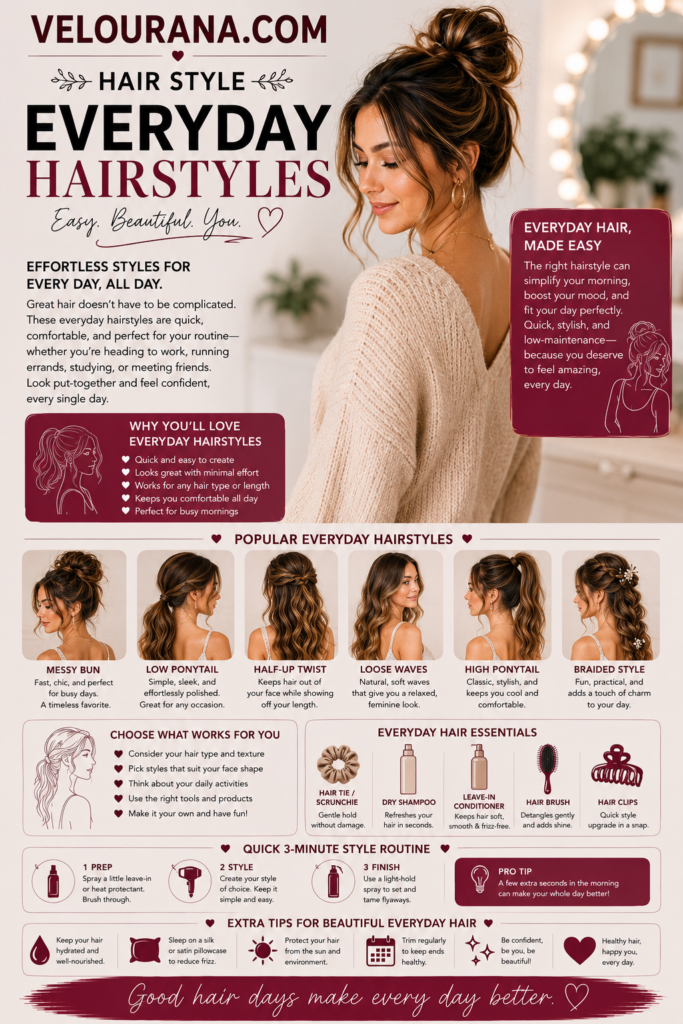
Everyday hair lives in a different world from occasion styling. It has to work when there is no stylist standing nearby, no uninterrupted hour in front of the mirror and no reason to build a hairstyle that survives a formal event. It has to fit into ordinary life: getting ready for work, taking children to school, meeting friends, shopping, commuting, exercising, working from home or simply wanting to look put together without turning hair into the main project of the morning.
That does not make everyday hairstyles unimportant. In many ways, they matter more because they are the styles worn repeatedly. A five-minute ponytail used three times a week has a greater influence on someone's relationship with their hair than an elaborate updo worn once a year.
The best everyday hairstyle therefore balances appearance with reality.
It should suit the hair's length, density and natural texture. It should feel comfortable. It should be achievable within the time normally available. It should not depend on constant correction. Ideally, it should also have enough flexibility to look good when the day does not go exactly as planned.
Everyday styling becomes much easier when the goal changes from creating perfect hair to creating intentional hair.
A slight bend does not need to be corrected if it works with the finished shape. Natural texture does not need to be eliminated before the hair can look polished. A ponytail does not need to be elaborate to look deliberate. A bun does not need dozens of pins to feel sophisticated.
Small decisions create the difference.
The placement of a part, the direction of the front pieces, the height of a ponytail, the shape of the ends and the amount of volume at the crown can turn an extremely simple hairstyle into one that looks considered.
That is the foundation of useful everyday hair: less unnecessary work, more purposeful styling.
Everyday Hair Should Begin With the Life It Has to Fit
A hairstyle can be beautiful and still be a poor everyday choice if it requires more time, maintenance or attention than the wearer can realistically give it.
Someone with ten minutes in the morning needs a different styling strategy from someone who enjoys spending forty minutes on hair. A person commuting in humid weather faces different challenges from someone working indoors. Someone who exercises after work may want a style that can transition easily into a ponytail or bun.
The haircut also influences what is realistic.
Long layers may naturally create movement with very little styling. A blunt bob may look polished after only the ends are directed. Curly hair may need definition in selected areas rather than complete manipulation. Coily hair may work beautifully in a twist, puff, bun or protective style that respects its natural volume.
The most useful routine starts by identifying what the hair already does well.
If the roots naturally have volume, there may be no reason to flatten them and then recreate lift. If the lengths already form attractive waves, straightening them before adding waves again creates unnecessary work. If second-day hair naturally holds a bun well, that can become part of the weekly styling rhythm.
Everyday hair becomes efficient when styling supports the existing characteristics instead of repeatedly erasing them.
The Five-Minute Hairstyle Can Still Look Deliberate
Speed does not automatically produce a careless result.
A simple hairstyle looks intentional when its main visual decisions are clear.
A low ponytail with a clean part has a different character from a high ponytail with crown volume. A bun positioned at the nape looks different from one placed high on the head. Loose hair with the front directed away from the face appears more finished than hair that has simply been left wherever it dried.
These changes can require very little additional time.
The front is particularly influential because it is the area seen most often in the mirror and during conversation. If the part, fringe and face-framing sections look deliberate, the rest of the hairstyle can remain relatively simple.
The ends provide another finishing point.
They can remain natural, curve inward, move outward or form part of a loose wave pattern. The objective is not to make every end identical. It is to prevent the perimeter from looking accidental when a more polished appearance is wanted.
A quick hairstyle should therefore focus effort where it creates the greatest visual difference.
That usually means the front, crown and overall silhouette rather than perfecting every individual strand.
Loose Hair Becomes an Everyday Style Through Shape
Wearing the hair down may appear to require no hairstyle at all, but small adjustments can transform loose hair considerably.
The part establishes the first line.
A center part creates symmetry and can feel modern and clean. A side part introduces asymmetry and often creates more apparent volume on one side. A slightly off-center part offers a softer compromise.
The crown determines whether the hair looks lifted or flat.
The front determines whether the style opens the face or falls forward.
The ends complete the shape.
Someone with naturally straight hair may need little more than brushing, selective smoothing and deliberate end direction. Naturally wavy hair may look best when the wave is encouraged rather than corrected. Curly hair can be refreshed selectively where definition has changed overnight. Coily hair can be shaped to emphasize volume and silhouette without requiring the texture to become something else.
Loose everyday hair does not have to resemble a salon blowout.
It simply needs enough coherence that the natural movement appears chosen.
The Everyday Ponytail Is More Versatile Than It Appears
Few hairstyles are as practical as the ponytail, but placement changes it dramatically.
A low ponytail can look restrained, professional and elegant. With a center or side part, it can work easily for an office, lunch or ordinary errands.
A mid-height ponytail feels more energetic while remaining practical.
A high ponytail creates greater lift and movement and can make the hairstyle feel sportier or more youthful depending on the finish.
Texture changes the impression again.
A sleek base creates polish.
A softer crown makes the style more relaxed.
Straight lengths create a clean line.
Waves or curls add movement.
Natural coils can create a full, expressive ponytail or puff.
The fastening area can remain simple for everyday wear. When a slightly more finished look is wanted, a small section of hair can conceal the elastic or an attractive hair accessory can become part of the style.
Comfort should influence placement.
A ponytail worn for many hours should not create unnecessary pulling. Extremely tight repeated styling in the same position may also be undesirable for the hairline and the same strands over time.
Variation is useful.
A low ponytail one day, loose hair another and a bun later can change both the appearance and the points of tension.
The Everyday Bun Can Move From Practical to Polished
A bun is often chosen because the hair needs to be out of the way, but practicality does not prevent it from looking refined.
A low bun can be extremely simple.
The hair can be gathered at the nape and secured into a compact shape. A clean part creates a polished impression, while a softer crown makes the style more relaxed.
A higher bun creates a different silhouette and keeps the hair completely away from the neck. This can be useful during warm weather, exercise or busy days.
A loose bun can work particularly well with second- or third-day hair because the existing texture provides grip and dimension.
The front can determine whether the bun feels casual or deliberate.
Leaving every short piece loose may create a very relaxed appearance. Directing the front sections and choosing only a little softness around the face can make the same basic bun feel significantly more finished.
The bun should remain comfortable.
Everyday hair should not require the tension or extensive pinning sometimes used for formal styling. If the hairstyle becomes painful after an hour, it is unlikely to remain a useful daily option.
A practical bun should be secure enough for normal movement and simple enough to recreate without frustration.
Half-Up Hair Solves the Problem of Wanting Hair Down but Out of the Face
Half-up hairstyles are particularly useful on days when the wearer wants to preserve the appearance of loose hair while gaining more control around the face.
The upper sections can be gathered simply at the back.
They can be twisted before securing.
A small claw clip can create an easy shape.
A half-up ponytail can introduce more lift.
The crown can remain smooth or slightly elevated.
This style works across many textures because the lower hair remains largely unchanged.
Straight hair retains its clean movement.
Wavy hair keeps its natural bends.
Curls remain visible.
Coily hair can create a beautiful contrast between the secured upper section and the volume below.
The proportion should suit density.
Fine hair may look fuller when only a smaller amount is taken upward. Dense hair can use a larger upper section to reduce bulk around the sides.
Half-up hair is also an effective transition style when loose hair has changed during the day. If the front has become less controlled while the lower lengths still look good, securing only the upper area can refresh the entire appearance without starting again.
Claw Clips Have Become Everyday Staples for a Reason
A claw clip can gather long or medium hair quickly while creating less visual severity than some tightly secured styles.
The hair can be twisted upward and clipped vertically, leaving the ends free or tucked according to length. A lower twist can create a softer shape. A half-up clip can control only the sides and crown.
The simplicity is part of the appeal.
The style can be adjusted easily during the day. It can be removed without dismantling a complicated arrangement, and it can work with hair that is straight, wavy, curly or textured.
The size of the clip should correspond to the amount of hair it needs to hold.
Very dense or long hair may require a larger or stronger design. Fine hair may need a smaller clip that closes securely rather than sliding.
The hairstyle should feel stable without depending on excessive twisting or pulling.
A claw clip also makes it easy to preserve some natural texture because the lengths do not need to be brushed into complete uniformity first.
The twist itself creates the shape.
That makes it one of the most useful tools for days when the hair needs to look organized quickly.
Braids Can Make Ordinary Hair More Manageable
Braids are valuable everyday styles because they organize the lengths while still allowing texture and personality to remain visible.
A simple three-strand braid can keep long hair controlled.
A low side braid changes the silhouette without requiring complex technique.
Two braids can be practical for active days.
A small braid can be added to loose or half-up hair simply as detail.
Natural texture can make braids look especially dimensional, and protective braided styles can serve a different long-term role depending on the hair and technique used.
For everyday purposes, the braid does not need to be perfect.
A slightly softer shape can look intentional, particularly when the rest of the hairstyle has a relaxed finish.
The front should still be considered.
A braid combined with a deliberate part and controlled face framing looks more polished than one created without attention to the upper hair.
The ends also need appropriate security so that the braid remains intact through normal movement.
Braids can be especially useful on windy days, during travel or whenever loose long hair would become inconvenient.
They transform the length into structure without eliminating its visual presence.
Second-Day Hair Should Be Restyled Selectively
One of the easiest ways to make everyday hairstyling unnecessarily time-consuming is to treat every morning as a complete reset.
Hair rarely changes uniformly overnight.
The front may become bent.
The crown may flatten.
One side may develop more texture.
The ends may still look completely acceptable.
Instead of recreating the entire previous style, the changed areas can be identified and addressed.
If only the front needs attention, the front can be refreshed.
If the lower lengths still have attractive waves, they can remain untouched.
If the crown has lost volume, changing the part or creating a half-up style may solve the problem.
If loose hair no longer looks cohesive, a ponytail, braid, bun or claw-clip twist can use the existing texture rather than fighting it.
This approach creates a natural progression through the days between washes.
Freshly washed hair may be worn loose.
The next day it may become half-up.
Later it can move into a ponytail or bun.
The styling evolves with the hair.
This is often faster and more realistic than trying to make every day look like wash day.
Fine Hair Benefits From Air and Movement
Fine hair can look polished very quickly, but it can also lose volume quickly when styling becomes too heavy.
Everyday styles should preserve as much natural movement as possible.
Loose hair can benefit from deliberate root direction and a little movement through the ends. A half-up style should avoid taking so much hair upward that the lower section becomes visually sparse. Ponytails can be positioned to create lift without requiring excessive tension.
Buns may appear smaller on fine hair, but that does not make them less elegant.
A compact low knot can look sophisticated precisely because it is simple. Texture can make the shape appear fuller when desired.
Product accumulation can influence fine hair strongly. A routine that adds multiple layers every day may eventually reduce movement and volume.
The goal should be enough support for the hairstyle without making the hair feel coated.
Everyday styling is an excellent place for restraint because the hair needs to remain manageable across repeated days rather than look maximally finished for one event.
Dense Hair Benefits From Controlling Volume Rather Than Removing It
Dense hair offers natural fullness, but everyday styling can become time-consuming if every strand is expected to be perfectly aligned.
A more efficient approach is to shape the volume.
Loose hair can remain full while the front is controlled.
A half-up style can remove some bulk from the sides.
A ponytail can gather the density while preserving movement through the length.
A bun can keep everything contained on days when loose hair feels impractical.
The size and strength of accessories matter because small clips or elastics may not comfortably support a large amount of hair.
Sectioning can also simplify quick styles.
Instead of trying to gather everything at once, upper and lower sections can be controlled before being combined.
Dense hair does not need to be made visually smaller to look polished.
Its abundance can be one of the defining qualities of the hairstyle.
The objective is organization.
When the silhouette is clear, natural fullness looks intentional.
Wavy Hair Can Save Time When Its Texture Is Allowed to Lead
Naturally wavy hair can be extremely adaptable for everyday styling because it already contains movement.
The fastest routine is often the one that stops trying to make every wave identical.
Some sections may be stronger.
Others may be almost straight.
The front can be refined, obvious irregularities can be corrected and the overall shape can be encouraged without reconstructing the entire pattern.
A half-up style works beautifully because it controls the crown while preserving waves below.
A loose ponytail can turn natural texture into movement.
A bun benefits from the grip and dimension of wavy lengths.
A braid can emphasize the texture.
On days when the wave pattern becomes less defined, the hair does not necessarily need to be washed or completely heat-styled again.
Changing the hairstyle can be more efficient than recreating the texture.
Everyday hair becomes easier when variation is accepted as part of its character.
Curly Hair Can Be Refreshed Without Rebuilding Every Curl
Curly hair often looks different from one day to the next, but that does not mean every curl needs individual correction.
The overall silhouette is more important.
If most of the shape remains attractive, attention can be directed toward areas that have flattened, stretched or become less defined.
The front may need a small refresh.
The crown may need reshaping.
One side may need more volume.
The rest can remain.
Curly hair also offers many everyday options beyond wearing the full length loose.
A high ponytail or puff can showcase the texture while keeping it controlled.
A half-up style can open the face.
A loose bun can gather the hair while preserving visible curls around the perimeter.
Braids or twists can introduce another styling direction.
The objective should not be to make natural curls behave like straight hair before they qualify as polished.
The curl pattern itself can be the finished texture.
Everyday styling simply organizes it into a shape that suits the day.
Coily Hair Can Make Volume Part of the Everyday Silhouette
Coily hair can create strong everyday hairstyles through shape alone.
A rounded loose silhouette can be deliberate and expressive.
A puff can gather the hair while keeping natural volume visible.
A high or low bun can create a clean outline.
Twists and braids can provide both styling variety and, when appropriately executed for the hair, protective options.
Half-up arrangements can combine control with fullness.
The edges and front can be styled according to personal preference rather than one universal standard of what polished hair should look like.
This matters because everyday beauty should not require natural texture to disappear.
The hairstyle can be neat without being flattened.
It can be formal enough for work without becoming straight.
It can be practical without sacrificing volume.
The strongest everyday routine is one that makes the natural characteristics of the hair useful.
Short Hair Needs Direction More Than Complexity
Short hairstyles demonstrate how much impact small changes can have.
There may not be enough length for a ponytail or bun, but the part, fringe, crown and ends can create several distinct looks.
A bob can be worn sleek, softly waved, tucked behind one ear or shaped with movement through the ends.
A pixie can be smooth and close to the head one day and more textured through the top the next.
A fringe can be worn forward, swept sideways or blended into the rest of the style.
Because there is less hair to manipulate, the direction of each visible area matters more.
The advantage is speed.
A small adjustment to the front or crown can transform the complete silhouette.
Short everyday hair does not need elaborate technique.
It needs a clear shape.
Accessories Can Change a Familiar Style Without Rebuilding It
Hair accessories are useful not only for decoration but for changing the identity of simple hairstyles.
A plain ponytail can feel different with a refined barrette.
A low bun can be secured with a decorative pin.
A headband can control the front while leaving the lengths natural.
A claw clip can turn loose hair into a twist within moments.
Small clips can create a half-up style.
The accessory should suit the amount and texture of hair it needs to manage.
It should also be comfortable enough for repeated wear.
An attractive accessory that slides constantly or creates pressure is unlikely to become part of a successful everyday routine.
The best pieces simplify styling.
They provide structure and visual interest at the same time.
This can be particularly valuable on mornings when there is little time for heat styling or detailed work.
Heat Does Not Need to Be the Beginning of Every Everyday Hairstyle
Heat tools can be extremely useful, but an everyday routine does not have to begin automatically with a straightener, curling iron or hot brush.
The first question can be whether the hair already has a usable shape.
Perhaps only the front needs smoothing.
Perhaps yesterday's waves remain through the lengths.
Perhaps the ends need a small correction.
Perhaps the natural texture looks better than a complete restyle would.
Selective heat styling can save time and reduce repetition.
A few face-framing sections may create enough polish for loose hair.
Only the ends may need direction.
A ponytail may require no heat at all if the existing texture works with it.
A bun or braid can use second-day movement as an advantage.
This is especially useful for long hair because a complete heat-styling session can consume substantial time.
Everyday styling should earn the effort it requires.
If five minutes of targeted work creates nearly the same visual result as thirty minutes of complete restyling, the shorter method is often the more intelligent routine.
Workday Hair Should Survive Concentration, Movement and Habit
A hairstyle worn to work needs to remain functional after the morning mirror is gone.
Someone who repeatedly pushes hair away from the face may be better served by a half-up style, ponytail or controlled front section than by loose hair that requires constant adjustment.
A person who spends much of the day moving may prefer a more secure style.
Someone working at a desk may care more about comfort at the back of the head, especially if a large clip or bun presses against a chair.
Headsets, helmets or other work equipment can influence styling too.
Everyday hair becomes genuinely useful when these practical details are considered.
Professional appearance does not require one specific hairstyle.
Loose natural curls can look professional.
A sleek ponytail can look professional.
A textured bob can look professional.
A bun, braid, twist or natural coily style can all be appropriate depending on the setting.
Polish comes from intention and condition, not from forcing every person into the same texture or silhouette.
A Good Everyday Hairstyle Should Be Easy to Change Midday
Ordinary days are unpredictable.
Hair worn loose in the morning may need to be secured later.
A workday can lead directly into exercise.
Wind can make a carefully arranged loose style inconvenient.
A spontaneous evening plan may make someone want a slightly more polished appearance.
Flexible hairstyles handle these changes easily.
Loose hair can become a low ponytail.
A ponytail can become a bun.
A half-up style can be gathered completely.
A claw-clip twist can be released back into loose hair.
A braid can keep long hair controlled during travel and then be undone later, leaving additional texture.
This flexibility reduces the need to carry an entire styling routine through the day.
A few basic accessories can provide enough options.
The best everyday hair often has an exit strategy: another attractive form it can take when circumstances change.
The Weekly Hair Routine Can Be Designed as a Progression
Instead of choosing each day's hairstyle independently, it can be useful to think across several days.
Fresh hair may be worn in the style that benefits most from cleanliness, movement and root freshness.
The following day can preserve much of that shape.
Later, the upper sections can be gathered.
A ponytail, braid or bun can use the remaining texture.
This creates continuity.
The work done earlier in the week continues to contribute rather than being erased every morning.
The exact progression depends on washing frequency, texture, lifestyle and personal preference. There is no universal schedule.
The useful principle is simply that yesterday's hair can become today's styling material.
This mindset can save considerable time.
It also encourages more selective manipulation because the hair does not need to be transformed completely each morning.
Everyday Hair Looks Better When Perfection Is Not the Goal
The word polished is sometimes confused with perfect.
They are not the same.
Polished hair has intention.
The silhouette makes sense.
The front looks considered.
The texture appears coherent.
The style feels appropriate for the person and the situation.
Perfect hair suggests that every strand must remain exactly where it was placed.
That standard is rarely useful in ordinary life.
Hair moves.
Weather changes it.
Hands touch it.
Clothing interacts with it.
Natural texture reappears.
A good everyday hairstyle accepts this movement.
A ponytail can become slightly softer without looking bad.
Waves can loosen.
A bun can have texture.
Curls can vary.
A claw-clip twist can be imperfectly symmetrical and still look elegant.
Allowing the hairstyle some flexibility makes it easier to wear and easier to maintain.
The Most Useful Everyday Hairstyles Become Almost Automatic
A successful everyday routine eventually requires less thought.
The wearer learns which part creates the best balance.
She knows whether a low or mid-height ponytail feels more comfortable.
She understands how much hair to take into a half-up style.
She knows which clip actually holds her density.
She recognizes when the ends need attention and when they can simply be left alone.
She learns which second-day changes need correction and which disappear naturally inside another hairstyle.
This familiarity is valuable.
Every morning does not need to become an experiment.
A small collection of dependable styles can cover most situations.
Loose hair with deliberate shape.
A ponytail that suits the face and hair density.
A comfortable bun.
A half-up option.
A quick clip or braid.
These basic forms can then change through texture, placement, accessories and the front.
The result is variety without complexity.
That is what makes everyday hairstyling sustainable.
It is not about producing a different elaborate look every day.
It is about understanding the hair well enough to make simple choices look intentional.
The natural texture becomes an asset rather than a problem to solve. The haircut provides the foundation. Accessories become tools rather than decoration alone. Heat is used where it contributes rather than automatically. Second-day hair is adapted instead of rebuilt.
Most importantly, the hairstyle serves the day.
It stays out of the face when necessary.
It can be changed when plans change.
It remains comfortable.
It looks polished enough for work, social plans or ordinary errands without demanding the preparation of a formal event.
Everyday beauty is often built from these small efficiencies.
A clean part.
A well-placed ponytail.
A soft bend through the ends.
A twist held by a clip.
Natural curls gathered away from the face.
A compact low bun.
A braid that keeps long hair organized.
None of these ideas needs to be complicated to be effective.
Their strength comes from repetition, familiarity and fit.
When a hairstyle works with the hair and with the life surrounding it, getting ready becomes easier. The wearer spends less time correcting characteristics that do not need correction and more time emphasizing what already works.
That is the real purpose of everyday hairstyling.
Not creating event hair every morning.
Creating hair that looks considered, feels comfortable and moves naturally through real life.
The End
Velourana.
 Discover More From Our Family of Websites
 ZodiacBearing (Astrology, Tarot, Numerology, Angel Numbers & Spiritual Guidance)
 Velourana (Beauty, Makeup, Hair Care, Skincare & Beauty Tips)
 HavenBearing (Home, Living, Organization, Décor & Everyday Inspiration)
 PawBearing (Pet Care, Dog Breeds, Animal Health, Training & Pet Products)
 PsyCatherine (Notes From the Journal of a Psychologist on Real Life)