
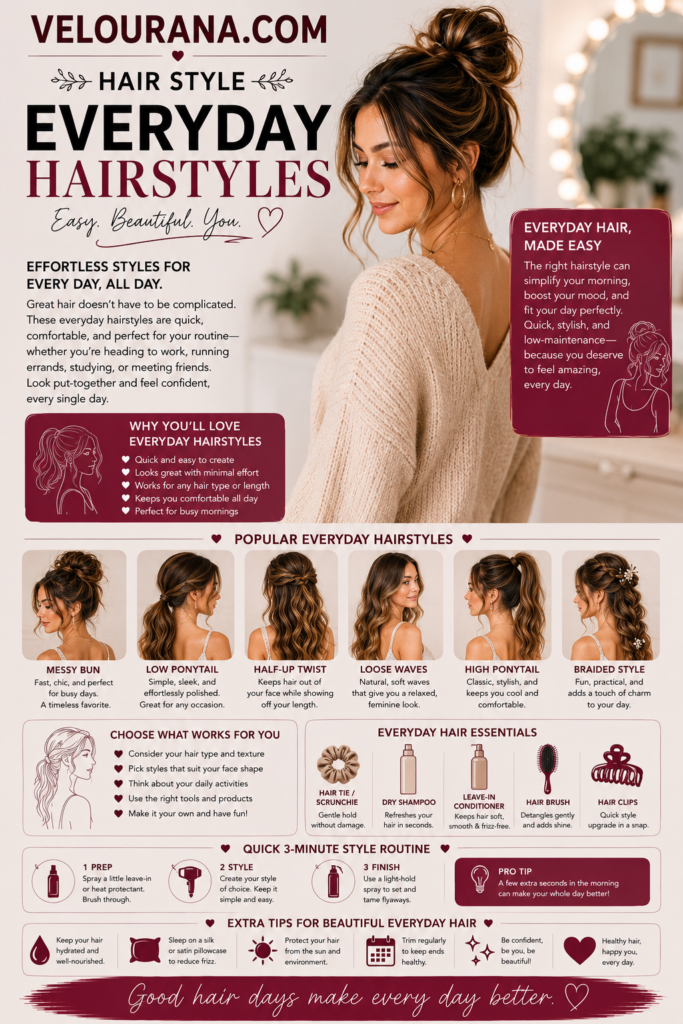
CATEGORY: Everyday Hairstyles
Workday hair has to meet a surprisingly demanding standard. It should look polished in the morning, remain comfortable through several hours, survive commuting and movement, and ideally require little or no attention once the day has begun. It also needs to suit the person wearing it. A hairstyle that feels elegant in a photograph can become distracting if it repeatedly falls into the face during meetings, catches on a headset or feels uncomfortable against the back of a chair.
This is why good workday hair is less about formality and more about control.
A professional hairstyle does not have to be sleek, straight or tightly secured. Natural curls can look professional. A textured bob can look professional. A soft ponytail, braid, bun, half-up style or loose wave can all work beautifully when the shape feels deliberate and the hair remains manageable.
The goal is to create a hairstyle that supports the day rather than becoming another task inside it.
That usually means starting with realistic questions. How much time is available in the morning? Will the hair be worn under headphones? Is the workplace warm? Will there be commuting, walking or travel? Does the wearer frequently push hair behind the ears? Does the style need to transition into evening plans?
These practical details matter because workday hair is judged over time.
A style that looks perfect for ten minutes but needs constant adjusting is less useful than one that begins slightly softer and remains comfortable for eight hours. The best everyday work hairstyles are therefore built around durability, comfort and visual intention rather than maximum complexity.
The Front Determines Whether the Style Feels Finished
The front of the hairstyle is usually the highest-value area to style carefully because it is seen constantly during conversation, video calls and mirror checks.
A clean center part can create a modern, balanced appearance. A side part introduces more movement and can create extra volume through the crown. Curtain bangs can remain soft while opening the face. A side fringe can be shaped so that it sits naturally without repeatedly falling into the eyes.
If time is limited, refining the front may be enough to make the entire hairstyle feel more polished.
The rest of the hair can remain relatively simple.
This is especially useful for loose styles. Straight hair may need only the face-framing pieces and ends directed. Wavy hair can keep much of its natural pattern while the front is shaped more deliberately. Curly hair may need only a few front curls refreshed. Coily hair can be styled so that the front and crown create a clear silhouette while the natural texture remains central.
The key is not to overwork the most visible sections.
Shorter front pieces usually respond quickly. Repeated heat or manipulation can make them look more rigid than the rest of the hairstyle. Once the front sits correctly, it should be allowed to remain there.
Loose Hair Can Be Professional When the Shape Is Controlled
Loose hair does not automatically look casual.
The difference between intentionally loose hair and hair that simply happens to be down often lies in the part, front direction and ends.
Straight hair can remain simple and fluid. A little root lift prevents the crown from looking compressed, while the ends can be left clean or given a soft inward bend. Long layers may benefit from slight separation so that the cut remains visible.
Wavy hair can use its natural movement as part of the finish. The goal does not need to be perfect uniformity. If the overall silhouette is balanced and the front is controlled, slight variation through the lengths can make the hairstyle look natural rather than unfinished.
Curly hair can be worn loose at work without every curl being individually perfected. The complete shape matters more than identical definition. A little attention to the crown, front and any visibly flattened sections may be enough.
Coily hair can create a strong loose silhouette through shape and volume alone. Professional appearance is not dependent on making the natural texture smaller or straighter. The hair can remain expressive while still looking deliberate.
Loose hair works best when the wearer is comfortable leaving it alone. If the hair is pushed away from the face every few minutes, another style may be more practical.
The Low Ponytail Is One of the Most Reliable Work Hairstyles
A low ponytail works well because it combines simplicity with structure.
The hair is controlled without being placed high enough to create unnecessary tension. It can sit comfortably behind the shoulders and usually works with office clothing, uniforms and more casual environments.
The finish can change according to the workplace and personal style.
A center part with a smooth low ponytail creates a clean, minimalist look. A side part softens the appearance. A little crown volume makes the style less severe. Natural waves or curls can remain through the lengths, creating movement without reducing practicality.
Fine hair can benefit from a softer base rather than an excessively tight one. Dense hair may need a stronger fastening but can retain natural fullness through the ponytail. Curly and coily textures can create particularly beautiful volume while keeping the front organized.
The placement should remain comfortable.
A ponytail worn for a full day should not feel as though it is pulling the hairline or scalp continuously. If tension becomes noticeable within the first hour, the style is unlikely to be a useful workday choice.
Comfort is part of polish because a hairstyle that feels good is less likely to be repeatedly adjusted.
The Mid-Height Ponytail Creates More Energy Without Losing Practicality
Raising the ponytail slightly changes the silhouette.
The crown appears more lifted. The lengths move more freely. The face can look more open.
This works especially well on days when the roots feel flat but the lower hair still looks good. Instead of trying to recreate volume through the entire head, the structure of the ponytail creates it.
A mid-height ponytail can still feel professional when the front is controlled.
The base may be sleek or softly textured. The lengths can remain straight, waved, curled or naturally textured. A section of hair can conceal the elastic when a more finished look is wanted, although this is not necessary for everyday wear.
The most important thing is balance.
The ponytail should not sit so high that it becomes uncomfortable against headphones, headrests or other work equipment. It should also not require constant tightening throughout the day.
A work hairstyle should survive normal movement without frequent maintenance.
Buns Solve More Practical Problems Than Almost Any Other Everyday Style
A bun keeps the hair away from the face, shoulders and neck while creating a clear silhouette.
This makes it particularly useful for long days, warm offices, active work environments and situations where loose hair becomes inconvenient.
The low bun is usually the easiest work option.
It can sit neatly at the nape with a center or side part. A smoother version feels more formal. A slightly softer version can retain some crown volume and natural texture.
The bun itself can remain compact. There is no need to create the scale or complexity of formal event hair.
A higher bun creates more lift and keeps the neck completely free. This can be useful during warm weather or active days, although placement should be tested for comfort.
Anyone who spends long periods sitting against a chair may find that a low or mid-height bun presses against the headrest. In that case, a higher placement or different style may actually be more comfortable.
This is an example of why practical testing matters.
The most elegant-looking bun is not necessarily the best work bun if it becomes physically irritating after several hours.
A Soft Bun Can Look Professional Without Becoming Severe
Professional hair is sometimes interpreted as hair that must be tightly controlled.
That is not necessary.
A softer bun can look polished when the silhouette remains intentional.
The crown can retain a little natural volume. The sides can move backward without being flattened completely. The bun can contain visible texture. A few short pieces near the face can remain if they do not become distracting.
The distinction is between softness and disorder.
A style with one or two controlled loose areas can look elegant. A style that is continually falling apart will not feel practical.
The structure should therefore remain secure even when the surface looks relaxed.
Second-day hair often works particularly well for this style because existing texture creates shape and grip. Rather than trying to make the hair perfectly smooth first, the natural movement can contribute to the bun.
This saves time and can make the result look less formal while still being appropriate for a work environment.
Half-Up Hair Is Ideal for People Who Want Length Without Constant Face Framing
The half-up hairstyle is one of the best compromises for work because it preserves the appearance of loose hair while removing the sections most likely to become distracting.
The sides and upper hair are secured.
The lower lengths remain free.
Straight hair keeps its clean movement. Wavy hair retains texture. Curls remain visible. Coily hair can preserve natural volume while the front becomes more controlled.
The secured section can be simple.
A small elastic creates a half ponytail. A barrette adds more visual detail. A claw clip creates a softer shape. Twists can be added when the wearer wants something more decorative.
The amount of hair taken upward should suit density.
Fine hair may look fuller when a smaller section is secured. Dense hair may benefit from taking more of the upper volume away from the sides.
The crown can remain smooth or slightly lifted.
This hairstyle is particularly useful for people who like wearing their hair down but find themselves constantly tucking it behind the ears during work.
Instead of fighting that habit, the hairstyle solves it in advance.
Braids Work Well for Long Days Because They Organize Length
Long hair can become inconvenient during commuting, travel or active work.
A braid gives the length structure while keeping it visible.
A simple low braid is often enough. It can sit behind the back or over one shoulder. A side braid creates a softer silhouette. Two braids can be practical for more active days. A small braid can also become part of a half-up style when only a little detail is wanted.
Natural texture makes braids visually interesting without requiring additional styling first.
The front still matters.
A deliberate part and controlled crown can make a simple braid feel more polished. The braid does not need to be elaborate.
Its usefulness comes from keeping the hair organized.
For very long hair, this can be especially valuable because the braid reduces tangling and keeps the lengths from constantly moving across clothing or work surfaces.
It can also transition easily into another hairstyle later. A braid can become a bun or be released after work, leaving additional texture through the lengths.
Claw Clips Can Be Practical, but Placement Matters
Claw clips offer speed and flexibility.
Hair can be twisted upward and secured in moments, making them useful when a hairstyle needs to be changed quickly during the day.
A full twist can gather most of the hair. A half-up clip can control the sides and crown. A lower twist can create a softer appearance.
The main consideration is comfort.
A large clip positioned directly against the back of the head may become uncomfortable against an office chair, car seat or headrest. This is why placement matters as much as appearance.
A higher or slightly different position may work better for someone who sits for long periods.
The clip also needs to suit the density of the hair. Fine hair may slide out of a clip that is too large. Dense hair may overwhelm one that is too small.
A useful accessory should hold securely without requiring constant readjustment.
The best workday hair tools are the ones the wearer eventually stops noticing.
Headphones and Headsets Change What Makes a Hairstyle Practical
Modern work often involves headsets, headphones or frequent video calls.
These practical details can completely change which hairstyles feel comfortable.
A high bun may interfere with some headsets. A low bun may press against a chair. Large clips can become uncomfortable under over-ear headphones. Thick volume around the sides can affect how a headset sits.
This does not mean certain hairstyles are impossible.
It means the routine should be designed around the equipment actually used.
A low ponytail may be easier with headphones than a large bun. Half-up hair can keep the sides controlled while leaving the crown free. A braid may be more comfortable than a clip during long calls.
Short hair may need only front control so that the headset does not constantly push sections into the face.
These are small considerations, but they can determine whether a hairstyle remains comfortable for an entire workday.
Everyday styling works best when it solves real problems.
Fine Hair Needs Work Hairstyles That Preserve Volume
Fine hair can look polished quickly, but long hours can cause roots to lose lift.
Workday styles should therefore avoid unnecessary compression.
A low ponytail does not need to be pulled extremely tight. A half-up style can preserve volume through the crown. Loose hair can use a side or off-center part to create movement. A compact bun can look elegant without pretending to be larger than the hair naturally creates.
Product buildup can make fine hair feel flatter as the day progresses.
A lighter routine often works better when movement and volume matter.
The front and crown deserve the most attention because these areas determine whether the hairstyle looks fresh.
If the lengths are already smooth, there is little reason to restyle them fully every morning.
Fine hair benefits from selective styling because every unnecessary layer of product or repeated pass can reduce the airy quality that makes the hair look fuller.
Dense Hair Needs Work Hairstyles That Control Rather Than Flatten
Dense hair often has the opposite problem.
There is plenty of volume, but managing all of it can take time.
A work hairstyle should organize that volume rather than trying to eliminate it completely.
Half-up styles are especially useful because they remove bulk from the sides while allowing the lower hair to remain full.
Ponytails gather the density into one clear shape.
Braids control long lengths.
Buns keep the entire hairstyle contained.
Loose hair can still work when the front and crown are shaped deliberately.
The objective is not to make dense hair smaller.
It is to give the volume structure.
Strong accessories matter too. A weak clip or elastic that gradually loosens creates frustration.
The right tool should match the amount of hair it needs to hold.
Practicality and appearance are closely connected.
Wavy Hair Can Look Professional Without Being Made Uniform
Wavy hair often becomes easier to manage when its natural irregularity is accepted.
Some waves may be stronger than others. One side may move differently. The lower hair may retain more texture than the crown.
This does not prevent the hairstyle from looking polished.
The overall shape matters more.
The front can be refined. The crown can be balanced. A few irregular sections can be corrected selectively. The rest of the wave pattern can remain.
Loose wavy hair can look professional when the silhouette is clear.
A half-up style can provide more structure.
A ponytail turns variation into movement.
A bun uses the texture naturally.
A braid organizes the lengths.
Trying to make every wave identical before work can create an unnecessarily long routine.
The natural texture is already contributing to the finished style.
Curly Hair Can Be Both Professional and Low-Maintenance
Curly hair does not need to become straight, brushed out or highly controlled to look professional.
A well-shaped curl pattern can be worn loose.
The front can be refined.
The crown can be adjusted.
Flattened sections can be refreshed.
The complete silhouette can remain natural.
When more control is useful, a high ponytail, puff, half-up style or bun can organize the hair while preserving visible curls.
The style should suit the work environment and the wearer's comfort, not an outdated assumption that professional hair must be smooth and straight.
Curly hair can also become easier on later days when the goal shifts from perfect definition to shape.
If a few curls have softened but the overall silhouette still works, they do not all need to be recreated.
Selective styling saves time and keeps the routine practical.
Coily Hair Can Build Professional Styles Around Natural Volume
Coily hair offers strong shape and structure naturally.
A puff can create a clear, polished silhouette.
A high or low bun can organize the hair.
Twists or braids can provide longer-term styling options depending on the hair and technique used.
Half-up styles can open the face while preserving volume.
The natural texture does not need to be reduced before it can look suitable for work.
Professional styling can celebrate volume while keeping the shape intentional.
The hairline and front can be finished according to personal preference. There is no single requirement for how every edge or coil should behave.
The most useful work style is one that remains comfortable and manageable for the wearer.
That principle should matter more than forcing the hair toward one aesthetic standard.
Short Hair Can Look Work-Ready With Very Little Styling
Short hair often requires less time, but directional changes are more visible.
A bob may need only a clear part and controlled ends.
A pixie can be shaped through the crown and front.
A fringe may need to be redirected after sleeping.
A short layered cut can gain texture through a few selected sections while the rest remains simple.
The advantage is that correcting one area can transform the complete hairstyle.
There is rarely a need for elaborate morning styling.
The haircut itself provides most of the structure.
The routine simply restores or emphasizes that shape.
For work, this can be especially convenient because the hairstyle is less likely to interfere with headphones, collars or movement.
Video Calls Make the Front and Crown More Important Than the Back
Remote and hybrid work have changed how hairstyles are seen.
During video calls, the camera usually shows the face, front hairline and upper crown much more than the back.
This makes targeted styling particularly efficient.
If the front looks polished and the silhouette around the face is balanced, the hairstyle can appear complete even when the back remains simple.
A half-up style works well because it controls the visible sides.
A ponytail or bun can keep the hair away from the face.
Loose hair can be refined primarily through the front sections.
A change of part may create enough volume to make the entire appearance feel refreshed.
This is not about styling only for the camera.
It is simply another example of visual priority.
When time is limited, effort should go where it has the greatest effect.
Humidity and Commuting Should Influence the Hairstyle Choice
A hairstyle does not move directly from the bathroom mirror to the desk.
For many people, there is commuting in between.
Wind, humidity, rain, public transport and walking can change the hair before the workday has even begun.
This is why the environment should influence the choice.
A braid can be useful on windy days.
A bun can control long hair during rain.
A half-up style can keep the front stable while allowing the lengths to move.
Naturally wavy, curly and coily hair can often be styled in ways that tolerate a little environmental change more gracefully than styles that depend on every strand remaining perfectly smooth.
The goal is not to defeat the weather.
It is to choose a hairstyle that still looks intentional after interacting with it.
A workday style should be designed for the route to work as well as the workplace itself.
Work Hair Should Be Easy to Refresh Without a Full Restyle
By midday, some hairstyles soften.
The crown may flatten.
The front may separate.
A few curls may lose definition.
A ponytail may become slightly looser.
A useful work hairstyle should be easy to correct.
A comb, small brush, clip or elastic may be enough.
The objective is not to recreate the morning.
It is to restore the silhouette.
A ponytail can be tightened once if necessary. A half-up clip can control a front section that has become distracting. Loose hair can become a bun for the afternoon. A braid can be gathered into a low knot.
This flexibility reduces the need for a large collection of styling products or tools at work.
The hairstyle can adapt instead of being rebuilt.
Work-to-Evening Hair Should Change Easily
Many days do not end when work ends.
Dinner, social plans or events may follow.
A practical everyday hairstyle can make this transition easier.
A low ponytail can be loosened and given more crown volume.
A bun can be released into waves if the hair has enough texture.
A half-up style can be converted into fully loose hair.
A braid can be undone to create additional movement.
Straight loose hair can gain a more dramatic side part.
A small accessory change can also transform the appearance quickly.
This kind of adaptability is useful because it avoids the need for a complete second styling session.
The work hairstyle becomes the foundation for the evening rather than something that has to be erased.
Professional Hair Is About Intention, Not One Specific Texture
There is no single professional hairstyle.
Straight hair is not automatically more professional than curls.
A bun is not automatically more appropriate than loose hair.
A ponytail is not automatically too casual.
Natural texture is not automatically less polished than heat-styled hair.
What matters is whether the hairstyle appears intentional, remains comfortable and suits the setting.
The front should be controlled enough for the wearer to work without constant adjustment.
The silhouette should feel coherent.
The style should remain secure.
The hair should be clean and cared for according to the individual's routine and texture.
Beyond that, there is room for enormous variety.
Professional appearance should not require everyone to erase the characteristics that make their hair unique.
The Best Work Hairstyle Is the One You Can Forget About
A successful work hairstyle should eventually disappear from attention.
The wearer should not spend the morning fixing it and the afternoon worrying about it.
It should remain comfortable against the chair.
It should work with headphones if necessary.
The front should stay out of the eyes.
The fastening should not pull.
The style should survive normal movement.
This practical standard is more useful than choosing a hairstyle only because it looks impressive at eight in the morning.
Fine hair may work best with a soft ponytail or half-up style that preserves volume.
Dense hair may benefit from a braid, bun or controlled half-up shape.
Straight hair can remain loose with minimal refinement.
Wavy hair can preserve natural movement.
Curly and coily textures can remain visible and professional.
Short hair can rely on directional styling rather than complexity.
The exact answer differs from one person to another.
That is what makes everyday hair personal.
The routine should reflect the actual workday, not an imaginary one.
A hairstyle that looks polished, feels comfortable and survives until the end of the day is doing its job.
It does not need to be elaborate.
It needs to be reliable.
When the front is intentional, the silhouette is balanced and the style works with the person's natural habits, professional hair becomes much easier.
The wearer stops checking it constantly.
The hairstyle becomes part of the day rather than a distraction inside it.
And that may be the most practical definition of polished workday hair: a style that looks considered enough for the environment and comfortable enough that, once the working day begins, it no longer demands attention.
The End
Velourana.
 Discover More From Our Family of Websites
 ZodiacBearing (Astrology, Tarot, Numerology, Angel Numbers & Spiritual Guidance)
 Velourana (Beauty, Makeup, Hair Care, Skincare & Beauty Tips)
 HavenBearing (Home, Living, Organization, Décor & Everyday Inspiration)
 PawBearing (Pet Care, Dog Breeds, Animal Health, Training & Pet Products)
 PsyCatherine (Notes From the Journal of a Psychologist on Real Life)

