
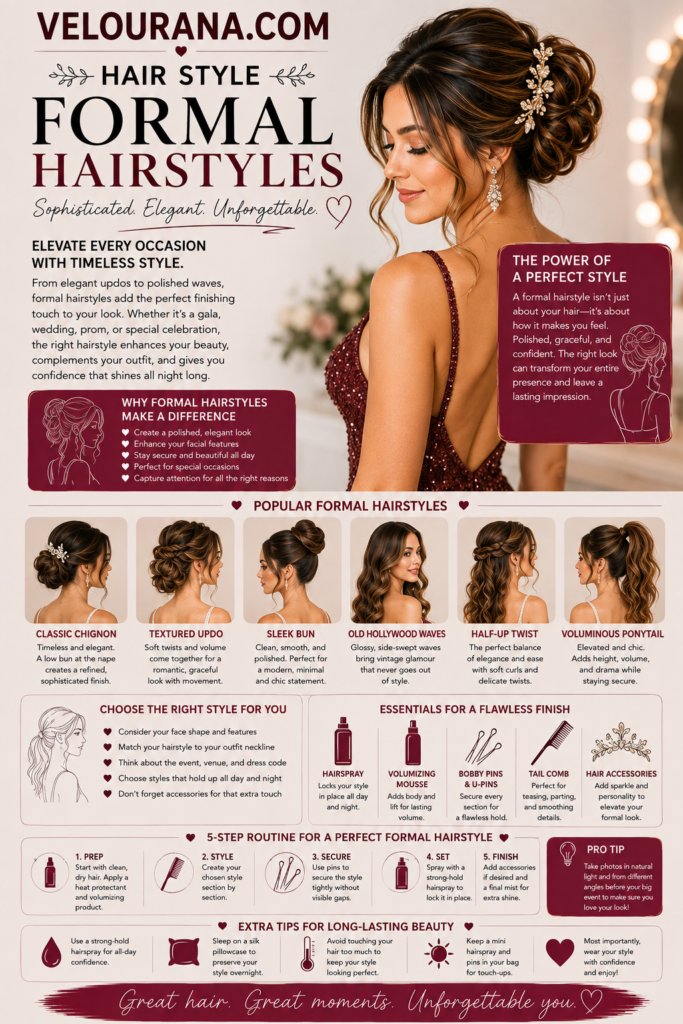
CATEGORY: Formal Hairstyles
An elegant updo can change the entire character of a formal appearance. Lifting the hair away from the shoulders reveals the neckline, creates a clearer frame around the face and gives jewelry, makeup and clothing more room to become part of the complete look. Yet the most successful formal updos rarely depend on complexity alone. Their sophistication comes from proportion, thoughtful placement and a finish that appears intentional from every angle.
There is an enormous difference between an updo that contains many techniques and one that has been beautifully designed.
A hairstyle can contain braids, curls, twists, decorative pins and elaborate volume and still feel visually confused. Another may consist almost entirely of a simple knot at the nape and look exceptionally elegant because its shape, texture and placement work perfectly with the person wearing it.
Formal styling therefore begins with selection rather than construction.
The hairstyle needs to suit the occasion, but it also needs to suit the hair. Length, density, natural texture and haircut influence which shapes can be created comfortably. The face and profile influence where volume feels balanced. Clothing determines how much of the neck, shoulders and back should remain visible. Jewelry and hair accessories introduce additional visual elements that need space.
Comfort matters just as much.
A formal event may last for many hours. There may be photographs, dinner, dancing, walking, travel and changes in temperature. An updo that looks magnificent for the first twenty minutes but becomes painful or unstable is not a successful design.
The ideal formal updo combines beauty with engineering that remains largely invisible.
The structure supports the style.
The texture creates character.
The silhouette creates elegance.
And the wearer should be able to enjoy the occasion without continually wondering whether the hairstyle is still where it began.
The Position of an Updo Changes Its Entire Personality
Before deciding how a bun, twist or knot will be constructed, it helps to decide where the visual weight of the hairstyle should sit.
A low updo creates a very different impression from a high one.
Low styles generally feel elegant, restrained and timeless. They place the visual weight around the nape and leave the upper head relatively clean. This can work beautifully with sophisticated evening clothing, open backs, delicate jewelry and minimalist dresses.
Moving the structure toward the middle of the head creates a more traditional updo silhouette. The hairstyle becomes more visible from the front and side while still leaving the neck exposed.
A high updo creates stronger drama.
It adds height, exposes more of the neck and can create a striking profile. Natural curls and coils can make high styles particularly expressive because their volume becomes an architectural feature.
None of these positions is automatically more formal than another.
The correct placement depends on the complete appearance.
A dramatic gown may benefit from a restrained low bun because the contrast prevents the look from becoming overloaded. A minimalist outfit may provide room for a higher or more sculptural hairstyle.
The hairstyle should also be evaluated in profile.
A bun that looks beautifully proportioned from behind may project too far when viewed from the side. A high style may need some crown transition so that it does not appear visually disconnected from the rest of the head.
Formal hair is three-dimensional.
Placement should therefore be judged from several angles before the details are perfected.
The Classic Low Bun Is Powerful Because It Does Not Need to Prove Anything
The low bun has survived generations of changing hair trends because its fundamental proportions are difficult to improve upon.
Hair moves away from the face and shoulders before gathering at the nape. The neck remains visible. The hairstyle has a recognizable focal point without dominating the head.
Within that simple structure, the possibilities are extensive.
A sleek low bun can feel contemporary and architectural.
A softly textured version can feel romantic.
A twisted bun can introduce dimension.
A wider knot can create a more substantial silhouette for dense hair.
A compact bun can look particularly elegant on fine hair.
The front determines much of the final character.
A center part produces symmetry and often gives the hairstyle a modern quality. A side part introduces direction and can create more softness around the forehead. Hair brushed backward without a visible part creates another form of controlled simplicity.
The bun does not need to be perfectly circular.
An elongated shape may suit the head better. A slightly wider structure can distribute dense hair more comfortably. A compact knot may complement delicate features more naturally than an artificially enlarged bun.
Formal styling becomes stronger when the natural amount of hair is respected.
The objective is not to create the largest possible shape.
It is to create the most convincing one.
A Textured Low Updo Creates Softness Without Losing Formality
Not every formal hairstyle benefits from a perfectly smooth surface.
Texture can introduce depth, movement and softness, particularly when the clothing or makeup has a romantic quality.
A textured low updo may allow sections to move backward individually rather than disappearing into one smooth surface. Gentle twists can overlap near the nape. Existing waves can remain visible. Curly hair can preserve its pattern while being gathered.
The challenge is maintaining distinction between texture and instability.
The hairstyle can look loose without actually being loosely constructed.
This is one of the most important principles of formal updos.
The visible surface and the hidden foundation do not need to have the same character.
A strong internal structure can support a soft exterior. Pins and anchor points can remain concealed while the visible sections appear relaxed.
This allows the hairstyle to move slightly without losing its identity.
A few pieces may soften as the evening progresses. The crown may settle subtly. Texture may become less precise.
If the underlying shape remains secure, these changes can actually make the hairstyle look more natural rather than damaged.
Formal hair does not need to resemble a sculpture that cannot tolerate movement.
It needs enough structure to remain recognizable as the evening unfolds.
Sleek Updos Create Drama Through Precision
A sleek updo removes much of the visual texture and places greater emphasis on line.
The part becomes more important.
The hairline becomes more visible.
The shape of the head becomes part of the hairstyle.
The bun or knot becomes the primary structural feature.
This simplicity can create enormous impact.
A sleek center-parted low bun can complement dramatic earrings and a strong evening dress without competing with either.
A deep side part can introduce a more glamorous direction.
Hair swept completely backward can create a clean, powerful frame around the face.
Because there is less surface detail, execution matters.
The hair should look controlled rather than overloaded with product. Shine should appear healthy rather than wet unless a deliberately wet-look finish is intended.
The transition into the bun should feel continuous.
The fastening should not appear accidental.
The hairstyle benefits from restraint because every visible element attracts attention.
Sleek formal hair is therefore less forgiving of unnecessary detail, but this is also its strength.
When the shape works, very little else is needed.
The French Twist Remains a Formal Classic Because of Its Vertical Line
The French twist creates a fundamentally different silhouette from a bun.
Instead of concentrating the hair into a rounded shape, it draws the eye vertically through the back of the head.
This can make the hairstyle feel elegant and elongated.
A traditional interpretation is controlled and smooth, with the ends concealed inside the structure. A contemporary version may retain more texture, crown volume or softness around the face.
The style can also be adapted according to density.
Fine hair may create a narrow, refined twist.
Dense hair can create a fuller structure.
Long hair may require more careful distribution so that the internal bulk does not become excessive.
The French twist works particularly well when the wearer wants the neck exposed without creating a visible bun.
It can complement structured dresses, tailored formal clothing and classic evening looks beautifully.
The hairstyle also provides an excellent location for accessories.
A decorative comb can follow the vertical line.
Small pins can sit along one edge.
A single statement piece can be positioned where the twist folds inward.
The accessory should emphasize the structure rather than obscure it.
The elegance of the French twist comes largely from its recognizable line, so preserving that line is usually more important than adding decoration.
High Buns Create Height, Presence and a Clear Neckline
A high bun changes the proportions of the complete appearance immediately.
The eye moves upward.
The neck becomes fully visible.
The hairstyle can create a sense of height even when the bun itself remains relatively compact.
This makes high updos particularly effective with statement necklines and dramatic earrings.
The bun can be sleek or textured.
A smooth high bun creates a strong, controlled silhouette.
A softer version can contain visible movement and a little crown texture.
Curly and coily hair can create spectacular high shapes because natural texture produces volume without requiring the hair to imitate a smooth bun.
The placement needs to remain comfortable.
Long or dense hair can become heavy when concentrated at the highest point of the head. If the foundation is too tight, that weight may become increasingly noticeable during the event.
A slightly broader base can distribute the load.
The style should feel secure without creating the sensation that the hair is pulling continuously upward.
A formal hairstyle needs to survive photographs and movement, but it also needs to survive dinner.
Comfort should never be treated as an afterthought.
Natural Curls Can Become the Architecture of an Updo
Curly hair does not need to be straightened before an elegant updo can be created.
The curls themselves provide texture and dimension.
They can be gathered loosely at the nape, arranged higher on the head, incorporated into a half-up structure or positioned asymmetrically.
The curl pattern can remain visible throughout the style.
This often produces a richer surface than would be created by smoothing the hair first and attempting to reintroduce texture later.
The objective is to organize the curls rather than erase them.
The crown can be shaped.
The sides can be controlled according to the desired silhouette.
Selected curls can frame the face.
Others can form the main body of the updo.
Individual variation does not need to disappear.
Formal curly hair can remain unmistakably curly.
The distinction between everyday curls and formal curls often comes from placement rather than from changing the texture itself.
A stronger silhouette, deliberate front and secure structure can elevate the entire appearance while preserving the character of the hair.
Coily Hair Can Create Extraordinary Formal Shapes
Coily hair has natural sculptural qualities that make it particularly suited to formal updos.
Volume can be concentrated high on the head, arranged toward the back, divided into twists or incorporated into braided structures.
A high puff can become formal through careful placement and a refined silhouette.
A textured bun can preserve the coil pattern.
Twists can create architectural direction.
Braids can become part of a larger updo.
The front can remain smooth, textured or shaped according to personal preference.
There is no requirement that coily hair become visually smaller to qualify as elegant.
Its volume can become one of the strongest features of the formal look.
Accessories can also interact beautifully with the texture.
Decorative pins can sit between sections rather than covering them.
Metallic details can create small points of contrast.
A headband can establish a clean line at the front while the natural volume remains behind it.
The strongest result usually comes from treating the natural texture as the primary design material rather than something that needs to be corrected before formal styling can begin.
Fine Hair Benefits From Proportion More Than Artificial Size
Formal updos for fine hair are sometimes approached with the assumption that the hair must be made to look dramatically thicker.
That can create unnecessary difficulty.
Fine hair can look exceptionally sophisticated in compact shapes.
A small low knot can feel elegant and minimalist.
A narrow French twist can look refined.
A sleek bun can create a beautiful clean silhouette.
Soft texture can introduce dimension without requiring enormous volume.
When more fullness is desired, it is often more effective to create visual space within the hairstyle than simply making the structure larger.
Gentle movement through the crown can add dimension.
A textured bun can create more visible surface.
A side part can create apparent lift.
The shape can be widened slightly without becoming oversized.
Accessories should also remain proportionate.
A very heavy decorative piece can overwhelm both the hairstyle and the hair supporting it.
A smaller accessory positioned deliberately may create considerably more elegance.
Fine hair does not need to pretend to be dense hair.
Formal styling is about making the most of its own qualities.
Dense Hair Needs Weight Distribution as Much as Styling
Dense hair creates impressive formal updos, but the amount of hair introduces practical challenges.
When all the length is concentrated into one small point, the hairstyle can become heavy.
A large low bun may pull backward.
A very high bun can create pressure at the crown.
Numerous pins inserted into the same area can become uncomfortable.
Distributing the hair across a broader structure can solve much of this.
A wider low updo spreads the weight.
Multiple internal anchor points can support different sections.
A French twist can distribute length vertically.
Braided structures can organize the hair before it is incorporated into the final shape.
The visible hairstyle can still look simple even when the internal support is more sophisticated.
This is another reason formal styling should not be judged only by its exterior.
Dense hair often needs stronger engineering beneath a graceful surface.
When the weight is managed properly, its natural fullness becomes an enormous advantage.
The hairstyle gains dimension without needing artificial enlargement.
Long Hair Offers Possibilities but Also Requires Editing
Long hair provides enough material for almost any formal style, but abundance can tempt the stylist to use all of it visibly.
That is not always necessary.
Very long hair can create a beautiful low bun, but the bun may become disproportionately large if every section is wrapped around the same point.
The hair can instead be distributed through a wider updo.
It can form multiple overlapping sections.
A braid can organize some of the length before it is incorporated.
A vertical twist can use the length differently from a circular bun.
The objective is to prevent the amount of hair from dictating the entire design.
Length should create possibilities, not visual clutter.
Long hair also carries more weight.
The foundation therefore matters enormously.
A hairstyle that feels secure when first completed may become uncomfortable after several hours if the weight is concentrated badly.
Formal styling should account for the duration of the event, not simply the appearance at the beginning.
Medium-Length Hair Is Exceptionally Versatile for Formal Updos
Medium hair often provides an ideal balance.
There is enough length to create buns, twists and gathered styles without the additional weight associated with very long hair.
A low bun can remain compact.
A French twist can form naturally.
A textured updo can be created from overlapping sections.
A half-up style can preserve enough loose length to remain visually substantial.
Shorter layers may escape more easily, but this does not necessarily create a problem.
They can become deliberate face-framing sections or contribute softness around the sides.
The hairstyle can be designed around them rather than attempting to force every short piece into the main structure.
This is particularly useful with layered cuts.
Formal hair often looks more contemporary when some of the haircut remains visible instead of disappearing completely inside an updo.
Short Hair Can Create the Impression of an Updo Without Traditional Length
Hair does not need to reach the shoulders before it can achieve the visual effect of formal lifted styling.
A short bob can be swept backward and secured where the length allows.
One side can be pinned while the other retains movement.
The crown can gain controlled volume.
A decorative accessory can create a focal point at the back or side.
A pixie can be sculpted upward or backward to create a formal silhouette without pretending to be an updo.
This is where the definition of formal hair becomes useful.
Formality comes from intention, finish and proportion.
It does not come from having enough hair to construct a bun.
A beautifully shaped short hairstyle can be every bit as appropriate for a formal event as an elaborate arrangement of long hair.
Face-Framing Pieces Should Look Chosen Rather Than Forgotten
Soft strands around the face can transform a formal updo.
They reduce severity.
They connect the hairstyle to layered haircuts.
They can create movement around the cheeks and jaw.
But their effectiveness depends on restraint.
When too many sections are deliberately pulled loose, the hairstyle may lose the clarity that made the updo elegant.
A few carefully chosen pieces usually create more impact.
Their length matters too.
Very short sections may sit naturally near the temples.
Longer face-framing layers can curve around the jaw or move backward.
Curly hair can retain selected curls.
Coily textures can frame the face according to the desired shape.
There is no requirement for softness around the face.
Some formal styles are strongest when everything is completely lifted away.
The decision should serve the complete look.
A dramatic neckline and statement earrings may benefit from a clean frame. A romantic dress may work beautifully with softer front sections.
The important thing is that the choice appears deliberate.
The Part Can Completely Change the Same Updo
The back of a formal hairstyle can remain identical while the front creates an entirely different impression.
A center part introduces symmetry.
It can make a low bun feel modern and minimalist.
A side part creates direction and often feels softer or more glamorous.
A deep side part can become a significant feature in itself.
Hair swept backward without a visible part creates a stronger, cleaner frame.
This makes the part one of the simplest ways to personalize a formal updo.
It should also reflect how the hair naturally behaves.
A part that continually fights a strong growth pattern may require more maintenance than one positioned more naturally.
Formal styling should be durable enough to survive the event without repeated correction.
Choosing a front structure that works with the hair helps achieve that.
Formal Hairstyles Should Complement the Face Without Being Reduced to Face-Shape Rules
Traditional hairstyle advice often attempts to assign specific styles to specific face shapes.
Real faces are more complex.
Features, proportions, hairline, profile, neck length, density and personal preference all interact.
It is more useful to think about visual balance.
Volume at the crown creates height.
Width at the sides creates horizontal emphasis.
A clean center part creates symmetry.
A side part introduces asymmetry.
Face-framing pieces can soften the outline.
A completely exposed face creates greater emphasis on features and makeup.
The best formal hairstyle is therefore discovered through proportion rather than rigid classification.
Two people described as having the same face shape may prefer completely different updos because their hair, features and clothing are different.
Formal beauty becomes more individual when rules are treated as tools rather than laws.
The Outfit Should Participate in the Hairstyle Decision
An updo reveals areas of clothing that loose hair may conceal.
This makes it especially valuable with detailed necklines, open backs, embellished shoulders and high collars.
If the dress contains significant detail around the neck, lifting the hair can prevent visual congestion.
If the back is a major design feature, an updo allows it to remain visible.
A strapless dress may gain elegance from the contrast of bare shoulders and lifted hair.
An extremely minimalist outfit can provide room for a more sculptural hairstyle.
The relationship does not need to be literal.
A romantic dress does not require romantic hair.
Contrast can be more interesting.
A clean sleek bun beside a soft flowing gown can create balance.
A textured updo can soften sharply tailored formal clothing.
The hairstyle and outfit should communicate with each other without becoming identical in character.
Earrings Become Part of the Composition When the Hair Goes Up
One consequence of an updo is that earrings become significantly more visible.
This changes the balance around the face.
Large statement earrings may provide enough decoration that the hair requires no additional ornament.
Smaller earrings can leave more room for decorative pins or a headband.
A strong necklace introduces another focal point.
Formal styling works best when these elements are considered together.
The goal is not to display every beautiful object simultaneously.
It is to create hierarchy.
One element may lead.
The others support it.
If the earrings are dramatic, the hairstyle can provide a clean background.
If the hair accessory is the main feature, jewelry can become quieter.
Editing is often what separates elegance from excess.
Hair Accessories Should Belong to the Structure
A formal accessory is most convincing when it appears integrated into the hairstyle.
A comb can sit where sections meet above a low bun.
Decorative pins can follow the curve of a twist.
Pearl details can be distributed through textured sections.
A barrette can secure a deliberate part of the design.
A headband can define the entire front.
Placement matters because an accessory added randomly after the hairstyle is finished may look disconnected.
Scale matters too.
A small accessory can disappear inside a large textured updo.
An oversized piece can overwhelm a compact bun.
The hair and accessory should remain visible as separate elements while still belonging to the same composition.
Formal styling becomes richer when decoration emphasizes structure instead of concealing it.
The Hidden Foundation Determines Whether an Updo Survives the Event
A beautiful surface cannot compensate for weak construction.
Formal hairstyles need to withstand ordinary movement.
The wearer turns the head.
Puts on a coat.
Travels in a car.
Hugs people.
Dances.
Moves between indoor and outdoor environments.
The hairstyle needs enough internal stability to tolerate these things.
That does not mean every section must be rigid.
It means the structural points need to remain secure.
The foundation should support the weight.
Pins should have a purpose rather than simply being added wherever movement appears.
Heavy sections need appropriate anchoring.
Accessories need support independent of decorative placement.
A well-constructed updo often feels surprisingly comfortable because the weight is distributed instead of being held through excessive tension.
This hidden engineering is what allows the visible hairstyle to look effortless.
A Formal Updo Should Be Designed to Age Gracefully Over Several Hours
No hairstyle remains absolutely identical throughout a long event.
The important question is what happens when it changes.
A sleek style may develop a little softness.
A textured updo may become slightly more relaxed.
Face-framing pieces may move.
Natural curls can respond to humidity.
The crown may settle.
If the hairstyle has a strong silhouette, these small changes do not destroy it.
They can make it look more natural.
This is why longevity should be built into the design rather than pursued through stiffness alone.
The hairstyle should have enough structure to preserve its identity while allowing normal movement.
An updo that can tolerate softness will usually look better late in the evening than one that depends on every visible strand remaining frozen.
Elegance Usually Improves When One Unnecessary Element Is Removed
Formal hairstyles can easily accumulate detail.
A braid is added.
Then twists.
Then curls.
Then volume.
Then decorative pins.
Then loose strands.
Each element may be attractive individually, yet the complete hairstyle can become crowded.
Editing is therefore one of the most valuable formal styling skills.
If the bun already has beautiful texture, perhaps a braid is unnecessary.
If statement earrings are being worn, perhaps the hair accessory should disappear.
If natural curls provide dimension, additional decorative structure may not be needed.
If the dress is highly ornate, the hair may become stronger by becoming simpler.
Sophistication often depends on knowing when the hairstyle is finished.
Formal does not mean maximum.
It means appropriate.
The Best Formal Updo Should Still Feel Like the Person Wearing It
A formal event creates an opportunity to elevate familiar styling, but elevation does not require disguise.
Someone who normally prefers sleek hair may feel most confident in a precise bun.
Someone who loves natural texture may prefer a soft curly updo.
Someone who dislikes hair around the face may feel uncomfortable in deliberately loose romantic sections.
Someone accustomed to volume may feel unlike herself in an extremely flattened style.
These preferences matter.
A hairstyle can be technically excellent and still feel wrong for the wearer.
The strongest formal style takes recognizable elements of personal appearance and refines them.
The texture remains familiar.
The preferred part may remain.
The amount of volume feels comfortable.
The face still looks like the focal point.
The hairstyle simply introduces greater structure, polish and intention.
That is ultimately what makes an elegant formal updo convincing.
The hair does not appear to be wearing the person.
The person appears completely comfortable wearing the hair.
When the silhouette complements the outfit, the texture belongs naturally to the hair, the structure remains secure and the details have been edited carefully, an updo does not need extraordinary complexity to look extraordinary.
A low knot can be enough.
A high natural shape can be enough.
A French twist can be enough.
A textured bun can be enough.
The elegance lies in how well the hairstyle has been considered.
And when every visible element has a reason to be there, formal hair achieves the quality that the most elaborate techniques cannot guarantee on their own: refinement.
The End
Velourana.
 Discover More From Our Family of Websites
 ZodiacBearing (Astrology, Tarot, Numerology, Angel Numbers & Spiritual Guidance)
 Velourana (Beauty, Makeup, Hair Care, Skincare & Beauty Tips)
 HavenBearing (Home, Living, Organization, Décor & Everyday Inspiration)
 PawBearing (Pet Care, Dog Breeds, Animal Health, Training & Pet Products)
 PsyCatherine (Notes From the Journal of a Psychologist on Real Life)

