
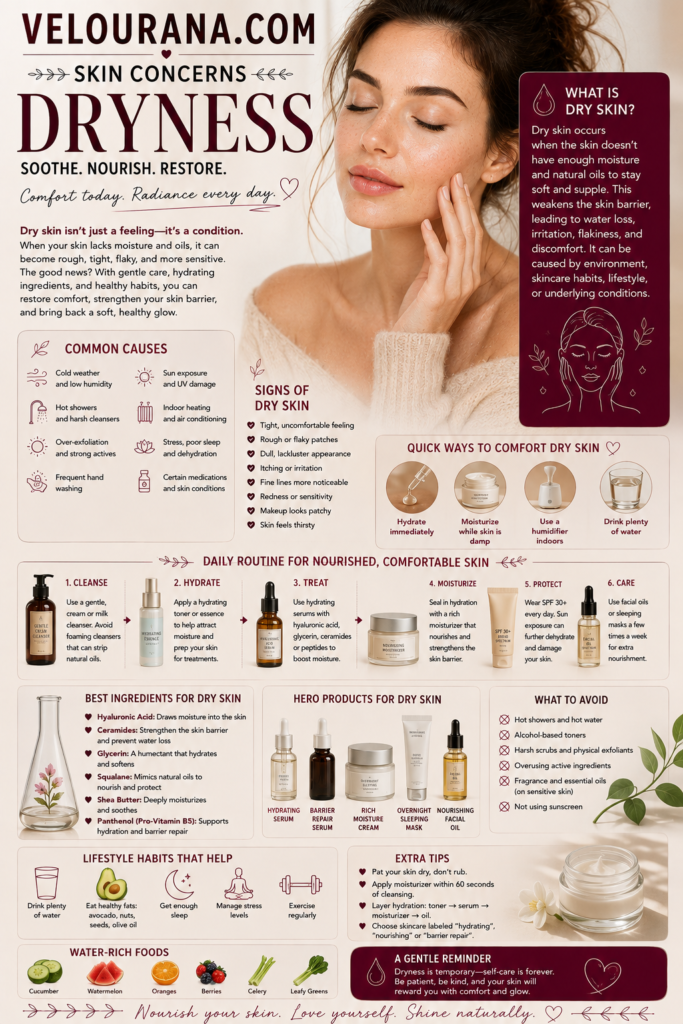
CATEGORY: Dryness
Dry skin rarely behaves exactly the same way throughout the year. A moisturizer that feels perfectly balanced in late spring can seem almost weightless by the middle of winter. A complexion that remains calm outdoors during humid summer evenings may begin feeling tight after several hours inside an air-conditioned room. Hands that require little attention for months can suddenly become rough when temperatures fall, while lips may begin cracking before the rest of the face shows any obvious change.
It is easy to interpret these fluctuations as inconsistency in the skin or failure in the products being used. In reality, the skin is responding to an environment that is continually changing.
Humidity, temperature, wind, sunlight, indoor heating, air conditioning, bathing habits, clothing, swimming, and even the amount of time spent outdoors can alter the conditions surrounding the skin barrier. The fundamental biology remains the same, but the pressure placed upon that biology changes from season to season.
This matters particularly for dry skin because its protective barrier may already have less room for error. When environmental conditions increase water loss, a routine that was previously sufficient may no longer provide enough support.
Seasonal skincare is therefore not about replacing an entire bathroom cabinet four times a year. It is about understanding which environmental pressures are changing and adjusting the intensity of cleansing, hydration, lipid replenishment, and protection accordingly.
The best dry-skin routine is not necessarily fixed.
It is responsive.
The Skin Exists in Constant Exchange With Its Environment
The outer layer of the skin is sometimes imagined as an impermeable wrapping around the body. It is better understood as a highly regulated boundary.
Water continuously moves from deeper tissues toward the surface and eventually evaporates into the surrounding air. This process, known as transepidermal water loss, is normal. The barrier's job is not to prevent all water from escaping but to regulate the rate.
The stratum corneum performs much of this work. Its flattened cells are surrounded by an organized lipid structure containing ceramides, cholesterol, and fatty acids. Natural moisturizing factors within the cells help attract and retain water, while surface lipids contribute flexibility and protection.
Environmental conditions influence how hard this system must work.
When surrounding air is dry, the difference between moisture levels within the skin and those in the environment encourages greater evaporation. When wind moves repeatedly across exposed skin, water can be lost more readily. When heat, swimming, frequent washing, or sweating leads to repeated cleansing, surface lipids may be removed more often.
The skin responds dynamically, but adaptation is not instantaneous or unlimited.
This is why someone can move from one climate to another and suddenly experience dryness despite using exactly the same products.
The routine has remained constant.
The conditions have not.
Winter Dryness Is About More Than Cold Temperatures
Winter has a well-earned reputation as the most difficult season for dry skin, but temperature alone is not responsible.
Cold air generally contains relatively little water. When that air enters buildings and is heated, relative humidity can fall considerably. The result is a combination that challenges the barrier from both directions: cold, wind, and exposure outdoors followed by hours of warm, dry indoor air.
The cheeks, lips, and hands often show the effects first because they are frequently exposed.
Hands experience an additional burden. Cold and flu season can increase handwashing, while gloves create friction and household heating dries the surrounding environment. A hand cream used occasionally may no longer compensate.
Winter also changes behavior.
Showers become hotter and often longer. People spend more time indoors with heating. Heavy clothing creates friction against the body. The desire for warm baths increases. Less visible areas such as the lower legs may receive little attention until itching or scaling becomes obvious.
The solution is not merely to buy a “winter moisturizer.”
The entire balance of the routine may need to shift.
Why a Summer Moisturizer Can Suddenly Feel as Though It Has Stopped Working
Imagine a lightweight moisturizer containing effective humectants and modest emollience. During humid weather, it may provide exactly the right balance. The surrounding environment does not aggressively encourage evaporation, and the skin remains comfortable for hours.
Move the same formula into a heated winter bedroom and the experience can change.
The product has not necessarily deteriorated.
The skin may simply need greater lipid replenishment or occlusion.
This is where moisturizer texture becomes useful as a practical guide, although texture alone cannot reveal everything about formulation.
Lotions contain relatively high proportions of water and usually feel lighter. Creams generally provide more richness and may contain larger amounts of emollient or occlusive ingredients. Balms and ointments can offer still greater protection against evaporation.
Dry skin may therefore benefit from moving one step richer as environmental dryness increases.
Someone who uses lotion in summer might prefer cream in winter. Someone already using cream may add a small amount of an occlusive product over particularly vulnerable areas at night.
The change does not need to involve the entire face.
Cheeks may require more protection while the forehead remains comfortable. Lips may need frequent occlusion while the rest of the complexion needs only a slightly richer moisturizer.
Seasonal care becomes more effective when it responds to actual skin behavior rather than obeying rigid product categories.
Wind Creates a Different Kind of Exposure
Cold wind produces a distinctive sensation on dry skin. The face may feel raw, tight, or almost polished after prolonged exposure.
Wind does not literally “burn” the skin in ordinary circumstances, but moving air can increase evaporation and amplify the effects of cold and low humidity. Physical particles, scarves, masks, and repeated wiping of the nose can add friction.
The result is often most visible across prominent areas of the face: cheeks, nose, lips, and sometimes the delicate region around the eyes.
Barrier protection before exposure can be more effective than attempting to repair the skin afterward.
A substantial moisturizer applied before going outdoors can provide emollience and reduce the sensation of vulnerability. Particularly dry areas may benefit from an additional protective balm.
Lips deserve special attention because their barrier differs from surrounding facial skin and they have very limited sebaceous protection. Repeated licking in cold weather compounds the problem.
Once wind-related irritation has already developed, strong active treatments may be poorly tolerated. The skin may sting when acids, retinoids, or highly fragranced products are applied.
At that moment, the priority changes.
Protection and recovery become more important than maintaining every optional step in the routine.
Indoor Heating Can Be the Hidden Winter Aggressor
People naturally associate winter dryness with being outdoors, yet much of the exposure responsible for persistent dryness may happen inside.
Central heating warms indoor air, often reducing relative humidity substantially. Someone may spend eight hours sleeping in a heated bedroom, another eight in a heated office, and most of the remaining time in other heated environments.
That is prolonged exposure.
The skin may feel comfortable immediately after applying moisturizer but gradually tighten as the day progresses. Lips require repeated balm. Hands become rough even when gloves are worn outdoors.
A humidifier may be useful in persistently dry indoor environments, particularly bedrooms, although hygiene is important because poorly maintained devices can accumulate microorganisms or mineral residue depending on their design and water source.
Even without a humidifier, skincare can compensate partly for indoor dryness through increased barrier protection.
Nighttime is particularly useful because richer products can remain undisturbed for hours.
The aim is not to seal the skin completely.
It is to reduce the mismatch between the amount of moisture leaving the skin and the amount the environment encourages it to lose.
Spring Can Be a Transitional Season Rather Than an Immediate Relief
When winter ends, it is tempting to switch instantly to the lightest possible routine.
The skin may not be ready.
Barrier recovery can lag behind weather changes. A complexion that spent several months coping with dry air and heavy indoor heating may remain reactive even after humidity begins rising.
Spring also introduces its own variables.
Temperatures fluctuate. One day may be warm and humid, the next cold and windy. Allergies can increase rubbing around the eyes and nose. More time outdoors means greater ultraviolet exposure. People may begin exercising outside again and cleansing more frequently after sweating.
This makes spring a useful time for gradual adjustment rather than sudden overhaul.
If a heavy winter cream begins feeling excessive, a medium-weight moisturizer may replace it. Occlusive products can become localized rather than applied broadly. Cleansing can remain gentle even as the complexion begins producing more oil.
There is no requirement to switch routines according to a calendar date.
The skin provides better information than the season name.
Summer Humidity Can Help Dry Skin—but It Does Not Eliminate Dryness
Summer is often easier for naturally dry skin because higher environmental humidity reduces some of the conditions that encourage rapid evaporation.
Many people notice that their complexion feels softer and more flexible with less moisturizer.
That does not mean dry skin has permanently changed type.
The environment is simply providing assistance.
This is why very heavy winter formulations may suddenly feel uncomfortable. A dense occlusive cream can become sticky in hot, humid conditions, particularly when combined with sweat and sunscreen.
A lighter moisturizer may provide enough support.
Some people with dry skin can even rely on a moisturizing sunscreen during the day rather than applying several separate layers underneath, provided the skin remains comfortable and the sunscreen is used correctly.
The temptation during summer is to swing too far in the opposite direction.
Because the face looks shinier, people may begin using stronger foaming cleansers, astringent toners, clay masks, or frequent exfoliation. The additional shine may partly reflect sunscreen, humidity, sweat, and normal sebum rather than a fundamental change in the skin's needs.
Dry skin can still be dry while looking luminous in August.
Appearance alone should not dictate how aggressively it is cleansed.
Air Conditioning Can Turn Summer Into an Artificial Winter
One of the most overlooked causes of summer dryness is air conditioning.
Outside, the air may be warm and humid. Inside, cooling systems reduce temperature and remove moisture from the air.
Someone working in an air-conditioned office for most of the day can therefore experience environmental conditions very different from those suggested by the weather outside.
The pattern can be confusing.
The face feels comfortable during the morning commute, becomes progressively tighter at work, improves again outdoors in the evening, and feels dry after sleeping in an air-conditioned bedroom.
The skincare routine may be blamed despite the environmental rhythm providing a strong clue.
In these circumstances, the answer may not be a heavy winter cream. A comfortable moisturizer with good humectant and emollient support may be enough, perhaps applied slightly more generously on days spent indoors.
The contrast between environments also explains why carrying a small hand cream or lip balm can be useful even during hot weather.
Summer dryness is not a contradiction.
Modern indoor climates have separated skincare seasons from outdoor seasons.
Sweat Changes the Routine in Ways That Can Indirectly Affect Dryness
Sweating is a normal and essential response to heat. It is not inherently harmful to dry skin.
The difficulty comes from what happens around it.
Summer exercise may lead to more frequent face washing and showering. Sweat is wiped away repeatedly with towels. Sunscreen is removed and reapplied. Swimming adds further washing. Clothing becomes damp and rubs against the body.
Someone who normally showers once daily may suddenly shower two or three times on active summer days.
Even when each cleansing episode is relatively gentle, cumulative exposure matters.
The solution is not to leave sweat and sunscreen sitting indefinitely on the skin. It is to make repeated cleansing as non-disruptive as reasonably possible.
After exercise, a gentle cleanse and lightweight moisturizer may restore comfort. The body may need lotion after repeated showers even when the weather feels too hot for rich creams.
Fast-absorbing body lotions can make this easier.
Seasonal skincare succeeds when it fits real behavior. A theoretically perfect product that feels so heavy in summer that nobody wants to use it provides little practical value.
Swimming Introduces an Entirely Different Set of Conditions
Summer holidays often expose the skin to swimming pools and seawater for hours at a time.
Both can influence dryness.
Pool water contains disinfectants necessary for hygiene, but repeated exposure can leave some skin feeling tight or irritated. Seawater contains salts that may contribute to a dry, tight sensation as water evaporates from the surface.
Swimming also introduces prolonged water exposure followed by evaporation, sun exposure, toweling, sunscreen reapplication, and often a shower afterward.
For someone prone to dryness, this becomes a demanding sequence.
Rinsing with fresh water after swimming can remove residual chlorine or salt. A gentle shower followed by moisturizer helps restore comfort.
Sunscreen must also be reapplied appropriately after swimming according to the product's directions and the circumstances of exposure.
The body is particularly easy to neglect on holiday because attention naturally focuses on sunscreen. Yet repeated swimming can leave the legs, arms, and shoulders noticeably dry even when the face remains comfortable.
A simple body lotion applied consistently after the final shower of the day may prevent several days of accumulated roughness.
Sun Exposure and Dryness Should Not Be Treated as Separate Concerns
Ultraviolet radiation is not usually the first factor people associate with dry skin, but sun exposure can affect barrier function and contribute to inflammation.
Sunburn is an obvious example. After significant ultraviolet injury, skin may become red, painful, tight, and eventually peel.
At that stage, the peeling is not an invitation to exfoliate.
It is part of injured skin shedding.
Even outside the context of sunburn, daily photoprotection remains important for overall skin health and the prevention of cumulative photodamage.
Dry skin, however, can make sunscreen selection difficult.
Some formulas feel drying. Others emphasize flakes. Alcohol-heavy textures may sting compromised skin. Very matte products may create an uncomfortable finish.
The practical answer is formulation matching.
A moisturizing sunscreen can reduce the number of layers needed in warm weather. Alternatively, a compatible moisturizer can be applied underneath sunscreen.
The essential requirement is that sunscreen remain usable in an adequate amount.
A theoretically excellent formula that feels so unpleasant on dry skin that it is consistently underapplied is not functioning effectively in real life.
Autumn Is Often the Best Time to Prepare Rather Than Repair
Autumn presents an opportunity that skincare routines frequently miss.
Instead of waiting for winter dryness to become established, the routine can begin adapting as humidity falls and indoor heating starts.
This might mean moving from a gel-cream to a cream before the cheeks begin flaking. Body lotion can become a regular post-shower habit again. Hand cream can return beside sinks and on bedside tables.
Exfoliation frequency may be reduced slightly as environmental dryness increases.
These adjustments are modest.
Their value lies in preventing the barrier from reaching the point where everything begins to sting.
Once significant irritation develops, active treatments may need to be paused and recovery can take time. Preventing that disruption is generally easier.
Autumn therefore illustrates a broader skincare principle: responding to early changes is more efficient than waiting for visible damage.
The Body Has Its Own Seasonal Geography
Facial dryness receives most of the attention in beauty discussions, but seasonal changes can affect the body even more dramatically.
Lower legs are particularly prone to winter scaling. They contain fewer sebaceous glands than some other areas and spend months under clothing where friction and dry indoor conditions contribute.
Elbows and knees may become rougher. Hands crack. Feet can develop thick dry skin around the heels.
Meanwhile, summer creates different patterns. Shoulders and arms experience greater sun exposure. Feet spend more time in sandals. Swimming affects the entire body. Shaving may become more frequent.
Different areas therefore require different strategies.
A rich cream that works beautifully on winter shins may feel unnecessary on the chest. Urea-containing formulations can help rough areas while a simpler lotion is sufficient elsewhere. Petrolatum-based products may protect cracked hands but feel excessive across the body.
Uniform application is not required.
Skincare can be anatomical as well as seasonal.
Mature Skin Often Experiences Seasonal Changes More Intensely
As skin ages, several changes can make environmental dryness more noticeable.
Sebum production may decrease. Barrier lipid organization can change. Recovery from irritation may become slower, and the skin's ability to maintain hydration can decline.
This means someone who tolerated winter with a lightweight lotion at thirty may need considerably richer support later in life.
Hormonal changes can intensify the shift.
The response should not automatically be framed as a need for more aggressive “anti-aging” products. If the principal change is increased dryness, barrier support deserves priority.
Well-hydrated mature skin generally appears smoother because the outer layer is more flexible and reflects light more evenly. Fine surface lines become less exaggerated.
This does not reverse structural aging, but it can substantially improve comfort and appearance.
Seasonal adaptation may therefore become more important with age rather than less.
Travel Can Compress Several Seasons Into a Single Day
Modern travel creates environmental changes faster than the skin could ever encounter naturally.
A person may leave a humid coastal city, spend several hours in an extremely dry aircraft cabin, land in a cold climate, enter a heated hotel, and wake the next morning to wind and low temperatures.
The skincare routine has crossed several environments within hours.
Aircraft cabins are particularly drying because humidity is low. Lips, hands, eyes, and facial skin may begin feeling uncomfortable during long flights.
This does not mean the face needs to be repeatedly sprayed with mist. Water applied without sufficient emollient or occlusive support may simply evaporate.
A moisturizer applied before or during a long journey can be more useful, with lip balm and hand cream addressing particularly exposed areas.
On arrival, the routine can be adjusted according to the destination rather than the climate at home.
Travel-size skincare is most useful when it preserves familiar, reliable products. A holiday is often a poor moment to introduce an entirely new collection of active treatments while the skin is simultaneously adapting to different water, weather, sleep patterns, and sun exposure.
Seasonal Dryness Does Not Always Mean the Season Is Responsible
Patterns are useful, but they can also mislead.
If dryness appears every winter, environmental factors are a reasonable explanation. If one persistent patch remains throughout the year, becomes intensely itchy, cracks repeatedly, or develops significant redness, another cause may be present.
Eczema, psoriasis, contact dermatitis, and other dermatological conditions can worsen seasonally, making them easy to mistake for ordinary weather-related dryness.
Similarly, sudden widespread dryness may coincide with medication changes or health conditions.
The distinction matters because adding richer cosmetic products may improve comfort without addressing the underlying issue.
Professional evaluation becomes appropriate when symptoms are severe, persistent, painful, inflamed, unusual in distribution, or resistant to sensible barrier care.
Seasonal skincare should explain normal fluctuations.
It should not become an excuse to ignore persistent abnormalities.
A Seasonal Routine Does Not Require Four Completely Different Collections
The idea of changing skincare with the seasons can easily become another invitation to overconsumption.
It does not need to be.
A core routine can remain remarkably stable throughout the year.
The same gentle cleanser may work in every season. The same sunscreen may remain comfortable year-round. The same moisturizer may work most of the time, with a lighter or richer alternative used during environmental extremes.
The adjustments can be small.
In humid weather, less moisturizer may be needed. During winter, more can be applied. A richer cream may replace a lotion temporarily. An occlusive balm can be added only to exposed areas. Exfoliation frequency can rise or fall according to tolerance.
This approach respects both the skin and the practical reality of skincare.
Products do not need to be discarded because September arrived.
The objective is flexibility, not seasonal consumption.
Listening to Early Sensations Is More Useful Than Waiting for Visible Flakes
Dryness often announces itself before it becomes visible.
The first sign may be a slight tightness around the mouth after cleansing. The cheeks may feel less flexible by late afternoon. Sunscreen may begin sitting differently. Lip balm may suddenly be needed more often.
These subtle changes are useful information.
Waiting until the face visibly flakes means the barrier has already become substantially uncomfortable.
Responding earlier might require nothing more than applying moisturizer more promptly, using a richer layer at night, reducing an exfoliant from three nights to one, or shortening hot showers.
The ability to recognize these early signals is one of the most valuable skills in long-term skincare.
It replaces rigid rules with observation.
The Best Seasonal Routine Follows Principles Rather Than a Calendar
Dry skin does not know whether it is January, April, July, or October.
It responds to humidity, temperature, ultraviolet exposure, wind, water, cleansing, friction, and the condition of its own barrier.
That is why two January days can require different skincare. One may be rainy and humid; another cold, windy, and spent entirely in heated rooms.
Likewise, a summer holiday beside the sea creates different conditions from a summer week spent in an air-conditioned office.
The most reliable seasonal routine therefore follows environmental principles.
When evaporation increases, strengthen moisture retention. When heat and humidity rise, reduce unnecessary heaviness without abandoning barrier support. When washing becomes more frequent, make cleansing gentler and moisturization more consistent. When exposure becomes harsh, protect vulnerable areas before irritation develops.
This is a more intelligent framework than simply owning a “winter routine” and a “summer routine.”
It allows skincare to adapt day by day without becoming complicated.
Dry Skin Becomes Easier to Manage When Change Is Expected
Perhaps the greatest benefit of understanding seasonal dryness is psychological as much as practical.
When skin suddenly feels different, there is less reason to panic and replace everything.
A moisturizer feeling insufficient in December does not mean it was a bad purchase in August. Increased shine during humid weather does not necessarily mean naturally dry skin has transformed into oily skin. Tightness during a week of air conditioning does not automatically indicate that every product has stopped working.
Context explains variation.
The skin barrier is constantly negotiating with its surroundings. Sometimes the environment makes that work easy. Sometimes it increases the demand dramatically.
A successful routine recognizes the difference.
The fundamental goals remain unchanged throughout the year: cleanse without unnecessary disruption, maintain water within the outer layer, replenish useful lipids, reduce excessive evaporation, protect against ultraviolet radiation, and avoid overwhelming the barrier with more treatment than it can tolerate.
Only the intensity changes.
When the weather becomes harsher, support increases. When conditions become gentler, the routine can become lighter. When the environment changes suddenly, as during travel, skincare can change with it.
This flexibility prevents dry skin from becoming a recurring seasonal emergency.
Instead of repairing the same damage every winter or struggling with the same air-conditioning dryness every summer, the routine begins anticipating what the barrier will face.
The result is not skin that never changes.
Healthy skin changes constantly.
The result is skin whose changing needs are understood well enough that those changes no longer feel unpredictable.
And for anyone who has spent years wondering why the moisturizer that worked beautifully three months ago suddenly seems inadequate, that understanding may be more useful than another jar of cream.
The End Velourana.
 Discover More From Our Family of Websites
 ZodiacBearing (Astrology, Tarot, Numerology, Angel Numbers & Spiritual Guidance)
 Velourana (Beauty, Makeup, Hair Care, Skincare & Beauty Tips)
 HavenBearing (Home, Living, Organization, Décor & Everyday Inspiration)
 PawBearing (Pet Care, Dog Breeds, Animal Health, Training & Pet Products)
 PsyCatherine (Notes From the Journal of a Psychologist on Real Life)

