
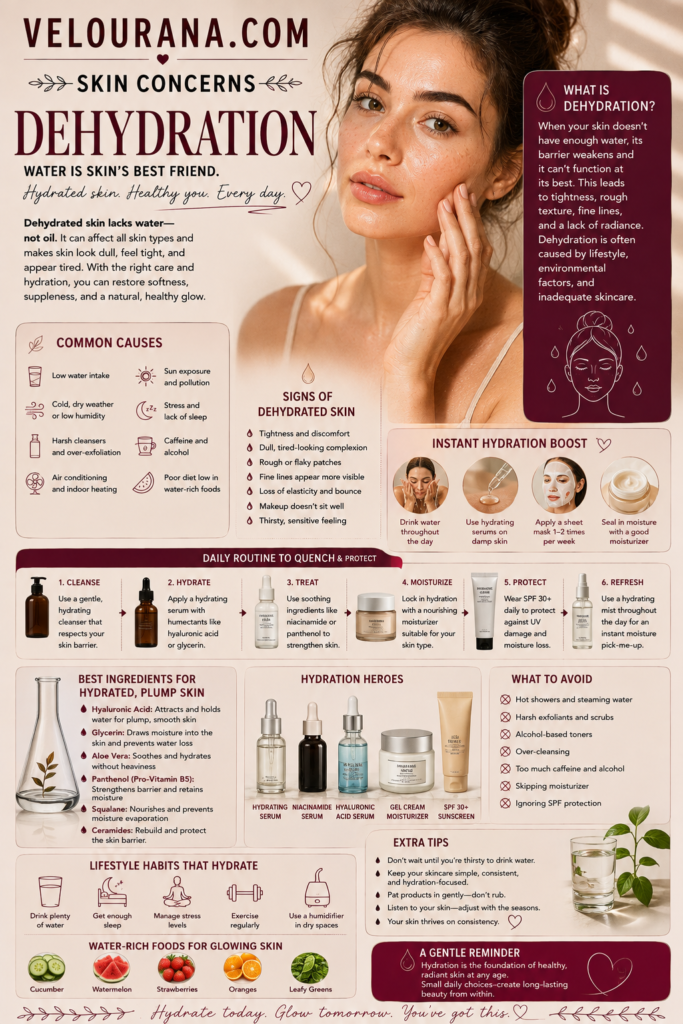
CATEGORY: Dehydration
Skin does not exist in a controlled laboratory. It moves constantly between weather systems, heated rooms, air-conditioned offices, hot showers, windy streets, humid summers, cold winters and unfamiliar climates during travel. A skincare routine that seems perfectly balanced in one environment can suddenly feel inadequate in another, not because the products have changed, but because the conditions surrounding the skin have.
This is one of the most useful ways to understand dehydration.
A complexion may feel comfortable for months and then become tight within a week of cold weather. Makeup that once sat beautifully may begin gathering around the nose and mouth. Fine surface lines may become more visible. The skin may look dull despite an unchanged routine. Someone with naturally oily skin may continue producing sebum while simultaneously developing a dry, rough surface.
These changes often create the impression that the skin type itself has transformed.
Usually, the explanation is less dramatic.
The skin is responding to its environment.
Water moves continuously through the outer layers of the skin and eventually evaporates from the surface. This normal process is influenced by barrier condition, surrounding humidity, temperature, cleansing habits and the products applied to the skin. When environmental conditions increase water loss or when the existing routine no longer provides enough support, dehydration can become more noticeable.
This means skincare should not necessarily remain identical throughout the year.
Consistency is valuable, but rigidity is not.
A sensible routine has a stable foundation and enough flexibility to respond when the climate changes.
Why Humidity Changes the Way Skin Feels
Humidity describes the amount of water vapour present in the air.
Its relationship with skin hydration is not the only factor determining how the complexion behaves, but it is an important one.
In humid conditions, the surrounding environment contains more moisture. Many people find that their skin feels more comfortable and flexible during humid weather, even when using lighter moisturisers.
This can be particularly obvious among people with oily or combination skin.
A lightweight gel may provide enough support during summer. The complexion remains soft, and heavy creams can feel unnecessary or uncomfortable.
Then the season changes.
The same person may enter winter using exactly the same products and suddenly experience tightness.
Nothing is necessarily wrong with the moisturiser.
Its level of support may simply no longer match the environment.
This is one reason skincare recommendations cannot be separated completely from geography and climate.
A routine developed in tropical humidity may feel entirely different in a cold continental winter.
Even within the same country, coastal and inland environments can produce different experiences.
Hydration is contextual.
Winter Creates a Perfect Environment for Water Loss
Winter can be particularly challenging because several dehydrating influences often appear together.
Outdoor air becomes colder and frequently drier.
Wind increases evaporation from exposed skin.
People spend more time indoors with heating systems running.
Showers become hotter because they feel comforting after exposure to cold air.
Moisturisers that were adequate in autumn suddenly seem to disappear into the skin without providing lasting comfort.
The result can be a noticeable decline in surface hydration.
Cheeks may feel tight first.
The area around the mouth begins flaking.
Hands become rough.
Lips crack.
Even people who consider their skin oily may find that the outer surface becomes uncomfortable.
The instinct may be to buy an entirely new routine.
Often, smaller adjustments are enough.
A gentle cleanser can replace a more aggressive one.
A gel moisturiser can become a lotion.
A lotion can become a cream.
Exfoliation frequency can be reduced.
Very dry areas can receive targeted occlusive support.
These modifications preserve the routine's basic structure while increasing its ability to reduce water loss.
Indoor Heating Can Matter as Much as Outdoor Weather
Many people blame winter dryness entirely on cold outdoor air.
But indoor heating can be equally important.
Heating systems create comfortable temperatures while often reducing indoor humidity.
Someone may therefore spend only thirty minutes outside but ten hours inside a dry office.
The complexion experiences that indoor environment continuously.
This is why dehydration can persist even among people who rarely spend long periods outdoors during winter.
The bedroom matters too.
Eight hours of sleep in a very dry heated room represents substantial environmental exposure.
A humidifier can be useful in particularly dry environments, although it should be maintained carefully according to manufacturer instructions to avoid hygiene problems.
The point is not that everyone needs new equipment.
It is simply that the room around the skin is part of the skincare environment.
Sometimes the most useful hydration adjustment happens outside the bathroom.
Summer Does Not Automatically Protect Against Dehydration
Warm weather is usually associated with sweat, oiliness and humidity.
This can make dehydration seem unlikely.
Yet summer creates its own set of challenges.
High temperatures increase sweating.
People shower more often.
Air conditioning becomes constant.
Swimming exposes the skin to chlorinated or salt water.
Sun exposure increases.
Oil-control products may be used more aggressively because the complexion looks shinier.
The result can still be dehydration.
This is especially common among oily skin types.
Because the face appears greasy, moisturiser is reduced or removed.
Strong foaming cleansers are introduced.
Clay masks are used more frequently.
Powder and mattifying products are layered throughout the day.
The skin may eventually become both shiny and tight.
Summer skincare therefore needs balance.
A lighter moisturiser may be appropriate.
Skipping moisturiser entirely may not be.
Air Conditioning Creates an Artificial Dry Season
Modern indoor life means that seasonal exposure is no longer straightforward.
A person can experience humid summer weather outdoors and extremely dry air conditioning indoors within minutes.
This transition repeats throughout the day.
Office workers may spend eight or ten hours inside cooled environments.
Cars are air-conditioned.
Shops are air-conditioned.
Homes are air-conditioned.
Hotels are air-conditioned.
The skin therefore experiences a kind of artificial dry climate despite hot weather outside.
This is one reason some people become confused when their skin feels dehydrated in July.
They look at the outdoor humidity and assume dehydration should be impossible.
But the relevant environment may be the office where they spend most of their waking hours.
A lightweight moisturiser that supports barrier function can help.
Aggressive mattifying routines can make the problem worse.
The goal is not to fight summer shine at every moment.
It is to keep the skin comfortable across changing conditions.
Wind Can Make Dehydration Feel More Severe
Wind is another environmental factor that is often underestimated.
Cold wind can make the complexion feel raw and tight.
Repeated exposure may contribute to surface dryness, especially when the barrier is already compromised.
The cheeks and lips are particularly vulnerable because they are directly exposed.
Cyclists, runners, sailors and people who spend long periods outdoors may notice this more clearly.
Protective clothing can help.
A suitable moisturiser before exposure can also provide additional support.
During windy conditions, skincare sometimes needs to become slightly more protective rather than more active.
This is not the ideal time to intensify exfoliation.
The environment is already creating stress.
The routine should compensate rather than compete.
Hot Weather Encourages Overcleansing
Summer creates another behavioural problem.
Sweat feels dirty.
Sunscreen feels heavy.
Oil becomes more visible.
People naturally want to wash more frequently.
After exercise, another cleanse seems necessary.
After returning home, another shower follows.
Before bed, sunscreen and makeup still need removal.
The cumulative amount of cleansing can become substantial.
This does not mean sweat should be ignored or sunscreen should remain on the face indefinitely.
It means cleansing intensity should be proportional.
A gentle cleanser can remove sweat and residue without leaving the skin stripped.
Very hot water is rarely necessary.
Vigorous rubbing is not required.
The objective is cleanliness without unnecessary disruption.
Swimming Changes the Hydration Equation
Swimming is one of summer's pleasures, but pool and seawater can influence skin comfort.
Chlorinated water may leave some people feeling dry or tight.
Salt water can create similar sensations as it dries on the surface.
Repeated swimming without rinsing and moisturising afterward can therefore contribute to dehydration.
The solution is not to avoid swimming.
It is to recognise the exposure.
Rinsing the skin after swimming and applying moisturiser afterward can help restore comfort.
Sunscreen should also be reapplied appropriately during outdoor activity.
These simple behaviours are more useful than waiting until the skin becomes severely dry and then introducing a complicated rescue routine.
Sun Exposure Affects More Than Immediate Dryness
Ultraviolet exposure is primarily discussed in relation to sunburn, pigmentation and premature ageing.
It also influences the overall condition of the skin.
A sunburned complexion can become dry, tender and compromised.
More broadly, chronic ultraviolet exposure contributes to structural changes that affect long-term skin quality.
Sunscreen therefore belongs within a sensible dehydration routine even though it is not technically a moisturiser.
A broad-spectrum sunscreen can help protect the skin from additional environmental stress.
Texture is important.
Someone with oily skin may avoid sunscreen if the product feels excessively greasy.
Someone with dry skin may dislike formulas that create a very matte finish.
Finding a texture that works with the individual complexion makes consistent protection easier.
Autumn Is Often the Transition People Miss
Autumn can be deceptive.
The weather may still feel relatively mild.
Humidity begins changing.
Heating systems gradually come back into use.
People continue using summer skincare because winter does not seem to have arrived yet.
This is often when the first dehydration symptoms appear.
The morning routine suddenly feels less comfortable.
The cheeks become slightly tight.
Lips require balm more frequently.
Foundation no longer sits quite as smoothly.
These subtle signs provide an opportunity.
Rather than waiting for severe winter dryness, the routine can be adjusted gradually.
A slightly richer night moisturiser may be enough.
Exfoliation frequency can be reduced.
Hot showers can be shortened.
Preventive adaptation is easier than repairing significant irritation later.
Spring Can Require Another Reset
Spring brings its own transition.
Humidity increases.
Temperatures rise.
Heavy winter creams begin feeling excessive.
The complexion may become oilier.
Someone who has become accustomed to a rich winter routine may suddenly experience clogged-feeling skin or uncomfortable heaviness.
The logical response is not to remove hydration entirely.
It is to reduce texture.
A cream can become a lotion.
A heavy night layer can become unnecessary.
Occlusive products can be reserved for dry areas.
The routine remains hydration-supportive while adapting to warmer conditions.
Seasonal skincare is therefore less about changing ingredients and more about changing proportions.
Travel Compresses Several Seasonal Changes Into Hours
Travel can move the skin through environmental extremes faster than any natural season.
Someone may leave humid Athens, spend hours inside a dry aircraft cabin and land in a cold northern European city on the same day.
The skin has no gradual adjustment period.
Low cabin humidity is particularly noticeable during long flights.
The complexion may feel tight by landing.
Lips dry out.
Hands become rough.
Fine surface lines become more visible.
This is temporary for most people, but it can be uncomfortable.
The best response is usually simple.
Hydration before the flight.
Moisturiser.
Lip care.
Gentle cleansing if necessary.
Sunscreen depending on exposure.
There is rarely a need for an elaborate airborne facial routine.
Aircraft Skincare Does Not Need to Become Theatre
Social media has turned in-flight skincare into a performance.
Sheet masks appear at cruising altitude.
Facial mists are sprayed repeatedly.
Multiple serums are applied in airplane bathrooms.
Some people enjoy this ritual, and there is nothing inherently wrong with that if hygiene and skin tolerance are considered.
But it is not necessary.
The aircraft environment is dry, but the solution does not require twenty products.
A good moisturiser applied before or during a long flight may be sufficient.
A lip balm can reduce discomfort.
Hand cream may be useful.
Repeatedly touching the face with unwashed hands in a shared environment may create more problems than skipping an elaborate routine.
Travel skincare works best when practical considerations remain central.
Hotel Products Can Introduce Unexpected Variables
Travel exposes the skin to unfamiliar cleansers, soaps, shampoos and water conditions.
Hotel amenities may be convenient, but they are not necessarily suitable for facial skin.
A strongly fragranced body wash is not automatically a good substitute for a familiar facial cleanser.
Hard water can also make cleansing feel different.
People sometimes return from travel convinced that the climate alone damaged their skin when the unfamiliar routine contributed as well.
Bringing a small quantity of trusted essential products can prevent this.
A cleanser.
Moisturiser.
Sunscreen.
These three products provide continuity.
Everything else can remain optional.
Changing Time Zones Can Change the Routine
Long-distance travel disrupts more than climate.
Sleep changes.
Meals change.
Cleansing schedules become irregular.
People may fall asleep wearing makeup or sunscreen because of exhaustion.
Long days create extra cleansing.
The routine becomes inconsistent.
This can contribute to the sense that travel "ruins" the skin.
The practical solution is not perfection.
It is maintaining the basic structure as much as possible.
Cleanse when necessary.
Moisturise.
Protect from the sun.
Resume normal treatment products when the skin and schedule stabilise.
Travel is usually not the ideal moment to introduce a powerful new active ingredient.
The Mediterranean Climate Creates Its Own Hydration Pattern
Mediterranean climates can produce a particularly interesting combination of skin challenges.
Summers may be hot and dry.
Sun exposure can be intense.
Air conditioning is common.
Winters can be milder than northern Europe yet still include wind, heating and lower humidity.
The result is that dehydration may occur in both seasons for different reasons.
In summer, the problem may involve sun, air conditioning, swimming and repeated cleansing.
In winter, indoor heating, wind and cooler air become more important.
This reinforces the idea that dehydration is not simply a "winter skin" problem.
The mechanism changes with the season, but the result can look surprisingly similar.
Naturally Dry Skin Usually Needs Earlier Seasonal Adjustments
People with naturally dry skin often notice environmental changes quickly.
Because their baseline sebum production is lower, they may have less tolerance for dry conditions.
A routine that remains comfortable for oily skin until midwinter may need adjustment for dry skin much earlier.
Richer moisturisers can be introduced gradually.
Cleansing can become gentler.
Occlusive products can be used strategically.
Body care also becomes important because dehydration is not limited to the face.
Hands, legs, elbows and feet frequently show seasonal dryness before facial skin becomes severely uncomfortable.
Oily Skin Can Conceal Environmental Dehydration
Oily skin presents the opposite challenge.
Sebum continues to create shine, masking the appearance of dehydration.
The person may therefore respond to seasonal changes by increasing oil-control measures.
That can create a conflict.
The environment is encouraging water loss while the routine is removing more surface lipids.
Eventually, the complexion becomes shiny, tight and reactive.
Recognising this pattern prevents unnecessary escalation.
The skin can remain oily while still needing more hydration support.
A lightweight lotion may be enough.
The goal is not to make the skin richer.
It is to make it more comfortable.
Combination Skin Changes by Zone and Season
Combination skin can feel almost like several complexions living on one face.
The nose may remain oily year-round.
The cheeks may become dry in winter.
The forehead may change according to humidity.
The mouth area may become dehydrated after retinoid use.
A uniform seasonal strategy may therefore fail.
Different zones can receive different levels of moisturisation.
A lightweight moisturiser can cover the entire face.
A richer cream can be added only to dry areas.
This targeted approach avoids overloading oily zones while protecting vulnerable areas.
There is no skincare rule requiring equal product quantities everywhere.
Mature Skin May Notice Dehydration More Visibly
As skin ages, natural changes can influence lipid production, barrier function and the appearance of the surface.
Dehydration can therefore become more visibly noticeable.
Fine lines look sharper.
Texture becomes rougher.
The complexion appears less luminous.
This does not mean every visible line is caused by dehydration.
Structural ageing involves much deeper biological changes.
But a poorly hydrated outer surface can exaggerate those changes.
Supporting hydration therefore improves appearance without making unrealistic claims about reversing ageing.
The result may be smoother-looking, more comfortable skin rather than the elimination of established wrinkles.
That distinction is important and still meaningful.
Seasonal Exfoliation Should Follow Tolerance
Exfoliation schedules often remain fixed throughout the year.
This is not always sensible.
A person may tolerate an acid three times weekly during humid summer weather but find the same frequency irritating during winter.
The product has not changed.
The skin's environment has.
Reducing frequency during dry periods can preserve the benefits while improving tolerance.
The same principle applies to retinoids and other potentially irritating actives.
Skincare schedules are not contracts.
They can be adjusted.
Layering Can Change With Humidity
Humid weather may require fewer layers.
A hydrating serum followed by sunscreen may feel sufficient for some oily skin types if the sunscreen itself is moisturising.
During dry weather, the same person may need a separate moisturiser.
Dry skin may add an occlusive layer at night.
This is one reason rigid routines copied from other people often fail.
The surrounding environment changes how much support is necessary.
The number of products should follow function.
The Bedroom Is Part of the Night Routine
Night skincare is usually discussed in terms of products.
But the room in which someone sleeps matters too.
A heavily heated bedroom can be very dry.
Air conditioning can create similar conditions.
The skin spends hours in that environment.
If someone wakes every morning feeling tighter than they did at bedtime, the bedroom deserves consideration.
Adjusting room temperature or humidity may improve comfort.
A richer night moisturiser may also help.
Hydration is not confined to what is applied to the face.
Hands Often Reveal Environmental Dryness First
Hands provide an excellent example of environmental dehydration because they are washed frequently and exposed constantly.
Cold weather, hand washing, sanitiser and indoor heating can leave them rough and cracked.
The mechanism is similar to facial dehydration but often more obvious because cleansing frequency is higher.
Applying hand cream after washing can help.
Protective gloves during cold weather or household cleaning can reduce exposure.
This illustrates a broader principle.
The skin barrier responds to cumulative behaviour.
The same logic that protects the hands can inform facial care.
Lips Need Their Own Strategy
Lips lack many of the protective features of surrounding facial skin and can become dry quickly.
Wind, cold, sun and habitual licking worsen the problem.
Lip balm with occlusive ingredients can help reduce water loss.
Daytime sun protection is also useful when exposure is significant.
Repeatedly licking dry lips provides temporary relief but often worsens dryness as saliva evaporates.
This is another example of immediate comfort producing a poorer long-term result.
Seasonal Dehydration Should Be Managed Before It Becomes Irritation
The best moment to adjust a routine is often when the first subtle signs appear.
Slight tightness.
More visible texture.
A moisturiser that no longer lasts through the day.
Foundation beginning to catch.
Waiting until the skin becomes red, flaky and painful makes recovery harder.
Small changes made early can prevent escalation.
Skincare works best when it responds to patterns rather than crises.
Not Every Seasonal Flare Is Dehydration
Environmental changes can also aggravate genuine dermatological conditions.
Eczema may worsen in winter.
Rosacea can react to temperature extremes.
Seborrheic dermatitis may fluctuate.
Contact dermatitis can appear after exposure to unfamiliar travel products.
Persistent redness, significant itching, rash, swelling, cracking or pain should not automatically be labelled dehydration.
If symptoms are severe or recurring, professional evaluation is appropriate.
The environment can reveal underlying conditions rather than simply create cosmetic dryness.
Build a Routine With a Stable Core and Flexible Edges
The most practical seasonal strategy is not to own four completely different skincare routines.
It is to maintain a stable core.
A gentle cleanser.
A reliable moisturiser.
A sunscreen that works well.
Then adjust the edges.
Use a richer moisturiser when conditions become dry.
Reduce exfoliation when tolerance falls.
Add targeted occlusion when necessary.
Switch back to lighter textures when humidity rises.
This approach creates both consistency and flexibility.
Let the Skin, Not the Calendar, Decide
Seasonal skincare does not have to begin on a particular date.
Weather does not follow the calendar perfectly.
A warm October may feel like summer.
A cold April can feel like winter.
Travel can move someone between climates overnight.
The skin itself provides better information.
If it feels comfortable, there may be no reason to change anything.
If tightness and roughness appear, the routine can adapt.
Observation is more useful than ritual.
Hydration Is a Relationship Between Skin and Environment
Dehydrated skin is often treated as though the solution exists entirely inside a bottle.
But products operate within an environment.
Humidity matters.
Temperature matters.
Wind matters.
Heating matters.
Air conditioning matters.
Swimming matters.
Travel matters.
Cleansing habits change in response to all of them.
A skincare routine that ignores these conditions can appear inconsistent because its effectiveness changes throughout the year.
A routine that acknowledges them becomes much more predictable.
This is why the same moisturiser can feel perfect in August and inadequate in January.
It did not necessarily become a worse product.
The skin's needs changed.
The Most Resilient Routine Is the One That Can Adapt
Healthy-looking hydration does not require perfectly controlled conditions.
Real life will always contain dry rooms, hot weather, flights, winter wind and unexpected changes.
The objective is resilience.
Skin should have enough support that ordinary environmental fluctuations do not create constant discomfort.
That support comes from maintaining a gentle routine, protecting the barrier, moisturising according to need and adjusting intensity when the environment changes.
The result is not skin that never reacts.
It is skin that recovers more easily.
A good hydration routine therefore behaves less like a fixed prescription and more like a well-designed wardrobe.
The basic pieces remain.
The layers change with the weather.
Understanding this relationship removes much of the mystery from seasonal dehydration.
When the complexion becomes tight during winter, it is not necessarily failing.
When it becomes shinier in summer, it is not necessarily unhealthy.
When travel leaves it dull for several days, it is not necessarily damaged.
Skin is responding to conditions.
The most effective routine listens to that response and adjusts without panic.
Hydration is ultimately not about maintaining exactly the same products every day of the year.
It is about maintaining the same objective: a comfortable, supported barrier capable of holding on to the water the skin needs.
The End Velourana
 Discover More From Our Family of Websites
 ZodiacBearing (Astrology, Tarot, Numerology, Angel Numbers & Spiritual Guidance)
 Velourana (Beauty, Makeup, Hair Care, Skincare & Beauty Tips)
 HavenBearing (Home, Living, Organization, Décor & Everyday Inspiration)
 PawBearing (Pet Care, Dog Breeds, Animal Health, Training & Pet Products)
 PsyCatherine (Notes From the Journal of a Psychologist on Real Life)

