
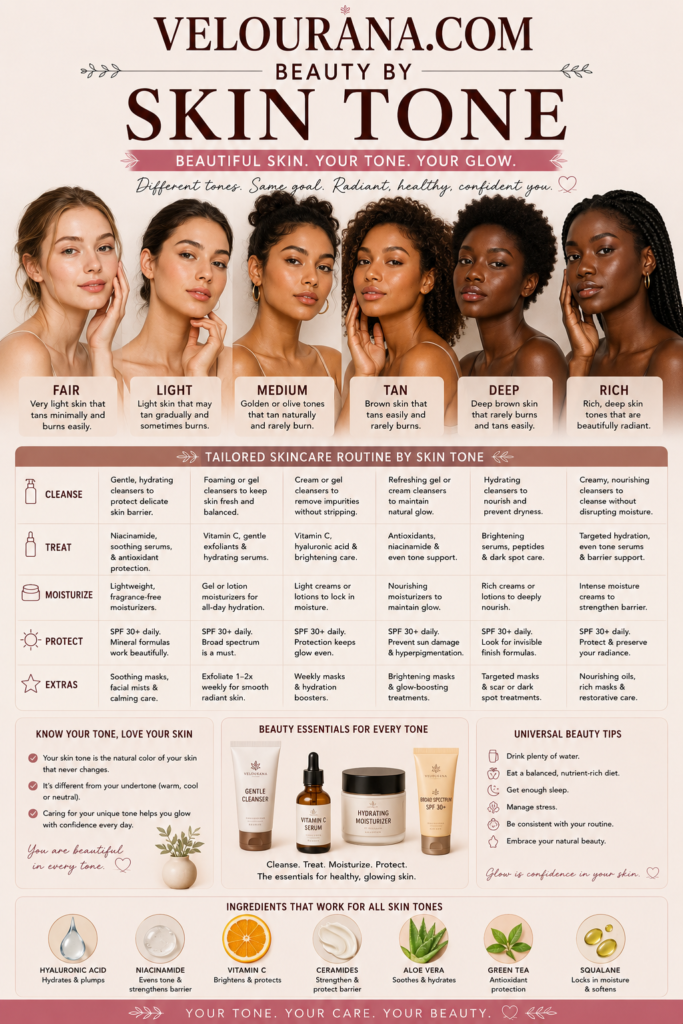
CATEGORY: Deep Skin Makeup
Deep skin possesses extraordinary visual depth. The interaction between melanin, undertone, light, texture, and color can create a complexion that appears dramatically different depending on the makeup placed over it. A foundation that looks seamless in daylight may seem unexpectedly red beneath warm indoor lighting. A blush that appears vivid in its packaging may almost disappear once blended. A highlighter that seems beautifully golden can become pale or metallic if its base is too light. These differences explain why successful makeup for deep skin depends on much more than simply choosing darker versions of familiar shades.
The most convincing makeup respects the natural dimensionality already present in the complexion. Deep skin is rarely one uninterrupted color from forehead to jawline. The center of the face may be lighter than the perimeter. The forehead can carry greater depth than the cheeks. The mouth and chin area may have naturally different pigmentation. The neck and chest can also vary from the face. None of these differences automatically need to be concealed. They are part of the complexion's natural structure, and understanding them makes it possible to create makeup that looks integrated rather than painted over.
Modern makeup for deep skin therefore begins with observation rather than correction. The objective is not to force the complexion into a single uniform shade. It is to determine where coverage is useful, where natural variation should remain visible, and which colors will maintain their character against a richly pigmented background.
Understanding the Visual Character of Deep Skin
Melanin gives deep skin an inherent richness that affects the appearance of nearly every cosmetic color. Pigments do not exist independently from the complexion beneath them. Once foundation, blush, bronzer, eyeshadow, or lipstick is applied, the color interacts visually with the skin.
This interaction becomes particularly important with sheer products. A translucent peach blush, for example, may look bright inside its compact yet become extremely subtle on deep skin because the natural complexion remains visible through the pigment. A more saturated coral, berry, terracotta, plum, or red-based shade can retain greater presence because its pigment has enough intensity to remain recognizable.
The same principle applies to eye makeup. Soft beige or pale pastel shadows may require an opaque base to show their intended color, while bronze, copper, burgundy, emerald, deep violet, rich blue, and metallic gold often gain remarkable intensity against deeper complexions.
This does not mean deep skin requires dramatic makeup. Saturation and drama are different things. A strongly pigmented product can still produce an understated result when applied lightly. In many cases, richer pigmentation actually makes subtle makeup easier because a small amount of product remains visible without requiring repeated layering.
Understanding this distinction changes the approach completely. Instead of searching only for darker colors, makeup can be selected according to depth, undertone, opacity, saturation, and finish.
Undertone Becomes Especially Important
Two people with apparently similar skin depth can require very different complexion products because their undertones differ.
Deep complexions may have warm golden, red, neutral, olive, cool, or combinations of undertones. Some skin displays noticeable warmth through the center of the face while appearing more neutral around the jaw. Others have a reddish surface tone but a more neutral underlying complexion. Olive undertones can also appear in deep skin, sometimes producing a subtle green-golden quality that conventional warm foundations fail to reproduce accurately.
This complexity explains why choosing foundation solely by whether it appears sufficiently dark can produce disappointing results.
A foundation can match depth and still be wrong.
If it contains excessive red pigment, the complexion may appear flushed or unnaturally warm. Too much yellow can create an orange or golden cast. A shade that is excessively cool may look dull or slightly gray. An incorrect olive balance can make the foundation appear disconnected from the neck.
The jawline remains one of the most useful areas for evaluating a shade because it allows the product to be compared simultaneously with the face and neck. Rather than judging a freshly applied swatch immediately, allowing it to settle can reveal whether the formula changes noticeably as it dries.
Natural daylight is particularly valuable during this evaluation. Artificial lighting can disguise undertone differences that become obvious outdoors.
The ideal match is not necessarily the foundation that disappears into one small section of the face. It is often the shade that creates the most convincing relationship between the face, jaw, neck, and visible upper chest.
Foundation Should Preserve Dimension
One of the persistent challenges in complexion makeup is the temptation to create absolute uniformity.
Applying a highly opaque foundation of identical depth over the entire face can sometimes remove the natural variation that gives deep skin its dimension. The result may technically provide perfect coverage while visually appearing flat.
A more sophisticated approach treats foundation as a balancing layer.
Where the complexion is already even, lighter coverage can allow the skin to remain visible. Areas of discoloration or uneven pigmentation can receive additional product. This controlled approach prevents unnecessary buildup and helps preserve the natural character of the complexion.
Formula matters as much as shade.
A luminous foundation can emphasize radiance, but excessive shine may become distracting in areas that naturally produce more oil. Matte foundation can offer durability and control, yet an extremely dry matte finish may diminish the richness of the skin if the surface has not been prepared properly. Natural and satin finishes often provide a middle ground, maintaining depth without creating either excessive reflection or complete flatness.
The condition of the skin beneath foundation also influences the result. Hydrated, comfortable skin generally allows complexion products to spread more evenly. Dry patches can catch pigment and make even an excellent shade appear inconsistent.
For deep skin, careful preparation has another benefit: it reduces the possibility of an ashy appearance caused by dry texture or pale product residue.
Concealer Is About Placement as Much as Brightness
Concealer can transform deep-skin makeup when its depth and undertone are chosen deliberately.
A concealer used to cover discoloration should generally remain close to the surrounding complexion. If it is significantly lighter, the corrected area can become more conspicuous than the pigmentation it was intended to disguise.
Brightening concealer serves a different purpose.
Applied beneath the eyes or through selected central areas of the face, a slightly lighter shade can create dimension. The important word is slightly. Excessive contrast between foundation and concealer can produce a sharply highlighted center that looks disconnected from the rest of the complexion.
The most refined brightening effects often come from controlled differences in depth rather than dramatic jumps between shades.
Undertone also influences correction. Areas of deeper pigmentation around the mouth or beneath the eyes may sometimes appear gray after foundation because the underlying discoloration remains visible through the base. Strategic color correction can neutralize this effect before foundation or concealer is applied.
Orange, red-orange, or related corrective tones can be useful on deeper complexions, but their intensity should correspond to the pigmentation being corrected. Too much corrector can alter the color of the complexion products layered over it.
The objective is neutralization, not creating another visible layer.
Powder Can Either Perfect or Disturb the Complexion
Powder deserves particular attention because an otherwise successful deep-skin makeup look can change dramatically after setting.
Some translucent powders contain bases that become visible on richly pigmented skin. The result may appear chalky in person or become especially obvious under flash photography. A product described as translucent is not automatically invisible on every complexion.
Finely milled powders with truly transparent finishes or tones designed for deeper skin can maintain the depth of the foundation more successfully.
Placement is equally important.
The entire face does not always require the same amount of powder. Concentrating it where makeup tends to move, crease, or become excessively shiny allows other areas to retain natural luminosity. This selective setting technique is particularly effective when the desired finish is polished rather than heavily matte.
Powder should integrate with the complexion rather than announce itself as a separate layer.
When too much is applied, the skin may lose its dimensional quality. When the shade is too pale, richness can be replaced by dullness. When the formula is excessively dry, texture can become more prominent.
The best result is often almost invisible: makeup stays in place while the complexion continues to look like skin.
Blush Can Become a Defining Feature
Deep skin can support an extraordinary range of blush colors, particularly shades with enough pigment to remain visible against the complexion.
Berry, wine, deep rose, burnt coral, brick, terracotta, plum, warm red, rich orange, and vivid fuchsia can all produce beautiful effects depending on undertone and desired intensity.
The appearance in the pan can be misleading. A shade that seems extremely strong before application may become remarkably natural once diffused over deep skin.
This is where controlled application matters.
Highly pigmented blush does not require heavy placement. Beginning with a small amount and gradually building the color preserves control. The result can range from a barely perceptible warmth to a highly editorial flush without changing products.
Placement changes the structure of the face as well. Blush concentrated on the apples creates a softer, rounded effect. Sweeping it upward toward the temples can visually lift the cheek area. Bringing a subtle amount across the upper cheek and toward the center of the face can create a more diffused, sun-touched impression.
Cream and liquid blushes can appear particularly integrated because their finish merges with foundation rather than sitting visibly above it. Powder blush remains useful for longevity and precision, especially when applied over a set base.
What matters most is sufficient color purity. Blush should retain its intended identity rather than turning dusty or disappearing into the complexion.
Bronzer Must Actually Be Deeper Than the Skin
Bronzer for deep complexions has historically been misunderstood because many products marketed as bronzers simply were not deep enough.
Bronzer is intended to introduce warmth and subtle depth. If the product is lighter than the complexion, it cannot perform that function effectively. If it contains a pale or strongly reflective base, it may create an unwanted cast instead.
Successful bronzers for deep skin tend to possess genuine depth together with warm brown, red-brown, neutral-brown, or golden-brown undertones.
The exact choice depends on the complexion.
A red-brown bronzer may harmonize beautifully with skin carrying red warmth, while a golden-brown formula can complement golden undertones. More neutral complexions may benefit from balanced browns that add warmth without becoming orange.
Bronzer and contour should not automatically be treated as the same product.
Bronzer recreates warmth. Contour creates the visual suggestion of shadow. Consequently, contour generally benefits from a more neutral or slightly cool quality, while bronzer can carry greater warmth.
On deep skin, distinguishing these roles prevents the face from becoming uniformly warm and allows sculpting to remain believable.
Contour Should Resemble Natural Shadow
Effective contour is rarely obvious.
Natural shadows are not orange, and they are not usually dramatically different from the surrounding complexion. A contour shade that is sufficiently deep but relatively neutral can create definition beneath the cheekbones, around the forehead, along the jaw, or beside the nose without appearing as a visible stripe.
Deep skin often already possesses substantial natural dimension. Contour therefore does not need to be aggressive to be effective.
The placement should respond to individual facial structure rather than follow a universal diagram. Some faces benefit from subtle cheek definition while requiring almost no forehead contour. Others may use contour primarily around the jaw or temples.
Blending is especially important because high contrast can remain visible if the contour is placed heavily and not diffused into the complexion.
Cream contours can merge beautifully with foundation and create soft transitions. Powder contours offer precision and can reinforce cream products when additional longevity is needed.
The goal is not to manufacture an entirely different face. It is to guide light and shadow while preserving the person's recognizable structure.
Highlighter and the Importance of Base Color
Highlighter can look spectacular on deep skin because luminous particles contrast beautifully with rich complexion depth. Yet this contrast also means the wrong base color becomes particularly visible.
Very pale champagne, icy silver, or white-based highlighters may leave a light stripe when viewed straight on, even if they appear attractive when catching direct light.
Gold, bronze, copper-gold, warm champagne, rose bronze, and other deeper luminous tones often integrate more naturally, although undertone remains important.
A successful highlighter should ideally look harmonious both when reflecting light and when the face is turned away from it.
This distinction separates luminosity from obvious metallic pigment.
Placement can remain restrained. The high points of the cheekbones naturally catch light and usually provide the most convincing location. Smaller amounts can be used elsewhere depending on the desired finish.
Texture should also be considered. Highly reflective products can emphasize skin texture because they draw attention to surface variations. A finely milled or softly luminous formula may create radiance without making texture the focal point.
Deep skin does not need excessive highlighter to look radiant. The complexion itself often possesses substantial visual richness; highlighter simply directs attention to selected areas.
Eye Makeup and the Power of Saturation
Deep complexions provide an exceptional background for eye color.
Warm metallics such as bronze, copper, antique gold, and deep champagne can appear luminous without creating severe contrast. Jewel tones including emerald, sapphire, amethyst, and burgundy can become especially striking. Deep browns, espresso, charcoal, and black provide definition while maintaining sophistication.
Pastels and pale shades are also possible, but their success often depends on opacity.
A pale lavender or powder blue shadow placed directly over deep skin may appear muted if the formula is sheer. Applied over an appropriate eye base, the same shade can become vivid and intentional.
This demonstrates an important principle: color selection does not have to be restricted by complexion depth, but product formulation determines whether the chosen color appears as intended.
For understated makeup, rich neutral shades can provide more definition than pale beige tones. Chocolate, caramel, warm brown, deep taupe, bronze, and espresso can create subtle transitions while remaining visible.
The concept of a "nude" eye therefore changes according to the wearer. Nude makeup is not defined by one universal palette. It is defined by colors that harmonize with the complexion while creating the desired degree of contrast.
Lip Color Can Range From Seamless to Dramatic
Lip makeup for deep skin demonstrates particularly clearly why universal ideas of nude color are inadequate.
A pale beige lipstick may create strong contrast rather than a natural effect. Nude shades for deep complexions frequently contain richer brown, caramel, cocoa, rose-brown, mauve-brown, terracotta, or berry-brown foundations.
Lip liner can become an important transitional tool. A deeper brown liner around the perimeter of the lips can help lighter center colors blend into the complexion, creating dimension without an abrupt border.
For stronger color, deep skin can carry remarkable saturation.
Classic reds can appear sophisticated when their undertone complements the wearer. Burgundy, wine, plum, deep berry, brick red, orange-red, violet, chocolate, and intensely pigmented pinks can all become focal points.
The natural pigmentation of the lips should also be considered. Many people have variation between the upper and lower lip or around the lip line. Sheer lipstick will interact with this pigmentation, while opaque formulas will cover more of it.
Neither approach is inherently preferable. The desired result determines whether natural variation should remain visible or whether a more uniform canvas is useful.
Avoiding Ashiness Without Avoiding Brightness
Ashiness is one of the most frequently discussed concerns in makeup for deep skin, yet it is useful to distinguish several possible causes.
Sometimes the issue comes from complexion products that are too light. In other cases, the depth is correct but the undertone is wrong. Pale powder can create a similar effect, as can sunscreen or skincare residue beneath makeup. Certain highlighters, primers, and finishing products can also introduce a light base that becomes visible over deeper skin.
Preventing ashiness therefore does not mean avoiding brightening products entirely.
Brightness can be beautiful when created with colors that remain compatible with the complexion. A carefully selected concealer can illuminate the under-eye area. A warm gold highlighter can create intense reflection. A vivid blush can brighten the entire face.
The problem is not brightness itself. It is a pale, incompatible base that sits visibly against the skin rather than integrating with it.
This distinction allows deep-skin makeup to remain expressive instead of becoming unnecessarily cautious.
Texture, Finish, and the Modern Skin-Like Approach
Contemporary complexion makeup increasingly favors controlled realism.
Instead of masking every variation, makeup can preserve freckles, natural pigmentation, facial dimension, and the subtle differences between areas of the face. This approach is particularly effective on deep skin because heavy uniform coverage can remove some of the tonal complexity that makes the complexion visually rich.
Skin-like makeup does not necessarily mean minimal makeup.
A face may include foundation, concealer, powder, blush, bronzer, contour, and highlighter while still appearing natural if each product is placed selectively and blended into the surrounding layers.
Texture becomes central to this effect.
Cream products can create seamless transitions. Powders can provide structure and longevity. Combining the two thoughtfully can produce a finish that survives wear without appearing excessively layered.
The order of application can also be flexible. Some makeup styles place blush or bronzer beneath foundation for an extremely diffused appearance. Others use complexion products conventionally and then soften transitions with a clean brush or sponge.
There is no single correct sequence. The visual result matters more than adherence to a rigid routine.
Makeup Should Respond to Lighting
Deep skin reacts dramatically to changes in illumination.
Warm indoor lighting can intensify red and golden undertones. Cool lighting may emphasize neutral or blue qualities. Strong sunlight reveals undertone mismatches that remain hidden indoors. Flash photography can expose powders or products containing reflective particles that are almost invisible to the naked eye.
Evaluating makeup under more than one lighting condition can therefore be useful, especially for occasions involving photography.
This does not mean the complexion must look identical everywhere. No skin tone does.
Instead, the makeup should remain coherent. Foundation should not suddenly separate visually from the neck. Powder should not become white beneath flash. Highlighter should not transform into an opaque pale stripe. Concealer should maintain a believable relationship with the surrounding complexion.
Lighting is ultimately another component of makeup design because makeup exists through reflected light.
Deep Skin Does Not Require a Single Makeup Aesthetic
There is no universal deep-skin makeup look.
One person may prefer nearly bare skin, softly defined brows, brown mascara, and muted lips. Another may enjoy intense blush, metallic eyes, sculpted cheeks, and glossy color. Both approaches can work beautifully when the products respect complexion depth and undertone.
The assumption that deep skin always requires extremely bold makeup is as limiting as the older assumption that vivid colors should be avoided.
Deep skin can support both restraint and intensity.
The difference lies in pigment selection and application. A richly pigmented blush applied lightly can create an understated flush. The same product built gradually can become editorial. A deep brown eye shadow can produce almost invisible definition when softly diffused or dramatic structure when concentrated.
Makeup becomes more versatile when color is treated as adjustable rather than predetermined.
The Most Successful Makeup Enhances What Is Already Present
Deep skin offers extraordinary possibilities because it naturally provides contrast, warmth, depth, and tonal variation.
Successful makeup does not need to erase these characteristics.
Foundation can unify without flattening. Concealer can brighten without creating an artificial mask. Blush can remain vivid without becoming overwhelming. Bronzer can add believable warmth. Contour can reinforce natural structure. Highlighter can illuminate without leaving a pale cast. Eye and lip colors can range from quiet neutrals to saturated statement shades.
The common principle is compatibility.
Every product should interact convincingly with the complexion beneath it.
When depth, undertone, saturation, texture, and finish are considered together, makeup stops functioning as a layer placed on deep skin and begins to look as though it belongs to the face itself.
That is where sophisticated deep-skin makeup becomes most compelling: not in covering richness, but in allowing that richness to remain the foundation of the entire look.
THE END VELOURANA
 Discover More From Our Family of Websites
 ZodiacBearing (Astrology, Tarot, Numerology, Angel Numbers & Spiritual Guidance)
 Velourana (Beauty, Makeup, Hair Care, Skincare & Beauty Tips)
 HavenBearing (Home, Living, Organization, Décor & Everyday Inspiration)
 PawBearing (Pet Care, Dog Breeds, Animal Health, Training & Pet Products)
 PsyCatherine (Notes From the Journal of a Psychologist on Real Life)

