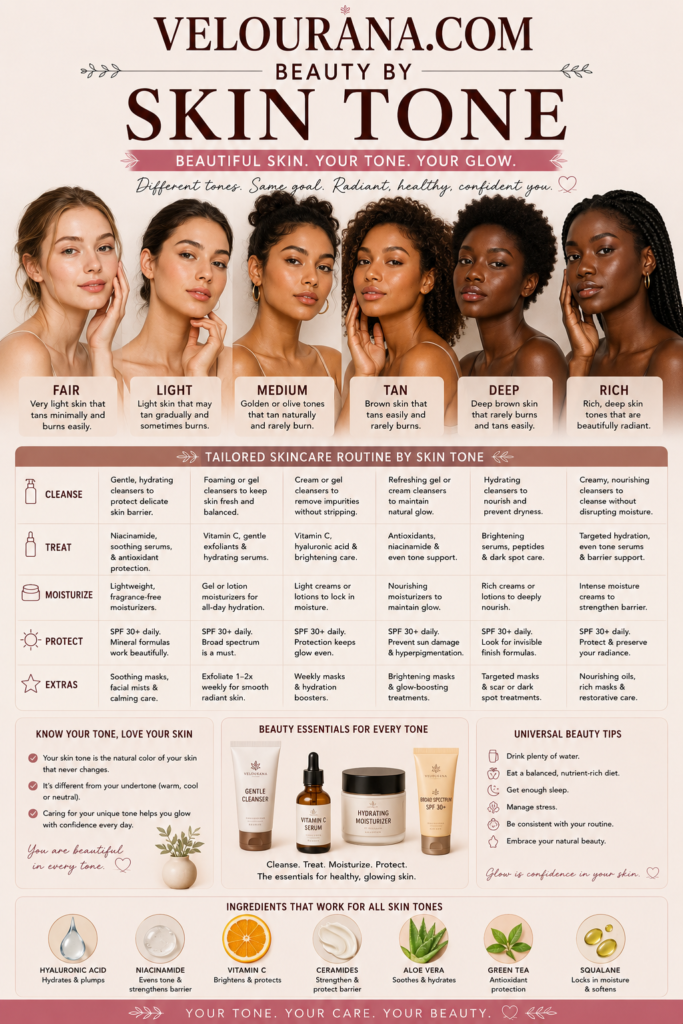
CATEGORY: Deep Skin Foundation
Choosing foundation for deep skin requires more precision than simply selecting the darkest available shade that appears reasonably close. A convincing foundation match depends on several interacting factors: actual skin depth, undertone, pigmentation patterns, formula, coverage, finish, oxidation, lighting, and the colors of products layered above and below it.
Deep complexions contain an extensive spectrum of tones. Some carry pronounced golden warmth, some have red or copper characteristics, some appear neutral, some lean olive, and others have cooler undertones. Many complexions contain characteristics that do not fit neatly into one conventional label.
Foundation becomes successful when these nuances are acknowledged.
The ideal base should visually belong to the person wearing it. It should integrate with the neck and visible body, remain believable in different lighting, and maintain the natural vitality of deep skin rather than creating an orange, red, gray, or overly uniform surface.
Why Deep Foundation Matching Can Be Complex
Foundation shade systems traditionally describe products using a combination of depth and undertone. In theory, this makes selection straightforward. In practice, terminology differs substantially between brands.
One company's neutral may appear warm in another range. A shade described as cool may contain more red than expected. Deep golden shades can vary from yellow-brown to rich amber. Olive options may be limited at deeper levels despite the existence of deep olive complexions.
Shade names provide orientation, but the skin remains the final reference.
Another complication is that the face itself may contain several depths. The forehead and perimeter can be deeper, while the center may appear lighter. Pigmentation around the mouth can create additional contrast. The neck may differ again.
Trying to find a foundation that exactly duplicates every one of these areas is impossible because the face is naturally multidimensional.
The better objective is harmony.
A good foundation should create a believable relationship between these different zones without making the complexion appear artificially uniform.
Identifying the Dominant Undertone
Undertone is often described as warm, cool, neutral, or olive, but deeper complexions can display more nuanced combinations.
Warm deep skin may carry golden, amber, peach, or red warmth. Cool deep skin may contain red, blue-red, or cooler brown characteristics. Neutral complexions can present a relatively balanced mixture without one direction dominating. Olive undertones can contain greenish or muted golden characteristics that are particularly easy to misread.
The visible surface of the skin does not always reveal undertone clearly.
Hyperpigmentation can make certain regions appear cooler or deeper. Redness can create temporary warmth. Sun exposure can alter surface coloration. Even dehydration and dryness can make skin look duller.
Observing several areas provides a more dependable impression than studying one small section.
The jaw, neck, chest, forehead, and less-pigmented portions of the face together can reveal how the complexion behaves as a whole.
Recognizing a Foundation That Is Too Warm
Excessively warm foundation on deep skin often announces itself through orange, yellow, red, or copper coloration that looks separate from the body.
The face may initially appear vibrant, which can make excessive warmth seem flattering under artificial lighting. Once viewed beside the neck or in daylight, however, the mismatch becomes clearer.
This is why warmth should not automatically be equated with radiance.
Radiance comes from finish, hydration, light reflection, and healthy-looking dimension. An orange foundation is not necessarily making the complexion more radiant; it may simply be introducing an undertone that does not naturally exist at that intensity.
If the depth seems correct but the face looks unusually orange or red, changing undertone may be more effective than changing shade depth.
Understanding Gray and Ashy Foundation
Ashiness is one of the most recognizable foundation problems on deep skin.
A pale or gray cast can occur when foundation is too light, but depth is not the only possible cause. An undertone mismatch can mute the complexion even when the foundation is technically within the correct depth family.
Products applied beneath or above foundation can contribute as well.
A sunscreen leaving a white cast can influence the finished base. A pale primer can alter foundation translucency. Excessive color corrector can show through. A setting powder that is not truly transparent on deep skin can produce a chalky finish.
When ashiness appears, evaluating the entire complexion system is therefore more useful than immediately blaming the foundation.
Removing each layer and testing the foundation alone can help identify where the unwanted cast originates.
Why Swatching on the Hand Is Unreliable
Hands are convenient but often poor references for facial foundation.
The hand may have a different depth from the face, neck, and chest because of sun exposure and natural pigmentation. Undertones can also appear different.
A foundation that disappears beautifully into the back of the hand can still look distinctly incorrect across the face.
Testing near the jaw or lower cheek provides more relevant information. The foundation can then be compared simultaneously with facial skin and the neck.
Several neighboring shades can be applied as narrow swatches. After they settle, the shade that visually recedes into the surrounding complexion is generally more promising than the one that appears attractive merely because it brightens or warms the skin.
A foundation match is not supposed to function like bronzer or highlighter. Its primary role is integration.
Allowing the Formula to Settle
Liquid foundation often changes appearance as it dries.
Immediately after application, the formula contains a particular balance of liquids, pigments, emollients, and other ingredients. As volatile components evaporate and the product forms its final film, the visible shade and finish can shift.
This is one reason foundation should not always be purchased according to a fresh swatch.
The complexion should be observed after the product has had time to settle. If possible, normal wear provides even better information because it reveals how the formula interacts with oil, skincare, sunscreen, heat, humidity, and movement.
A shade that remains harmonious throughout wear is considerably more useful than one that matches perfectly for only the first few minutes.
Choosing Coverage According to Need
Foundation coverage influences how forgiving a shade match can be.
A sheer formula allows the natural complexion to show through, meaning subtle shade differences may blend into the skin more easily. Medium coverage conceals more variation while retaining some translucency. Full coverage replaces more of the visible natural coloration and therefore makes inaccuracies more obvious.
This does not mean deep skin should avoid full coverage.
It means full coverage benefits from particularly accurate shade selection and careful application.
When only certain areas require additional correction, applying medium coverage broadly and building selectively can create a more dimensional finish than applying maximum opacity everywhere.
This technique also reduces unnecessary product around the jaw, hairline, and areas where the natural skin already looks even.
Correcting Pigmentation Without Overloading Foundation
Deep skin frequently displays pigmentation patterns that contribute to its natural dimension.
When post-inflammatory marks, pronounced unevenness, or darkness around the mouth are concerns, the instinct may be to add more foundation. Yet increasing foundation repeatedly can produce heaviness without fully correcting the underlying contrast.
Targeted correction offers another approach.
Color correction works by introducing a carefully selected hue beneath foundation to reduce the visual prominence of discoloration. On deeper complexions, richer peach, orange, red-orange, or other corrective tones may be appropriate depending on skin depth and the color of the pigmentation.
The corrector should not dominate the face.
A thin layer concentrated only where needed allows foundation to cover the corrected area with less effort. If the corrector remains strongly visible before foundation is applied, there may be more product than necessary.
Correction should simplify the complexion process rather than create another layer that must itself be concealed.
Building Foundation in Thin Layers
Thin layers provide control.
Applying a large quantity immediately can make it difficult to determine whether additional coverage is actually necessary. It can also exaggerate texture, increase transfer, and flatten the natural variation of deep skin.
Beginning with a modest amount allows the foundation to establish overall tone. Areas requiring greater coverage can then receive another controlled layer.
This approach is particularly effective when the face contains multiple natural depths.
Instead of forcing the entire complexion into the opacity of the most pigmented area, thin layering allows foundation to adapt to the face.
The technique can also improve wear because less excess product remains available to move, crease, or collect around expression lines.
Choosing Tools According to the Desired Result
The application tool changes the character of foundation.
Dense brushes can provide efficient coverage and a polished surface. Looser brushes can diffuse lighter formulas. Damp sponges can soften edges and absorb excess product, creating a more seamless finish. Fingers can warm certain formulas and provide excellent control in smaller areas.
The tool should correspond to both the formula and the intended level of coverage.
A highly absorbent sponge may remove too much of a sheer foundation. A dense brush can make a highly pigmented formula appear heavier than intended if too much product is used.
Technique matters more than loyalty to one application method.
Regardless of tool, careful blending around the hairline, ears, jaw, and mouth prevents the foundation from appearing as a separate layer.
Foundation and the Natural Perimeter of the Face
Many deep complexions naturally display greater depth around the forehead and outer face.
Covering this variation completely can remove natural structure. When foundation matching is based only on the lighter center, the perimeter can also begin to look pale or muted.
One approach is to use a shade that harmonizes with the overall complexion and apply it lightly toward the perimeter.
Another is to work with two closely related shades when the natural depth difference is substantial. The deeper shade can integrate with the outer face while the central shade maintains continuity through the middle.
This does not need to resemble obvious contouring. The transition can remain extremely subtle.
The purpose is simply to respect the complexion's existing tonal architecture.
Setting Foundation on Deep Skin
Setting products require the same attention to tone as foundation itself.
A powder can alter depth, undertone, and finish. Even powders marketed as colorless can become visible when enough product is deposited on deep skin.
Heavy powder beneath the eyes can be particularly conspicuous if it is several shades lighter than the surrounding complexion. While intentional brightening can be part of a makeup style, accidental grayness is different.
A finely applied powder that complements the base can improve longevity while maintaining richness.
Not every area requires equal powder.
The center of the forehead, nose, sides of the nose, chin, or other areas prone to movement may need more setting than the cheeks. Leaving selected areas less powdered can preserve luminosity and dimension.
The amount should correspond to actual performance needs rather than habit.
Coordinating Foundation With Bronzer and Contour
Foundation establishes the complexion, but bronzer and contour can influence whether the final shade still appears correct.
Bronzer adds warmth. On deep skin, the product needs sufficient depth and pigment to create a visible transition. A bronzer that is too light can become invisible or produce an odd dusty cast.
Contour aims to suggest shadow rather than warmth. Depending on the complexion, neutral deep browns or cooler tones may create more convincing structure than strongly red or orange products.
The distinction becomes useful because applying a very warm bronzer around an already warm foundation can push the entire complexion toward excessive orange or red coloration.
Balance matters.
Foundation does not exist independently from the colors surrounding it.
Blush and the Perception of Foundation
Blush can dramatically change how foundation reads.
Highly saturated shades often perform beautifully on deep skin because they remain visible against greater depth. Berry, wine, plum, brick, terracotta, coral, red, and vivid pink families can each create different effects.
When blush harmonizes with the undertone and overall makeup, the complexion can appear more integrated and lively.
When foundation looks unexpectedly dull after application, the problem is not always the foundation itself. A face covered in one continuous base shade naturally loses some of the color variation present before makeup.
Restoring cheek color can reveal that the base was accurate but simply needed dimension.
This is another reason foundation should be evaluated as part of a complete complexion rather than as an isolated patch of color.
Texture and Finish on Deep Complexions
Deep skin reflects light beautifully, making finish an especially influential component of foundation.
Radiant formulas can emphasize luminosity, but they may also highlight texture when highly reflective. Matte formulas can provide smooth visual control but may emphasize dry patches when the skin is insufficiently prepared.
Satin and natural finishes can offer a balance, although individual preferences and skin behavior remain more important than broad rules.
Texture should not be confused with incorrect shade.
When foundation catches on dry areas, those sections can appear lighter because of the way they reflect light. When oil breaks through, parts of the complexion may appear deeper or more saturated.
Skin preparation and finish selection therefore influence perceived color as well as physical texture.
Adapting Foundation Throughout the Year
A foundation wardrobe does not necessarily need to consist of one permanent shade.
Changes in sun exposure can shift complexion depth. Different seasons can also change skin behavior, making a formula that performs beautifully in one period less comfortable in another.
A deeper shade and a slightly lighter companion shade can provide flexibility. Mixing them in different proportions can accommodate gradual changes without requiring an entirely new search every time the complexion shifts.
Formula compatibility matters when mixing products. Foundations from the same range are generally easier to combine because their bases and finishes are designed similarly.
The mixture should still be tested after drying because combining shades can produce a final color that is not obvious from the wet mixture alone.
Evaluating Foundation Beyond the Bathroom Mirror
Foundation should be observed in several realistic conditions.
Daylight can expose undertone problems. Indoor lighting shows how the complexion appears in the environment where much of everyday life occurs. Photographs can reveal contrast between the face and body that may be less obvious in a mirror.
Distance also matters.
A foundation application can look imperfect under extreme magnification while appearing completely natural at ordinary conversational distance. Real skin contains pores, lines, texture, and movement. Attempting to eliminate all of these features often requires enough product to make the complexion look less natural overall.
The goal should be refinement rather than microscopic perfection.
When Two Foundation Shades Work Better Than One
Some deep complexions are difficult to represent with a single foundation because the difference between facial zones is significant.
Using two shades can provide a sophisticated solution.
A shade corresponding more closely to the center can be applied where appropriate, while a deeper complementary shade can integrate the perimeter. The transition should be blended so thoroughly that no visible division remains.
This method can reduce dependence on heavy contour because some natural dimension is already preserved through the base.
It can also be useful when a person's exact depth lies between two commercial shades. Mixing adjacent colors can produce a closer match than accepting either one independently.
Foundation should adapt to the complexion rather than requiring the complexion to fit neatly into the limitations of a shade chart.
The Most Important Standard: Visual Harmony
Rules about foundation are useful only when they lead toward a believable result.
A technically correct undertone label is irrelevant if the shade visibly clashes with the skin. A foundation described as full coverage does not need to be applied heavily. A matte product does not need to eliminate every trace of luminosity. A radiant formula does not need to remain shiny everywhere.
Deep skin foundation works best when the finished complexion appears coherent from face to neck and when natural richness remains present.
The most successful application often becomes visually quiet. Foundation stops attracting attention as a separate product and begins functioning as part of the complexion.
That effect comes from accuracy rather than excess.
Correct depth establishes the foundation of the match. Appropriate undertone prevents orange, red, or gray distortion. Thoughtful coverage preserves dimension. Compatible skincare supports texture. Controlled powder maintains richness. Complementary cheek products restore the color variation that naturally gives a face life.
Deep skin does not require simplification into one uniform brown shade. Its beauty lies partly in its complexity.
Foundation reaches its highest purpose when it works with that complexity: evening where desired, correcting where necessary, and preserving enough natural variation that the finished complexion remains recognizably, convincingly skin.
THE END VELOURANA
 Discover More From Our Family of Websites
 ZodiacBearing (Astrology, Tarot, Numerology, Angel Numbers & Spiritual Guidance)
 Velourana (Beauty, Makeup, Hair Care, Skincare & Beauty Tips)
 HavenBearing (Home, Living, Organization, Décor & Everyday Inspiration)
 PawBearing (Pet Care, Dog Breeds, Animal Health, Training & Pet Products)
 PsyCatherine (Notes From the Journal of a Psychologist on Real Life)