
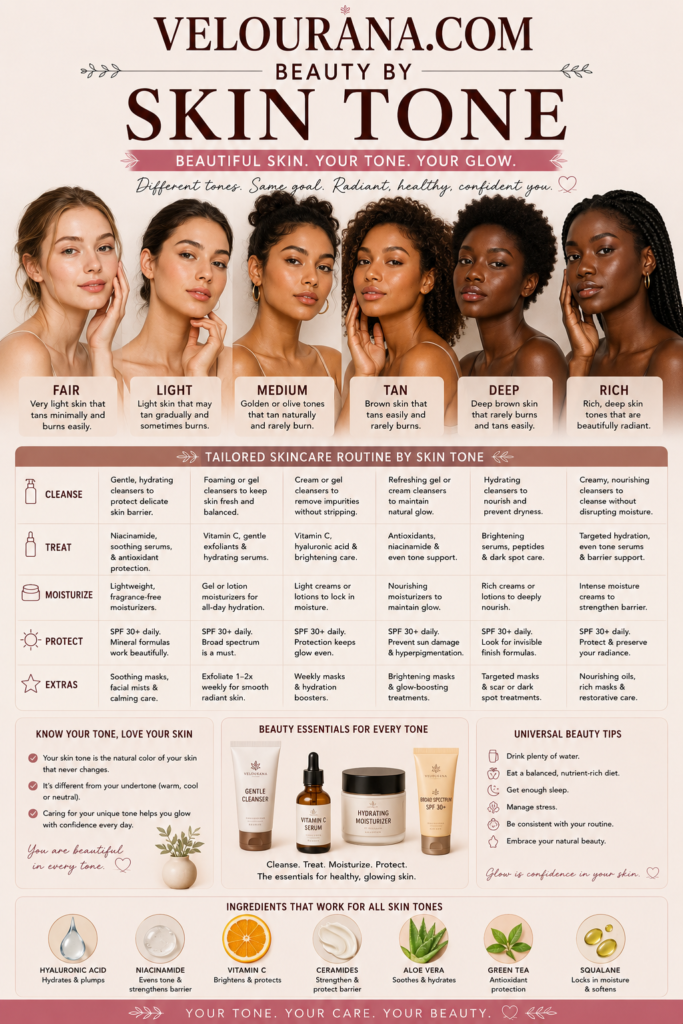
CATEGORY: Deep Skin Foundation
Foundation for deep skin is at its most successful when it respects the natural complexity of deeper complexions rather than attempting to flatten them into a single uniform shade. Deep skin can carry extraordinary richness, depth, warmth, neutrality, coolness, and variation across different areas of the face. The purpose of foundation is therefore not simply to cover the skin. It is to create a refined complexion while allowing the character and dimension of the skin to remain visible.
For many people with deep complexions, choosing foundation has historically involved compromises. Shades may appear promising in the bottle but become orange, red, gray, dull, or unusually dark after application. Some ranges offer depth without sufficient undertone diversity, while others jump dramatically between neighboring shades. Even when the correct color exists, application technique, lighting, oxidation, skin preparation, and surrounding makeup colors can influence whether the finished complexion looks harmonious.
A sophisticated approach begins with understanding that depth and undertone are separate characteristics. Two people may have similarly deep skin while requiring foundations with entirely different undertones. Recognizing this distinction transforms foundation selection from guesswork into a much more precise process.
Understanding the Dimension Within Deep Skin
Deep skin is not one uninterrupted field of identical color. The forehead may naturally appear deeper than the center of the face. The area around the mouth can have additional pigmentation. The cheeks may display greater warmth, while the jaw and neck can appear more neutral. These variations are normal features of the complexion.
Attempting to eliminate every difference with a highly opaque foundation can create an artificial effect. A shade chosen specifically to cover the deepest pigmentation may become too dark across the rest of the face. Conversely, choosing foundation according only to the lightest central area can produce an obvious contrast along the jawline.
The most convincing complexion generally preserves some natural variation. Foundation can soften unevenness while still allowing the face to retain dimension.
This becomes particularly important when using medium-to-full coverage formulas. Greater pigmentation gives foundation more visual authority. If the shade or undertone is slightly inaccurate, the discrepancy may become more noticeable as coverage increases.
For this reason, shade accuracy becomes increasingly important when a foundation is intended to cover most of the natural skin beneath it.
Depth Is Only the Beginning
A foundation can be technically deep enough and still look incorrect.
Depth describes how light or dark a foundation appears. Undertone describes the underlying color direction within that depth. Deep foundations can have warm golden, red, neutral, olive, cool, or combinations of these characteristics.
A foundation that is too golden may become conspicuously yellow or orange. A shade containing excessive red may intensify redness or appear disconnected from a more neutral neck. A formula that lacks sufficient warmth can create the familiar gray or ashy appearance that sometimes occurs on deep complexions.
The difficulty is that undertones are not always visually obvious. Surface pigmentation, tanning, lighting, redness, hyperpigmentation, and even clothing can alter perception.
Instead of judging undertone from one small area of the face, it is useful to consider the relationship between the face, jaw, neck, and upper chest. The objective is not necessarily to identify one perfect color appearing everywhere. It is to determine which foundation creates the most natural transition across the visible complexion.
Why Undertone Accuracy Matters So Much
Deep foundation contains enough pigment that undertone differences can become pronounced. A slight undertone mismatch in a sheer skin tint may remain relatively forgiving because much of the natural complexion remains visible. The same discrepancy in a full-coverage foundation can dominate the entire face.
Ashiness is one of the clearest examples.
A gray cast does not necessarily mean that the foundation is simply too light. It can also indicate an undertone conflict. When a shade lacks the warmth, redness, neutrality, or olive character present in the complexion, the resulting mixture can look muted and lifeless.
Likewise, excessive orange coloration does not automatically mean that a foundation is too dark. The depth may actually be appropriate while the undertone contains too much warmth.
Separating these two variables makes shade adjustment considerably easier. Before moving lighter or darker, determine whether depth is actually the problem.
Matching the Face, Neck, and Chest
There is no universal rule stating that foundation must exactly match one particular location.
For some people, the jaw and neck provide an excellent reference. For others, the face may naturally be substantially deeper or lighter than the neck. The upper chest can sometimes provide another useful point of comparison, especially when it is regularly visible with clothing.
The ideal match is generally the one that creates visual continuity rather than an obvious boundary.
Testing foundation near the lower cheek and jaw allows the shade to be observed against both facial and neck coloration. A successful shade should integrate into the surrounding skin rather than forming a visible stripe.
The swatch should also be allowed to settle. Freshly applied liquid foundation may not represent its final appearance. As water and volatile ingredients evaporate and the formula interacts with skin oils, the color can shift.
This is why an immediate store swatch can occasionally be misleading.
Oxidation and Deep Foundation Shades
Oxidation is often discussed whenever foundation becomes darker or warmer during wear, although several processes can contribute to visible color change.
The formula may dry down differently from its wet appearance. Natural oils can alter the way pigments look. Skincare underneath the foundation can affect the finish. Powder, bronzer, blush, and setting products can also change the overall perception of the base.
Deep shades may make these shifts particularly noticeable because even a modest movement toward red, orange, or deeper brown can influence the balance of the entire complexion.
When evaluating a new foundation, applying a controlled swatch and observing it after it has dried is more informative than relying exclusively on its initial appearance.
Testing it during normal wear is even more useful. A foundation that looks beautiful for five minutes but changes substantially after several hours may require a different shade, formula, preparation method, or combination of products.
Skin Preparation Determines the Quality of the Finish
Foundation cannot completely compensate for an unsuitable surface beneath it.
Dryness can make pigment collect around texture and create patches that appear lighter or duller. Excess oil can cause foundation to separate, shift, or become increasingly reflective. Dehydrated skin can simultaneously feel tight while producing oil, complicating the behavior of complexion products.
Preparation should therefore respond to the skin rather than follow an inflexible ritual.
A comfortable layer of skincare can help foundation spread more evenly. Heavy layers of incompatible products, however, may encourage slipping or pilling. Allowing skincare and sunscreen sufficient time to settle can improve the stability of the makeup applied above them.
Deep skin also makes certain residues particularly visible. Sunscreens, primers, powders, and creams that leave a pale cast can influence the appearance of foundation even when the foundation shade itself is accurate.
The base beneath foundation should therefore be considered part of the final color equation.
Coverage Should Serve the Complexion
More coverage is not automatically better coverage.
Sheer foundation allows much of the natural complexion to remain visible and can work beautifully when the goal is subtle refinement. Medium coverage offers greater evening while preserving some translucency. Full coverage can be valuable when stronger correction is desired, but it demands careful shade matching and thoughtful application.
Deep complexions often contain localized areas of pigmentation that do not require the entire face to receive equally heavy coverage.
Strategic application can create a more natural result. Foundation can establish overall harmony, while additional concealer or corrective products can address specific areas where greater opacity is wanted.
This avoids building multiple layers of foundation across skin that does not need them.
The result is often lighter in appearance, more dimensional, and more resistant to looking mask-like.
Working With Hyperpigmentation
Hyperpigmentation is common across many skin tones and can be especially visually prominent on deeper complexions. Areas around the mouth, cheeks, forehead, or sites of previous blemishes may be darker than surrounding skin.
One of the common mistakes is choosing foundation according to the darkest marks rather than the broader complexion.
This can make unaffected areas appear unnecessarily deep. Alternatively, repeatedly layering a lighter foundation over dark pigmentation can create a muted or gray result.
When stronger correction is desired, localized color correction can reduce the amount of foundation required. Corrector shades should be chosen carefully and used sparingly. The intention is to neutralize unwanted contrast beneath complexion products, not to create another visible layer of color.
A thin, controlled application generally integrates more naturally than a large amount of corrective pigment.
Applying Foundation Without Losing Natural Depth
Application technique affects both coverage and perceived shade.
A dense brush can deliver substantial pigment quickly. A damp makeup sponge can soften application and remove excess product. Fingers can work effectively with certain lightweight or flexible formulas. None of these methods is universally superior.
The important principle is control.
Beginning with a small amount of foundation makes it easier to preserve natural skin dimension. Product can then be added selectively where more coverage is useful.
Starting in areas requiring the most evening and blending outward can prevent unnecessary buildup along the hairline and jaw. This is especially helpful when the perimeter of the face naturally carries a different depth from the center.
Blending should not mean spreading foundation indefinitely. Excessive manipulation can lift product, expose uneven areas, and create streaking. Once a section looks integrated, allowing it to settle is often more effective than repeatedly working over it.
The Role of Concealer
Concealer can support foundation without replacing the natural architecture of the face.
A complexion does not need dramatically lighter concealer beneath the eyes to appear finished. Very bright concealer can create striking contrast, but it can also disconnect the central face from the surrounding skin if the difference is excessive.
For natural correction, a concealer close to the foundation depth or only modestly lighter can create continuity.
When a brighter effect is intentionally desired, undertone remains important. A lighter concealer that becomes yellow, pink, or gray against the surrounding foundation may look more conspicuous than its depth difference alone would suggest.
Concealer around the mouth or over pigmentation often works best when it closely corresponds to the foundation rather than functioning as a highlighting shade.
Different areas can therefore benefit from different concealer strategies.
Powder Without Ashiness
Powder can transform an excellent deep-skin foundation into an ashy complexion if its tone is unsuitable.
Some powders described as translucent are not completely invisible on every depth of skin. Pale mineral particles or an overly white base can leave a visible cast, particularly when applied generously.
A powder that looks almost invisible in a light application may become chalky when heavily layered.
Using the smallest effective quantity is therefore valuable. Powder can be concentrated where foundation tends to move, crease, or become excessively shiny rather than automatically covering every part of the face.
Tinted powders designed for deeper complexions can provide another option, although their undertone should complement the foundation beneath them.
The goal is to set the complexion without replacing its richness with a flat veil.
Restoring Dimension After Foundation
Even a perfectly matched foundation can make the face appear flatter when applied uniformly.
Natural faces contain changes in depth created by bone structure, light, pigmentation, and contour. Foundation reduces some of these differences. Bronzer, blush, contour, and highlight can restore dimension, but they should complement rather than compete with the base.
On deep skin, bronzer must be sufficiently deep to remain visible. A product only marginally deeper than the foundation may disappear entirely. Undertone also influences whether bronzer produces believable warmth or an unnatural orange or red cast.
Contour serves a different purpose. It creates the visual impression of shadow and therefore generally benefits from a more neutral or cool-leaning character than a warming bronzer.
Blush can bring remarkable vitality to deep complexions. Rich berries, reds, terracottas, plums, corals, and saturated pinks can interact beautifully with deeper skin, depending on undertone and desired effect.
The foundation beneath these products should function as a coherent canvas rather than an opaque mask.
Natural, Matte, and Radiant Finishes
Finish can dramatically alter how foundation color is perceived.
Matte formulas absorb or reduce visible shine and can create a polished, controlled complexion. Extremely flat matte finishes, however, may emphasize dryness or make deep skin appear less dimensional if applied heavily.
Radiant formulas reflect more light and can emphasize the natural luminosity of the complexion. Excessive shine may become difficult to distinguish from oiliness in certain areas, particularly after extended wear.
Natural and satin finishes occupy a versatile middle ground and often allow skin to retain dimension without becoming excessively reflective.
Finish does not need to be identical across the entire face. Strategic powdering can reduce shine through the center while leaving the cheeks more luminous. This approach can create a sophisticated balance between longevity and natural radiance.
Foundation in Different Lighting
A foundation match should not be judged under only one light source.
Artificial lighting can distort color dramatically. Warm bulbs can make foundation appear more golden. Cool lighting can exaggerate grayness. Strong overhead illumination can create shadows that alter perceived depth.
Natural daylight is extremely useful for evaluating complexion products because it often reveals undertone discrepancies that indoor lighting disguises.
Photography introduces another variable. Flash, camera processing, exposure, and powder ingredients can influence the recorded appearance of makeup. A complexion that looks balanced in person may photograph differently.
For everyday foundation selection, the most important reference should remain the environment in which the makeup will actually be worn. Photography can be considered when relevant, but it should not automatically override how the complexion appears to the eye.
Seasonal Changes and Shade Flexibility
Deep skin can change in depth throughout the year.
Sun exposure may deepen visible areas of the face and body. Reduced exposure can gradually shift the complexion lighter. These changes may be subtle or substantial depending on the individual.
A foundation that works perfectly during one season may therefore become less accurate later.
Some people maintain more than one shade and use them separately or combine them as needed. Mixing can also accommodate differences between the center and perimeter of the face, provided the formulas are compatible.
This flexibility is often more practical than expecting one bottle to remain exact throughout every seasonal change.
The key is to observe the complexion rather than remaining loyal to a shade simply because it once matched.
Foundation as Enhancement Rather Than Erasure
The most refined deep-skin foundation application does not attempt to remove every visible sign of real skin.
Texture remains texture. Natural pigmentation can remain part of the face. Different areas can retain subtle variations in depth. Luminosity does not need to disappear beneath powder.
A successful foundation creates cohesion.
When depth is appropriate, undertone is harmonious, coverage is controlled, and preparation supports the formula, foundation becomes less noticeable. Attention returns to the complexion itself rather than to the makeup sitting on top of it.
Deep skin offers enormous tonal richness. Foundation works best when it respects that richness, allowing the complexion to appear polished without becoming visually simplified.
The objective is not a single flat color from forehead to jaw. It is a balanced, dimensional finish in which foundation supports the natural beauty and complexity already present in the skin.
THE END VELOURANA
 Discover More From Our Family of Websites
 ZodiacBearing (Astrology, Tarot, Numerology, Angel Numbers & Spiritual Guidance)
 Velourana (Beauty, Makeup, Hair Care, Skincare & Beauty Tips)
 HavenBearing (Home, Living, Organization, Décor & Everyday Inspiration)
 PawBearing (Pet Care, Dog Breeds, Animal Health, Training & Pet Products)
 PsyCatherine (Notes From the Journal of a Psychologist on Real Life)

