
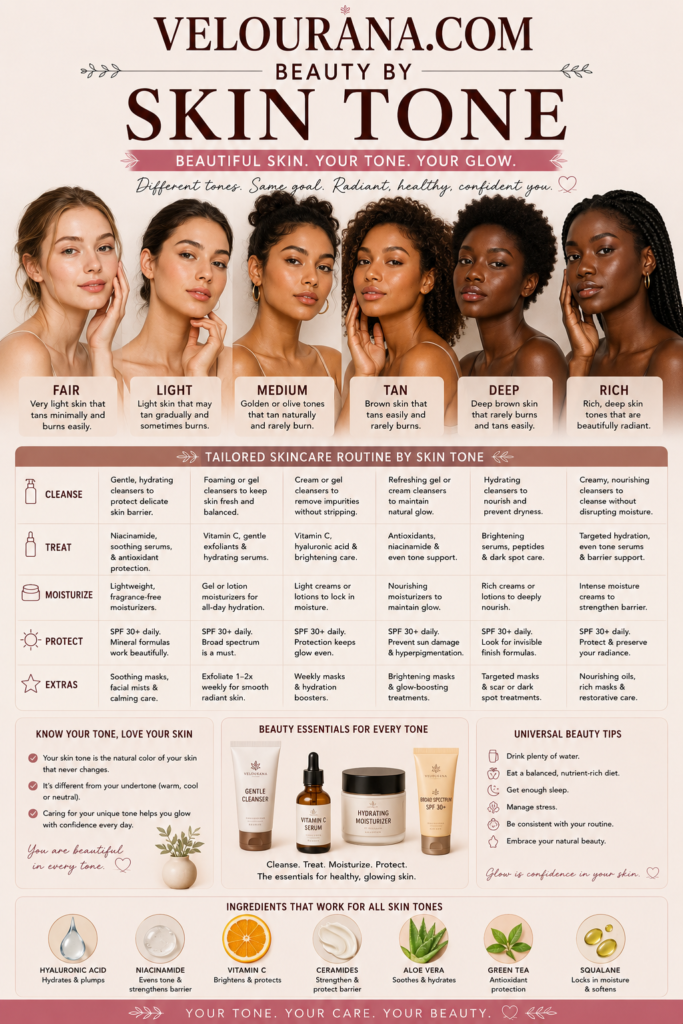
CATEGORY: Dark Skin Colors
Dark skin is not a single color. It is an extraordinary spectrum of complexions shaped by melanin concentration, undertones, genetics, ancestry, environmental influences, and the way light interacts with the surface of the skin. From deep golden brown and warm mahogany to rich espresso, reddish ebony, neutral cocoa, and blue-black tones, darker complexions contain remarkable variation that deserves to be understood rather than compressed into one broad description.
Color matters in beauty because the visible shade of the skin influences how makeup appears, how pigmentation changes are perceived, how certain colors interact with the complexion, and how unevenness may become visible. Yet skin color alone never determines skin type. A person with deeply pigmented skin can have dry, oily, combination, sensitive, resilient, acne-prone, dehydrated, or mature skin. Understanding dark skin colors therefore begins with separating complexion depth from the biological characteristics that determine how skin behaves.
The beauty of deeply melanated skin becomes especially apparent when it is viewed closely. What may initially appear to be a uniform brown complexion can reveal golden, red, olive, neutral, or cool dimensions. These subtleties affect everything from foundation matching to the appearance of hyperpigmentation and the colors that create harmony or contrast around the face.
A thoughtful approach to dark skin celebrates this diversity while recognizing that melanin-rich complexions have particular considerations regarding visible discoloration, sun protection, cosmetic formulation, and color selection. Rather than treating darker skin as a variation of a lighter standard, modern beauty increasingly recognizes it as an expansive category with its own remarkable range.
The Spectrum Within Dark Skin
The phrase dark skin describes a broad range of complexions rather than one specific shade. Even people who appear to have similar skin depth can possess dramatically different underlying colors.
Some deep complexions have a luminous golden quality. Others contain strong red or copper influences that become especially noticeable in sunlight. Some appear almost neutral, balancing warm and cool characteristics, while others have distinctly cool, bluish, or violet undertones.
The visible color of skin is created through several interacting biological and optical factors. Melanin plays the dominant role, particularly eumelanin, the brown-to-black pigment responsible for much of the depth seen in darker complexions. Blood circulation beneath the skin contributes red and blue tones, while carotenoids can add subtle yellow or golden influences.
The result is a living color rather than a flat shade.
This explains why descriptions such as brown, dark brown, or black rarely capture the true complexity of melanated skin. Two people categorized within the same general depth can look entirely different beside one another because their undertones and surface tones differ.
Lighting can further transform perception. Warm indoor illumination may intensify gold and red qualities, while cool daylight may reveal neutral or blue characteristics. Photography, camera processing, screen settings, and surrounding clothing colors can also alter how complexion depth appears.
For beauty purposes, therefore, understanding dark skin requires observing both depth and undertone rather than relying on a single color label.
Melanin and the Creation of Deep Complexion
Melanin is produced by specialized cells called melanocytes. Human beings generally possess similar numbers of melanocytes, but differences in melanin production, distribution, type, and persistence contribute significantly to variation in skin color.
In deeply pigmented skin, melanosomes—the structures that contain melanin—tend to be larger, more heavily melanized, and distributed differently through epidermal cells. This contributes to deeper and often more persistent pigmentation.
Melanin serves important biological functions. Most notably, it absorbs and disperses ultraviolet radiation, providing some natural photoprotection. This does not mean dark skin is immune to ultraviolet damage. Sunburn, photoaging, DNA damage, and skin cancer remain possible, making appropriate sun protection important across every complexion.
Higher melanin activity also influences how the skin responds after inflammation. Acne lesions, irritation, burns, cuts, insect bites, eczema, and aggressive cosmetic treatments may stimulate pigment production. The resulting post-inflammatory hyperpigmentation can persist long after the original inflammation disappears.
This relationship between melanin and inflammation is one reason maintaining a calm, healthy skin barrier can be especially important for people concerned about uneven coloration in dark skin.
Melanin should therefore be understood not simply as the pigment that creates beautiful complexion depth, but as an active biological component of the skin that responds dynamically to environmental and inflammatory signals.
Warm Dark Skin Colors
Warm dark complexions contain noticeable golden, yellow, peach, copper, orange, or red influences beneath their overall depth.
Deep golden skin can appear radiant under sunlight, with warmth becoming particularly visible across the forehead, cheeks, shoulders, and other areas where light naturally reflects. Rich caramel-brown complexions may contain golden or honey undertones even when their overall depth is considerable.
Copper and reddish-brown complexions can appear especially vibrant. Mahogany is often used descriptively for deep brown skin with red warmth, although real skin is naturally more complex than any single color comparison.
Warm undertones influence cosmetic color harmony. Gold, bronze, copper, terracotta, warm berry, coral, rich orange-red, and many earthy shades may interact beautifully with warm melanated complexions. Yet undertone should never become a rigid rule. Contrast can be equally striking, and individual preference remains central to personal style.
Foundation matching can become challenging when deep shades are produced primarily with red pigments. A genuinely golden or neutral dark complexion may look orange or overly red when paired with such formulas.
Accurate complexion products therefore need enough tonal variation to distinguish depth from undertone.
Cool Dark Skin Colors
Cool dark skin may contain blue, violet, reddish-blue, or subtly pink influences beneath the dominant brown pigmentation.
At the deepest end of the complexion spectrum, cool undertones can create an exceptionally rich appearance sometimes described as ebony, deep espresso, or blue-black. These descriptions are visual references rather than precise biological categories, but they illustrate how darkness can coexist with distinctly cool tonal qualities.
Cool undertones may become particularly visible when the skin is compared with warm-colored clothing or jewelry. Jewel tones such as sapphire, emerald, amethyst, cool red, magenta, and certain berry shades can create dramatic relationships with cool deep complexions.
Foundation matching for cool dark skin has historically presented difficulties because insufficient shade ranges sometimes forced consumers to choose between products that were too light and products with excessive orange or red warmth.
An accurate foundation should disappear into the complexion rather than impose an artificial undertone.
The face itself may contain multiple tones. The forehead and perimeter can be deeper, while the center of the face may appear lighter. Around the mouth, pigmentation may be naturally deeper. These variations are normal and can make matching a single foundation shade more nuanced.
Neutral and Olive Dimensions in Dark Skin
Not every complexion fits neatly into warm or cool classifications. Neutral dark skin contains a relatively balanced mixture of tonal characteristics, while olive complexions can contain greenish, muted golden, or slightly gray influences.
Deep olive skin is frequently misunderstood because olive coloration is often associated primarily with medium complexions. In reality, olive undertones can occur across a much wider range of skin depths.
A deep olive complexion may appear warm in one environment and almost neutral in another. Foundations that contain too much orange can look conspicuous, while formulas that are too cool may appear gray.
Neutral complexions can experience similar difficulties because heavily undertoned foundation formulas may distort their natural balance.
Recognizing these subtle categories helps explain why simply making a foundation darker does not create an inclusive shade range. Depth and undertone must develop together.
The same principle applies to concealers, powders, bronzers, contour products, and tinted sunscreens. Pigments that work beautifully at one depth may become chalky, gray, orange, or ashy when transferred directly to another.
Why Dark Skin Can Appear Ashy
Ashiness is one of the most recognizable visual changes in deeper skin tones. It occurs when the surface develops a pale, grayish, or whitish appearance that contrasts strongly with the underlying complexion.
Dryness is a common cause. When the outermost layer of the skin becomes rough and dehydrated, microscopic changes in its surface alter the way light is reflected. On deeply pigmented skin, this can create a particularly visible gray cast.
Residue from skincare or sunscreen can produce a similar effect. Some mineral filters and poorly formulated creams leave a visible white film that becomes increasingly noticeable as skin depth increases.
Ashiness does not mean dark skin is inherently dry. Oily dark skin can also become dehydrated, and combination complexions may display ashiness in certain areas while remaining shiny elsewhere.
Gentle cleansing, adequate moisturization, barrier-supportive ingredients, and cosmetically elegant sun protection can help preserve the natural richness of the complexion.
The objective is not artificial shine. Healthy-looking dark skin can be matte, satin, luminous, or naturally textured. The goal is simply to prevent unwanted surface dullness caused by dryness or product residue.
Natural Variation Across the Face and Body
Human skin is rarely perfectly uniform.
Dark complexions may show particularly visible variations because small changes in pigment concentration can produce noticeable differences in depth. The forehead may naturally appear darker than the cheeks. The area around the mouth can carry deeper pigmentation. Eyelids may be darker, while the central face may appear brighter.
The body also contains natural variation. Elbows, knees, knuckles, underarms, inner thighs, and areas exposed to friction frequently appear darker. Palms and soles are naturally lighter because melanin regulation differs in these regions.
Not every difference in coloration needs correction.
Beauty culture has sometimes encouraged unrealistic expectations of perfectly uniform skin, leading people to treat normal pigmentation as a defect. A healthier perspective distinguishes natural variation from discoloration that is new, bothersome, or associated with irritation.
Attempts to aggressively lighten naturally darker areas can damage the skin barrier and paradoxically increase pigmentation through inflammation.
Even-looking skin should therefore not be confused with uniformly colored skin. Healthy human skin has dimension.
Hyperpigmentation and Dark Complexions
Hyperpigmentation occurs when areas of skin become darker because of increased melanin production or distribution. It can affect every skin tone, but certain forms can be particularly persistent or visually significant in deeply pigmented complexions.
Post-inflammatory hyperpigmentation is especially important. After acne, irritation, eczema, injury, or other inflammation, melanocytes can increase pigment production. A blemish that heals within days may leave a dark mark that remains visible for weeks or months.
Preventing unnecessary inflammation can therefore be as important as treating pigmentation afterward.
Aggressive scrubbing, frequent picking, harsh exfoliation, and overly strong skincare combinations can create cycles in which irritation produces additional discoloration.
Ingredients commonly incorporated into routines addressing uneven pigmentation include niacinamide, azelaic acid, vitamin C derivatives, retinoids, and carefully selected exfoliating acids. Their suitability depends on the individual skin condition, formulation, concentration, and tolerance.
Patience matters. Pigmentation exists at different depths within the skin, and visible improvement is often gradual.
Sun protection also remains important because ultraviolet and visible light can contribute to persistent pigmentation.
Sun Protection Across Deep Skin Colors
Melanin provides meaningful natural protection against ultraviolet radiation, but it does not replace sunscreen or other forms of sun protection.
Dark skin can still experience sunburn and cumulative photodamage. Ultraviolet exposure can also worsen existing hyperpigmentation and contribute to uneven tone.
One historic obstacle has been cosmetic acceptability. Sunscreens that leave a white or purple cast can be extremely visible on dark complexions, discouraging consistent application.
Modern formulations increasingly address this through transparent chemical filters, improved dispersion technologies, tinted formulations, and more elegant textures.
A sunscreen that suits dark skin should protect effectively while integrating comfortably into the person's routine. Finish matters because a product that feels greasy, looks chalky, or interferes with makeup may be used less consistently.
Tinted products can be useful for some people concerned with visible-light-related pigmentation, although the available tint must actually suit the complexion. A supposedly universal tint that appears beige or orange on deep skin is not truly universal.
Sun protection is most successful when both dermatological effectiveness and cosmetic wearability are considered.
Makeup Color and Deep Complexions
Dark skin offers exceptional possibilities for color cosmetics because its depth can support both saturated shades and sophisticated neutrals.
Highly pigmented jewel tones can appear vivid against rich complexions. Metallic gold, bronze, copper, rose gold, and deep silver can interact beautifully with different undertones. Bright colors that may dominate lighter complexions can appear balanced and expressive on deeper skin.
Neutral makeup requires equal attention. Nude lipstick, for example, is not a universal beige. A convincing nude on deep skin may involve brown, caramel, mauve, cocoa, rose, plum, or terracotta depending on undertone and natural lip pigmentation.
Blush needs sufficient pigment to remain visible. Deep berry, wine, burnt orange, brick, rich rose, plum, and vibrant coral shades can create effects ranging from subtle warmth to dramatic color.
Bronzer should add warmth rather than simply appear darker. Contour should create believable shadow rather than leave a gray stripe. Highlighter should reflect light without producing an unwanted pale cast.
The fundamental principle is that color cosmetics must be designed with the complexion itself in mind rather than merely adapted from formulas originally developed for lighter skin.
Foundation Matching Beyond a Single Shade
Foundation matching for dark skin often requires understanding the architecture of facial pigmentation.
Many people have a darker forehead, temples, jawline, or area around the mouth. Matching only the lightest part of the face can create an artificial mask, while matching only the deepest area may unnecessarily darken the center.
The neck and chest also matter because the face should appear harmonious with visible surrounding skin.
Oxidation can complicate selection. Some foundations become darker or warmer after application because of interactions between pigments, oils, air, and skin chemistry. Testing a product and allowing it to settle before evaluating the shade can therefore be useful.
Undertone accuracy is equally important. A foundation can be technically dark enough while still looking wrong because it contains excessive red, orange, yellow, or gray.
Inclusive complexion design requires more than adding a handful of deep shades at the end of a range. Deep complexions deserve the same nuanced undertone choices routinely expected elsewhere in the spectrum.
Caring for the Richness of Dark Skin
The most effective skincare philosophy for dark skin is not based on changing its natural color. It is based on maintaining barrier health, comfort, hydration, protection, and clarity while addressing specific concerns appropriately.
Gentle cleansing helps remove impurities without unnecessarily stripping protective lipids. Moisturization supports the surface barrier and can reduce visible ashiness. Sun protection helps limit environmental damage and pigment persistence.
Treatment products should be introduced according to actual concerns rather than complexion alone.
Someone with dark oily skin may benefit from a very different routine than someone with dark dry skin. Sensitive skin requires different considerations from resilient skin. Acne, eczema, melasma, post-inflammatory pigmentation, and signs of aging each require individualized approaches.
The richness of deeply melanated skin is already present. Good skincare should support it rather than attempt to replace it with an artificial ideal.
Dark Skin as a Multidimensional Beauty Spectrum
Understanding dark skin colors ultimately requires abandoning the idea that darkness itself is one color.
Deep skin can be golden, bronze, copper, red-brown, neutral, olive, cool brown, espresso, ebony, or almost blue-black. It can shift visually under different light. It can contain multiple depths across one face. It can be luminous or matte, freckled or uniform, warm or cool, highly reactive or remarkably resilient.
This complexity is precisely what makes dark skin such a fascinating part of the human complexion spectrum.
Beauty becomes more accurate when it recognizes these distinctions. Foundation ranges become more realistic. Makeup colors become more intentional. Skincare recommendations become more individualized. Photography becomes more respectful of actual skin depth. Consumers gain better tools for understanding their own complexions.
Dark skin does not need to be interpreted through comparison with lighter skin. Its colors deserve to be understood on their own terms—as a vast, sophisticated, and naturally varied spectrum shaped by biology, ancestry, environment, and individuality.
The End Velourana
 Discover More From Our Family of Websites
 ZodiacBearing (Astrology, Tarot, Numerology, Angel Numbers & Spiritual Guidance)
 Velourana (Beauty, Makeup, Hair Care, Skincare & Beauty Tips)
 HavenBearing (Home, Living, Organization, Décor & Everyday Inspiration)
 PawBearing (Pet Care, Dog Breeds, Animal Health, Training & Pet Products)
 PsyCatherine (Notes From the Journal of a Psychologist on Real Life)

