
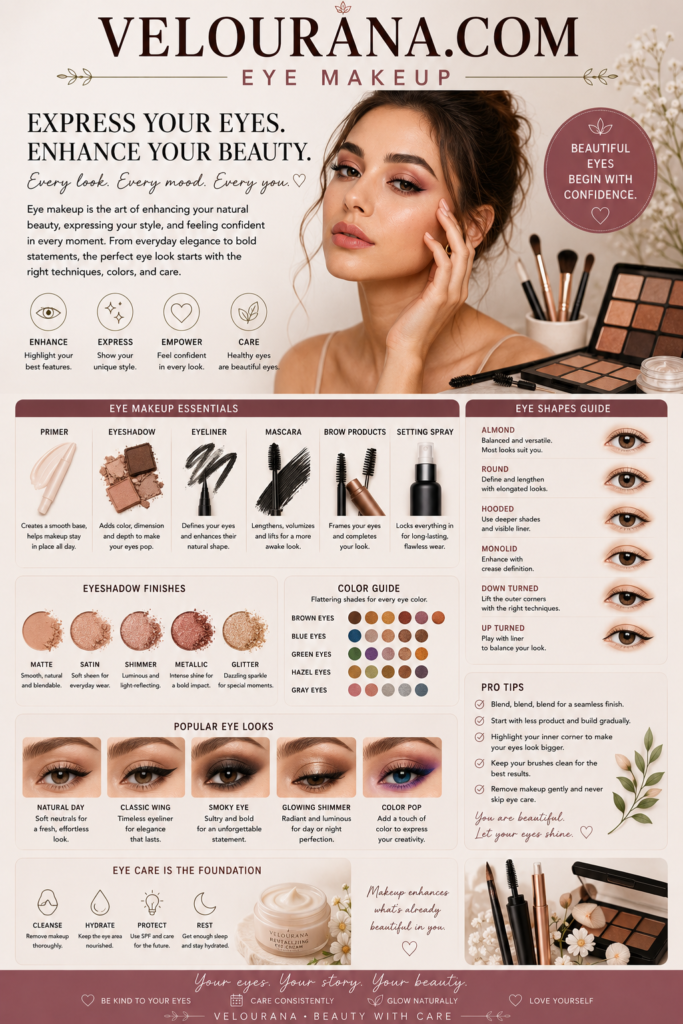
CATEGORY: Cream Eyeshadow
Modern eye makeup has increasingly embraced texture as strongly as color, and cream eyeshadow sits at the center of that shift. The appeal is easy to understand. A cream formula can create the impression of color becoming part of the eyelid itself rather than resting visibly above it. It may resemble a soft stain, a smooth veil, a polished metallic surface or a smoky shadow that seems to emerge naturally from the lashes.
This versatility makes cream eyeshadow particularly suited to contemporary beauty, where highly constructed makeup and intentionally effortless makeup frequently coexist. One person may use a sheer beige cream to create almost imperceptible definition, while another presses dense silver pigment across the entire lid for an editorial finish. Both rely on the same fundamental advantage: cream can change opacity, texture and intensity according to how it is manipulated.
The modern cream shadow also resists rigid categories. It can behave like eyeshadow, eyeliner, primer or highlight. A deep chocolate shade may sculpt the crease and define the lashes simultaneously. A champagne cream can illuminate the lid and inner corner. A black cream can create the foundation for a smoky eye, while a vivid blue formula can become the entire visual statement.
Understanding cream eyeshadow therefore requires thinking beyond traditional palette logic. The question is not only which colors belong together. Texture, transparency, light and movement become equally important.
Barely Visible Cream Shadow and the Illusion of Natural Depth
One of the most sophisticated uses of cream eyeshadow involves makeup that does not obviously look like eyeshadow at all.
A neutral cream slightly deeper than the natural skin can be blended through the crease and outer lid to recreate the kind of shadow that naturally appears around the eye. Instead of changing the eye with obvious color, the product simply strengthens existing structure.
This technique is particularly effective with muted taupe, beige-brown, soft caramel and mushroom tones.
The exact shade depends on complexion and undertone. A neutral that appears beautifully sculpting on one person may look orange, gray or overly dark on another.
Transparency makes a major difference.
A sheer cream allows the skin to remain part of the final color, creating a more believable effect. The natural variation of the eyelid continues to show through rather than being completely covered.
This type of eye makeup pairs naturally with minimal foundation, subtle brow definition and softly tinted lips because none of the elements appears excessively constructed.
The eye becomes more dimensional without looking heavily decorated.
A light reflective cream can be added to the center of the lid when a little brightness is desired. If the shimmer is finely milled, it can appear like natural light rather than obvious sparkle.
The result demonstrates how cream eyeshadow can create impact through subtlety.
The Lived-In Eye
Cream shadow is uniquely suited to makeup that looks slightly worn in rather than freshly painted.
A brown or charcoal cream pressed along the lash line and diffused upward can create a soft haze that resembles shadow rather than precise cosmetic placement.
The edges do not need to be perfectly symmetrical.
Slight variation between areas of greater and lesser pigment can add character, particularly when the desired aesthetic is relaxed, smoky or editorial.
This lived-in quality differs from careless makeup because the overall direction remains intentional.
The deepest pigment may remain near the lashes. The outer corner may carry greater concentration. The crease may fade gradually into bare skin.
The structure exists, but it is not over-refined.
Cream formulas make this easier because they respond naturally to tapping and smudging.
A fingertip can blur a sharp edge immediately, while a small brush can soften the lower lash line without producing the dusty effect sometimes associated with powder.
Muted colors are particularly effective.
Espresso, charcoal, plum-brown and olive can create atmospheric depth without the starkness of black.
Black cream can still be used, especially for dramatic evening makeup, but a thin layer softened thoroughly often appears more sophisticated than a thick opaque block.
Monochromatic Cream Eyes
Monochromatic makeup has a natural relationship with cream eyeshadow because one product can produce several intensities of the same hue.
A cream placed densely across the mobile lid may appear rich and saturated. The same product blended through the crease becomes lighter because the skin shows through. A small amount diffused beneath the eye creates an even softer variation.
This gives the impression of multiple coordinating shades without introducing additional colors.
Rose-brown, bronze, terracotta, plum, taupe and olive all work particularly well in this structure because their depth changes naturally with transparency.
A monochromatic cream eye can also include tonal differences in finish.
A matte cream may provide the primary shape, while a related metallic cream is pressed across the center of the lid.
The eye remains within one color family but gains textural complexity.
This approach can be highly polished while remaining relatively simple to create.
The Wet-Look Effect
Some cream eyeshadows are designed to retain or imitate a glossy appearance.
The wet-look eye uses reflected light rather than conventional shimmer to create dimension.
Instead of seeing individual sparkling particles, the viewer perceives a smooth sheen across the eyelid.
This effect can make neutral shades particularly interesting. A simple beige, taupe or bronze becomes more dramatic when the surface appears almost lacquered.
Glossy eye makeup can be visually striking, but formulas vary significantly in how securely they remain in place.
Some wet-look products are designed specifically for the eye area and maintain flexibility. Others may crease intentionally as part of the aesthetic.
The movement of the eyelid becomes visible in the makeup rather than hidden.
This is often part of the attraction.
A perfectly smooth glossy eye can appear polished, while a slightly creased one may feel more editorial and organic.
Safety remains essential. Products should be used according to their intended eye-area directions rather than improvised from unrelated glossy cosmetics.
Metallic Creams and High-Impact Evening Makeup
Cream texture reaches maximum drama when combined with dense metallic pigment.
The smooth base can hold reflective particles close together, creating a finish that resembles foil rather than scattered shimmer.
Gold and bronze remain enduring choices because they combine easily with neutral and smoky tones.
Copper introduces stronger warmth, while silver creates a cooler, sharper effect.
Metallic jewel tones extend the possibilities significantly.
Emerald, sapphire, violet and burgundy creams can create intense color while retaining sophisticated depth.
These shades often become more dramatic when surrounded by matte neutrals because the eye contains both reflective and non-reflective surfaces.
A metallic cream does not necessarily need to cover the entire lid.
Placed only in the center, it creates a spotlight effect. Concentrated near the inner corner, it introduces brightness. Applied across the outer lid, it can create a more unconventional reflective structure.
The placement determines whether the metallic behaves like highlight or dominant color.
Cream Eyeshadow and Smoky Eye Makeup
The smoky eye depends on gradients, and cream eyeshadow can create them remarkably efficiently.
A deep cream placed close to the lashes establishes the darkest point. As it is blended upward, the thinning product becomes softer and more transparent.
This automatically produces the essential architecture of smoke.
Brown creates a wearable version. Charcoal and black increase intensity. Plum, navy and forest green create colored interpretations without requiring bright shades.
The lower lash line can be connected to the upper outer corner, allowing the smoke to wrap continuously around the eye.
A metallic cream can then be pressed into the lid if additional light is desired.
The resulting makeup can appear more seamless than one constructed entirely from powders because the base color already adheres closely to the skin.
Powder can still be introduced selectively for additional control, but it is not always necessary.
Layering Multiple Cream Textures
Cream-on-cream layering can create sophisticated effects when formulas are compatible.
A matte neutral base can establish structure before a metallic cream is added.
A deep cream can create the outer corner while a lighter satin formula brightens the lid.
The key is controlling thickness.
If every layer is applied heavily, the eyelid may become overloaded and prone to movement.
Thin layers allow each texture to contribute without creating excessive buildup.
Fast-setting formulas may require working one area at a time. A slower cream provides greater blending freedom but may need additional time before another layer is introduced.
The application can therefore be approached almost like painting.
One texture establishes depth. Another introduces light. A third may refine the lash line.
The final eye remains cohesive because the creams merge visually rather than sitting as visibly separate powder layers.
Cream Shadow as Eyeliner
Deep cream eyeshadow can function beautifully as eyeliner, particularly when a softer edge is desired.
Using a small angled or detail brush, the product can be pushed close to the upper lashes.
Brown and charcoal create understated definition. Black produces stronger intensity, while plum, navy and green introduce subtle color.
The advantage over conventional liquid liner is softness.
The edge can remain precise or be diffused immediately before the cream sets.
This makes cream shadow especially useful for smoky wings.
The liner can extend beyond the outer corner and then be softened, preserving direction without requiring a razor-sharp point.
The same shade can also be diffused through the crease or lower lash line, creating a unified eye from one product.
This multifunctionality is one of the reasons cream shadow is valuable in streamlined makeup routines.
Cream Shadow for Bright and Editorial Color
Neutral creams may dominate everyday beauty, but the format is equally capable of vivid experimentation.
Opaque cobalt, turquoise, emerald, violet, orange and pink creams can produce extremely saturated eyelids.
Because cream creates a continuous surface, bright color can appear almost painted onto the skin.
This makes the format particularly effective for editorial makeup.
The edges may be sharply controlled or deliberately blurred.
A block of vivid color across the mobile lid creates graphic impact. The same cream diffused transparently through the crease feels softer and more atmospheric.
Bright cream can also be used in isolated areas.
A narrow band above the lashes, a concentrated inner-corner accent or a colored outer wing allows intense pigment to remain controlled.
The relationship between color and bare skin becomes part of the design.
Creating Dimension Without Several Shades
Traditional eyeshadow instruction often depends on several different colors: one for the lid, another for the crease, a deeper shade for the outer corner and a lighter tone for highlight.
Cream eyeshadow demonstrates that dimension can come from other sources.
Opacity creates one kind of variation.
A cream applied thickly becomes darker or more saturated. The same product blended thinly becomes lighter.
Finish creates another.
A reflective center surrounded by matte pigment can make the eye appear dimensional even when the colors are very similar.
Natural eyelid structure contributes additional shadow as the eye opens and closes.
This means a sophisticated eye can be created with far fewer products than expected.
Minimal product does not automatically mean minimal visual interest.
Managing Fast-Setting Formulas
Some modern cream shadows are designed for extremely long wear and begin setting quickly after application.
These formulas reward decisive blending.
Rather than applying product across both eyes and then returning to blend, it may be more effective to complete one eye at a time or work section by section.
The initial placement should also be controlled.
A small amount is easier to expand than a large dry patch is to correct.
Synthetic brushes tend to work well because they do not absorb as much cream as many natural fibers and can distribute product efficiently.
Fingers may also be effective for metallic formulas, particularly when pressing rather than sweeping.
Once a fast-setting cream has dried, attempting to manipulate it aggressively may disturb the surface.
At that point, additional product can sometimes be layered over it instead of repeatedly moving the existing layer.
Understanding setting time is therefore as important as understanding color.
Long-Wear Cream Shadow and Everyday Practicality
Cream eyeshadow is often chosen for convenience, particularly when formulas combine easy application with reliable wear.
A long-wearing neutral cream can become a complete everyday eye in minutes.
The appeal is not simply speed.
Because there may be fewer separate layers, the makeup can feel lighter and easier to maintain.
A single taupe cream blended around the eye may require less correction than a complex powder look containing several transitions.
Stick formats increase portability further.
The product can be drawn directly onto the lid and blended immediately, eliminating the need for a separate palette.
Potted creams offer greater control over quantity and are often well suited to brush application.
Liquid-cream hybrids can create particularly thin layers that set rapidly.
The packaging format therefore influences not only convenience but technique.
Cream Eyeshadow and Eyelid Preparation
The success of cream shadow begins before pigment is applied.
Excess skincare, oil or heavy emollient products around the eyelid can interfere with adhesion, particularly when the cream formula already contains significant slip.
Allowing skincare to absorb and keeping the lid appropriately prepared can improve consistency.
Some people benefit from primer, particularly when eyelids become oily during the day.
Others may find that primer creates unnecessary layers beneath a cream designed to adhere directly to skin.
The correct preparation depends on both formula and individual eyelid behavior.
The goal is a surface that allows smooth movement during application while providing enough stability for the cream to remain where intended.
Combining Cream Eyeshadow With Mascara and Liner
Cream shadow often looks particularly polished once lashes are defined.
Mascara establishes a strong boundary against luminous or sheer cream, preventing the eye from appearing visually washed out.
With deep cream shadow, mascara reinforces the smoky lash line and creates greater separation.
Conventional eyeliner can also be layered over cream after it sets.
A crisp black wing across a soft bronze cream creates contrast between precision and diffusion.
Brown liner over taupe cream produces a more understated relationship.
Colored liner can introduce another layer of interest.
The important consideration is whether the cream surface is stable enough to support the liner without dragging or skipping.
Allowing the shadow to settle first can improve definition.
Texture as the Main Design Element
One of the most modern approaches to cream eyeshadow involves choosing texture before color.
A makeup look may be built around the idea of a smooth matte lid, a wet-look surface or a highly reflective metallic center.
Color then supports that texture.
This reverses traditional eyeshadow thinking, where color combinations often lead and finish is considered afterward.
Cream formulations make this possible because their surface qualities are so distinctive.
A neutral glossy eye can be more dramatic than a colorful matte one.
A dense silver cream can become almost sculptural.
A soft matte taupe can create understated sophistication through complete absence of reflection.
Texture becomes expressive in its own right.
The Relationship Between Cream Shadow and Skin Finish
The complexion surrounding the eye changes how cream eyeshadow is perceived.
Luminous skin combined with glossy or metallic eyes can create a cohesive reflective look.
Matte skin makes the shine on the eyelid appear more pronounced.
A natural satin complexion provides balance between the two.
This relationship is particularly important in minimal makeup because there are fewer competing elements.
A sheer bronze cream on otherwise bare-looking skin can appear effortless and sunlit.
The same cream paired with full matte complexion coverage may look more deliberately glamorous.
Neither is superior.
The surrounding skin simply changes the context.
When Cream Shadow Creases
Creasing is not always catastrophic.
In highly polished makeup, visible product collecting in the crease may be undesirable and can be minimized through thinner application, suitable formulas and preparation.
In editorial or deliberately lived-in makeup, a small amount of movement can become part of the texture.
The distinction lies in intention.
A sheer brown cream that settles slightly into the natural folds may still look attractive because the effect reinforces depth.
A bright opaque metallic formula breaking into obvious uneven patches is more likely to disrupt the desired finish.
Understanding the aesthetic determines how much movement can be accepted.
The eyelid is one of the most mobile areas of the face. Makeup that acknowledges this can sometimes look more natural than makeup attempting complete immobility.
Choosing Cream Shadow According to Lifestyle
Cream eyeshadow can suit very different routines depending on formulation.
Someone seeking speed may prefer a neutral stick that blends immediately with a finger.
Someone creating elaborate evening makeup may prefer dense potted creams that can be layered precisely.
A minimalist may value sheer washes, while someone interested in editorial color may prioritize opacity.
Long-wear formulas suit extended days, whereas highly emollient textures may appeal more when comfort and luminous finish are the priorities.
There is no universal ideal cream shadow.
The format succeeds because it includes many different behaviors within one broad category.
Why Cream Eyeshadow Feels Contemporary
Cream eyeshadow aligns naturally with modern beauty because it allows boundaries to become less obvious.
Eyeshadow can merge with skin. Liner can blur into shadow. Metallic pigment can appear melted rather than powdered.
The makeup can look polished without appearing overbuilt.
At the same time, cream is capable of extreme impact.
A saturated metallic or bright opaque shade can create more immediate visual force than a complicated multi-powder look.
This tension between simplicity and intensity gives the format unusual relevance.
A single cream shadow may create an entire eye look, yet the same product category can support highly technical artistry.
The Lasting Strength of a Flexible Formula
Cream eyeshadow has endured because it responds to the eye rather than forcing the eyelid into a rigid method.
It can follow folds, blend into natural shadow and catch light as the eye moves.
Its opacity can be manipulated. Its edges can remain clean or become diffused. Its finish can imitate skin, satin, metal or gloss.
This flexibility makes cream eyeshadow one of the most adaptable tools in modern eye makeup.
A softly blended neutral can become almost invisible. A bronze cream can produce instant warmth. A deep charcoal can create smoke. A liquid-metal silver can transform the entire face.
The format does not demand complexity.
It rewards understanding.
Once the relationship among formula, setting time, opacity, eyelid movement and desired texture is clear, cream eyeshadow becomes extraordinarily intuitive.
Its greatest strength may be that it allows makeup to remain visibly alive.
The lid moves, light changes and the pigment responds.
Rather than sitting separately on the eye, the cream becomes part of its surface.
That seamless quality is what gives even the simplest application a sense of depth and sophistication.
THE END VELOURANA
 Discover More From Our Family of Websites
 ZodiacBearing (Astrology, Tarot, Numerology, Angel Numbers & Spiritual Guidance)
 Velourana (Beauty, Makeup, Hair Care, Skincare & Beauty Tips)
 HavenBearing (Home, Living, Organization, Décor & Everyday Inspiration)
 PawBearing (Pet Care, Dog Breeds, Animal Health, Training & Pet Products)
 PsyCatherine (Notes From the Journal of a Psychologist on Real Life)

