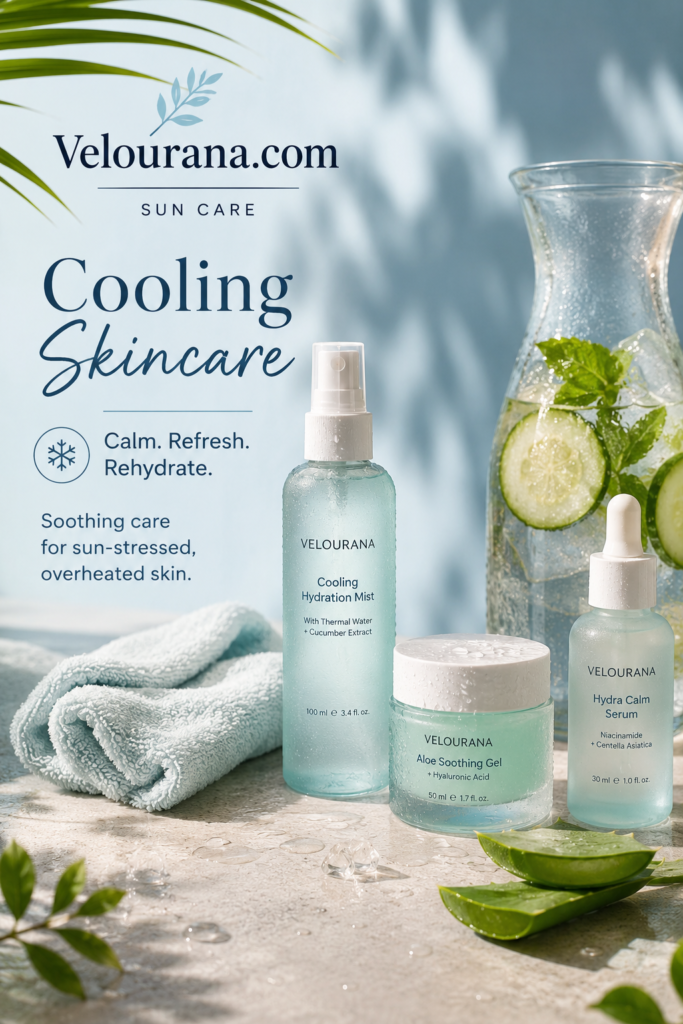
CATEGORY: Cooling Skincare
Cooling skincare is often associated with an immediate sensation: the refreshing feeling of a cool gel spreading across warm skin, the fine droplets of a facial mist, or the relief of applying a chilled moisturizer after spending hours outdoors. Yet the most effective cooling skincare is about considerably more than temperature.
When skin has been exposed to summer heat, sunshine, perspiration, wind, swimming, sunscreen, and repeated cleansing, it may need hydration and gentle moisturization as much as it needs physical refreshment. Choosing suitable ingredients can help create a routine that feels cool while also addressing the dryness, tightness, and discomfort that often accompany hot weather.
Some ingredients are useful because they attract and retain moisture. Others are valued for soothing or skin-conditioning properties. Certain botanical ingredients are popular in after-sun formulas, while lightweight gel textures can provide much of the refreshing sensation without relying on intensely stimulating ingredients.
Understanding these differences makes shopping for cooling skincare easier. Instead of choosing a product solely because its packaging promises an icy sensation, it becomes possible to evaluate what the formulation may actually contribute to a summer skincare routine.
Cooling Sensation Versus Cooling Skincare
The first distinction to understand is that an ingredient capable of producing a cold sensation is not necessarily the same thing as an ingredient that supports sun-stressed skin.
Menthol is a classic example. It can create an unmistakable cooling sensation, yet an intense sensory effect does not automatically mean that the skin is receiving hydration or barrier support.
Conversely, a simple hyaluronic acid gel stored at a comfortably cool temperature may provide only a subtle cooling sensation while offering useful hydration.
This changes the way cooling products should be evaluated.
Instead of asking only, "How cold does this feel?" consider asking, "How does my skin feel ten minutes later?"
Comfort that remains after the initial cooling sensation has disappeared is often a better measure of whether the product belongs in the routine.
Hydration Is the Foundation
Many of the most useful ingredients in cooling skincare are humectants.
Humectants help attract water and support hydration within the upper layers of the skin. They appear across virtually every product category, including cleansers, toners, essences, serums, gels, moisturizers, masks, and body lotions.
Their usefulness becomes particularly noticeable during summer because hot-weather skin can be deceptive.
The face may look shiny because of sebum and perspiration while simultaneously feeling dehydrated. Swimming, air conditioning, wind, cleansing, and prolonged exposure to environmental conditions can contribute to this sensation.
Adding hydration without immediately covering the complexion in a very heavy texture can therefore be particularly satisfying.
This is why water-rich serums and gels feature so prominently in cooling skincare.
Hyaluronic Acid
Hyaluronic acid is one of the best-known hydrating ingredients in contemporary skincare.
It is commonly incorporated into serums, essences, masks, moisturizers, eye products, and body care.
Its popularity in cooling formulas makes sense because hyaluronic-acid products are frequently created in lightweight, water-rich textures.
A clear gel serum can feel naturally refreshing even when it contains no ingredient specifically intended to create a cold sensation.
Apply it after cleansing while the skin is comfortable and slightly damp, then follow with an appropriate moisturizer if needed.
This final step is particularly important for dry skin. Hydration and moisturization are related but not identical concepts, and a watery serum alone may not provide sufficient comfort for everyone.
The ideal summer routine uses hyaluronic acid as one part of a balanced approach rather than expecting a single ingredient to perform every function.
Glycerin
Glycerin may not have the glamorous image of some fashionable botanical extracts, but it is an extremely common skincare humectant.
It appears in everything from inexpensive moisturizers to sophisticated serums.
For cooling skincare, glycerin is useful because it can provide hydration without requiring a heavy product format.
A lightweight gel containing glycerin can feel refreshing immediately after cleansing, while a lotion containing glycerin may be particularly useful for the body after a cool shower.
The effectiveness of a cooling product should not therefore be judged by how exotic its ingredient list appears. Familiar ingredients can perform important functions extremely well.
This is especially relevant when the skin feels stressed after sun exposure. A simple, well-tolerated formulation may be more appropriate than an elaborate product containing numerous unfamiliar botanical extracts and active ingredients.
Panthenol
Panthenol, sometimes referred to as provitamin B5 in cosmetic descriptions, is frequently included in products designed for hydration and skin conditioning.
It can be found in facial serums, gels, creams, masks, body lotions, and after-sun products.
Panthenol works particularly well within the philosophy of cooling skincare because it does not need to create a dramatic sensory effect to be useful.
A chilled lightweight serum containing panthenol may feel refreshing because of its temperature and texture while the formulation itself contributes to hydration and comfort.
This demonstrates an important principle of intelligent cooling skincare: temperature can provide the sensation while ingredients provide the skincare function.
The two do not have to come from the same source.
Aloe Vera
Few ingredients are associated with summer skincare as strongly as aloe vera.
Aloe gels have become a traditional choice after time in the sun, partly because their watery texture feels naturally refreshing.
Aloe vera can appear in gels, lotions, facial mists, masks, serums, and body products.
However, the presence of aloe on the front of a package does not tell you everything about the formula.
Two aloe gels can be completely different products.
One may have a relatively simple formulation, while another may contain fragrance, alcohol, colorants, or numerous botanical extracts.
This is why reading beyond the headline ingredient is worthwhile, particularly when shopping for products intended for skin that may already feel sensitive.
The cooling experience of an aloe gel can also be enhanced by storing it according to the manufacturer's instructions and, where appropriate, using it slightly chilled.
There is no need to freeze it.
Comfortably cool is sufficient.
Centella Asiatica
Centella asiatica has become increasingly prominent in modern skincare, particularly in products positioned for sensitive-looking or stressed skin.
It appears in essences, ampoules, serums, gels, creams, masks, and toners.
Many centella products happen to have the lightweight textures that suit warm-weather skincare particularly well.
A watery centella essence can provide a refreshing first layer after cleansing, while a gel cream can provide additional moisturization without feeling excessively dense.
As always, the entire formulation matters.
The presence of a fashionable botanical does not guarantee that every product containing it will suit every complexion.
Cooling skincare should remain individualized.
A product that feels beautifully calming on one person's skin may be unnecessary or uncomfortable for another.
Cucumber Extract
Cucumber has an almost universal association with freshness.
The image of chilled cucumber slices over closed eyes has been part of beauty culture for generations, and modern cosmetic formulations continue to use cucumber extracts in toners, gels, masks, mists, and eye products.
Cucumber's appeal fits naturally within cooling skincare, but it is useful to distinguish between the ingredient and the sensory experience surrounding it.
A cucumber gel taken from a cool environment may feel wonderfully refreshing. Much of that immediate sensation comes from the product's temperature, water content, evaporation, and gel texture.
The cucumber extract itself is only one part of the formulation.
This does not diminish the pleasure of using it.
Skincare can be both functional and enjoyable.
The important point is simply to avoid assuming that a botanical name alone determines the performance of a product.
Green Tea
Green tea extracts are frequently included in skincare formulations aimed at a wide variety of complexion types.
In summer products, green tea often appears in lightweight toners, essences, gels, and facial mists.
Its association with freshness makes it particularly compatible with cooling routines.
A chilled green-tea toner can create a pleasant sensory experience after cleansing, especially when applied gently rather than rubbed vigorously into warm skin.
However, homemade preparations deserve caution.
A professionally formulated cosmetic product has been designed with preservation, stability, and skin application in mind. A cup of tea prepared in the kitchen and stored for repeated cosmetic use is not equivalent to a preserved skincare formulation.
Cooling skincare does not need to become a home chemistry experiment.
Reliable products used according to their instructions are the simpler approach.
Beta-Glucan
Beta-glucan appears in various hydrating and soothing skincare products.
Although it may receive less attention than hyaluronic acid, it can be found in serums, essences, creams, and masks designed around hydration and comfort.
For summer routines, beta-glucan works particularly well when incorporated into lightweight formulas.
A serum combining several humectants can provide hydration without requiring a large number of separate products.
This can be valuable when the weather is hot because layering too many products can eventually make even individually lightweight formulas feel heavy.
The best cooling routine is not necessarily the one with the most steps.
A multifunctional hydrating serum can sometimes replace several layers.
Niacinamide
Niacinamide is widely used across modern skincare and can be found in products designed for many different skin concerns.
It also appears in numerous lightweight summer moisturizers and serums.
The important consideration is concentration and individual tolerance.
A person who already uses and tolerates a niacinamide product may find it fits easily into a summer routine.
However, skin that feels unusually reactive after excessive sun or heat exposure is not necessarily the ideal situation for introducing a powerful new formulation simply because the ingredient is popular.
Cooling skincare should prioritize comfort.
Familiar products that the skin already tolerates often make more sense during periods of temporary sensitivity.
Ceramides
Cooling skincare often emphasizes watery ingredients, but the skin barrier should not be forgotten.
Ceramides are lipids naturally associated with the skin barrier and are widely used in moisturizers.
Their presence can be particularly useful for people whose skin feels dry or tight after swimming, cleansing, wind exposure, or long periods in air-conditioned environments.
A ceramide product does not need to be a thick winter cream.
Modern formulations include lotions, emulsions, and gel creams that can provide barrier-supporting moisturization while still feeling suitable for warm weather.
This is an excellent example of why texture should be evaluated separately from ingredient category.
Dry skin can enjoy cooling skincare without sacrificing adequate moisturization.
Squalane
Squalane is another ingredient found in many moisturizing formulations.
Although oils may initially seem incompatible with cooling skincare, small amounts can work well for people whose skin requires additional softness after hydration.
The key is proportion.
A few drops within a balanced formulation may feel entirely different from applying a heavy layer of oil to overheated skin.
People with dry complexions can use a refreshing hydrating serum first and then choose a moisturizer containing emollient ingredients such as squalane.
Cooling and nourishment are not opposites.
The routine simply needs to be layered intelligently.
Allantoin
Allantoin is another ingredient frequently encountered in skincare products designed around comfort.
It may appear in lotions, creams, gels, cleansers, and after-sun products.
Because it is often combined with humectants and moisturizing ingredients, allantoin can fit naturally into a simple post-sun routine.
Again, there is no need for every product in the routine to contain it.
Ingredient duplication does not necessarily create better results.
If a soothing gel already contains several appropriate ingredients, adding three additional serums with overlapping formulas may only make the routine heavier.
Cooling skincare works best when products complement one another rather than compete for space on the skin.
Thermal Water and Mineral Water Mists
Thermal-water facial sprays are popular for summer refreshment because they offer one of the simplest possible skincare experiences.
Mist the face and enjoy the immediate cooling sensation created by fine droplets and evaporation.
They can be especially pleasant during travel, after outdoor activity, or following cleansing.
However, a mist is not necessarily a complete moisturizing routine.
Someone with dehydrated or dry skin may benefit from following it with a serum or moisturizer rather than repeatedly spraying the face and allowing every application to evaporate completely.
Think of water mist as refreshment and preparation.
It can be an excellent first step without needing to become the only step.
Marine Ingredients
Seaweed, algae, and other marine-derived ingredients frequently appear in products designed around hydration and freshness.
Their oceanic associations make them particularly common in summer-themed skincare.
Many marine products are formulated as lightweight gels, watery essences, and masks, which can feel refreshing in hot weather.
As with every botanical or marine ingredient, the overall formula remains more important than the theme.
A beautifully packaged ocean-inspired hydration gel may be excellent, but its suitability depends on the actual formulation and how the individual's skin responds.
Cooling skincare becomes easier when marketing imagery is appreciated without allowing it to replace ingredient evaluation.
Mint and Peppermint
Mint is strongly associated with coolness because certain mint-derived compounds create a characteristic sensory effect.
This can make mint-containing products feel particularly refreshing.
However, stronger sensation does not necessarily mean better skincare.
People with sensitive or reactive skin may prefer products that achieve refreshment through temperature and texture rather than through intensely stimulating ingredients.
If a mint-containing product causes burning, persistent tingling, or discomfort, the sensation should not be interpreted as proof of effectiveness.
Cooling should feel comfortable.
The objective is not to create the most dramatic possible contrast between hot skin and cold sensation.
Menthol
Menthol deserves particular attention because it is one of the ingredients most strongly associated with instant cooling.
It can produce the perception of cold, which can be extremely satisfying in certain personal-care products.
Yet perception and actual temperature are not identical.
A menthol product can make the skin feel colder without necessarily lowering its temperature dramatically.
This is why a strong menthol sensation should never be confused with treatment for sunburn or heat injury.
For ordinary cosmetic use, some people enjoy the sensation.
Others find it irritating, especially on sensitive skin.
Cooling skincare does not require menthol.
A refrigerator-cooled gel can provide plenty of refreshment without it.
Alcohol in Cooling Formulas
Some lightweight products contain alcohol because it evaporates rapidly and can contribute to a fresh, quick-drying sensation.
This may be desirable in certain formulations.
However, people with dry or sensitive skin may find some alcohol-heavy products uncomfortable, particularly when their skin already feels stressed.
It is difficult to judge a complete cosmetic formula based on a single ingredient in isolation because formulation context matters.
Nevertheless, someone who consistently finds alcohol-rich products drying may prefer a different type of cooling formula.
Personal experience with a product matters.
Summer is not the time to repeatedly use something that leaves the skin feeling progressively tighter simply because it initially feels cold.
Fragrance
Cooling skincare often uses fragrance to reinforce the sensory experience.
Cucumber, mint, citrus, ocean, aloe, and herbal fragrances can make a product feel psychologically fresher before it even touches the skin.
For people who enjoy fragranced skincare and tolerate it well, this can be part of the pleasure.
Those with sensitive skin may prefer fragrance-free alternatives, especially when the complexion feels temporarily reactive.
There is no universal requirement that cooling skincare must smell like mint or cucumber.
A fragrance-free gel stored at a cool temperature can provide an equally refreshing physical experience.
What About Vitamin C?
Vitamin C is commonly used in morning skincare routines and often discussed alongside sun protection.
However, cooling skincare and antioxidant skincare are not necessarily the same category.
Someone who already has a well-tolerated vitamin C routine may continue according to the product's directions and their own needs.
But when skin feels unusually irritated or uncomfortable after excessive exposure, it can make sense to simplify temporarily rather than insisting on every normal active step.
The cooling routine should respond to the condition of the skin that day.
This is one of the reasons rigid skincare routines can become counterproductive.
The skin does not experience every summer day identically.
Retinoids and a Cooling Routine
Retinoids are another category that should not be confused with immediate after-sun comfort products.
People using retinoids should follow the instructions appropriate to their specific product and maintain careful sun protection.
If skin feels significantly irritated, introducing additional active products is unlikely to make a cooling routine more comfortable.
A simple hydrating and moisturizing routine may be preferable until the complexion feels normal.
Anyone using prescription treatments should follow professional medical advice rather than changing treatment solely on the basis of cosmetic trends.
Cooling skincare occupies a different role: immediate comfort, hydration, and pleasant summer texture.
Exfoliating Acids
Alpha-hydroxy acids, beta-hydroxy acids, and other exfoliating ingredients are valuable components of many skincare routines.
They are not automatically necessary in a post-sun cooling routine.
If skin feels hot, tender, or unusually reactive, this may not be the moment for aggressive resurfacing.
The desire to remove roughness immediately can lead to over-treatment.
Cooling skincare takes the opposite approach.
Allow the skin to become comfortable first.
There will be time for exfoliation later, when the complexion feels normal and the regular routine can resume.
Gel Texture as a Cooling Tool
Sometimes the most important cooling ingredient is not an ingredient at all.
It is texture.
Gels contain a substantial water phase and often spread thinly across the skin. This can create an immediate sensation of freshness, particularly as some water evaporates.
Gel creams add more moisturizing components while retaining much of that lightweight character.
This makes them ideal for people who find pure gels insufficient but traditional creams too heavy during summer.
Texture can therefore determine whether a product feels cooling even when its ingredient list contains nothing specifically marketed as such.
When shopping, notice how quickly the product spreads, whether it becomes sticky, and how the skin feels after several minutes rather than judging only the first instant of application.
Water-Gel Serums
Water-gel serums sit somewhere between liquid serums and moisturizers.
They can be particularly satisfying in hot climates because they provide a substantial feeling of hydration while remaining relatively light.
Products combining glycerin, hyaluronic acid, panthenol, or similar hydrating ingredients can serve as the central hydration step in a cooling routine.
Apply a modest amount.
More product does not necessarily equal more hydration.
Excessive application can create pilling, stickiness, or difficulty layering sunscreen.
This is especially relevant in morning routines.
Cooling skincare should make sun protection easier, not create a slippery surface that makes sunscreen application unpleasant.
Lightweight Emulsions
Not everyone enjoys gels.
Some people prefer the smoothness of a lotion but still want something lighter than a traditional cream.
Emulsions can fill this gap.
They combine water and oil phases in a relatively fluid texture, providing both hydration and emollience.
For combination or dry skin during summer, a lightweight emulsion can be an excellent final step after a cooling serum.
This demonstrates why product categories should not become rigid rules.
Cooling skincare can include gels, lotions, emulsions, creams, sprays, and masks.
What matters is how the complete routine feels and functions.
Cooling Eye Gels
Eye gels are often formulated specifically around lightweight hydration.
Their texture makes them particularly suitable for refrigeration when the manufacturer permits it.
Applied cool, an eye gel can feel refreshing after a long day in bright sunlight.
The application should remain gentle.
The skin around the eyes does not need aggressive rubbing or extreme cold.
A small amount tapped lightly around the appropriate eye area is sufficient according to the product's directions.
A clean cool compress can also provide refreshment without requiring a dedicated eye product.
After-Sun Body Gels
The face receives enormous attention in skincare, but the body may have been exposed to much more sunlight.
Shoulders, arms, chest, back, and legs can all feel warm after outdoor activity.
After-sun body gels are designed to spread easily across larger areas and often contain aloe, glycerin, panthenol, or other hydrating ingredients.
Their lightweight consistency can feel much more comfortable than a thick body butter immediately after a hot day.
Once the skin has cooled, people with naturally dry skin can add a richer lotion if necessary.
There is no requirement to choose between cooling and moisturizing.
Products can be layered according to need.
Ingredients for Dry Summer Skin
Dry skin needs a cooling routine with enough substance.
A watery mist alone is unlikely to be sufficient.
Look for combinations of humectants and moisturizing ingredients rather than choosing only the lightest possible products.
A routine might begin with a hydrating essence containing glycerin or hyaluronic acid, continue with a soothing serum, and finish with a lightweight ceramide moisturizer.
If certain areas remain dry, a richer cream can be applied selectively.
The entire face does not always need the same amount of product.
This targeted approach preserves the refreshing feeling of the routine while still addressing dryness.
Ingredients for Oily Summer Skin
Oily skin can benefit greatly from lightweight hydration.
The presence of oil does not mean the skin should be stripped.
A gentle cleanser followed by a humectant-rich serum and lightweight gel moisturizer may provide a more balanced experience than repeated harsh cleansing.
Niacinamide is commonly found in products marketed toward oily complexions, while glycerin and hyaluronic acid can provide hydration across skin types.
The final choice should depend on tolerance and texture.
Sunscreen remains essential, so the morning routine should remain light enough to accommodate it comfortably.
Ingredients for Sensitive Skin
Sensitive skin generally benefits from a conservative approach.
Look for formulas the skin already tolerates and avoid assuming that intense tingling is desirable.
Panthenol, glycerin, simple moisturizers, and carefully formulated soothing products may fit well into the routine.
Fragrance-free options may be preferable for people who know fragrance causes them problems.
The fewer new variables introduced after a stressful day outdoors, the easier it becomes to understand how the skin is responding.
Cooling skincare for sensitive complexions should feel uneventful in the best possible way.
Comfort is the objective.
Ingredient Lists Versus Marketing Claims
The front of a skincare package is designed to attract attention.
Words such as "ice," "aqua," "freeze," "glacier," "arctic," "fresh," and "cool" can create powerful expectations.
Turn the package around.
The ingredient list provides a different perspective.
Look at the complete formulation rather than focusing exclusively on the highlighted ingredient.
Consider whether the product contains humectants, whether its texture suits your skin type, whether it includes ingredients you already know you dislike, and whether its intended use matches what you actually need.
Marketing can introduce a product.
It should not make the entire decision.
Do You Need a Dedicated After-Sun Product?
Not necessarily.
A dedicated after-sun gel can be convenient and enjoyable, but a well-formulated moisturizer already in your routine may provide exactly what your skin needs.
Similarly, an ordinary hydrating serum stored appropriately can feel wonderfully refreshing when applied after a cool shower.
The label "after sun" describes intended positioning, not a mandatory category every skincare collection must contain.
If you enjoy a dedicated after-sun product, use one.
If your existing products already provide gentle hydration and comfortable moisturization, there may be no need to duplicate them.
This is particularly useful for anyone trying to keep skincare simple or economical.
Refrigeration Can Transform Familiar Products
One of the easiest ways to create a cooling routine is to change the temperature of an appropriate existing product rather than buying an entirely new collection.
Where storage instructions permit, a hydrating mist or gel moisturizer kept cool can provide a significantly more refreshing sensory experience.
The formulation remains familiar.
Only the temperature changes.
This can be particularly useful for sensitive skin because it avoids introducing unnecessary new ingredients.
Never assume every cosmetic belongs in the refrigerator, however.
Follow storage directions, and avoid freezing products.
Cosmetic formulas are designed for particular storage conditions.
Build Around Three Functions
A practical cooling routine can be organized around three functions: cleanse, hydrate, and moisturize.
The cleanser removes sunscreen, perspiration, makeup, salt, chlorine, and environmental residue.
The hydrating step replenishes water and creates immediate refreshment.
The moisturizer helps maintain comfort afterward.
Everything else is optional.
A mist can enhance the sensory experience.
An eye gel can provide targeted refreshment.
A sheet mask can turn the routine into a relaxing ritual.
But the fundamental structure remains straightforward.
This simplicity is particularly valuable when the skin feels stressed.
When the Skin Is Actually Sunburned
Cooling cosmetics have limits.
If skin is significantly burned, blistered, severely painful, markedly swollen, or accompanied by concerning symptoms, ordinary beauty products should not be treated as medical care.
Likewise, serious symptoms associated with excessive heat require appropriate medical attention rather than a skincare routine.
Cosmetics can provide comfort for ordinary hot-weather skin.
They cannot replace diagnosis or treatment when a genuine medical problem is present.
Recognizing this boundary is an important part of responsible sun care.
Sunscreen Remains the Most Important Sun-Care Product
No collection of cooling ingredients can compensate for inadequate sun protection.
Aloe cannot reverse ultraviolet exposure.
Hyaluronic acid cannot replace sunscreen.
A refrigerated gel cannot make prolonged unprotected exposure harmless.
Cooling skincare belongs after protection, not instead of it.
During the day, use appropriate sun-protective measures including broad-spectrum sunscreen, shade, protective clothing, hats, and sunglasses as appropriate.
Afterward, cooling skincare can make the transition into evening significantly more comfortable.
The two approaches complement each other.
Choose Comfort Over Drama
Cooling skincare marketing often celebrates intensity.
Products promise freezing sensations, instant ice effects, or dramatic freshness.
The skin does not need drama.
It needs comfort.
A product that quietly hydrates, spreads beautifully, and leaves the complexion feeling comfortable may be far more valuable than one that produces five minutes of spectacular tingling.
The best cooling ingredients are therefore not necessarily the ingredients that feel coldest.
They are the ingredients that work within a formulation suited to the individual's skin.
Create Your Own Ingredient Shortlist
Instead of searching for one perfect cooling product, identify the functions your skin actually needs.
If dehydration is the main issue, look for humectants such as glycerin and hyaluronic acid.
If you enjoy soothing gel textures, aloe or centella formulations may appeal.
If dryness persists after hydration, consider moisturizers containing ceramides or other emollient ingredients.
If sensitivity is a concern, prioritize familiar, gentle formulations and minimize unnecessary stimulation.
If the primary goal is simply refreshment, a suitable refrigerated mist or gel may be enough.
This approach turns skincare shopping from a search for marketing promises into a practical assessment of needs.
Cooling Skincare Can Be Simple
A sophisticated routine does not have to be complicated.
The most satisfying summer skincare may consist of only a few well-chosen products.
A gentle cleanser removes the day.
A cool hydrating serum restores freshness.
A lightweight moisturizer provides comfort.
A body gel takes care of shoulders, arms, and legs.
The following morning, sunscreen returns as the central protective step.
That is a complete routine.
Additional products should be added because they contribute something useful or enjoyable, not because cooling skincare requires a long sequence.
The Best Cooling Ingredient Is the One Your Skin Likes
Skincare is personal.
Some people love aloe gels.
Others prefer centella essences.
Some find gel moisturizers perfect, while dry complexions may need emulsions or creams.
Some enjoy a mild mint sensation, while sensitive skin may strongly prefer products without it.
There is no universal cooling ingredient that every complexion requires.
The most successful routine combines appropriate ingredients with suitable textures, comfortable temperatures, and responsible sun protection.
Pay attention to how the skin responds after the initial refreshing sensation disappears.
Does it remain comfortable?
Does it feel hydrated?
Is there tightness?
Does the product become sticky?
Does it layer well with the rest of the routine?
Those questions provide far more useful information than the word "cooling" on the front of a bottle.
A Smarter Way to Shop for Cooling Skincare
Cooling skincare becomes much easier to navigate once ingredients are considered according to function.
Humectants provide hydration.
Moisturizing ingredients help maintain comfort.
Botanical ingredients can complement formulas designed around soothing textures.
Gels and watery emulsions provide refreshing sensory qualities.
Refrigeration, where appropriate, can enhance the experience without requiring intense cooling agents.
Meanwhile, sunscreen and sensible sun protection remain responsible for the job that cooling skincare cannot perform: reducing exposure to ultraviolet radiation.
The ideal product therefore does not need to freeze the face.
It needs to fit comfortably into a complete summer routine.
When heat, swimming, perspiration, wind, and sunshine have left the skin feeling exhausted, the combination of gentle cleansing, cool hydration, and suitable moisturization can provide exactly the kind of refreshment the complexion needs.
Choose ingredients thoughtfully, keep the routine comfortable, and let cooling skincare do what it does best: turn the end of a hot summer day into a calmer, fresher moment for the skin.
The End
Velourana.
 Discover More From Our Family of Websites
 ZodiacBearing (Astrology, Tarot, Numerology, Angel Numbers & Spiritual Guidance)
 Velourana (Beauty, Makeup, Hair Care, Skincare & Beauty Tips)
 HavenBearing (Home, Living, Organization, Décor & Everyday Inspiration)
 PawBearing (Pet Care, Dog Breeds, Animal Health, Training & Pet Products)
 PsyCatherine (Notes From the Journal of a Psychologist on Real Life)