
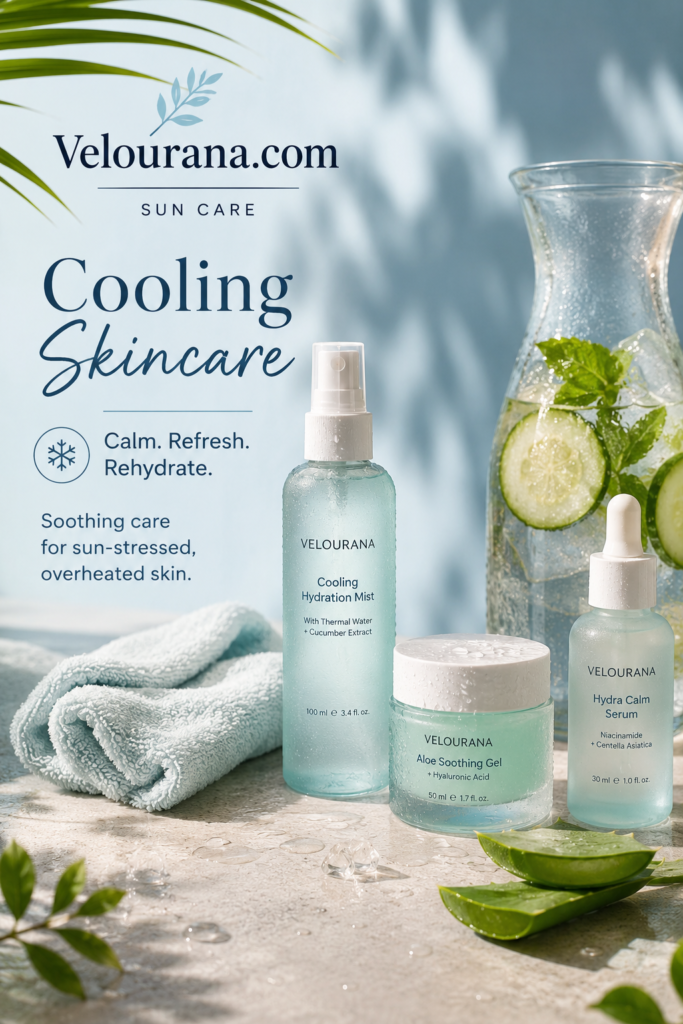
CATEGORY: Cooling Skincare
Sunshine can make a day feel brighter, warmer, and more energetic, but prolonged exposure to heat can leave the skin feeling considerably less comfortable. Even when the skin is not visibly sunburned, hours spent outdoors may leave the face and body feeling warm, tight, flushed, sticky, dry, or unusually sensitive. Add perspiration, sunscreen, salt water, chlorine, wind, and air conditioning to the equation, and the skin can finish a summer day needing a very different kind of attention from its usual routine.
Cooling skincare is designed around that need.
The purpose of a cooling routine is not simply to make the skin feel cold. Effective cooling skincare combines gentle temperature control with hydration, soothing textures, careful cleansing, and support for the skin barrier. The objective is comfortable skin rather than dramatically chilled skin.
This distinction matters. Ice-cold treatments and intensely stimulating ingredients may sound appealing when the skin feels hot, but aggressive cooling is not necessarily better. Sun-stressed skin generally benefits from a gentler approach: comfortably cool water, lightweight hydration, soothing formulations, minimal friction, and time away from additional heat and ultraviolet exposure.
A well-designed cooling skincare routine can become one of the most enjoyable parts of summer sun care. It transforms the period after outdoor exposure into an opportunity to refresh the complexion, replenish moisture, and give the skin a calmer environment in which to recover.
Why Skin Feels Overheated After Time in the Sun
The sensation of hot skin after being outdoors is not imaginary. Sunlight transfers heat to exposed surfaces, while warm environmental temperatures make it harder for the body to release excess heat. The skin plays an important role in temperature regulation, and blood flow near its surface can increase as the body attempts to cool itself.
This is one reason the complexion can look flushed after a hot afternoon.
Perspiration provides another cooling mechanism. As sweat evaporates, it helps release heat. During humid weather, however, evaporation becomes less efficient. The result can be skin that remains warm while also feeling damp and sticky.
Skincare products can add another layer to the sensation. Sunscreen is essential during sun exposure, but repeated applications combined with perspiration, sebum, sand, environmental particles, or makeup may eventually make the skin feel coated.
By evening, someone can therefore experience several sensations simultaneously: warmth, oiliness, dehydration, stickiness, and sensitivity.
Cooling skincare works best when it addresses these conditions together rather than treating warmth as the only concern.
Cooling Skincare Does Not Reverse UV Damage
A fundamental principle of responsible sun care is understanding the difference between cooling the skin and protecting it from ultraviolet radiation.
A refreshing gel can make the skin feel dramatically better. A cool shower may reduce the sensation of heat. A hydrating mist can provide immediate comfort.
None of these measures reverses ultraviolet exposure.
Cooling skincare should therefore be considered an after-exposure comfort strategy rather than an alternative to sun protection. Broad-spectrum sunscreen, appropriate clothing, shade, hats, sunglasses, and sensible management of exposure remain the important preventive measures.
This is particularly important because the absence of discomfort does not necessarily mean the absence of UV exposure. Skin can receive ultraviolet radiation without immediately feeling hot or painful.
Similarly, once cooling skincare has reduced discomfort, that improvement should not be interpreted as evidence that the effects of excessive sun exposure have disappeared.
Prevention and aftercare serve different purposes. Both belong in a thoughtful sun-care routine, but one cannot replace the other.
Start With Shade and a Cooler Environment
The first step in cooling overheated skin does not come from a skincare bottle.
Move away from direct sunlight.
If the skin feels excessively warm, continuing to sit in the sun while applying cooling mist accomplishes little. A shaded or indoor environment allows the body and skin to begin returning toward a more comfortable temperature.
Airflow can help. A fan or naturally ventilated room may make the transition more comfortable. Air conditioning can also provide relief, although very dry conditioned air may eventually make dehydrated skin feel tighter.
This is where skincare and environment need to work together.
Allow the body to cool gradually and avoid immediately exposing overheated skin to another source of intense heat.
Once the body feels more comfortable, the skincare portion of the routine can begin.
The Cooling Shower
A shower is one of the most effective transitions between a hot outdoor environment and an evening skincare routine.
The ideal temperature is comfortably cool rather than painfully cold.
Extremely cold water can be unpleasant and is unnecessary for ordinary post-sun refreshment. The objective is to remove accumulated perspiration and product while gently reducing the sensation of surface heat.
Avoid very hot water.
A steaming shower may normally feel relaxing, but it can be uncomfortable on sun-stressed skin and may intensify feelings of dryness or tightness.
During the shower, cleansing should remain gentle. The body does not need to be aggressively scrubbed simply because several layers of sunscreen were applied during the day.
A mild cleanser and careful washing are usually preferable to rough exfoliating gloves, abrasive body scrubs, or vigorous brushing.
The face deserves similar restraint.
If makeup and water-resistant sunscreen are present, thorough removal is important, but cleansing can still be gentle. The objective is clean skin without leaving it feeling stripped.
Why Cleansing Matters Before Cooling Products
It can be tempting to arrive home from the beach and immediately cover the face with aloe gel or a cooling mask.
Cleansing first is usually more comfortable.
During a summer day, the skin can accumulate sunscreen, perspiration, oil, dust, salt, makeup, and other residues. Applying multiple skincare products directly over this mixture may create an uncomfortable heavy layer.
Clean skin also provides a more pleasant base for lightweight hydration.
This does not mean cleansing repeatedly throughout the evening. Over-cleansing can create its own problems. One careful cleansing session is generally a better approach than repeatedly washing the face whenever it feels warm.
After cleansing, pat rather than rub the skin dry.
Leaving the skin slightly damp can make the next hydrating step feel especially refreshing.
Hydration Is at the Heart of Cooling Skincare
Cooling and hydration work exceptionally well together.
Heat, perspiration, swimming, wind, and cleansing can all contribute to the sensation that skin needs moisture. Yet heavy creams may feel uncomfortable when the weather remains hot.
Water-rich products provide an alternative.
Hydrating toners, essences, serums, gels, gel creams, and lightweight lotions can provide moisture without necessarily creating the dense sensation associated with richer winter products.
Humectant ingredients are commonly used in these formulations because they help attract and retain water within the upper layers of the skin.
Hyaluronic acid is perhaps the best-known example, but glycerin, panthenol, beta-glucan, and other hydrating ingredients can also appear in summer skincare.
The exact ingredient matters less than finding a formulation that suits the individual complexion and feels comfortable under warm conditions.
Someone with dry skin may still need a richer moisturizer after applying a hydrating serum. Someone with oilier skin may prefer a lighter gel cream.
Cooling skincare should adapt to the skin rather than forcing every complexion into the same summer routine.
Aloe Vera and the Classic Cooling Gel
Aloe vera has become strongly associated with after-sun skincare because gel formulations can feel light, watery, and refreshing.
The cooling sensation often comes partly from the gel texture itself and partly from evaporation as the product spreads across the skin.
Aloe-containing products can be enjoyable when the skin feels warm, but formulation still matters.
An aloe product is not automatically gentle simply because aloe appears prominently on the label. Fragrance, alcohol, botanical extracts, preservatives, and other components vary considerably between formulas.
For skin that feels particularly reactive after sun exposure, a simpler formulation may be preferable.
Texture also matters.
A thin layer generally feels more pleasant than repeatedly applying thick coats until the skin becomes sticky. Cooling skincare should leave the skin comfortable rather than encased.
Refrigerating Skincare Products
Keeping selected skincare products in the refrigerator can enhance their refreshing sensation during hot weather.
A facial mist, gel moisturizer, eye gel, or soothing mask may feel especially pleasant when applied cool.
However, refrigeration is not automatically suitable for every cosmetic product.
Products should be stored according to their manufacturer's directions. Some formulations are designed for normal room-temperature storage, and unnecessarily changing their storage conditions may affect texture or stability.
Freezing skincare is particularly unnecessary.
A product does not need to approach freezing temperature to feel refreshing. Mild refrigeration can create a pleasant sensory effect without turning skincare into an extreme temperature treatment.
A useful approach is to choose one or two simple products specifically for cooling use rather than placing an entire skincare collection in the refrigerator.
A chilled hydrating mist followed by a lightweight moisturizer can create an effective summer ritual with very little complexity.
Facial Mists for Immediate Refreshment
Facial mists are among the easiest cooling products to use.
They can be applied after cleansing, during a skincare routine, or whenever the face feels warm and uncomfortable.
The fine droplets create an immediate refreshing sensation, particularly when the product itself is slightly cool.
However, misting alone is not always enough for dehydrated skin.
If water is repeatedly sprayed onto the surface and simply allowed to evaporate, the refreshing sensation may be temporary. Following a hydrating mist with a serum or moisturizer can help make the routine feel more complete.
Think of the mist as the first hydration layer rather than necessarily the final step.
Mists can also be useful because they require almost no rubbing. When the complexion feels sensitive, minimizing friction can make skincare more comfortable.
Cooling Gel Moisturizers
Gel moisturizers are particularly popular during summer because their texture naturally complements hot weather.
They spread easily, often absorb quickly, and generally leave less of a heavy sensation than dense creams.
A gel cream can provide a useful compromise for skin that needs both hydration and some moisturizing support.
The ideal texture depends on climate as well as skin type.
In humid Mediterranean weather, a very rich cream may feel excessive during the daytime. In a heavily air-conditioned environment, however, the same skin may eventually need more protection against dryness.
This means summer skincare can change throughout a single day.
A lightweight product may work beautifully during the afternoon, while a somewhat richer moisturizer becomes comfortable at night.
Cooling skincare does not require abandoning nourishing products. It simply encourages choosing texture according to the conditions.
The Role of Panthenol
Panthenol is frequently included in products intended for soothing and hydrating skin.
Its versatility makes it useful in summer formulations ranging from serums to lotions and gels.
Unlike ingredients designed primarily to create a strong sensory cooling effect, panthenol is generally included for skin-conditioning and moisture-supporting purposes.
This highlights an important principle: the best cooling routine is not necessarily the one containing the greatest number of ingredients marketed as "cooling."
Sometimes the most effective combination is a physically cool product containing straightforward hydrating and soothing ingredients.
The skin experiences refreshment from the temperature and texture while receiving hydration from the formulation.
Centella Asiatica in Summer Skincare
Centella asiatica has become increasingly familiar in modern skincare, particularly in products marketed toward sensitive or stressed complexions.
It appears in toners, essences, serums, gels, masks, and moisturizers.
For a cooling summer routine, centella-based products can be attractive because many are formulated in lightweight textures.
Again, the complete ingredient list matters more than a single highlighted botanical.
A product containing centella alongside numerous strongly fragranced ingredients may behave very differently from a minimalist centella gel.
Choose according to the skin's tolerance rather than the popularity of the ingredient.
Cucumber and the Psychology of Cooling
Few ingredients visually communicate freshness as effectively as cucumber.
Cucumber slices placed over the eyes have become an enduring beauty image because their high water content and naturally cool feel create an immediate sensory association with refreshment.
Modern skincare products may use cucumber extracts in gels, masks, toners, and mists.
The cooling effect of these products often depends heavily on their temperature and formulation rather than cucumber alone.
This is worth remembering when evaluating skincare marketing.
Words such as "ice," "arctic," "fresh," "water," and "cooling" can create strong expectations. The actual usefulness of the product depends on whether its formula provides hydration and comfort appropriate for the skin.
Be Careful With Menthol
Menthol produces a recognizable cooling sensation, which is why it appears in numerous personal-care products.
The sensation can feel impressive, especially during hot weather.
However, intensely cooling sensory ingredients are not necessarily ideal for skin that already feels sensitive or irritated.
A dramatic cold sensation does not automatically indicate that the product is providing superior after-sun care.
For sensitive complexions, gentler cooling through product temperature and water-rich textures may be preferable to formulations designed primarily to create an intense tingling effect.
The goal should be comfort.
If a cooling product stings, burns, or creates significant discomfort, its dramatic sensation should not be interpreted as evidence that it is working.
Cooling Sheet Masks
Sheet masks can become an enjoyable occasional part of a summer routine.
Their wet format naturally feels cooling, and refrigeration can enhance the sensory experience when permitted by the product's storage instructions.
A hydrating sheet mask can be especially pleasant after cleansing on an evening when the skin feels warm and tight.
Longer is not necessarily better.
Leaving a sheet mask on far beyond its recommended application time does not automatically increase its benefits.
After removing the mask, gently patting the remaining essence into the skin can be more comfortable than rubbing vigorously.
A moisturizer can then be applied if needed.
The ritual is simple: cleanse, cool, hydrate, seal according to the skin's needs.
Cooling the Eye Area
The eye area can feel particularly tired after a bright day outdoors.
Squinting, heat, travel, lack of sleep, and general fatigue can contribute to a heavy sensation around the eyes.
A cool eye gel or refrigerated eye mask can provide a refreshing experience.
A clean cool compress is another straightforward option.
As with the rest of the face, avoid extreme cold directly against delicate skin.
The objective is a pleasant reduction in warmth, not numbness.
Sunglasses during the day also remain an important part of sun protection and comfort around the eye area.
Body Cooling Deserves Equal Attention
Cooling skincare is often discussed as though it applies only to the face, yet the shoulders, arms, chest, back, and legs may receive far more sun exposure.
A lightweight body lotion or gel can make a significant difference after showering.
Apply it while the skin retains a little moisture from the shower. This can make spreading easier and help the routine feel lighter.
During very hot weather, body gels and gel lotions may feel more comfortable than thick body butters.
Dry skin may still require richer products, particularly on areas such as the elbows, knees, hands, and feet.
There is no rule requiring one texture for the entire body.
A cooling gel can be used on warm exposed areas while richer moisturizer is applied where dryness is more pronounced.
Salt Water and Cooling Skincare
A day at the sea combines several environmental factors: ultraviolet exposure, salt, wind, sand, heat, and repeated sunscreen application.
Salt residue can leave the skin feeling tight after water evaporates.
Rinsing with fresh water after swimming is therefore a useful part of a beach skincare routine.
Once home, gentle cleansing followed by hydration can restore comfort.
Avoid interpreting the rough sensation created by salt and sand as an opportunity for aggressive exfoliation.
Skin that has spent hours exposed to the elements may benefit more from gentleness than polishing.
Save strong exfoliation for another time when the skin feels completely normal.
Chlorine and Post-Pool Skin
Swimming pools create a different challenge.
Chlorinated water can leave some people's skin feeling dry or tight, especially after prolonged swimming.
Rinsing after leaving the pool helps remove residual pool water from the skin.
A cool shower followed by a hydrating body product can then become part of the post-swim routine.
The face should also be cleansed appropriately, particularly if water-resistant sunscreen has been reapplied throughout the day.
Afterward, lightweight hydration can restore a more comfortable feel without creating excessive heaviness.
Why Exfoliation Can Wait
When skin feels rough after a day outside, exfoliation may seem like the obvious solution.
Often it is better to wait.
Sun-stressed skin does not necessarily need additional friction or aggressive resurfacing.
Physical scrubs, strong exfoliating acids, and intensive treatments may feel uncomfortable when the skin is already warm or reactive.
A cooling routine should prioritize cleansing, hydration, moisturization, and comfort.
Exfoliation can return when the complexion feels normal again.
This principle simplifies summer skincare considerably.
Not every skincare concern must be addressed simultaneously.
Sometimes the most intelligent routine is the one that deliberately does less.
A Minimal Cooling Routine
An effective post-sun routine can be surprisingly simple.
Begin by leaving direct sunlight and allowing the body to cool.
Take a comfortably cool shower and gently cleanse away sunscreen, perspiration, salt, chlorine, makeup, and environmental residue.
Pat the skin dry without aggressive rubbing.
Apply a hydrating product while the complexion is still comfortable and slightly damp.
Follow with a lightweight moisturizer appropriate for the skin type.
For the body, apply a gel lotion, lightweight moisturizer, or soothing after-sun product.
That may be enough.
Skincare does not need ten layers simply because the day involved sun exposure.
When skin feels stressed, simplicity can be luxurious.
Cooling Skincare for Oily Skin
Oily skin can become particularly uncomfortable in hot weather because perspiration and sebum combine with sunscreen.
The temptation may be to cleanse aggressively until the skin feels completely oil-free.
That approach can leave the complexion feeling tight and uncomfortable.
Instead, choose effective but gentle cleansing followed by lightweight hydration.
Gel moisturizers can work particularly well because they provide moisture without necessarily producing the dense sensation associated with richer creams.
A hydrating mist can also be useful for refreshment.
Most importantly, oily skin still needs sunscreen.
Skipping sunscreen because it feels heavy is not the solution. Finding a sunscreen texture better suited to oily skin is a more appropriate strategy.
Cooling Skincare for Dry Skin
Dry skin may appreciate cooling textures but often requires more than a lightweight gel.
A hydrating serum can provide the refreshing first layer, followed by a moisturizer containing ingredients that help support the skin barrier.
The routine can therefore feel cool without being insufficient.
One useful strategy is layering.
Instead of immediately applying a very heavy cream to hot skin, begin with a cool hydrating serum or gel. Allow it to settle. Then add the amount of moisturizer required for comfort.
This creates the sensory benefit of cooling skincare while still respecting dry skin's greater need for moisturization.
Cooling Skincare for Sensitive Skin
Sensitive skin requires particular restraint.
A product advertised as dramatically cooling may contain ingredients that create tingling or strong sensory stimulation.
For reactive skin, physical cooling through a cool environment, gentle water temperature, and refrigerated products may provide a better experience.
Fragrance-free or simpler formulations may also be worth considering when the skin feels unusually reactive.
Patch testing new skincare is sensible, particularly when sensitivity is already known.
A hot, sun-exposed evening is not necessarily the ideal moment to experiment with several unfamiliar active ingredients simultaneously.
Familiar, well-tolerated products often make the safest foundation for a calming routine.
Do Not Put Ice Directly on the Skin
When the face feels extremely hot, an ice cube can appear to offer the fastest possible solution.
Direct prolonged ice contact is unnecessarily extreme.
A cool damp cloth provides a gentler alternative.
If a cold pack is used, it should not be placed directly against bare skin for prolonged periods.
Cooling should remain comfortable.
The skin does not need to become numb to benefit from a reduction in temperature.
This is another example of the principle that stronger is not always better.
Nighttime Recovery After a Hot Day
Evening is an ideal time to simplify skincare.
Once sunscreen, perspiration, makeup, and environmental residue have been removed, the complexion can be treated according to how it actually feels.
If it feels comfortable, a normal hydrating routine may be sufficient.
If it feels unusually dry, additional moisturizer may help.
If it feels sensitive, consider temporarily reducing potentially irritating products and concentrating on gentle hydration and moisturization.
The next morning, sun protection begins again.
This daily cycle—protect, cleanse, cool, hydrate, moisturize, protect again—creates a practical framework for summer skincare.
When Cooling Skincare Is Not Enough
Ordinary warmth and mild post-sun discomfort are different from significant sunburn or heat-related illness.
Skin that is severely burned, blistered, markedly swollen, or associated with significant pain deserves more than a cosmetic cooling routine.
Similarly, symptoms such as confusion, fainting, severe weakness, significant dizziness, or other signs of serious heat illness require appropriate medical attention rather than skincare experimentation.
Cosmetics have a defined role.
They can cleanse, moisturize, hydrate, soothe, and improve comfort. They should not be expected to replace medical care when symptoms move beyond ordinary skincare concerns.
Knowing that boundary is part of responsible sun care.
Prevention Makes After-Sun Care Easier
The best cooling skincare routine begins before the skin becomes overheated.
Seek shade when appropriate.
Wear protective clothing.
Use broad-spectrum sunscreen according to its directions and reapply when required.
Consider hats and sunglasses.
Be especially thoughtful about extended outdoor activity during intense sun conditions.
These habits reduce the burden placed on after-sun skincare.
Cooling products should be the pleasant conclusion to responsible sun care, not emergency compensation for repeatedly excessive exposure.
Build a Summer Cooling Kit
A small collection of carefully selected products can make summer skincare easier.
A gentle cleanser handles sunscreen and perspiration.
A hydrating mist provides quick refreshment.
A lightweight serum adds hydration.
A gel or gel-cream moisturizer provides comfortable moisturization.
A body gel or lotion extends the same approach below the neck.
A clean soft cloth can become a simple cooling compress.
Nothing more elaborate is necessarily required.
The products should earn their place through comfort and usefulness rather than through the intensity of their cooling claims.
The Importance of Texture
Texture is one of the most underrated elements of seasonal skincare.
A formula can contain excellent ingredients and still feel wrong for a particular climate.
During a humid summer afternoon, a dense cream may feel oppressive. During winter, that same cream may feel perfect.
Cooling skincare recognizes sensory comfort as part of successful product selection.
Watery essences, fluid serums, gels, emulsions, and gel creams often feel naturally refreshing because they spread easily and create less perceived weight.
This does not make them universally superior.
It simply makes them particularly useful tools for warm-weather routines.
Layer Lightly
One of the easiest mistakes in summer skincare is applying too many products because each individual layer feels lightweight.
A mist, essence, toner, serum, second serum, gel, moisturizer, oil, and sleeping mask can collectively become far from lightweight.
Cooling skincare works beautifully when layers remain purposeful.
If a hydrating serum and gel moisturizer provide enough comfort, additional products may not be necessary.
The skin does not benefit simply from the number of steps completed.
A shorter routine can be easier to maintain and more pleasant during hot weather.
Morning Cooling Skincare
Cooling skincare is not limited to after-sun care.
Hot mornings can also benefit from refreshing textures.
A gentle cleanse or rinse, lightweight hydrating product, moisturizer when needed, and sunscreen can create a comfortable foundation for the day.
A refrigerated facial mist can provide a refreshing start, although sunscreen should remain the essential final protective skincare step before sun exposure.
The morning routine should support sunscreen rather than interfere with it.
Allow skincare layers to settle appropriately before applying sun protection, and avoid creating so many slippery layers that sunscreen becomes difficult to distribute evenly.
Midday Refreshment Without Starting Over
There is rarely a need to perform a complete skincare routine every time the face feels warm.
Moving into shade, cooling the environment, and using a refreshing mist may be sufficient for comfort.
Sunscreen requirements still need to be respected, particularly after swimming, sweating, toweling, or according to the product's directions.
The goal is to refresh without unnecessarily cleansing the face repeatedly throughout the day.
Summer skincare becomes much easier when every sensation of warmth does not trigger an elaborate routine.
The Sensory Pleasure of Cooling Skincare
Skincare is not purely functional.
Texture, temperature, fragrance, packaging, application, and atmosphere can all influence how enjoyable a routine becomes.
Cooling skincare has an especially strong sensory dimension.
The sound of a fine mist, the glide of a water gel, the relief of a cool compress, and the freshness of a lightweight moisturizer can turn an ordinary evening routine into a moment of genuine comfort.
That pleasure has practical value.
People are more likely to maintain routines they enjoy.
A beautiful cooling routine can therefore encourage consistent cleansing, moisturization, and sun-care habits without requiring complexity.
A More Intelligent Definition of Cooling
The most useful interpretation of cooling skincare is broader than simply creating a cold sensation.
Cooling can mean lowering uncomfortable surface warmth.
It can mean replacing a heavy cream with a refreshing gel.
It can mean stepping out of direct sunlight.
It can mean cleansing away layers of perspiration and sunscreen.
It can mean applying hydration to skin that feels tight after swimming.
It can mean avoiding aggressive exfoliation when the complexion needs gentleness.
It can mean giving the skin a quiet evening rather than introducing another powerful treatment.
Under this definition, cooling skincare becomes less of a marketing category and more of a thoughtful summer philosophy.
Keep the Routine Calm
When skin feels hot, there is an understandable desire to do something immediately.
That instinct can lead to over-treatment.
Multiple masks, strong actives, ice, scrubs, fragranced gels, and repeated cleansing can transform a simple need for comfort into an unnecessarily complicated routine.
A calmer approach is often more appropriate.
Cool the environment.
Cleanse gently.
Hydrate.
Moisturize according to need.
Protect the skin again the following day.
Consistency is more valuable than drama.
Cooling Skincare as Part of Complete Sun Care
Sun care is often reduced to sunscreen, but a complete routine extends beyond the moment sunscreen is applied.
Preparation, protection, reapplication, shade, clothing, cleansing, hydration, and aftercare all contribute to how the skin experiences summer.
Cooling skincare occupies the transition between exposure and recovery.
It helps remove the physical reminders of a long hot day: the sticky sunscreen, dried perspiration, salt residue, tightness after swimming, and uncomfortable warmth.
Done well, it does not require harsh ingredients or extreme temperatures.
It requires attention to what the skin is communicating.
The Ideal End to a Summer Day
After a long summer day, skincare should feel like relief rather than another challenge.
Move into a cooler environment and allow the body to settle.
Wash away the day's sunscreen, perspiration, salt, chlorine, and environmental residue with comfortably cool water and gentle cleansing.
Apply refreshing hydration.
Choose a moisturizer whose texture matches both the skin and the climate.
Avoid unnecessary friction and aggressive treatments if the complexion feels sensitive.
Then allow the skin to rest.
Cooling skincare is most effective when it respects the difference between refreshment and treatment, between comfort and extreme cold, and between aftercare and genuine sun protection.
The result is not merely skin that feels cooler for a few minutes.
It is a summer skincare routine built around hydration, gentleness, comfort, and sensible sun care—exactly what overheated skin is asking for at the end of a bright day.
The End
Velourana.
 Discover More From Our Family of Websites
 ZodiacBearing (Astrology, Tarot, Numerology, Angel Numbers & Spiritual Guidance)
 Velourana (Beauty, Makeup, Hair Care, Skincare & Beauty Tips)
 HavenBearing (Home, Living, Organization, Décor & Everyday Inspiration)
 PawBearing (Pet Care, Dog Breeds, Animal Health, Training & Pet Products)
 PsyCatherine (Notes From the Journal of a Psychologist on Real Life)

