
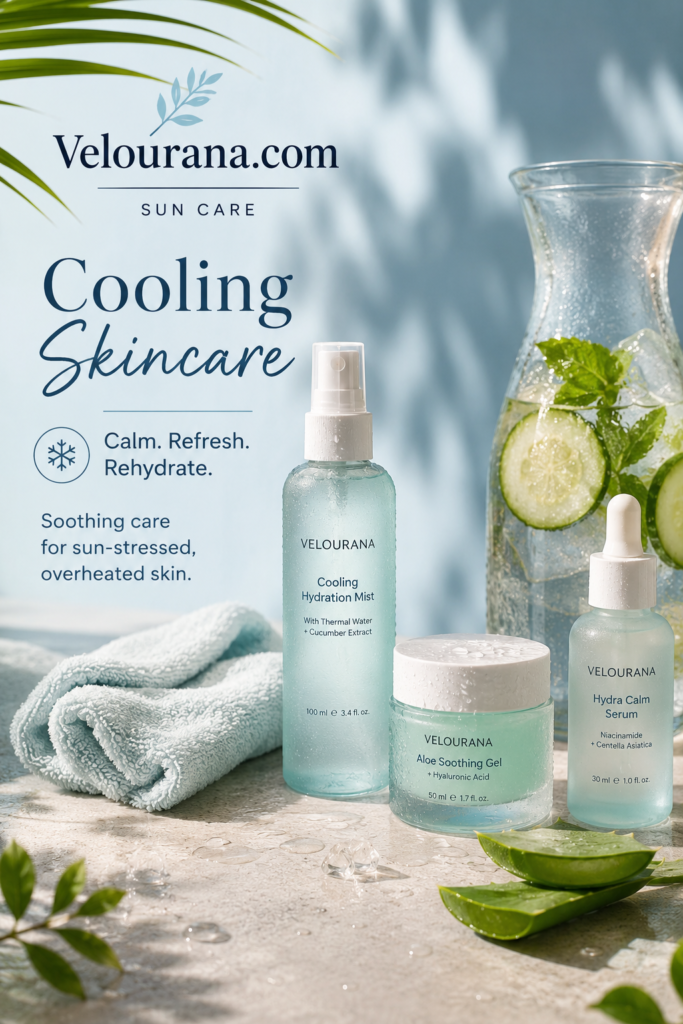
CATEGORY: Cooling Skincare
When summer temperatures rise, skincare becomes as much about texture as ingredients. A rich cream that feels comforting during winter may suddenly seem heavy. A thick mask may feel excessive after a humid day. Even a favorite serum can become less appealing when combined with perspiration, sunscreen, and warm weather.
This is why cooling skincare products are often built around three particularly refreshing formats: facial mists, lightweight gels, and hydrating masks.
Each provides a different experience.
A mist offers instant refreshment with almost no weight. A gel provides longer-lasting hydration in a texture that usually feels light and fresh. A mask creates a more intensive ritual, combining prolonged contact with a cooling sensory experience.
None is automatically better than the others.
The right choice depends on when the product will be used, what the skin needs, the surrounding climate, and how the rest of the skincare routine is structured.
Understanding these differences makes it much easier to build a cooling routine that feels genuinely comfortable rather than simply collecting products marketed for summer.
Why Texture Matters So Much in Hot Weather
Skincare texture influences how a product feels from the moment it touches the skin.
During cooler weather, richer textures can feel protective and luxurious. In hot or humid conditions, the same products may feel sticky or overly occlusive.
Perspiration changes the experience further.
As sweat mixes with sebum, sunscreen, makeup, and skincare, the surface of the skin can begin to feel increasingly coated.
This does not necessarily mean the skin needs less hydration.
It may simply need hydration delivered differently.
Cooling skincare textures solve this problem by providing water and moisturizing ingredients through lighter formats.
The Three Main Cooling Textures
Facial mists are the lightest option.
They deliver fine droplets across the skin and provide immediate sensory refreshment.
Gels sit in the middle.
They generally provide more substantial hydration and remain on the skin longer than a mist.
Masks provide the most intensive experience.
They remain in contact with the skin for a defined period and can deliver a larger quantity of hydrating formulation.
A well-designed routine may use only one of these formats.
It may also use all three at different times.
The important thing is avoiding unnecessary duplication.
Facial Mists: The Fastest Refreshment
A facial mist is one of the simplest cooling skincare products available.
Spray.
Allow the fine droplets to settle.
Enjoy the immediate sensation of freshness.
This simplicity makes mists particularly useful during the day.
They can be kept at a desk, carried during travel, used after exercise, or applied after cleansing as the first hydrating step.
A mist requires almost no rubbing, which can also make it appealing when the skin feels warm or sensitive.
Why Mists Feel Cooling
Part of the cooling sensation comes from evaporation.
As fine droplets evaporate from the skin's surface, they can create a temporary feeling of reduced warmth.
If the mist itself has been stored at a cool temperature according to its instructions, the sensation becomes even more noticeable.
This means a facial mist does not necessarily require menthol or other intensely cooling ingredients.
Water, temperature, and evaporation can create plenty of refreshment on their own.
Thermal Water Mists
Thermal-water sprays are among the simplest facial mists.
They are commonly used for quick refreshment during hot weather.
Their appeal lies largely in convenience.
There is no complicated application technique.
They can be used whenever the face feels warm.
However, someone with dry or dehydrated skin may need more than water alone.
A mist can begin the routine, but a serum or moisturizer may still be necessary for lasting comfort.
Hydrating Facial Mists
Some mists contain humectants such as glycerin or other hydrating ingredients.
These formulas attempt to combine refreshment with more meaningful hydration.
They may feel slightly more substantial than simple water sprays.
For someone who finds basic water mists too temporary, this can be useful.
The formulation should still remain light enough to spray evenly.
Botanical Mists
Cucumber, aloe, green tea, centella, rose, and other botanical ingredients frequently appear in facial mists.
They can add both sensory appeal and additional skincare characteristics.
However, botanical does not automatically mean gentle.
The complete formulation matters.
Someone with sensitive skin should consider fragrance and other ingredients rather than selecting a product solely because it contains a familiar plant extract.
When to Use a Facial Mist
A mist can be used after cleansing.
It can be used before serum.
It can provide midday refreshment.
It can be used after exercise once the skin has been appropriately cleaned.
It can also become part of a nighttime cooling ritual.
Its versatility is one of its greatest advantages.
When a Mist Is Not Enough
A common mistake is assuming that repeated misting automatically solves dehydration.
If the skin feels tight shortly after the droplets evaporate, it may need a more complete hydrating and moisturizing routine.
This is particularly true for dry skin.
Use the mist for freshness.
Follow with a suitable serum or moisturizer when additional support is needed.
Refrigerating Facial Mists
A cool facial mist can feel dramatically more refreshing than the same product at room temperature.
Where the manufacturer's storage instructions permit, refrigeration can enhance the sensory experience.
There is no need to freeze the bottle.
Mildly chilled is sufficient.
Facial Mists and Makeup
Using a mist over makeup requires some experimentation.
A very fine spray may provide refreshment without significantly disturbing makeup.
A heavier spray can create droplets or movement.
The distance from which the mist is applied and the amount used both matter.
If makeup preservation is important, begin with a small amount.
Facial Mists and Sunscreen
A facial mist does not replace sunscreen.
It should also not create false confidence about sun protection.
If sunscreen requires reapplication, follow the directions appropriate to the sunscreen and the circumstances.
Cooling refreshment and ultraviolet protection are separate functions.
Gels: The Heart of Cooling Skincare
If mists provide the quickest cooling sensation, gels may be the most versatile cooling texture.
Their high water content often makes them feel naturally fresh.
They spread easily.
They can provide hydration without the density of traditional creams.
They also work well across many product categories.
There are gel serums, gel moisturizers, eye gels, body gels, aloe gels, after-sun gels, and gel masks.
Why Gels Feel So Refreshing
A gel typically distributes a water-rich formulation across the skin in a thin layer.
This creates a light sensory experience.
When the product is cool, the effect becomes even more refreshing.
Unlike a mist, a gel remains on the skin rather than evaporating almost immediately.
This allows it to serve as a more substantial skincare step.
Hydrating Gels
Hydrating gels commonly contain humectants.
Glycerin and hyaluronic acid are familiar examples.
Panthenol, beta-glucan, aloe, and other ingredients may also appear.
A hydrating gel can be used beneath moisturizer or, for some skin types, as the primary moisturizing step.
The skin's response should determine whether additional product is needed.
Aloe Gels
Aloe gels remain one of the classic summer skincare formats.
Their lightweight consistency makes them particularly pleasant after a cool shower.
They can be used on the face or body depending on the product's intended use.
Not all aloe gels are identical.
Read the complete ingredient list rather than judging the formula by the percentage or prominence of aloe alone.
Gel Moisturizers
Gel moisturizers combine the sensory freshness of a gel with ingredients intended to maintain skin comfort.
They are particularly popular with oily and combination complexions.
During humid weather, they can feel considerably more comfortable than dense creams.
However, very dry skin may need something more substantial.
Gel Creams
Gel creams solve some of the limitations of very lightweight gels.
They retain a fresh, water-rich feel while incorporating more moisturizing components.
This makes them useful for normal, combination, and moderately dry skin.
A gel cream can also be an excellent choice for people who spend their days moving between outdoor heat and air-conditioned interiors.
Eye Gels
Eye gels are designed specifically for the delicate eye area.
Their lightweight texture makes them especially suitable for cooling use.
A slightly chilled eye gel can feel refreshing after a long day.
Use a small amount and apply gently.
There is no benefit in rubbing aggressively.
Body Gels
Cooling skincare should not stop at the face.
Body gels can feel excellent on shoulders, arms, chest, legs, and back after a hot day.
They spread quickly across larger areas and generally feel lighter than rich body creams.
After showering, apply while the skin is comfortable and slightly damp.
After-Sun Gels
After-sun gels are specifically positioned for use after outdoor exposure.
They often combine aloe, humectants, botanical ingredients, or soothing agents in a lightweight base.
Their greatest practical advantage may be texture.
A gel is simply pleasant to apply when the body still feels warm.
Remember that an after-sun product does not reverse ultraviolet exposure.
It is part of comfort care, not a substitute for prevention.
How Much Gel Should You Apply?
More is not necessarily better.
A thick layer can become sticky.
Start with a modest amount.
Spread it evenly.
Allow it to settle.
If the skin still feels dry, add moisturizer rather than automatically applying another enormous layer of gel.
Refrigerating Gels
Cooling a suitable gel can transform the experience.
A refrigerated gel moisturizer may feel especially pleasant after cleansing.
A body gel can provide similar relief after a summer shower.
Always follow storage instructions.
Do not assume every cosmetic formula benefits from refrigeration.
Masks: Cooling Skincare as a Ritual
Masks provide a different experience from mists and gels.
They are less about instant convenience and more about a dedicated period of skincare.
A cooling mask can be particularly enjoyable in the evening after a hot day.
The user cleanses the skin, applies the mask, and allows the product to remain in place for a defined period.
This creates both a skincare step and a moment of relaxation.
Sheet Masks
Sheet masks are perhaps the most recognizable cooling mask format.
The sheet is saturated with a liquid essence or serum and placed across the face.
Because the material remains wet, it naturally creates a refreshing sensation.
Cooling the mask appropriately can enhance this experience.
Refrigerated Sheet Masks
A slightly chilled sheet mask can feel particularly pleasant during summer.
The important word is slightly.
There is no need to freeze it.
Follow the product's storage instructions and avoid extreme temperatures.
The purpose is gentle cooling.
How Long Should a Sheet Mask Stay On?
Follow the manufacturer's recommended application time.
Leaving the mask on much longer does not automatically improve results.
Once the recommended time has passed, remove it.
Gently distribute remaining product if appropriate.
Follow with moisturizer if the skin needs it.
Gel Masks
Gel masks combine the refreshing texture of a gel with the prolonged application of a mask.
Some are rinsed off.
Others are removed after a defined period.
Some sleeping masks also use gel textures.
Always distinguish between them.
A rinse-off mask should not automatically become an overnight mask.
Sleeping Gel Masks
Sleeping masks are specifically designed to remain on the skin overnight.
Lightweight gel versions can be particularly suitable for summer.
They may provide more lasting moisturization than a simple hydrating gel without feeling as dense as a heavy cream.
For oily skin, however, even a sleeping mask may be unnecessary.
Use according to need.
Eye Masks
Cooling eye patches and masks can provide targeted refreshment.
They are especially popular after travel, poor sleep, or long periods in bright conditions.
Hydrogel eye patches can feel particularly cooling because of their texture.
Again, refrigeration can enhance the sensory experience when permitted.
Face Masks After the Beach
After a beach day, cleansing comes first.
Remove sunscreen, salt, sand, perspiration, and environmental residue.
Once the face is clean and comfortable, a hydrating mask can become part of the evening routine.
Avoid immediately reaching for aggressive exfoliating masks if the skin feels stressed.
Hydration and comfort are usually more appropriate.
Face Masks After the Pool
Pool exposure may leave some people's skin feeling tight.
A hydrating mask can provide a pleasant evening step after cleansing.
Look for formulas that focus on hydration rather than intense resurfacing.
The objective is to restore comfort.
Choosing Between Mist, Gel and Mask
The easiest way to choose is to think about time and need.
For immediate refreshment, choose a mist.
For everyday hydration, choose a gel or gel cream.
For an occasional longer ritual, choose a mask.
There is no need to own all three.
Cooling Products for Oily Skin
Oily skin often responds well to lightweight gels.
A mist can provide daytime refreshment.
A gel moisturizer can provide hydration without excessive heaviness.
Masks should be selected carefully.
A hydrating gel mask may feel more comfortable than a very rich cream mask.
Cooling Products for Dry Skin
Dry skin needs more substantial support.
A mist can begin the routine but is unlikely to be sufficient alone.
A hydrating gel can provide the first layer.
Follow with a gel cream, lotion, or cream.
A hydrating mask can be used occasionally when additional comfort is desired.
Cooling Products for Combination Skin
Combination skin can mix textures.
Use a gel moisturizer across the face.
Apply additional cream only to dry areas.
A mist can refresh the entire complexion.
Masks can even be applied selectively according to different areas if the product instructions permit.
Cooling Products for Sensitive Skin
Sensitive skin should prioritize simple, familiar formulas.
A fragrance-free mist may be preferable to a heavily perfumed botanical spray.
A gentle gel may be preferable to a strongly mentholated product.
A hydrating mask may be more suitable than an intensive active treatment.
The strongest cooling sensation is not the goal.
Comfort is.
Mist Versus Toner
Facial mists and toners can overlap, but they are not automatically identical.
A toner is generally designed as a specific step after cleansing.
A mist is defined more by its spray format and may be used at multiple points throughout the day.
Some products function as both.
The label and instructions should clarify intended use.
Gel Versus Cream
The difference is largely one of formulation and texture.
Gels tend to feel lighter and more water-rich.
Creams generally feel richer.
Gel creams occupy the middle.
None is universally superior.
Climate and skin type determine which feels best.
Mask Versus Moisturizer
A mask is usually an occasional treatment step.
A moisturizer is designed for regular use.
A hydrating mask may provide an intensive temporary experience, but it does not necessarily eliminate the need for everyday moisturizer.
This distinction prevents masks from becoming substitutes for basic skincare.
The Problem With Sticky Cooling Products
Some gels contain large amounts of humectants or film-forming ingredients and can become sticky when applied too generously.
If this happens, first reduce the amount.
Applying more products on top may only intensify the problem.
A good cooling routine should eventually feel comfortable rather than tacky.
The Problem With Heavy Masks
A rich cream mask can feel luxurious in winter.
During a humid summer night, it may feel oppressive.
Switching to a gel mask can preserve the ritual while making the experience more seasonally appropriate.
The Problem With Over-Misting
A facial mist can become addictive during hot weather because the immediate sensation is so pleasant.
Repeated application every few minutes may not be necessary.
If the skin continually feels dry after evaporation, address hydration more substantially with serum or moisturizer.
Layering Mist and Gel
Mist and gel work naturally together.
After cleansing, apply the mist.
While the skin remains slightly damp, follow with a hydrating gel.
This can create a refreshing two-step routine.
Add moisturizer only if needed.
Layering Gel and Cream
Dry skin can use gel beneath cream.
The gel provides immediate hydration and freshness.
The cream provides additional moisturization.
During summer, the cream can be applied more sparingly than in winter.
Layering Mask and Moisturizer
After using a hydrating mask according to its instructions, assess the skin.
If it feels comfortable, a small amount of moisturizer may be enough.
If the mask itself is designed as a final overnight step, follow its directions.
Do not automatically pile several products on top.
Morning Cooling Textures
Morning skincare needs to remain compatible with sunscreen.
A lightweight mist can provide refreshment.
A gel serum can provide hydration.
A gel cream can provide moisturization.
Then sunscreen completes the protective routine.
Avoid excessive layers that make sunscreen difficult to apply.
Afternoon Cooling Textures
The afternoon is where mists excel.
They are portable and quick.
A full gel routine is rarely practical over sunscreen and makeup.
Use environmental cooling first, then a mist if desired.
Manage sunscreen reapplication appropriately.
Evening Cooling Textures
Evening is where gels and masks become especially useful.
Once the skin has been cleansed, a gel can provide immediate hydration.
A mask can be used occasionally for a more relaxing experience.
A gel cream can finish the routine.
Cooling Textures After Exercise
After exercise, cleanse perspiration appropriately.
A lightweight gel can provide refreshment without feeling heavy.
A mist may also be enjoyable after the body has cooled.
Avoid applying elaborate skincare directly over heavy perspiration.
Cooling Textures During Travel
Mists are particularly useful during travel because of their convenience.
A small gel moisturizer can handle hydration.
Masks can be saved for the hotel or destination.
A compact routine is easier to maintain than carrying numerous specialized products.
Cooling Textures in Humid Weather
Humidity often favors lighter formulas.
Mists and gels feel particularly appropriate.
A gel cream may provide enough moisturization without excessive weight.
Use only the quantity needed.
Cooling Textures in Dry Heat
Dry heat may require more substantial moisturization.
A mist alone can feel temporary.
Layer a gel beneath a lotion or cream.
This combines freshness with longer-lasting comfort.
Cooling Textures in Air Conditioning
Air-conditioned environments can create dryness despite the summer heat outside.
A gel cream may be more suitable than an ultra-light gel.
Keep a mist nearby for sensory refreshment, but use moisturizer when the skin actually feels dry.
Ingredients to Look for in Cooling Gels
Common hydrating ingredients include glycerin, hyaluronic acid, panthenol, beta-glucan, and similar humectants.
Aloe and centella frequently appear in soothing-style formulations.
Ceramides may be useful when additional barrier-supporting moisturization is desired.
The complete formula matters more than any single highlighted ingredient.
Ingredients to Approach According to Tolerance
Strong menthol sensations may appeal to some people but feel uncomfortable to others.
Heavy fragrance can enhance the sensory experience but may not suit sensitive skin.
High levels of unfamiliar active ingredients may be unnecessary when the skin already feels stressed.
Choose according to tolerance.
Cooling Does Not Mean Tingling
A product can feel refreshing without tingling.
This is worth emphasizing because marketing often equates intensity with performance.
A refrigerated fragrance-free gel may provide a wonderful cooling experience without creating any tingling at all.
Cooling Does Not Mean Freezing
Products do not need to be frozen.
A cool refrigerator temperature, where appropriate, is enough.
Extreme cold does not make ordinary skincare more effective.
Cooling Does Not Mean More Products
Adding a mist, gel, mask, eye gel, body gel, and sleeping mask to an already complete routine may create unnecessary duplication.
Choose the format that solves the actual problem.
Building a Minimal Cooling Collection
A very practical collection might contain only two dedicated cooling products.
A facial mist for daytime refreshment.
A gel moisturizer for morning and evening hydration.
An occasional mask can be added if the ritual is enjoyable.
That is enough.
Building a More Complete Cooling Collection
Someone who genuinely enjoys skincare may prefer a larger selection.
A mist for daytime.
A hydrating gel serum.
A gel cream.
An eye gel.
A body gel.
A hydrating mask.
The important thing is not to use every product simultaneously simply because it exists.
Use Texture Strategically
The greatest advantage of cooling skincare is flexibility.
Mists provide almost weightless freshness.
Gels provide lightweight hydration.
Masks provide occasional intensive care.
Creams can still be added when more moisturization is necessary.
This allows the routine to change according to weather, time of day, and skin condition.
Remember Sun Protection
No mist, gel, or mask replaces sunscreen.
Cooling products manage comfort.
Sunscreen manages ultraviolet protection.
Keep these roles separate.
A refreshing routine should make consistent sun protection easier, not create a false sense of security.
Know When Skincare Is Not Enough
Ordinary warm or uncomfortable skin can benefit from cosmetic cooling products.
Severe sunburn, blistering, marked swelling, significant pain, or other concerning symptoms may require appropriate medical attention.
Likewise, serious symptoms of heat illness are not cosmetic concerns.
Cooling skincare has a useful but limited role.
The Best Facial Mist
The best facial mist is not necessarily the one with the longest ingredient list.
It is the one that sprays evenly, feels comfortable, fits easily into the routine, and does not cause unwanted irritation.
For some people, simple thermal water is enough.
Others prefer a more hydrating formulation.
The Best Cooling Gel
The best gel provides refreshment without leaving the skin sticky or tight.
It should deliver enough hydration for the intended skin type.
Dry skin may prefer a gel cream.
Oily skin may prefer a lighter water gel.
The Best Cooling Mask
The best mask creates a pleasant experience without leaving the skin uncomfortable afterward.
It should fit the skin's needs.
A hydrating mask is often the most logical choice after heat exposure.
Strong resurfacing treatments can be reserved for another occasion.
Let the Climate Guide the Texture
Summer is not the same everywhere.
A humid Mediterranean coast feels different from dry inland heat.
An air-conditioned office feels different from a beach.
A nighttime routine feels different from midday skincare.
Texture should respond to these conditions.
Let Your Skin Guide the Final Choice
Product categories provide guidance, but the skin gives the final answer.
If a mist feels refreshing but the face becomes tight afterward, add hydration.
If a gel feels sticky, use less or choose another texture.
If a gel cream feels too heavy, switch to a lighter formula.
If a mask creates discomfort, stop using it.
Cooling skincare should improve comfort, not become another source of difficulty.
Refreshment Without Complexity
The beauty of cooling skincare lies in its simplicity.
A mist can provide a few seconds of immediate freshness during a hot afternoon.
A gel can transform the feeling of an evening routine after a cool shower.
A mask can create twenty quiet minutes of relaxation after a demanding summer day.
None requires extreme temperatures.
None needs to replace basic skincare.
None compensates for inadequate sun protection.
They are simply different tools for making warm-weather skincare more comfortable.
Choose the texture according to the moment.
Use a mist when speed matters.
Use a gel when lightweight hydration is needed.
Use a mask when the skin and schedule invite a longer ritual.
Combined thoughtfully with gentle cleansing, appropriate moisturization, and responsible sun protection, these cooling textures can turn summer skincare from something that feels heavy and inconvenient into one of the most refreshing parts of the day.
The End
Velourana.
 Discover More From Our Family of Websites
 ZodiacBearing (Astrology, Tarot, Numerology, Angel Numbers & Spiritual Guidance)
 Velourana (Beauty, Makeup, Hair Care, Skincare & Beauty Tips)
 HavenBearing (Home, Living, Organization, Décor & Everyday Inspiration)
 PawBearing (Pet Care, Dog Breeds, Animal Health, Training & Pet Products)
 PsyCatherine (Notes From the Journal of a Psychologist on Real Life)

