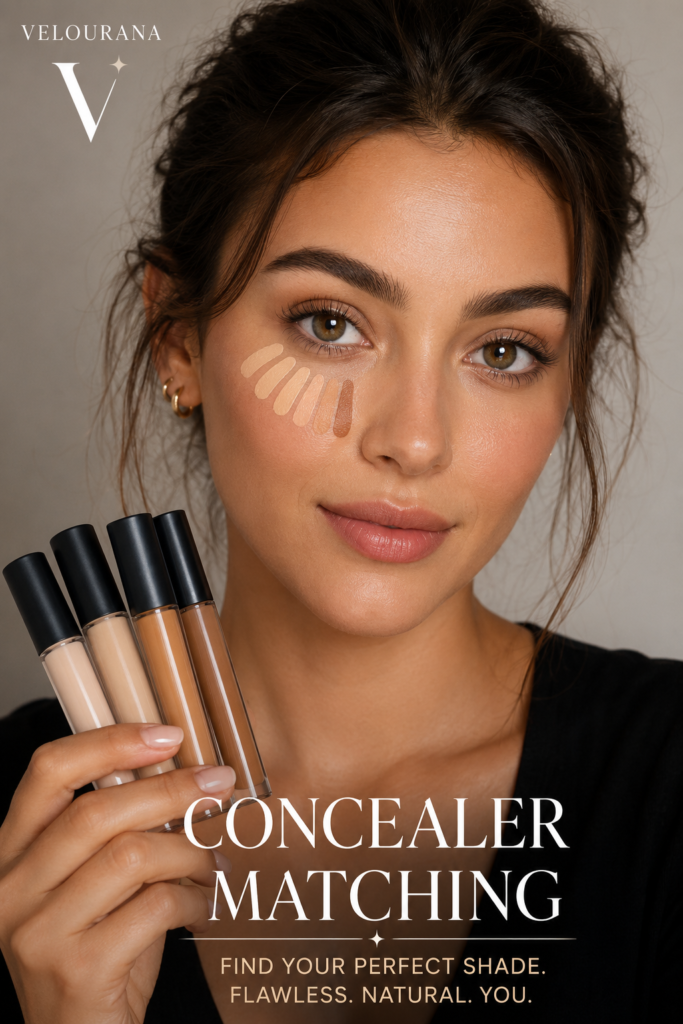
CATEGORY: Concealer Matching
Concealer matching becomes much easier when you stop treating every complexion as though the same rules apply equally across all skin depths and undertones.
The basic principles are universal: identify skin depth, understand undertone, consider what you are concealing and decide whether the product should disappear into the skin or intentionally brighten it.
But the way those principles behave can change considerably between fair, light, medium, tan, olive, deep and rich complexions.
A concealer that is only slightly too yellow may be extremely obvious on very fair skin. A concealer that is too pale can create immediate ashiness on deep skin. Olive complexions can make ordinary neutral shades look unexpectedly pink or peach. Medium and tan complexions may sit between several conventional shade categories and require much more attention to undertone than to depth.
This is why generalized advice such as “choose a concealer two shades lighter than your foundation” can fail.
There is no universal definition of one shade lighter, no universal undertone system and no single concealer depth that works for every purpose.
The correct match depends on the relationship between the product and your individual complexion.
Understanding how that relationship changes across different skin depths can make concealer shopping far more predictable.
Begin With Skin Depth, Not Shade Names
Cosmetic brands use words such as fair, light, medium, tan, deep and rich to organize complexion products.
These descriptions are useful, but they are not standardized.
One company’s fair shade may resemble another company’s light shade.
A medium shade in a range with twenty colors may be significantly different from a medium shade in a range with sixty.
The same problem applies to shade numbers.
A number such as 3, 20 or 250 has no universal meaning outside the specific product range.
For this reason, concealer matching should always begin with visual depth rather than the name printed on the packaging.
Ask whether the product is lighter, deeper or approximately equal to the complexion you are trying to match.
Only then consider undertone.
Skin Depth and Undertone Work Together
Two people may both wear a medium-depth foundation yet require completely different concealers.
One may have golden undertones.
Another may be cool-neutral.
A third may be olive.
A fourth may sit between warm and neutral.
The depth category simply tells you where to begin.
Undertone tells you which shades within that depth range are likely to harmonize.
This distinction becomes especially important with high-coverage concealers because the stronger the pigment, the more visible an undertone mismatch becomes.
A sheer product may allow enough natural skin to show through that a slight mismatch remains acceptable.
An opaque concealer replaces more of the visible skin color and therefore requires greater precision.
Fair Skin Has Very Little Room for Error
Fair skin can make concealer mismatches particularly noticeable.
Because the complexion is already light, moving even slightly lighter can create a strong contrast.
This means that under-eye concealer does not need to be dramatically paler to create brightness.
A small difference in depth may be sufficient.
For spot concealing, the match needs to be especially close.
A blemish covered with a concealer that is visibly lighter than the surrounding skin can become a bright dot.
A shade that is only slightly too yellow or peach may also stand out because there is less overall pigment in the surrounding complexion to visually absorb the difference.
Fair Skin Is Not Automatically Cool
One of the most persistent assumptions in complexion matching is that fair skin must have pink or cool undertones.
That is incorrect.
Fair complexions can be cool, neutral, warm, golden, peach, olive or somewhere between conventional categories.
Someone with fair golden skin may find many pale concealers too pink.
Someone with fair olive skin may discover that most conventional fair shades appear peach or orange.
Someone with fair cool skin may find yellow-toned concealers immediately obvious.
Depth tells you how pale the product should be.
It does not determine undertone.
Matching Concealer for Fair Cool Skin
Fair cool complexions often harmonize with shades that have subtle pink, rosy or neutral-cool characteristics.
The word subtle matters.
A strongly pink concealer can look artificial even when the complexion is cool.
For blemishes, choose a shade close to the surrounding skin with enough coolness to prevent yellow or golden contrast.
For the under-eye area, a neutral-cool concealer may work well if discoloration is mild.
If blue or violet circles are pronounced, a delicate peach or pink-peach corrector can be used underneath before applying the complexion shade.
The corrective warmth does not mean the natural undertone has changed.
It simply performs a color-neutralizing function.
Matching Concealer for Fair Warm Skin
Fair warm skin may contain golden, yellow or peach characteristics.
A cool-pink concealer can appear rosy against the complexion.
However, strongly yellow products can also become obvious because fair skin amplifies small color differences.
Look for warm shades that remain muted rather than intensely golden.
For under-eye darkness, soft peach tones can integrate naturally when they also provide correction.
For blemishes, keep the shade very close to the natural complexion rather than using the brighter under-eye color.
Matching Concealer for Fair Neutral Skin
Fair neutral skin often sits between clearly warm and clearly cool.
This can sound easy, but neutral shades differ greatly between brands.
Some lean yellow.
Some lean peach.
Some lean slightly pink.
Test several neighboring shades rather than assuming the word neutral guarantees a perfect fit.
The best option is usually the one that looks least colorful on the skin.
If you cannot describe the swatch as distinctly yellow, pink, orange or peach once blended, that is often a good sign.
Fair Olive Skin Can Be Surprisingly Difficult
Fair olive skin is frequently underserved by traditional shade ranges.
The complexion may be pale in depth but contain a muted greenish or gray-green undertone.
Standard fair warm shades can become peach.
Neutral shades may become pink.
Cool shades can look rosy.
The ideal concealer often needs both lightness and mutedness.
Neutral-olive or olive-labeled shades are worth testing when available.
If they are not available, a neutral shade with very little peach may be more successful than a conventional warm option.
Light Skin Adds More Flexibility
Light skin generally offers slightly more room for under-eye brightening than very fair skin because there is more depth available before the concealer becomes starkly pale.
However, undertone still determines whether the product harmonizes.
A concealer that is one small depth step lighter can create natural brightness.
For spot concealing, stay close to the actual complexion.
If pigmentation is strong, do not compensate by going lighter.
Use better coverage or color correction.
Light Warm and Golden Complexions
Light warm complexions often work well with soft golden, yellow-neutral or peach-golden concealers.
The difficulty is avoiding shades that become too orange.
Warm does not mean orange.
If every warm concealer seems to pull orange, your skin may be more neutral or olive than you realized, or the product range may simply use excessively peachy warm pigments.
Compare warm and neutral versions at the same depth.
The correct match is the one that blends, not the one whose label sounds most appropriate.
Light Cool Complexions
Light cool skin may show redness on the cheeks, but visible redness should not automatically be treated as undertone.
Look at the jaw, forehead and neck as well.
If the complexion genuinely leans cool, overly golden concealers can look yellow.
Neutral-cool or rosy-neutral shades may integrate more naturally.
For under-eye darkness, corrective peach can still be used where necessary because the corrector is addressing discoloration rather than matching undertone directly.
Light Neutral Complexions
Light neutral skin can often wear several neighboring undertone families successfully depending on formula and coverage.
A slightly warm concealer may work under the eyes.
A more neutral shade may work better for blemishes.
This is a useful reminder that one person may legitimately own more than one concealer undertone for different purposes.
The complexion remains the same.
The function changes.
Medium Skin Often Sits Between Multiple Shade Families
Medium complexions can be particularly difficult to classify because the same depth may appear in golden, neutral, olive, peach and red-leaning versions.
This is where broad shade labels become less useful.
Two medium concealers may look nearly identical in the tube but behave very differently on skin.
One may become yellow.
Another may become orange.
Another may disappear.
Testing undertones side by side becomes extremely valuable.
Medium Golden Skin
Medium golden complexions typically contain noticeable warmth but do not necessarily tolerate highly orange concealers.
Look for yellow-golden, golden-neutral or warm-neutral shades depending on how saturated the complexion appears.
For blemishes and dark spots, use a shade close to the surrounding skin.
For under-eye darkness, a slightly warmer or peachier tone may provide useful correction if blue or purple discoloration is present.
But the eye area should still connect visually with the cheeks.
Medium Neutral Skin
Medium neutral skin can often appear balanced enough that strongly warm and strongly cool products both look wrong.
A good neutral concealer should not visibly shift the complexion toward either yellow or pink.
If a supposedly neutral product appears peach, try another brand’s interpretation of neutral.
Cosmetic terminology is inconsistent.
Your skin is the reference point.
Medium Olive Skin
Medium olive complexions are among the most commonly mismatched because many mainstream medium shades contain prominent golden, peach or red undertones.
Olive skin may appear warm at first glance while still rejecting conventional warm concealers.
The product can suddenly look orange once applied.
This happens because olive undertones often contain a muted greenish element.
An orange-peach concealer creates stronger contrast against that muted background.
Neutral-olive, golden-olive or muted neutral shades may integrate better.
If a shade repeatedly becomes orange despite matching the correct depth, investigate undertone before moving lighter.
Medium Cool and Red Undertones
Medium cool complexions may have rosy, red or neutral-red characteristics.
Golden concealers can look unnaturally yellow.
However, a concealer that is too pink may also exaggerate redness.
Look for balanced cool or neutral-cool shades rather than the strongest rosy option available.
If your cheeks contain temporary redness, match to calmer skin rather than to the flush itself.
Tan Skin Requires Careful Undertone Separation
Tan complexions often have strong visible warmth because sun exposure and natural pigmentation can intensify golden, bronze or olive qualities.
But not every tan complexion is warm.
Some are neutral.
Some are olive.
Some have red or cool undertones.
The tan category describes depth, not color direction.
This becomes especially important when shopping from ranges that assume all tan shades should be orange-golden.
If those shades look excessively warm, seek neutral or olive alternatives.
Concealer Matching for Tan Golden Skin
Tan golden skin can usually accommodate richer yellow-golden concealers than light complexions.
Still, saturation matters.
If the concealer looks orange rather than golden, it may contain too much red or peach.
For spot coverage, match the surrounding skin closely.
For under-eye brightening, move only modestly lighter.
A highly pale concealer can create a visible strip beneath the eyes even if the undertone is otherwise suitable.
Concealer Matching for Tan Olive Skin
Tan olive skin can appear bronzed and warm while still making peach-heavy concealers look orange.
Look for muted olive or neutral-golden shades.
If the complexion changes significantly during summer, the undertone may appear warmer while the underlying olive character remains.
This can make seasonal mixing particularly useful.
A slightly deeper olive shade can be combined with a lighter one as the complexion changes.
Tan Neutral Skin
Tan neutral complexions often work well with balanced beige, neutral-golden or neutral-cool formulas depending on the precise skin.
The challenge is that some brands classify tan shades almost exclusively as warm.
If every tan concealer looks orange, try a deeper neutral shade rather than a lighter warm one.
A depth mismatch and an undertone mismatch should not be solved with the same adjustment.
Deep Skin and the Importance of Preserving Depth
Deep skin requires concealer matching that respects the natural richness of the complexion.
One of the most common mistakes is selecting an under-eye concealer dramatically lighter than the face because brightness is assumed to require strong contrast.
The result can become gray, chalky or disconnected.
Brightness on deep skin can be created beautifully with a relatively modest shift in depth, especially when the discoloration underneath has been properly corrected.
The goal should be illumination rather than erasure of natural depth.
Deep Warm Skin
Deep warm complexions may contain golden, red-golden, bronze or warm-neutral undertones.
The exact balance matters.
A concealer that is too yellow can look artificial.
A product that is too red can become orange or copper.
For spot concealing, match closely.
For under-eye darkness, a warm concealer may already provide some corrective benefit, especially when paired with an orange or red-orange corrector where needed.
Deep Neutral Skin
Deep neutral skin can be difficult to match because many deep shade ranges lean strongly warm or red.
A neutral complexion may therefore find both golden and red-toned concealers too saturated.
Look for balanced deep neutral or neutral-olive options when available.
The ideal match should preserve depth without introducing a visible warm cast.
Deep Cool and Red Complexions
Deep cool skin may have red, blue-red or cool-neutral characteristics.
A strongly golden concealer can appear yellow or even greenish by contrast.
A balanced red-neutral or cool-deep shade may integrate more naturally.
For under-eye correction, orange or red-orange correctors can still be useful depending on the color of the darkness.
Again, corrective color and natural undertone are different concepts.
Deep Olive Skin
Deep olive skin can contain both richness and muted greenish undertones.
Concealers that are heavily orange may look especially obvious.
Neutral-olive or golden-olive shades can be more harmonious.
Unfortunately, deep olive shades are still less common in some ranges than deep warm shades.
When an exact olive match is unavailable, mixing a neutral and warm shade of similar depth may sometimes provide a better result than using a strongly orange product alone.
Rich Complexions and Under-Eye Correction
Rich complexions often display under-eye discoloration differently from lighter skin.
Blue, purple, gray and brown tones can all be present.
Very pale beige concealer can exaggerate ashiness.
Appropriate warm correction may therefore be especially valuable.
Orange, burnt orange or red-orange correctors can reduce cool darkness depending on the precise complexion and discoloration.
After correction, use a concealer that remains connected to the natural skin depth.
Brightening can then be added selectively rather than covering the entire under-eye region with a pale shade.
Why Ashiness Is More Obvious on Deep and Rich Skin
Ashiness usually appears when a product contains too much white or pale pigment relative to the complexion, especially when underlying discoloration remains visible.
A pale concealer over dark pigmentation can create a gray mixture.
Certain translucent powders can intensify the effect.
Some sunscreens or base products may also contribute a visible cast beneath makeup.
If your concealer looks good before powder and gray afterward, do not automatically replace the concealer.
Evaluate every complexion layer.
Very Deep Skin Needs Adequate Shade Range Depth
One of the most practical problems in concealer matching is simply insufficient range.
If the deepest concealer offered by a brand is still lighter than your complexion, there is no technique that can make it an exact spot match.
You may be able to use it as a brightener, but it cannot perform seamless facial camouflage.
In that situation, the correct solution is a deeper shade range rather than additional blending.
A product cannot disappear into skin when its available pigment never reaches the necessary depth.
Olive Is an Undertone, Not a Depth Category
Olive deserves separate discussion because it appears across many complexion depths.
You can have fair olive skin.
Light olive skin.
Medium olive skin.
Tan olive skin.
Deep olive skin.
This matters because people are sometimes told that olive skin must be medium or tan.
It does not.
The defining feature is the undertone rather than the depth.
Olive complexions may look greenish, muted, golden-green, gray-green or neutral-olive depending on the individual.
The most common matching clue is how conventional concealers behave.
If warm shades repeatedly look orange and neutral shades repeatedly look pink, olive undertones are worth considering.
Muted Skin Versus Saturated Skin
Another useful concept in concealer matching is saturation.
Some complexions have vivid golden, red or pink undertones.
Others appear more muted or subdued.
Two people with the same depth and broad undertone category may still require different products because one needs stronger saturation and the other does not.
This is particularly relevant for olive and neutral complexions.
A very saturated peach concealer can look unnatural on muted skin even if the general warm-neutral direction is correct.
Sometimes the problem is not simply warm versus cool.
It is vivid versus muted.
Do Not Assume More Pigmented Skin Needs More Concealer
Deeper skin is sometimes approached as though greater natural pigmentation automatically requires heavier makeup.
That is not true.
Coverage needs depend on the amount of discoloration you want to conceal, not the natural depth of the complexion.
A person with deep skin and minimal pigmentation may need very little concealer.
A person with fair skin and pronounced redness may need more targeted coverage.
The goal is always to use enough product for the specific correction, not to cover the complexion because of its depth.
Spot Concealing Across Different Skin Depths
The principle of spot concealing remains consistent across every complexion.
Match the normal surrounding skin.
Do not match the blemish.
Do not automatically go lighter.
If the discoloration is strong, correct it underneath rather than forcing a pale concealer over it.
The deeper the complexion, the more obvious an excessively light spot may become.
The fairer the complexion, the more obvious even a small undertone difference may become.
Different skin depths create different matching sensitivities, but the objective remains the same: disappearance.
Under-Eye Brightening Across Different Skin Depths
Under-eye brightening should be proportional to the complexion.
On fair skin, even a small increase in lightness can produce visible brightness.
On medium skin, there may be slightly more flexibility.
On deep skin, brightness should preserve richness rather than create a pale mask.
The ideal amount is not determined by a universal number of shade steps.
It is determined by visual harmony.
Apply the concealer and look at the relationship between under-eye, cheek and forehead.
The brightness should improve the face rather than divide it into separate color zones.
Dark Spot Correction Across Different Skin Depths
Dark pigmentation behaves differently depending on both the depth of the mark and the skin surrounding it.
Fair complexions may use softer peach correction.
Medium skin may require peach or orange-peach.
Deep complexions may benefit from richer orange or red-orange tones where strong cool discoloration exists.
However, correction should always be matched to the actual color.
A dark spot that is predominantly red requires a different approach from one that appears blue-gray.
Color charts are guides, not automatic prescriptions.
Redness Across Different Skin Depths
Redness is highly visible on some fair complexions because the contrast is strong.
On deeper skin, inflammation may appear red, purple, brown or deeper rather than bright red.
This means green correction is not universally appropriate for every inflamed mark.
Look at the color you actually see.
If the area appears red, subtle green may help.
If it appears deep purple or brown, another corrective approach may be more suitable.
Matching should respond to visible color rather than assumptions about how redness “should” look.
Your Neck Can Help, but It Is Not Always the Final Answer
The jaw and neck are useful references because they often contain less facial redness.
However, the neck can also be lighter than the face due to sun exposure patterns.
If you match concealer exclusively to the neck while the rest of your face is significantly deeper, spot coverage may become too light.
Consider the entire complexion.
If you wear foundation, match concealer to the finished foundation tone.
If you wear concealer alone, match to the surrounding facial skin where the product will actually be applied.
The Chest Can Provide Additional Context
The upper chest can help determine whether your face is unusually red, tanned or pigmented compared with the rest of your body.
This is especially useful when trying to understand undertone.
However, the goal is not necessarily to make your face identical to your chest.
Use the chest as another reference point, not as an absolute standard.
Complexion matching is about harmony between visible areas rather than forcing every body region into one exact color.
Seasonal Tanning Changes Depth More Than Undertone
Many people become several shades deeper during summer.
This can make concealer that worked perfectly in winter appear pale.
The underlying undertone usually remains relatively consistent, though surface warmth may become more pronounced.
If your skin changes significantly, keeping two concealer depths can be practical.
One can serve as a winter match.
One can serve as a summer match.
Mix them during spring and autumn.
This is often more economical than repeatedly searching for entirely new formulas.
Self-Tan Creates a Temporary Matching System
Self-tanning products can change both visible depth and surface warmth.
A concealer matched to bare skin may no longer work after tanning.
If you regularly use self-tan on the face, match concealer to the finished tanned complexion rather than your untreated skin.
Be aware that some self-tanners create warmer surface tones than your natural undertone.
Your usual concealer undertone may therefore require slight adjustment while the tan is present.
Foundation Can Change the Concealer You Need
If your foundation perfectly matches your skin, concealer selection is straightforward.
But if your foundation deliberately warms, neutralizes or deepens the complexion, your concealer needs to coordinate with the finished base.
For example, someone with facial redness may use a foundation that brings the face closer to the neck.
A spot concealer matched to the untreated red facial skin may then look wrong over the foundation.
Always evaluate complexion products as a system.
Sheer Foundation Gives Concealer Less Cover
When foundation is sheer, more of the natural complexion remains visible.
This means spot concealer still needs to match the skin closely.
A full-coverage foundation creates a more uniform base, which can sometimes make concealer matching slightly easier because the surrounding color is consistent.
However, heavily opaque bases also make any undertone mismatch between foundation and concealer more noticeable.
Consistency remains important.
Concealer Alone Works Best With a True Skin Match
No-foundation makeup is one of the strongest tests of concealer accuracy.
The product is sitting directly next to bare skin.
There is nowhere for a mismatch to hide.
For blemishes and pigmentation, use a near-exact match.
For under-eyes, keep brightening moderate.
Blend the edges carefully without spreading product unnecessarily.
The more natural skin remains visible, the more convincing the result can become.
Different Parts of the Face May Need Slightly Different Depths
The forehead is often deeper than the center of the face.
The jaw may be lighter.
The eye area may contain pigmentation.
The area around the mouth may be deeper.
This does not mean you need a separate concealer for every centimeter of skin.
But it explains why one exact shade can sometimes look perfect in one region and slightly wrong in another.
If your complexion varies substantially, choose the shade that works for the areas where you conceal most often or keep two adaptable shades.
Mixing Two Concealer Depths Can Solve Many Problems
Keeping one lighter and one deeper shade from the same formula offers significant flexibility.
You can create a precise spot match.
You can adjust throughout the year.
You can use the lighter shade under the eyes.
You can deepen the mixture for the forehead or tanned areas.
This strategy can be more practical than owning many unrelated concealers.
The same formula also makes mixing easier because texture, finish and setting behavior remain consistent.
Mixing Undertones Requires More Care
Adjusting depth is relatively straightforward.
Adjusting undertone through mixing can be more complex.
A warm shade mixed with neutral may create a useful balance.
An olive shade mixed with golden can sometimes produce a better seasonal match.
But mixing radically different undertones can create unpredictable results.
Use small amounts and compare against the skin.
If extensive color mixing becomes necessary every day, finding a better pre-mixed shade may save time.
How to Compare Concealers Across Skin Depths
When testing concealer, place several small swatches next to one another.
Keep the depths reasonably close.
Allow the product to dry.
Then look for the shade that creates the least visible contrast.
Do not focus only on the swatch itself.
Look at the border where the product meets bare skin.
A strong border indicates mismatch.
A disappearing edge suggests compatibility.
Natural Daylight Remains Essential
Complexions of every depth can be distorted by artificial lighting.
Warm light can disguise excess yellow.
Cool lighting can exaggerate grayness.
Very bright store lighting can wash out deeper complexions and make pale concealers seem more suitable than they actually are.
Always perform a daylight check whenever possible.
Indirect window light is sufficient.
The goal is to see color without strong artificial bias.
Phone Cameras Can Change Complexion Depth
Automatic camera processing can brighten shadows, alter white balance and increase contrast.
A concealer that looks perfect in a selfie may not look the same in person.
Likewise, a product that looks slightly uneven on camera may appear seamless in natural viewing conditions.
Use photographs as an additional check, not as the only matching tool.
Flash Photography Can Reveal Certain Mismatches
Some powders and complexion products can reflect flash strongly, creating a pale cast in photographs.
If your under-eye concealer looks normal in person but dramatically lighter in flash photography, the concealer itself may not be entirely responsible.
Setting powder, sunscreen or other base products may contribute.
Evaluate each layer before changing your shade.
Powder Needs to Match the Complexion Strategy Too
A carefully matched concealer can be ruined by an unsuitable powder.
Very pale translucent powder may appear chalky on deep complexions.
Strongly yellow powder can alter neutral or cool concealer.
Pink brightening powder can change the undertone of the under-eye area.
Use setting products that maintain the color you deliberately created.
The concealer should not be judged independently from the powder placed on top of it.
Texture Affects Every Skin Depth
Dryness, oiliness and surface texture can make concealer appear more visible regardless of complexion depth.
A mismatched finish may look like a color mismatch.
For example, a very dry matte patch can reflect light differently and seem lighter than surrounding skin.
An oily patch can look deeper or shinier.
Before replacing the shade, check whether the product is blending texturally as well as chromatically.
The Perfect Shade Is Not Necessarily the Most Popular Shade
Popular concealer shades often become associated with certain complexion categories online.
But popularity does not make a shade universal.
Two people who appear similar in photographs can have different undertones, different surface pigmentation and different levels of contrast.
Use other people’s matches as reference points, not guarantees.
The final evidence comes from your own skin.
Shade-Matching Tools Are Starting Points
Online shade finders can be helpful when a range contains dozens of options.
They can narrow your selection based on known foundation shades or questionnaire answers.
But they cannot perfectly account for every variation in lighting, formula, undertone classification or personal preference.
Treat a recommended shade as a candidate.
Test it when possible.
If it turns yellow, orange, pink or gray, that behavior provides more useful information than the algorithm’s label.
Correct Depth With Wrong Undertone Still Fails
This is one of the most important lessons across every complexion.
A concealer can be the perfect lightness and still look wrong.
Fair skin may reveal unwanted yellow.
Medium skin may reveal peach.
Olive skin may reveal orange or pink.
Deep skin may reveal red or golden imbalance.
Always evaluate depth and undertone separately.
Correct Undertone With Wrong Depth Also Fails
The reverse is equally true.
A beautiful olive undertone does not help if the shade is several levels too light for spot concealing.
A perfect golden undertone can still create a dark patch if the product is too deep.
Successful matching requires both dimensions to work together.
Brightening Is a Stylistic Choice
There is no rule requiring the under-eye area to be significantly lighter than the rest of the face.
Some people prefer a natural, nearly skin-matched result.
Others enjoy visible brightness.
Both can be intentional.
The problem occurs only when a dramatic difference is mistaken for necessary correction.
Choose brightness according to the makeup style you want rather than according to a supposedly universal rule.
Spot Concealing Is Less Flexible Than Brightening
Because spot concealing aims for invisibility, there is less room for creative shade variation.
A blemish concealer should generally match.
A dark-spot concealer should generally match after any necessary correction.
A facial scar concealer should generally match.
The closer the product sits to bare skin, the more important precision becomes.
Your Best Concealer Category May Change Over Time
Your complexion may change with age, sun exposure, skincare, medication, climate or lifestyle.
A shade family that worked several years ago may no longer be ideal.
Skin can become lighter, deeper, less red or more pigmented.
Do not assume you must remain permanently in the same shade category.
Evaluate the complexion you have now.
Build a Personal Concealer Map
Once you identify successful matches, keep track of them.
Record the brand, shade, undertone and purpose.
For example, one shade may be your exact winter spot match.
Another may be your summer match.
A third may be your under-eye brightener.
This makes future shopping easier because you are no longer starting from nothing.
You are building from known references.
The Most Reliable Matching Question
Rather than asking, “Am I fair, medium, olive or deep?” ask a more practical question:
“What happens when this color touches my skin?”
Does it disappear?
Does it become yellow?
Does it look pink?
Does it become orange?
Does it turn gray?
Does it create an obvious light patch?
The skin gives you the answer through comparison.
Concealer Should Respect the Complexion Rather Than Correct It Into Another One
The purpose of concealer is not to make fair skin look whiter, olive skin look peachier, medium skin look golden or deep skin look lighter.
The goal is to reduce specific areas of discoloration while preserving the character of the complexion.
A good concealer match respects depth.
It respects undertone.
It respects natural variation.
This is especially important when brightening.
Illumination should enhance the complexion rather than replace it.
Learn the Behavior of Your Shade Family
Over time, patterns become obvious.
Fair neutral shades may consistently suit you better than fair cool shades.
Medium golden products may turn orange while medium olive products disappear.
Deep neutral concealers may work while warm-red options look too saturated.
These patterns become your personal matching system.
They are far more reliable than generic rules.
The Best Concealer Match Is Relative, Not Absolute
There is no single universally perfect concealer color.
The correct shade is always relative to something else.
Relative to your skin depth.
Relative to your undertone.
Relative to the area being concealed.
Relative to your foundation.
Relative to the amount of brightness you want.
Relative to the discoloration underneath.
This is why the same concealer can be perfect for one purpose and unsuitable for another.
Matching Becomes Easier Once You Stop Chasing Categories
Fair, medium, tan, olive, deep and rich are useful navigation tools.
They help you find the correct section of a shade range.
But they should not become rigid identities.
Your complexion may sit between categories.
Your undertone may not correspond perfectly with the brand’s terminology.
A product labeled neutral may work better than the warm shade you expected.
An olive shade may solve years of orange concealer problems.
Let the actual result override the category.
The Final Goal Is Harmony
A successful concealer match does not necessarily look identical in every context.
Under the eyes, it may be slightly brighter.
Over blemishes, it should disappear more completely.
Over dark pigmentation, it may sit above a corrective layer.
On olive skin, it may need muted undertones.
On deep skin, it should preserve richness.
On fair skin, it may require unusually precise depth control.
The details change, but the goal remains consistent.
Harmony.
When concealer matches well, the complexion looks more balanced without looking painted into a different color family.
The eye sees smooth continuity rather than separate patches of product.
That is the standard worth aiming for regardless of whether your skin is fair, light, medium, tan, olive, deep or rich.
Your best concealer is not the one that fits the most convenient category.
It is the one that fits you.
The End
Velourana
 Discover More From Our Family of Websites
 ZodiacBearing (Astrology, Tarot, Numerology, Angel Numbers & Spiritual Guidance)
 Velourana (Beauty, Makeup, Hair Care, Skincare & Beauty Tips)
 HavenBearing (Home, Living, Organization, Décor & Everyday Inspiration)
 PawBearing (Pet Care, Dog Breeds, Animal Health, Training & Pet Products)
 PsyCatherine (Notes From the Journal of a Psychologist on Real Life)