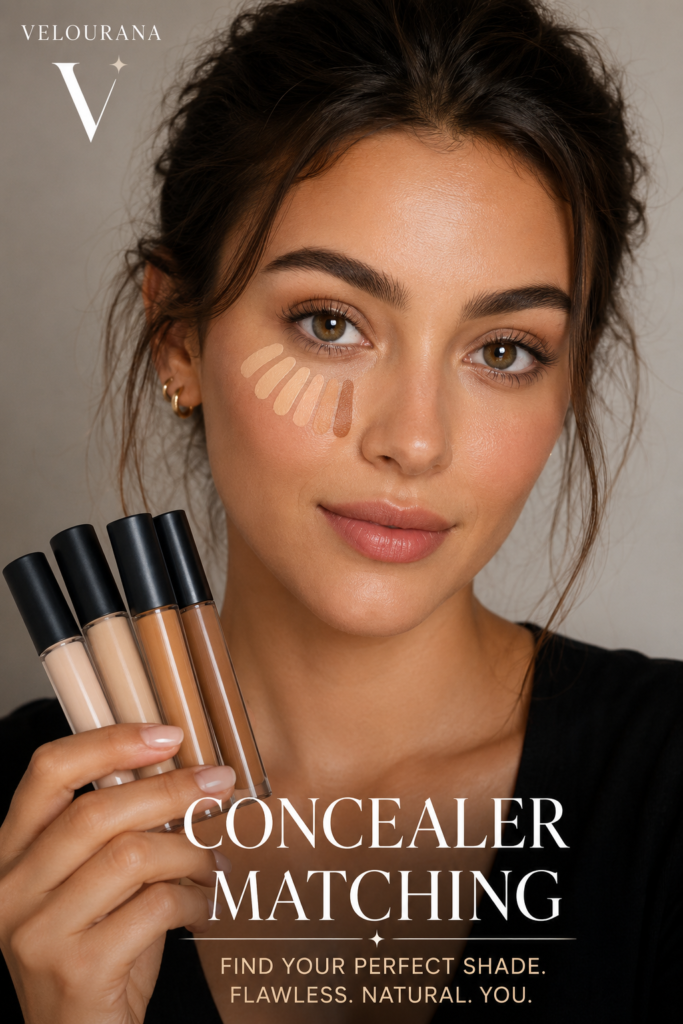
CATEGORY: Concealer Matching
A concealer can look perfect when first applied and completely wrong twenty minutes later.
This is one of the most frustrating problems in complexion makeup because the initial shade match may seem convincing. The concealer blends into the skin, the undertone appears balanced and the depth looks exactly right.
Then the formula settles.
Suddenly the under-eye area appears darker.
A spot-concealed blemish becomes warmer than the surrounding skin.
A neutral shade turns noticeably yellow or orange.
A product that seemed like an exact match in the store begins to look different by the time you leave.
These changes are often described broadly as oxidation.
In everyday beauty language, the term is frequently used for any complexion product that becomes darker, warmer or otherwise different after application.
The actual reasons can be more complex.
A concealer can change visually because volatile ingredients evaporate, pigments become more concentrated as the formula dries, oils interact with the product, skincare alters the base, foundation underneath changes the final color or the product genuinely undergoes chemical oxidation.
For practical shade matching, the precise mechanism is less important than the result.
What matters is that the concealer you match while wet may not be the concealer you actually wear once it has settled.
This is why dry-down behavior should be treated as part of concealer matching rather than as a separate technical issue.
Fresh Concealer Is Not Always the Final Color
Liquid and cream concealers contain ingredients that affect how the pigment initially appears.
When the product is freshly applied, it may contain more moisture, solvent or emollient material around the pigments.
As the formula settles, some of those components can evaporate or redistribute.
The color can appear slightly deeper, more concentrated or warmer.
Not every concealer does this noticeably.
Some remain extremely stable.
Others can shift enough to change an otherwise excellent shade match.
This is why a thirty-second swatch is not always enough.
If you are comparing several shades, you need to see what they look like after the formula has had time to settle.
Why People Call Every Shade Change Oxidation
Oxidation is a useful beauty term because it describes a familiar experience: complexion makeup becomes darker after application.
However, visible shade change does not always prove that oxidation is the only process involved.
Pigment concentration during drying can make a product appear deeper without requiring a dramatic chemical transformation.
Lighting can change.
The skin beneath the product can influence color.
Powder can alter the finish.
Oil can change how light reflects from the concealer.
All of these can create what looks like oxidation.
For everyday makeup decisions, you do not need to identify the exact chemistry.
You simply need to know whether the final color remains compatible with your skin.
The Dry-Down Test Should Be Part of Shade Matching
When testing concealer, apply a small amount to the area where you intend to wear it.
If you are testing a spot concealer, place it near the jaw or over a representative facial area.
If you are testing an under-eye concealer, eventually test it beneath the eye because the underlying color there is different.
Do not judge immediately.
Allow the product to settle.
Then compare the final shade with your skin.
If it has become darker, warmer, more orange or more yellow, that final appearance should determine whether the shade works.
You wear dried concealer for hours.
You wear fresh concealer for only moments.
Some Concealers Change Mostly in Depth
A product may maintain approximately the same undertone while becoming deeper.
This type of shift is relatively straightforward.
If the dry-down consistently makes the concealer one small step darker, you may need to begin with a slightly lighter shade.
However, this adjustment should be modest.
Do not automatically buy a dramatically lighter concealer because you have heard that the formula oxidizes.
The amount of change varies between products and individuals.
Test the actual formula whenever possible.
Some Concealers Change Mostly in Warmth
Other concealers may appear relatively neutral when first applied but become warmer as they settle.
This can create a strong mismatch on cool, neutral or olive complexions.
A concealer that initially disappears may later produce a yellow or orange patch.
This type of change is more difficult to fix merely by adjusting depth.
A lighter version of the same warm undertone may still look wrong.
You may need a different undertone family instead.
A Concealer Can Become Both Darker and Warmer
This is the classic oxidation complaint.
The product begins as a plausible match and later looks deeper and more orange.
When both variables change, the mismatch becomes more obvious.
For spot concealing, this can create a visible dark-orange mark where the blemish used to be.
Under the eyes, it may make the area look dull or overly warm rather than bright.
The solution depends on how consistent the shift is.
If every shade in the range changes similarly, choose the final dried shade rather than the fresh shade.
If the formula behaves unpredictably on your skin, a different concealer may be easier to work with.
Skin Oil Can Change How Concealer Looks
Oily skin can alter the appearance of complexion makeup throughout the day.
As natural oils mix with the concealer, the surface may become more reflective.
This can make the color appear deeper or more saturated.
Oil can also cause pigment to move, separate or concentrate in certain areas.
A shade that looks correct immediately after application may therefore change several hours later.
If this happens consistently, evaluate the concealer after realistic wear rather than only after the initial dry-down.
Skincare Can Influence Concealer Behavior
The products beneath your concealer matter.
Heavy moisturizer, facial oil, sunscreen, eye cream or primer can affect how the concealer dries and adheres.
A highly emollient base may prevent the product from setting normally.
An incompatible primer may cause separation.
Certain combinations can make the concealer appear darker or patchier.
This means a shade should ideally be tested over the skincare routine you actually use.
A perfect bare-skin swatch may behave differently over your normal morning products.
Sunscreen Can Change the Apparent Shade
Some sunscreens leave a visible white, gray or reflective cast.
Others create a very dewy surface.
If you apply concealer over such a base, the final appearance may be different from the same product on bare skin.
A sunscreen cast can make the concealer appear warmer by comparison.
A reflective surface can make the concealer look brighter.
If your shade seems inconsistent from day to day, check whether the underlying skincare changed.
Primer Can Affect Dry-Down
Primers are designed to change the skin surface.
Some smooth texture.
Some control oil.
Some add luminosity.
Some create a more adhesive base.
Because they alter the way concealer sits on the skin, they can also affect perceived color.
A mattifying primer may make the concealer appear slightly flatter or deeper.
A luminous primer may make it look brighter.
Again, this does not necessarily mean the concealer pigment itself changed dramatically.
Perception is influenced by the entire surface.
Foundation Underneath Can Change the Match
A concealer tested on bare skin may not look identical when applied over foundation.
If the foundation is slightly warmer than your natural complexion, a neutral concealer may look cooler by comparison.
If the foundation oxidizes too, the relationship can change even more over time.
This is why spot concealer should be tested with your usual foundation when you normally wear both together.
Complexion products function as a system.
Powder Can Create the Illusion of Oxidation
Sometimes concealer looks perfect until powder is applied.
A yellow setting powder can make the product appear warmer.
A pale translucent powder can make it look lighter or ashy.
A darker powder can deepen the entire area.
This may be mistaken for concealer oxidation even though the change actually occurred because another product was added.
Evaluate the concealer before and after powder separately.
If the color changes only after setting, the powder deserves investigation.
Lighting Can Make Dry-Down Seem More Dramatic
Imagine applying concealer in warm bathroom lighting and checking it later near a daylight window.
The product may appear to have changed substantially.
Some of that difference may come from the formula.
Some may come from the lighting.
Warm indoor light can disguise yellow and orange undertones.
Natural daylight can reveal them.
For reliable shade testing, compare the fresh and dried product under the same lighting conditions whenever possible.
Store Lighting Can Hide Future Problems
Cosmetics stores often use strong artificial lighting.
A concealer may look flattering under those conditions even when the undertone is slightly wrong.
If the formula also dries warmer, the mismatch can become obvious only after you leave.
When possible, allow the swatch to settle and then view it in natural light before deciding.
This is particularly important with high-coverage concealers because small color differences become more visible.
Phone Cameras Are Not Reliable Dry-Down Judges
Taking photographs of fresh and dried swatches can be useful, but automatic camera processing can alter the comparison.
The phone may adjust exposure differently between images.
White balance may shift.
HDR processing may brighten shadows.
The camera can therefore exaggerate or reduce the apparent change.
Use photographs as supplementary evidence.
Your eyes in consistent natural light remain the more useful reference.
Full-Coverage Concealers Make Dry-Down Changes More Obvious
A highly opaque concealer deposits more visible pigment.
If that pigment shifts darker or warmer, the change becomes obvious.
A sheer concealer may also change slightly, but the natural skin showing through can soften the effect.
This is one reason full-coverage formulas require more careful dry-down testing.
The stronger the coverage, the less forgiving the shade.
Matte Concealers May Appear Deeper After Setting
Matte formulas often lose surface shine as they dry.
This change in reflection can make the color appear deeper even when the pigment shift itself is modest.
A wet concealer reflects more light.
A dry matte surface reflects less.
The eye interprets this as increased depth.
For this reason, matte concealers should always be judged after they have reached their final finish.
Radiant Concealers Can Appear Brighter
Radiant formulas reflect more light.
Even when their pigment depth is similar to a matte concealer, they may appear visually brighter.
This can influence under-eye shade selection.
You may not need to choose a substantially lighter radiant concealer to achieve brightness.
Conversely, if the formula becomes less luminous as it sets, the final result may appear deeper than the fresh application.
The Under-Eye Area Can Change the Perceived Dry-Down
A swatch on the arm may dry beautifully.
The same shade beneath the eyes may appear grayer or darker.
This does not necessarily mean the formula behaved differently.
The underlying discoloration is different.
Blue, purple, brown or gray shadows can interact visually with the concealer.
As the formula settles and becomes thinner or more transparent, those colors may influence the final appearance more strongly.
This is why the under-eye area should be tested directly.
Dark Circles Can Make a Drying Concealer Look Ashy
Suppose a concealer is initially creamy and opaque.
It covers blue-purple darkness well.
As it sets, the layer becomes thinner and slightly more matte.
Some discoloration begins to show through.
The area now appears gray.
It may seem as though the concealer oxidized into grayness.
In reality, insufficient correction may be contributing.
A peach or orange corrector underneath may solve the problem more effectively than changing concealer shade.
Dry-Down Is Especially Important for Spot Concealing
Spot concealing requires close color accuracy.
A small depth shift can turn an invisible correction into a noticeable mark.
If your concealer dries half a shade darker than your skin, the difference may be obvious over a blemish even if it would be acceptable beneath the eyes.
For spot work, always match the final settled color.
Precision matters more here than in broad, sheer application.
A Fresh Exact Match Can Become a Dark Spot
This is one of the clearest signs that the formula dries deeper than expected.
You cover a blemish.
The concealer initially disappears.
Ten minutes later, the area looks darker than the surrounding skin.
The original blemish may be gone, but it has effectively been replaced by a makeup-created spot.
If this happens consistently, choose a slightly lighter version or change formulas.
A Fresh Neutral Match Can Become Orange
Olive and neutral complexions frequently notice this problem.
The product begins as beige or neutral.
After setting, it becomes peach or orange.
If this happens across several shades in the same range, the formula’s undertone behavior may simply be incompatible with your skin.
Moving lighter may not solve it.
A more olive, cooler or muted undertone may be necessary.
Dry-Down Can Vary Between Shades in the Same Range
Do not assume every shade in a concealer line changes identically.
Different pigment combinations may behave slightly differently.
One shade may remain stable.
Another may warm noticeably.
This is another reason direct testing is valuable.
A general review saying “this concealer oxidizes” does not tell you exactly what your chosen shade will do.
Reviews Can Help Identify Consistent Patterns
Online reviews become useful when many people describe the same behavior.
If numerous users report that a concealer dries darker, consider that pattern when selecting depth.
If olive-skinned users repeatedly report orange dry-down, that is meaningful undertone information.
One isolated review should not determine your decision.
Repeated observations are more valuable.
Look for Before-and-After Swatches
Some reviewers show fresh and dried swatches side by side.
These comparisons can be particularly useful because they demonstrate the product’s relative change under the same lighting and on the same skin.
Pay attention to both depth and undertone.
Does the shade simply deepen?
Does it become more yellow?
Does it become more orange?
Does it lose luminosity and only appear deeper?
These differences matter.
How Long Should You Wait?
There is no universal settling time for every concealer.
Some formulas change within minutes.
Others continue settling as they wear.
For an initial shade test, waiting several minutes is better than judging immediately.
For a truly important purchase, realistic wear provides more information.
Apply the concealer as you normally would and check it again later.
The purpose is not to identify an exact laboratory time point.
It is to see whether the product remains compatible after it has stabilized on your skin.
A Wear Test Is More Valuable Than a Swatch Test
Swatching is useful for narrowing shades.
Wearing the product tells you whether the match survives real conditions.
A concealer may dry correctly but become darker after several hours because of oil.
It may separate over skincare.
It may turn ashy after powder.
It may remain perfect.
If possible, test a candidate for several hours before committing to it as your long-term match.
Test One Side of the Face
When comparing two shades, apply one under each eye or use them on separate areas of the face.
Then allow both to settle.
This makes relative comparison much easier.
If one side becomes warmer or darker, you can see the difference immediately.
Side-by-side testing is particularly useful when choosing between neighboring shades.
Do Not Blend Test Swatches Together
When testing concealer depth and dry-down, keep swatches separate.
If you blend several shades into one area, their pigments mix and you lose useful information.
Apply small distinct sections.
Label them mentally or photograph the arrangement.
Then compare after settling.
Swatch Thickness Matters
A thick stripe of concealer may dry differently from the thin layer you actually wear.
The concentrated pigment can appear deeper and more saturated.
For realistic testing, apply the product in approximately the same thickness you would use on your face.
You can also compare both a concentrated and blended swatch.
The concentrated stripe shows undertone more clearly.
The blended section shows how the product is likely to behave in practice.
The Same Shade Can Look Different With a Brush and Sponge
Application tools affect product thickness.
A dense brush may deposit more concealer.
A damp sponge may sheer it out.
A fingertip may warm and spread the formula.
Because coverage density changes, the perceived shade can also change.
A concealer that looks too warm when applied heavily may become more natural when used thinly.
Test it using your preferred application method.
Too Much Product Can Exaggerate Oxidation
If the concealer has any tendency to deepen, applying a thick layer can make the effect more obvious.
More pigment means more visible color.
Using a smaller amount may reduce the apparent shift.
This is another reason accurate shade matching and controlled application work together.
You should not need excessive product when the shade and correction strategy are appropriate.
Mixing Concealers Can Adjust Dry-Down
If you already own a concealer that dries slightly too dark, mixing it with a lighter shade from the same line can help.
The important point is to test the mixture after it dries.
Do not judge the wet blend.
You are creating a custom final shade, not a custom fresh shade.
Mixing Undertones Can Also Help
A concealer that dries too warm may sometimes be moderated by mixing it with a more neutral shade.
An orange-leaning shade can be softened with neutral or olive depending on the complexion.
However, this is most practical when the original mismatch is small.
If the formula consistently becomes strongly orange on your skin, another product may be easier to match.
Seasonal Changes Can Alter Dry-Down Perception
A concealer may appear to oxidize more dramatically in winter simply because your skin has become lighter.
The formula may be behaving exactly the same way.
The contrast is greater.
Likewise, a concealer that seemed too dark in spring may suddenly look perfect after summer tanning.
Always consider whether your skin depth has changed before blaming the product entirely.
Increased Oiliness in Summer Can Change Wear
Hot weather can increase perspiration and surface oil.
This may make complexion products appear deeper or more saturated later in the day.
A concealer that behaves perfectly in winter may become less stable during summer.
If the problem is seasonal, application technique and setting products may solve it without requiring a completely different shade.
Dry Winter Skin Can Make Concealer Look Lighter
Dryness can make concealer sit more visibly on the skin.
A matte or powdery surface may reflect light differently and appear lighter or chalkier.
This can resemble a shade mismatch.
Hydration and formula choice may therefore influence whether the same concealer appears correct across seasons.
Skin Preparation Should Be Consistent During Testing
If you test a concealer on one day over rich eye cream and another day on bare skin, the results may not be directly comparable.
Use approximately the same skincare routine when comparing shades.
Consistency removes variables.
This is particularly important when you are trying to understand whether the concealer itself is changing.
Check the Concealer Before Adding Other Makeup
To isolate dry-down behavior, apply concealer and evaluate it before powder, bronzer, blush or other complexion products.
This gives you a baseline.
Then complete the makeup and observe whether the appearance changes again.
If the mismatch begins only after another product is added, the concealer may not be the main problem.
Color Corrector Can Affect the Final Shade
Correctors alter the color underneath concealer.
A peach base can make a neutral concealer appear warmer.
A strong orange corrector can influence the final color if the concealer layer is thin.
This is intentional to some degree.
But if the final result becomes too warm, you may be using too much corrector.
Do not immediately blame concealer oxidation.
Corrector Should Be Thin Enough to Disappear Into the System
The corrector’s purpose is to neutralize unwanted color, not remain visible.
Apply only enough to reduce the discoloration.
Then place concealer over it.
If the orange or peach remains obvious after concealer, reduce the corrector amount before changing the concealer shade.
Foundation Oxidation Can Make Concealer Look Too Light Later
Sometimes the concealer remains stable while the foundation around it becomes darker.
The concealer then appears to have become too light.
This is an important diagnostic clue.
Compare the concealer with bare skin as well as foundation.
If the surrounding base has deepened while the concealer has not, the foundation may be responsible.
Foundation Can Also Make Concealer Look Too Cool
If foundation dries warmer, a neutral concealer may suddenly appear pink or cool by comparison.
Again, the concealer itself may not have changed.
Complexion matching is relational.
Every product influences how neighboring colors are perceived.
Set Concealer Only After the Initial Color Check
If you immediately powder a fresh concealer, you lose the opportunity to see its natural dry-down.
When testing a new product, allow it to settle first.
Evaluate the color.
Then powder if that is part of your normal routine.
This helps separate formula behavior from setting-product behavior.
Some Concealers Look Darker Only Because They Lose Shine
A glossy wet product reflects light and appears brighter.
As it dries matte, the same pigment can look deeper.
This can happen even if the actual color change is small.
You may describe the result as oxidation, but the practical solution is the same: match the final finish.
Texture Can Affect Perceived Color Boundaries
If a concealer dries much more matte than the surrounding skin, the boundary can become visible even when depth and undertone are close.
You may think the shade changed.
In reality, the finish changed.
Matching texture can be as important as matching pigment for seamless spot concealing.
Concealer on Dry Blemishes May Darken Unevenly
A healing blemish often has irregular surface texture.
Concealer can collect in some areas and remain thin in others.
The concentrated sections may appear darker.
This patchiness can resemble oxidation.
Using less product and preparing dry texture gently can produce a more consistent color.
Concealer Around the Nose Can Behave Differently
The nose and surrounding area may be oilier than the cheeks.
A concealer that remains stable elsewhere may deepen or separate around the nose.
This is another reason one product can appear to “oxidize” only in certain areas.
Skin condition and location matter.
Under-Eye Concealer May Remain Stable While Facial Concealer Changes
The eye area often produces less oil than the center of the face.
A formula may therefore remain stable beneath the eyes but shift over blemishes around the forehead, nose or chin.
Do not assume your experience in one area predicts another perfectly.
Test the product where you intend to use it.
How to Tell Whether the Shade Really Changed
Use a simple comparison.
Apply a fresh swatch beside a swatch that has already dried.
If the dried section is clearly darker or warmer under the same lighting, the product has changed visually.
This is much more reliable than trying to remember what it looked like twenty minutes earlier.
Side-by-side fresh-versus-dry comparison removes memory from the equation.
Compare With a Known Stable Product
If you own a concealer that you know remains stable, swatch it beside the new product.
Allow both to dry.
The stable reference helps you see whether lighting or skin changes are affecting your perception.
This can be especially useful when evaluating subtle shifts.
Keep Notes When Testing Several Concealers
If you are comparing multiple formulas, record how each one behaves.
Fresh shade.
Dry shade.
Undertone shift.
Coverage.
Finish.
Wear after several hours.
This may sound excessive, but it is useful if you frequently struggle with complexion matching.
Patterns quickly emerge.
Online Shopping Requires Special Attention to Dry-Down Reports
You cannot perform a physical test when buying online.
In that situation, reviews and swatch comparisons become more important.
Search for current discussions of whether the concealer dries darker or warmer.
Look for images showing fresh and settled swatches.
Use repeated reports rather than isolated comments.
Then factor the likely shift into your shade choice cautiously.
Do Not Automatically Size Down Because Reviews Say It Oxidizes
Suppose reviews claim the concealer dries darker.
It may be tempting to buy two shades lighter.
That can create a new mismatch.
The degree of change may be small.
Your skin chemistry may differ.
The reviewer may use a different amount or base.
Use oxidation reports as one factor, not as a mathematical rule.
A Slightly Lighter Starting Shade Can Make Sense
If you have personally tested the formula and know it consistently dries one small step deeper, choosing a slightly lighter starting shade can be logical.
The key is evidence.
You are not guessing that it might oxidize.
You have observed the actual shift.
This distinction prevents overcorrection.
Undertone Shift Is More Important Than Simple Darkening
A concealer that dries slightly deeper but maintains the correct undertone may still be workable.
A concealer that remains the correct depth but turns orange can be much more obvious.
When evaluating dry-down, always ask two separate questions.
Did the depth change?
Did the undertone change?
These require different solutions.
If It Turns Yellow, Try a More Neutral Starting Point
A concealer that consistently dries yellow may work better if you begin with a more neutral or slightly cooler shade.
This depends on your complexion.
The goal is for the final dried product to match.
Do not become attached to the fresh appearance.
If It Turns Orange, Consider Olive or Neutral Alternatives
Orange dry-down is especially common as a complaint among olive and neutral skin tones.
If warm concealers repeatedly become orange, moving toward olive, neutral-olive or muted neutral shades can help.
Again, do not assume lighter automatically means less orange.
Undertone needs separate adjustment.
If It Turns Gray, Investigate More Than Oxidation
Grayness often indicates something different.
The shade may be too light.
Underlying dark circles may still be visible.
Powder may be creating ashiness.
A pale sunscreen may contribute.
Color correction may be insufficient.
Before replacing the concealer, determine exactly when the grayness appears.
If It Looks Perfect Until Powder, Change the Powder Test
Apply the same concealer on two areas.
Powder one.
Leave the other unpowdered.
Compare.
If only the powdered side changes, the concealer shade is probably not the main issue.
This simple test can prevent unnecessary product replacement.
If It Looks Perfect for Hours, Trust the Result
Not every concealer requires complicated troubleshooting.
If the product matches when fresh, remains compatible after drying and continues looking good after several hours, you have found a stable match.
There is no need to compensate for theoretical oxidation simply because other people experience it.
Your Perfect Shade Is the Final Shade
This is the most important principle.
Concealer matching should be based on the color that remains on your face during wear.
Not the color in the tube.
Not the fresh swatch.
Not the shade name.
Not the manufacturer’s digital sample.
The final settled color determines whether the product belongs on your complexion.
Build Dry-Down Into Your Shopping Routine
Every time you test a new concealer, make dry-down part of the process.
Apply.
Wait.
Check in natural light.
Compare depth.
Compare undertone.
Then wear it with your normal skincare and base products.
This small change can prevent many disappointing purchases.
Do Not Mistake Formula Behavior for Bad Application
When concealer consistently becomes too dark or warm despite careful matching, the issue may simply be the formula’s interaction with your skin.
You do not need to keep changing brushes or blending techniques indefinitely.
Sometimes the product is not compatible with your complexion chemistry or routine.
A different formula may solve the problem more easily than trying to control an unstable shade.
Do Not Mistake Bad Shade Matching for Oxidation Either
The reverse is also true.
A concealer may have been too warm from the beginning.
Warm store lighting simply disguised it.
When you later see the orange tone in daylight, it can feel as though the product changed.
A careful fresh-versus-dry comparison under the same light will reveal whether an actual shift occurred.
The Best Concealer Match Survives Time
A truly successful concealer shade does more than look good for the first minute.
It survives the formula’s dry-down.
It remains harmonious with skincare.
It works with foundation.
It is not ruined by setting powder.
It stays believable after natural skin oils begin to appear.
This is why concealer matching should be evaluated as a process rather than a single moment.
Your skin, formula and surrounding products continue interacting after application.
Match What You Wear, Not What You Swatch
The perfect swatch can be seductive.
A stripe disappears into your jaw and seems to prove that you have found the shade.
But if that stripe later becomes darker or warmer, the initial match was temporary.
The true match is the color that remains after the product settles into its normal wearable state.
For blemishes, this means the dried concealer should continue disappearing into surrounding skin.
For the under-eye area, the final shade should remain bright without turning gray, yellow or orange.
For pigmentation, the corrected area should remain balanced rather than developing an artificial color cast.
If a concealer changes slightly but the final result is still harmonious, the shift is not necessarily a problem.
If it changes enough to create visible contrast, incorporate that behavior into your shade choice or select a more stable formula.
The important lesson is simple.
Never stop evaluating at the first swatch.
Concealer is not a static color sitting in a tube.
It is a formula that changes as it dries, settles and interacts with your skin.
The best shade is therefore not the one that matches first.
It is the one that still matches later.
The End
Velourana
 Discover More From Our Family of Websites
 ZodiacBearing (Astrology, Tarot, Numerology, Angel Numbers & Spiritual Guidance)
 Velourana (Beauty, Makeup, Hair Care, Skincare & Beauty Tips)
 HavenBearing (Home, Living, Organization, Décor & Everyday Inspiration)
 PawBearing (Pet Care, Dog Breeds, Animal Health, Training & Pet Products)
 PsyCatherine (Notes From the Journal of a Psychologist on Real Life)