
CATEGORY: Makeup Techniques
Concealer is one of the most versatile products in any makeup collection. While foundation creates an even base across the entire face, concealer focuses on specific areas that require additional coverage or brightness. Whether you’re covering dark circles, hiding blemishes, reducing redness, or highlighting facial features, the right concealer can dramatically improve your makeup look.
Despite its popularity, concealer is often misunderstood. Many people purchase the wrong shade, choose an unsuitable formula, or apply far too much product. The result can be creasing, cakiness, or an unnatural appearance.
This comprehensive guide explains everything you need to know about concealer, including the different formulas, finishes, coverage levels, application techniques, and how to choose the best concealer for your unique skin type and concerns.
—
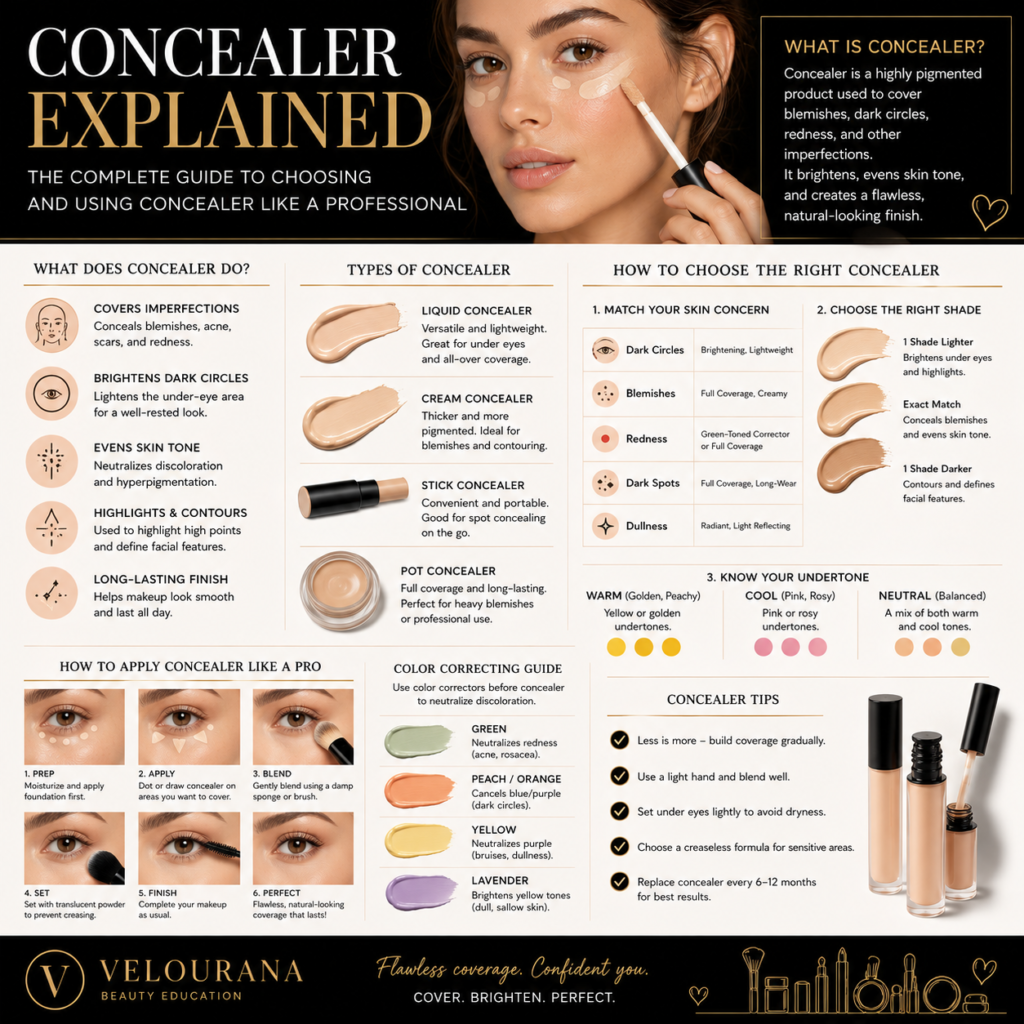
What Is Concealer?
Concealer is a highly pigmented cosmetic product designed to provide targeted coverage. Unlike foundation, which is applied over larger areas of the face, concealer is used only where extra correction or brightening is needed.
Concealers are typically thicker than foundation and contain a higher concentration of pigment, allowing them to effectively hide imperfections while blending naturally with the surrounding skin.
When applied correctly, concealer can create a brighter, fresher, and more even complexion without making makeup appear heavy.
—
Why Use Concealer?
Concealer serves several different purposes depending on how it is applied.
Common uses include:
- Covering dark under-eye circles.
- Concealing acne and blemishes.
- Reducing redness.
- Hiding hyperpigmentation.
- Covering scars.
- Brightening dull areas.
- Correcting uneven skin tone.
- Highlighting facial features.
- Defining makeup looks.
Because of its versatility, concealer is considered an essential product in both everyday makeup and professional artistry.
—
Different Types of Concealer
Modern concealers are available in several formulations, each offering unique advantages.
—
Liquid Concealer
Liquid concealer is the most widely used formula.
Advantages include:
- Easy blending.
- Lightweight feel.
- Suitable for most skin types.
- Available in multiple coverage levels.
- Excellent for under-eye use.
Liquid concealers are ideal for beginners because they are forgiving and easy to work with.
—
Cream Concealer
Cream concealers provide richer textures and stronger coverage.
They are particularly suitable for:
- Hyperpigmentation.
- Acne scars.
- Mature skin.
- Dry skin.
Because cream formulas contain more pigment, they often require less product to achieve effective coverage.
—
Stick Concealer
Stick concealers are convenient for travel and quick touch-ups.
Benefits include:
- High coverage.
- Precise application.
- Easy portability.
- Excellent for covering blemishes.
Their thicker consistency makes them especially useful for targeted correction.
—
Pot Concealer
Pot concealers typically offer the highest level of coverage.
Professional makeup artists frequently use them for:
- Severe discoloration.
- Birthmarks.
- Tattoos.
- Stage makeup.
- Photography.
Because these formulas are concentrated, a small amount usually goes a long way.
—
Understanding Concealer Coverage
Like foundation, concealer is available in different coverage levels.
Light Coverage
Provides subtle correction while maintaining a natural appearance.
Suitable for minimal makeup looks.
—
Medium Coverage
Balances coverage with realism.
Effective for:
- Mild redness.
- Small blemishes.
- Light dark circles.
—
Full Coverage
Designed to conceal more significant concerns, including:
- Severe pigmentation.
- Acne.
- Scars.
- Prominent dark circles.
When blended carefully, full-coverage concealer can still appear natural.
—
Choosing the Right Concealer Shade
Shade selection depends on the intended purpose.
—
Concealing Blemishes
To hide acne, redness, or pigmentation, choose a concealer that closely matches your foundation or natural skin tone.
Using a lighter shade may actually draw attention to imperfections rather than conceal them.
—
Brightening the Under-Eye Area
For under-eye brightening, many makeup artists recommend selecting a concealer that is one shade lighter than your foundation.
This gently lifts the appearance of the eyes without creating an obvious contrast.
Choosing shades that are too light can produce an unnatural “reverse raccoon” effect, especially in flash photography.
—
Highlighting the Face
Concealer may also be used to highlight areas such as:
- Center of the forehead.
- Bridge of the nose.
- Chin.
- Under the eyes.
These lighter areas help create dimension and balance within the face.
—
Understanding Color Correctors
Sometimes standard concealer alone cannot fully neutralize discoloration.
Color correctors are designed to cancel specific unwanted tones before concealer is applied.
—
Green Corrector
Neutralizes redness caused by:
- Acne.
- Rosacea.
- Broken capillaries.
—
Peach Corrector
Works well for light skin with bluish under-eye circles.
—
Orange Corrector
Ideal for medium to deep skin tones with dark pigmentation.
—
Yellow Corrector
Softens purple discoloration while adding warmth.
—
Lavender Corrector
Brightens yellow or dull complexions.
—
Applying Concealer Under the Eyes
Proper technique helps avoid creasing and cakiness.
Step 1
Apply foundation first if using it.
This often reduces the amount of concealer needed.
—
Step 2
Place small dots of concealer near the inner corner and outer corner of the under-eye area.
Avoid covering the entire under-eye region with thick layers.
—
Step 3
Blend gently using:
- Damp makeup sponge.
- Small concealer brush.
- Fingertips.
Soft tapping motions usually produce the smoothest finish.
—
Step 4
Set lightly with translucent powder if necessary.
Too much powder can emphasize fine lines.
—
Concealing Blemishes
For acne or individual spots:
- Apply a tiny amount directly onto the blemish.
- Allow it to sit for several seconds.
- Blend only around the edges.
- Leave maximum coverage directly over the imperfection.
This technique preserves coverage while keeping the finish natural.
—
Choosing Concealer According to Skin Type
Dry Skin
Hydrating liquid or cream concealers generally provide the most flattering finish.
Avoid excessively matte formulas that may emphasize dryness.
—
Oily Skin
Long-wearing matte concealers usually perform best.
Setting powder can help improve longevity.
—
Combination Skin
Flexible liquid concealers often adapt well to different areas of the face.
—
Mature Skin
Lightweight hydrating concealers tend to settle less into fine lines.
Applying very small amounts usually produces the most natural result.
—
Common Concealer Mistakes
Many disappointing results come from avoidable application errors.
Common mistakes include:
- Choosing a shade that is too light.
- Applying excessive product.
- Skipping moisturizer.
- Not blending properly.
- Using heavy formulas under mature eyes.
- Setting with too much powder.
- Ignoring color correction when needed.
Correcting these habits often improves makeup dramatically.
—
Can Concealer Replace Foundation?
For many people, yes.
If your skin is generally even with only a few areas requiring correction, concealer alone can create a fresh, natural appearance.
Simply apply concealer where needed and blend well.
This lightweight approach has become increasingly popular in modern beauty routines.
—
How Long Does Concealer Last?
Most liquid concealers remain usable for approximately 12 to 24 months after opening, depending on the manufacturer’s recommendations.
Replace concealer if you notice:
- Unpleasant odor.
- Texture changes.
- Product separation.
- Eye irritation.
- Packaging contamination.
Maintaining clean applicators also helps preserve product quality.
—
Building a Concealer Collection
Many makeup enthusiasts eventually own multiple concealers for different purposes.
A practical collection may include:
- Hydrating concealer for under-eyes.
- Full-coverage concealer for blemishes.
- Brightening concealer for highlighting.
- Color corrector for persistent discoloration.
Having specialized products often produces more natural results than relying on a single concealer for every task.
—
Final Thoughts
Concealer is much more than a product for hiding imperfections—it is a powerful tool that brightens, balances, and enhances the complexion. Whether you want to disguise dark circles, minimize blemishes, or add subtle dimension to your face, understanding the different formulas, shades, and application techniques will help you achieve smoother, more professional-looking makeup.
By selecting the right concealer for your skin type and using it sparingly where it is truly needed, you can create a flawless yet natural finish that enhances your features without masking them. Mastering concealer is one of the simplest ways to elevate any makeup routine, from everyday looks to glamorous special-occasion styles.
The End,
Velourana
 Discover More From Our Family of Websites
 ZodiacBearing (Astrology, Tarot, Numerology, Angel Numbers & Spiritual Guidance)
 Velourana (Beauty, Makeup, Hair Care, Skincare & Beauty Tips)
 HavenBearing (Home, Living, Organization, Décor & Everyday Inspiration)
 PawBearing (Pet Care, Dog Breeds, Animal Health, Training & Pet Products)
 PsyCatherine (Notes From the Journal of a Psychologist on Real Life)

