
CATEGORY: Color Melting
Hair color is often described in terms of shades: brunette, blonde, copper, caramel, auburn, ash, honey, chocolate. Color melting approaches the subject differently. Instead of asking only which colors should appear in the hair, it asks how those colors should move into one another. The technique is built around transition, creating a visual progression in which neighboring tones seem to dissolve together rather than meeting at obvious boundaries.
That distinction is what gives color melting its particular sophistication. A beautifully executed melt can contain considerable contrast, yet the eye does not encounter the color as a collection of separate bands. The root, mid-lengths and ends remain related. Darker areas appear to flow naturally toward lighter ones, warmer notes can emerge gradually from neutral foundations, and highlights can feel embedded within the overall color rather than placed on top of it.
The result is frequently described as seamless, but seamless does not mean flat. In fact, some of the most successful color melts depend on carefully controlled differences in depth, temperature and saturation. What disappears is not variation but abruptness. The technique preserves dimension while softening the visual borders that would otherwise divide one shade from another.
This makes color melting especially relevant to contemporary hair color, where the desired finish is often less about displaying a technique and more about creating believable richness. The work may be technically complex, but the finished color can look remarkably effortless.
Color Melting Is About Relationships Between Shades
The central idea behind color melting is tonal continuity. Rather than applying one root color and one contrasting length color and allowing the two to meet directly, a colorist works with intermediate shades or carefully overlapped tonal zones. These transitional colors create a bridge.
Imagine deep neutral brown at the root and luminous beige blonde toward the ends. If those two colors meet too suddenly, the division may be obvious even when the placement itself is attractive. Introducing an intermediate brunette-blonde tone through the middle creates a more gradual shift in value. The eye travels through the color rather than stopping at a line.
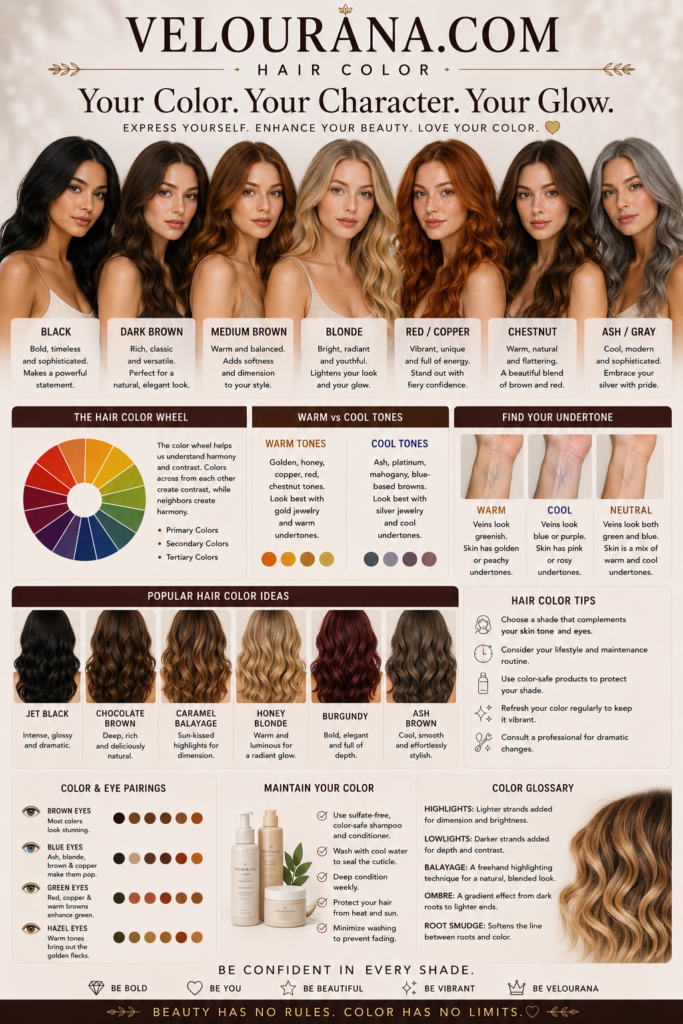
This principle can be applied to many palettes. Espresso can melt into chestnut and then caramel. Deep auburn can soften into copper before becoming strawberry gold. Dark ash blonde can move through mushroom beige into a cooler pale blonde. Even fashion colors can be melted, with burgundy moving into magenta, violet transitioning into lavender, or blue deepening and lightening through related tonal families.
The intermediate color is not merely filler between two more important shades. It determines the quality of the transition. If its undertone does not relate convincingly to the colors around it, the melt can feel disconnected. A bridge shade that is too warm between two distinctly cool colors, for example, may create an unintended band. A shade that is too dark can interrupt the gradual movement in depth.
Successful melting therefore depends on seeing color relationally. Every tone needs to make sense beside the tone before it and the tone after it.
This is also why color melting can appear deceptively simple in finished photographs. The observer sees harmony. The complexity lies in creating that harmony through several controlled decisions involving level, undertone, placement, processing and blending.
Depth Creates the Architecture of the Melt
Before considering whether a melt should be warm, cool or neutral, it is useful to understand depth. Depth establishes the underlying structure of the color.
A darker root naturally creates visual weight around the scalp and can make lighter lengths appear brighter by comparison. When that depth is extended slightly into the mid-lengths and gradually softened, the result can create the impression that the hair becomes increasingly illuminated toward the ends.
This is one reason color melting works so beautifully with dimensional brunette and blonde combinations. The technique allows the colorist to preserve darkness without allowing it to dominate the entire result.
The amount of difference between the darkest and lightest areas changes the character of the melt. A subtle progression between neighboring levels can create an exceptionally polished, expensive-looking finish in which the dimension is noticeable primarily when the hair moves. A greater difference can produce more drama while still avoiding harsh demarcation.
Contrast therefore does not contradict seamlessness. The important factor is how the contrast is distributed.
When depth changes too abruptly, the eye recognizes sections. When depth changes progressively, the eye recognizes movement.
Hair texture intensifies this effect. Waves and curls reveal different portions of the color as the hair bends, so transitional tones can become especially visible through movement. Straight hair can reveal the precision of the blend more directly because the surface behaves almost like a continuous canvas. Neither texture is inherently better suited to melting, but each exposes different aspects of the work.
Density also matters. On very dense hair, internal areas may require enough dimensional variation to prevent the color from appearing like a dark exterior surrounding light ends. On finer hair, excessive tonal segmentation can sometimes make the overall result feel busy. The visual scale of the melt needs to correspond to the amount and movement of the hair.
A sophisticated color melt therefore considers not merely where the root ends and the lengths begin, but how the architecture of depth behaves across the entire head.
Undertone Determines Whether the Transition Feels Harmonious
Two colors can be close in depth and still look disconnected if their undertones conflict unexpectedly.
This is where color melting becomes closely connected to color theory. Hair does not move from dark to light in a neutral vacuum. Lightening exposes underlying warmth, artificial pigments interact with natural pigment, and toners alter the visible balance between yellow, orange, red, violet, blue and neutral tones.
A warm color melt may deliberately celebrate these underlying pigments. Deep chocolate can transition into cinnamon, amber and honey. Copper can move from a richer auburn root toward increasingly luminous golden-copper ends. In these combinations, warmth is not something that needs to be erased. It becomes part of the visual continuity.
Cooler melts require a different type of control. A smoky brunette progressing into taupe, mushroom and cool beige needs enough tonal consistency to avoid an accidental warm band between the deeper root and cooler ends. Because lightened hair naturally reveals warmth, achieving this type of progression may require careful neutralization rather than simply choosing several cool-looking formulas.
Neutral color melts occupy an interesting middle territory. Neutral does not necessarily mean the complete absence of warm or cool pigment. Often it means that neither dominates strongly enough to define the overall impression. A neutral brunette-to-beige melt may contain subtle warmth in illuminated areas because removing every trace of warmth could make the color look dull or artificial.
The most convincing melts frequently contain more tonal complexity than their labels suggest. A “cool brunette” may contain controlled neutral warmth that keeps the hair from looking grey. A “golden blonde” may contain cooler beige elements near the root to prevent excessive brassiness. A copper melt may use deeper red-brown pigment near the base to create richness before opening into brighter orange-gold.
The goal is not mathematical uniformity. It is visual coherence.
That coherence should also be considered in relation to the person wearing the color. Skin undertone can influence whether a particular degree of warmth or coolness appears harmonious, but it should not be treated as a rigid rule. Personal style, makeup, natural coloring, contrast preference and the emotional character of the desired result are equally important.
Someone with cool skin may intentionally choose warm copper because the contrast feels vibrant and expressive. Someone with warm skin may prefer a cooler brunette because the restraint feels modern and sophisticated. Color melting provides enough tonal flexibility to make these choices nuanced rather than absolute.
The Root Is Often the Beginning of the Story
The root area has enormous influence over how a color melt is perceived because it establishes the first point of depth and often determines how naturally the color relates to new growth.
In many contemporary melts, the root is intentionally deeper than the lengths. This can create softness around the scalp, preserve a connection with the natural base and allow lighter pieces to emerge gradually. The root may be close to the natural color or deliberately altered, depending on the desired result.
A deeper root can also change the visual impression of blonde. Instead of appearing uniformly pale from scalp to ends, blonde can gain dimensional framing. The lighter areas seem more luminous because they exist beside controlled shadow.
However, a root melt is not simply a dark formula applied to the first few centimeters of hair. Its success depends on diffusion. If the root color ends abruptly, the technique has merely created another band. The root must transition convincingly into the next tonal zone.
Placement becomes particularly important around the hairline. Brightness close to the face may be retained even when the internal root is deeper, allowing the finished color to combine softness with illumination. In other cases, a more uniform root shadow creates a moodier, lower-contrast result.
The natural base also influences maintenance. When the root formula remains relatively close to the wearer’s natural depth and undertone, new growth may integrate more discreetly. When the root is significantly altered, the grow-out pattern can become more noticeable.
Color melting is often associated with lower-maintenance color for this reason, but the phrase should be understood carefully. A softer grow-out does not mean that the color never needs maintenance. Tonal shifts, fading, porosity and environmental exposure continue to affect the lengths even when the root transition remains attractive.
The real advantage is that the design can accommodate change. Rather than depending on a perfectly sharp starting point, the color already contains graduated depth. As the hair grows, that visual logic can continue to work.
Color Melting and Highlighting Techniques Can Work Together
Color melting is sometimes treated as though it were an alternative to balayage, foiling or other lightening methods. In practice, these techniques often address different stages of the color design.
Balayage and foiling primarily concern where and how hair is lightened. Color melting concerns how the resulting tonal areas are connected.
A colorist might create highlights with foils, freehand painting or another lightening approach and then use a melt to refine the root, middle and ends. The finished result can therefore contain both deliberate highlight placement and seamless tonal transitions.
This distinction explains why two clients can receive similar lightening patterns but leave with very different-looking color. One may have bright, clearly defined highlights with noticeable separation from the base. Another may have the same underlying lightness softened by a root and tonal melt that integrates everything into a more diffused finish.
Balayage can be particularly compatible with color melting because both techniques are often used to create graduated effects. Yet they are not synonymous. Balayage describes a method of painting lightener or color, while melting describes the blending relationship among tones.
Foiled highlights can also be transformed dramatically through melting. Strong ribbons of brightness can be softened at their starting points while remaining luminous through the lengths. This can create a sophisticated balance between visible dimension and polished integration.
The combination becomes especially useful when correcting older highlights. Hair may contain several histories at once: natural regrowth, previous root color, old highlights, faded toner and more porous ends. A carefully designed melt can help visually connect these zones, although significant correction may require more than toning alone.
The technique is therefore not defined by one application method. It is a philosophy of transition that can be incorporated into many color services.
Porosity, Texture and Condition Change the Final Color
Hair color does not exist only in a formula bowl. It exists on a fiber whose condition influences how pigment is absorbed, reflected and retained.
Porous ends may accept toner more rapidly than healthier mid-lengths. They may also release pigment faster during subsequent washing. This creates a particular challenge for color melting because the technique depends on tonal continuity. If one section becomes significantly darker, cooler or more saturated than intended, the seamless progression can be disrupted.
Previously lightened hair often has varying degrees of porosity from root to end. The oldest portions may have experienced repeated chemical processing, heat styling, ultraviolet exposure and mechanical wear. Even when the hair initially appears evenly lightened, these structural differences can influence the final tonal result.
This is one reason professional formulation cannot be reduced to choosing three attractive shades from a chart. The same formula may behave differently on separate areas of the same head.
Texture influences perception as well. Curly and coily hair can display a melt in a multidirectional way because individual bends expose different tonal surfaces. Strategic brightness may appear and disappear throughout the shape, creating remarkable depth. Wavy hair naturally emphasizes gradients because the curves catch light at different points. Straight hair reveals transitions with exceptional clarity, making precision especially important.
Finish changes the visual experience too. Glossy hair reflects more light, which can make tonal transitions appear brighter and more dimensional. Matte or highly textured styling diffuses reflection, sometimes making the same shades appear softer or deeper.
Color melting therefore needs to be designed for real hair rather than an abstract swatch. The condition, movement and styling habits of the wearer all participate in the final result.
Why the Technique Can Age Gracefully
One of the strongest aesthetic qualities of color melting is its ability to remain visually coherent as the hair changes between appointments.
Traditional high-contrast color can depend heavily on the relationship between freshly colored hair and the scalp. As new growth appears, the original geometry changes. A line that was initially precise becomes increasingly obvious.
A well-designed melt already contains transition. If the root area has been chosen with the natural base in mind, new growth may extend that transition rather than immediately contradicting it.
This can make color melting attractive to people who enjoy dimensional color but do not want the appearance to depend on extremely frequent root appointments.
The lengths still evolve. Blonde can become warmer as toner fades. Brunette glosses may lose richness. Copper and red pigments can change relatively quickly because vibrant tonal molecules often require regular refreshing. Mineral deposits, hard water, sun exposure and heat can alter the visible balance of the color.
Maintenance therefore becomes less about preserving an exact frozen image and more about maintaining the quality of the tonal relationships.
Appropriate cleansing, conditioning and heat protection help preserve both pigment and surface condition. Excessive heat can accelerate fading and contribute to dryness, while repeated aggressive cleansing may reduce the longevity of deposited tone. Purple or blue products can sometimes help manage unwanted warmth in appropriate color families, but overuse can distort a carefully balanced melt, particularly on porous lightened sections.
A color melt should be maintained as a complete palette. Correcting one area aggressively without considering neighboring tones can upset the relationship that made the color successful in the first place.
The Most Beautiful Melt Is Designed for the Individual
Color melting is powerful because it is not a single look.
It can be almost invisible, creating the impression of naturally multidimensional hair. It can be glamorous, with deep roots dissolving into luminous blonde. It can be warm and sensual, moving through chocolate, caramel and honey. It can be restrained and cool, built from espresso, ash brown, mushroom and beige. It can also become highly creative, allowing unconventional colors to graduate through related or contrasting hues.
What connects these possibilities is the treatment of boundaries.
The technique recognizes that sophisticated color often depends on what happens between the obvious shades. The transitional areas may occupy less visual attention, but they determine whether the entire composition feels integrated.
This is why reference photographs are most useful when they are discussed rather than simply copied. The natural base, existing color history, hair condition, density, texture and achievable level of lightness all influence whether a particular photograph can be recreated convincingly. Even when the exact colors change, the underlying principle of the inspiration can often be preserved.
A person may be drawn not to the specific beige blonde in an image but to the softness of its root transition. Another may love the richness created by three brunette depths rather than the actual hue. Understanding what makes the reference appealing allows the technique to be adapted intelligently.
Color melting ultimately represents a broader shift in hair color toward integration. It celebrates dimension without requiring visible separation and contrast without insisting on hard edges.
When the technique succeeds, it becomes difficult to identify exactly where one shade stops and another begins. That ambiguity is not a lack of precision. It is the evidence of precision.
The colors have been designed to belong together.
THE END VELOURANA
 Discover More From Our Family of Websites
 ZodiacBearing (Astrology, Tarot, Numerology, Angel Numbers & Spiritual Guidance)
 Velourana (Beauty, Makeup, Hair Care, Skincare & Beauty Tips)
 HavenBearing (Home, Living, Organization, Décor & Everyday Inspiration)
 PawBearing (Pet Care, Dog Breeds, Animal Health, Training & Pet Products)
 PsyCatherine (Notes From the Journal of a Psychologist on Real Life)

