
CATEGORY: Medium Haircuts
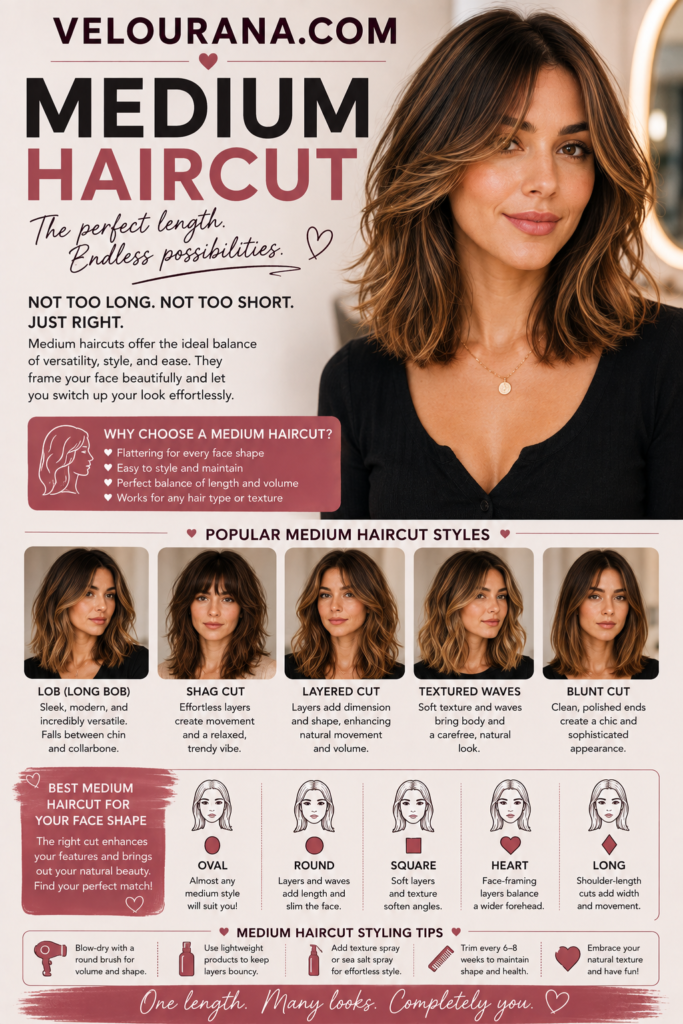
There is a reason collarbone-length hair repeatedly returns as one of the most wearable medium haircuts. It sits in a particularly useful position: long enough to move naturally beyond the shoulders, short enough to retain a strong and visible shape, and practical enough for most of the everyday styles people expect from longer hair.
It is also a length that can produce a meaningful transformation without necessarily feeling dramatic.
Someone cutting very long hair may remove a considerable amount and still retain the familiar sensation of hair falling beyond the shoulders. Someone growing out a bob can reach the collarbones and suddenly discover that ponytails, loose waves and more elaborate styling have become easier again. Someone who has maintained medium hair for years can alter the perimeter, layers or front without changing the fundamental convenience of the length.
This adaptability is one of the haircut's greatest strengths.
A collarbone cut can be blunt and polished, softly layered, heavily textured or shaped around natural curls. It can carry bangs or remain completely open around the face. It can emphasize density or redistribute it. Straight hair can turn the length into a sleek, clean silhouette, while waves and curls can use the reduced weight to create considerably more movement.
The collarbones also provide a natural visual reference. The haircut has enough length to move past the shoulders, avoiding some of the persistent outward flipping associated with hair that ends directly against them, while remaining close enough to the face for the perimeter to contribute strongly to the overall appearance.
The result is a genuine middle ground, but not in the sense of compromise.
Collarbone hair works because it retains many of the advantages of long hair while recovering some of the lightness and structure associated with shorter cuts.
Why Moving Below the Shoulders Makes Such a Difference
The distinction between shoulder and collarbone length may involve only several centimeters, but those centimeters change the physical behavior of the hair.
At exact shoulder length, the ends repeatedly encounter the body. They may turn outward simply because the shoulder prevents them from continuing downward.
Once the perimeter moves lower, more of the hair can pass that point of contact.
Gravity regains influence.
The ends may fall more naturally rather than being constantly redirected.
This is particularly useful for someone who enjoys medium hair but dislikes fighting an outward flip every morning.
The additional length also improves the ability to tie the hair.
Sections around the nape have farther to travel before reaching a ponytail, and the extra centimeters can make the difference between a secure tie and pieces constantly escaping underneath.
Yet the haircut still remains substantially lighter than very long hair.
That combination is one of the reasons collarbone length can be so comfortable in everyday life.
The Perimeter Establishes the Character
Before layers are considered, the baseline already determines much of the haircut's personality.
A strong perimeter creates density and definition.
Most of the strands reach approximately the same level, producing a substantial lower edge. This can look particularly effective on fine or lower-density hair because the haircut concentrates the available hair rather than distributing it across many different lengths.
A slightly curved perimeter softens the shape.
The center may sit a little lower than the outer sections, creating gentle movement without significantly reducing the appearance of fullness.
More texturing through the ends creates a lighter result.
Instead of forming one obvious boundary, individual sections separate and move more freely.
Dense hair may benefit from this reduction in solidity.
Fine hair may require greater restraint.
The choice should therefore reflect both the desired aesthetic and the amount of density available.
The Collarbone Lob Keeps the Strength of a Bob
A collarbone-length lob retains some of the structural qualities that make a bob so recognizable.
The perimeter remains important.
The haircut can still feel clean and deliberate.
But the additional length changes its movement considerably.
Instead of sitting around the jaw or neck, the hair passes the shoulders and reaches toward the upper chest.
This makes the haircut softer.
It also expands the styling possibilities.
A sleek finish emphasizes the strong baseline.
Loose waves create a more relaxed interpretation.
A side part can produce volume.
A center part can make the shape feel more symmetrical and minimal.
The lob can therefore work particularly well for someone who likes the visual discipline of a bob but wants more flexibility than a shorter perimeter provides.
Fine Hair Can Look Remarkably Strong at This Length
When fine hair has been grown substantially longer, the lower section may eventually contain fewer strands than the upper lengths.
This can happen through natural growth cycles, breakage and accumulated wear.
Moving the perimeter upward to the collarbones can remove much of this sparse section.
The new ends may suddenly look considerably fuller.
This does not change the actual number of follicles or strands growing from the scalp.
It changes where the haircut ends relative to the existing density.
A blunt or softly curved perimeter can emphasize this effect.
Layers can still be included, but they are often most successful when used selectively.
A few long layers or face-framing pieces may provide enough movement without removing large amounts of hair from the baseline.
For fine hair, that restraint can make the difference between a light, healthy-looking medium cut and one whose ends become unnecessarily thin.
Thick Hair Can Lose Weight Without Losing Its Richness
For dense hair, collarbone length can remove a significant amount of physical weight compared with very long hair.
But cutting away length does not automatically make thick hair lie flatter.
Sometimes the opposite happens.
The long sections may previously have been pulling the hair downward. Once removed, natural body, waves or curls can become more pronounced.
This needs to be considered before aggressively removing additional density.
Layers can distribute the hair more effectively.
Internal shaping can prevent the perimeter from becoming overwhelmingly heavy.
Face framing can reduce some of the bulk around the front.
But thick hair should still look thick.
Its abundance is part of its beauty.
The objective is to make the density easier to wear rather than reducing it until the ends no longer reflect the richness of the hair above them.
Long Layers Give Collarbone Hair a Softer Flow
A collarbone haircut does not need layers, but the length provides enough room for them to develop naturally.
Long layers introduce movement without creating a dramatic difference between the upper and lower sections.
The perimeter can remain relatively substantial while selected pieces become light enough to move independently.
This works especially well for someone who wants softness rather than obvious layering.
When the hair is worn straight, the layers may be subtle.
During a blowout, they become more visible.
Waves reveal them in another way, allowing different sections to bend independently.
The haircut can therefore change character according to styling without requiring an extreme structure.
More Pronounced Layers Create a Different Silhouette
Shortening the upper sections further creates greater movement and redistributes volume.
This can be useful for dense hair or for textures that need some weight removed before their natural movement becomes visible.
The haircut begins to feel less like a lob and more like a fully layered medium style.
The crown may gain additional lift.
The sides can become lighter.
The ends separate more easily.
The trade-off is reduced density through the perimeter.
This may be insignificant on extremely thick hair but more noticeable on fine hair.
Layering should therefore be judged according to its effect on the whole haircut rather than according to the appeal of one isolated section.
Face Framing Can Make the Cut Look Completely Different
A relatively simple collarbone haircut can be transformed by changing only the front.
Long framing beginning around the chin creates a gentle transition.
Shorter jaw-length pieces make the effect more visible.
Cheekbone layers create considerably greater contrast.
From the back, the haircut may remain almost unchanged.
From the front, it can appear like an entirely new style.
This makes face framing particularly valuable for someone who wants variety without sacrificing the strong perimeter.
The front pieces can also soften tied hairstyles, remaining loose around the face while the rest of the hair is secured.
For someone who prefers everything inside a ponytail, the framing can begin lower so that more of it reaches the tie.
Curtain Bangs Can Flow Naturally Into the Collarbone
Curtain bangs and collarbone hair have enough distance between them to create a beautiful progression.
The shortest pieces begin around the forehead.
They become longer around the temples and cheeks.
The framing continues through the jaw and neck before reaching the main perimeter.
When styled outward, this creates a sweeping effect through the entire front.
The same structure can look considerably softer when air-dried.
As the bangs grow, they gradually become longer face-framing pieces rather than immediately losing their place within the haircut.
This makes the combination adaptable for someone who likes changing the front more frequently than the overall length.
Straight Hair Makes the Structure Easy to See
Straight collarbone-length hair can look exceptionally polished because the perimeter remains close enough to the face for its precision to be visible.
A blunt cut creates a strong line.
Subtle layers add movement without dramatically interrupting the smooth surface.
Face framing can introduce softness.
A center part emphasizes symmetry, while a side part shifts volume toward one side and changes the entire balance.
The ends can be worn completely straight or given a slight curve.
Even a small amount of movement can significantly alter the finished appearance because the haircut is compact enough for the perimeter to remain visually dominant.
Straight hair therefore does not require complex layering to avoid looking plain.
Precision itself can become the style.
Waves Often Benefit From the Reduced Weight
Collarbone length can reveal natural waves that were less obvious when the hair was considerably longer.
Removing length reduces the downward pull on the strands.
The pattern may become stronger.
Movement can begin higher.
Sections may separate more easily.
A relatively simple haircut can therefore appear surprisingly textured once the hair is allowed to dry naturally.
Layers can encourage this further, but they should be added according to the amount of volume desired.
Someone with dense waves may already have considerable movement after the initial reduction in length.
Adding aggressive layering immediately could create more expansion than expected.
The haircut should work with the texture that appears after the weight changes.
Curly Hair Can Develop a Stronger Shape
For curls, collarbone length is less about establishing a perfectly visible baseline and more about deciding where the overall volume should sit.
A predominantly one-length structure can keep more weight toward the bottom.
Layers can redistribute some of that volume upward.
Shorter sections may contract more strongly because they carry less weight.
The silhouette can become rounder and more dynamic.
Shrinkage remains crucial.
Hair that reaches the collarbones when stretched may sit significantly above them when naturally curled.
The finished dry position should therefore guide the haircut.
This is especially important around the front, where a few centimeters can move a curl from the jaw toward the cheek.
The Length Is Ideal for a Soft Blowout
Collarbone hair responds particularly well to blow-drying because it has enough length to create flowing curves but not so much weight that those curves immediately disappear.
Root lift can give the upper section volume.
Face-framing pieces can sweep outward.
Long layers can overlap through the sides.
The ends can curve softly rather than forming a rigid perimeter.
This creates the full, moving appearance often associated with medium layered hair.
It is important, however, to distinguish between haircut and styling.
A photograph showing enormous volume may depend on careful blow-drying, brushes and styling products in addition to the cut itself.
The same haircut worn naturally may appear considerably more restrained.
That versatility can be an advantage rather than a disappointment.
Air-Drying Can Make the Haircut More Relaxed
The haircut can work just as successfully without a polished finish.
Straight hair may develop subtle bends.
Waves can form naturally.
Curls can create their own distribution of volume.
The perimeter may appear softer than it does after blow-drying, but the underlying structure should still be recognizable.
Someone who regularly air-dries should choose the haircut with that everyday result in mind.
There is little benefit in selecting a structure that looks beautiful only after a styling routine the wearer has no intention of performing.
Ponytails Become Particularly Practical
At the collarbones, the hair generally has enough length to gather more securely than many exact shoulder cuts.
This can make the difference surprisingly important for everyday life.
A ponytail is available for exercise, work or warm weather without carrying the considerable weight of very long hair.
Face-framing pieces may remain loose depending on their length.
Layers can create some shorter sections around the nape or sides, but the majority of the haircut is usually manageable.
For someone who wants a significant haircut without giving up the ability to tie their hair easily, collarbone length is often a practical compromise.
Buns Become Lighter and More Textured
The reduction in length also changes buns.
There is less hair to wrap, making the finished style smaller and lighter.
Layers can create natural texture as shorter pieces emerge.
This can look attractive in relaxed styles.
For highly polished buns, those sections may require pins or styling products.
The haircut should therefore consider how frequently formal or tightly controlled updos are worn.
A highly layered style and a perfectly smooth everyday bun may demand more work than a predominantly one-length cut.
Braids Remain Possible but Become Shorter
Collarbone-length hair still provides enough length for various braids, although the final result is naturally shorter than with long hair.
Layers influence how quickly pieces begin escaping from the braid.
A predominantly one-length haircut produces a cleaner structure.
A layered haircut creates more texture and taper.
Neither is inherently preferable.
Someone who enjoys loose, relaxed braids may appreciate the movement created by layers.
Someone who frequently creates intricate polished braids may prefer greater consistency in the lengths.
Cutting From Very Long Hair Can Feel Dramatic Even When the Result Is Still Medium
Removing hair that has taken years to grow can feel significant regardless of the final length.
A cut from the waist to the collarbones removes a large visual part of the hairstyle.
Yet the result retains many familiar features.
The hair still moves beyond the shoulders.
It can usually be tied.
There is enough length for waves, curls and a range of styling options.
This makes the collarbones a useful stopping point for someone considering a substantial transformation but uncertain about going shorter.
There is no requirement to move directly from very long hair to a bob.
Medium length can provide an opportunity to experience lighter hair before deciding whether another change is desirable.
It Is Also an Excellent Stage for Growing Longer
Collarbone hair works equally well for someone moving in the opposite direction.
A bob eventually grows beyond the shoulders and reaches this point.
Instead of treating the stage as temporary, the haircut can be deliberately reshaped.
The perimeter can be strengthened.
Old short layers can be blended into longer ones.
A fringe can become curtain bangs.
The entire style can evolve toward long hair without becoming shapeless along the way.
Regular shaping does not necessarily prevent growth.
It can maintain the appearance while the overall length continues increasing.
The Cut Can Help Remove Years of Damaged Ends
Long hair carries its history through its ends.
The lowest section may have experienced repeated heat styling, coloring, friction and environmental exposure.
When that damage becomes extensive, moving to collarbone length can remove a significant portion in one change.
The new perimeter may appear substantially stronger.
Styling can become easier because fewer compromised ends need to be managed.
The haircut does not repair damage remaining in the strand, but it can remove the section that has accumulated the greatest amount of wear.
For someone who wants to begin growing long hair again, this can create a stronger visual starting point.
Maintenance Can Be Flexible
A precise collarbone haircut does not remain at the collarbones forever.
Growth gradually moves it toward the upper chest.
For some people, this is perfectly acceptable.
The haircut simply becomes longer.
For someone who loves the exact medium silhouette, maintenance will be required to return the perimeter to its intended position.
Layers and face framing can also be refreshed independently.
Bangs may require attention more frequently than the rest of the haircut.
There is therefore no universal maintenance interval.
The question is whether the wearer wants to preserve one exact shape or allow the haircut to evolve.
The Difference Between Easy Hair and Low-Maintenance Hair
Collarbone length is frequently described as low maintenance because it is manageable, but that description depends heavily on the chosen structure.
A natural-texture cut that air-dries well may genuinely require little daily work.
A heavily layered style chosen specifically for a large blowout may require regular styling to reproduce the desired appearance.
A blunt cut may be easy to style but require more frequent trimming if a precise perimeter is important.
Curtain bangs may create a beautiful front but need their own attention.
Low maintenance therefore does not come from length alone.
It comes from matching the haircut to the person's routine.
A Medium Cut Can Still Have a Strong Identity
The collarbone cut demonstrates why medium hair should not be treated merely as a compromise between two more distinctive lengths.
It can have the precision of a bob.
It can have the movement of long hair.
It can preserve a substantial perimeter while accommodating layers.
It can support bangs, face framing, waves, curls, sleek styling and tied hairstyles.
The proportions can be changed without abandoning the fundamental length.
That gives the haircut unusual flexibility.
When the Length Is Long Enough but Never Too Much
The attraction of collarbone hair ultimately comes from balance.
It passes the shoulders without traveling so far that weight dominates the haircut.
It provides enough length for styling without making every wash and dry a major undertaking.
It can retain density without feeling excessively solid.
Layers have enough room to move.
Face framing has enough distance to develop naturally.
Straight hair can display a strong perimeter, while waves and curls can use the reduced weight to express more texture.
For someone leaving long hair, the haircut can feel freeing without becoming short.
For someone growing a bob, it can feel like the return of versatility.
And for someone who simply likes medium hair, there is no need for it to represent a transition at all.
Collarbone length can be complete exactly where it is: substantial enough to feel like long hair when it moves, structured enough to behave like a defined haircut, and flexible enough to change character whenever the wearer wants something different.
The End
Velourana.
 Discover More From Our Family of Websites
 ZodiacBearing (Astrology, Tarot, Numerology, Angel Numbers & Spiritual Guidance)
 Velourana (Beauty, Makeup, Hair Care, Skincare & Beauty Tips)
 HavenBearing (Home, Living, Organization, Décor & Everyday Inspiration)
 PawBearing (Pet Care, Dog Breeds, Animal Health, Training & Pet Products)
 PsyCatherine (Notes From the Journal of a Psychologist on Real Life)

