
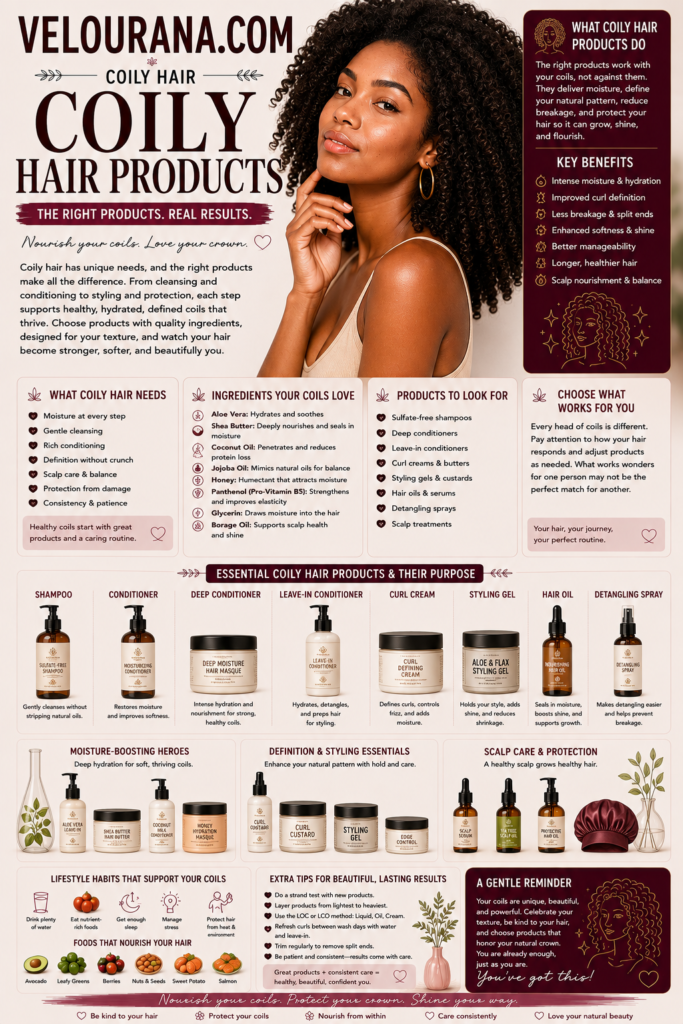
CATEGORY: Coily Hair Products
Coily hair can hold extraordinary shape.
Its bends, turns and compact structure allow it to form sculptural wash-and-go styles, intricate twist-outs, stretched braid-outs, dense afros, soft clouds of texture and highly defined coils that appear almost architectural when carefully styled. Yet the same structure that creates this visual richness also makes styling unusually sensitive to product choice.
Definition alone is not enough.
A product can create beautiful coils on wash day and leave the hair rigid, coated or difficult to refresh. A rich cream can make the hair feel wonderfully soft but weaken the hold needed for a style to survive several days. A strong gel can preserve definition exceptionally well while creating more firmness than the wearer enjoys. An oil can add shine but interfere with the ability of a water-based styler to form an even film.
The most successful coily-hair products therefore do not simply make curls visible. They create a workable balance between conditioning, flexibility, hold, movement, drying time and longevity.
That balance is personal.
Someone who wants soft, expansive hair may accept less definition in exchange for volume. Another person may prefer a highly sculpted finish that remains intact for most of the week. Fine coils may require a lighter system than coarse coils. Dense hair may need products that spread easily and dry efficiently. Hair that has been bleached or heat-damaged may need more conditioning support than untreated hair with a similar visible pattern.
This is why choosing products for definition should begin with the desired finish rather than the assumption that every coily style needs the same sequence of leave-in, cream, oil and gel.
The routine becomes more effective when every formula is selected according to what it contributes after the hair dries.
Definition Begins With the Condition of the Hair
Styling products receive most of the attention when definition is discussed, but the final result is influenced long before gel reaches the hair.
Clean, properly conditioned hair behaves differently from hair carrying layers of old product.
When residue accumulates, water may distribute less evenly. Styling products may sit on the surface instead of spreading consistently. Certain sections may clump while others remain coated and irregular. Gels that once produced a smooth cast can begin flaking when mixed with residues left from previous wash days.
This is one reason cleansing affects definition.
A shampoo does not create curls, but it creates the surface on which styling products must work.
The same principle applies to conditioner.
If the hair remains rough and tangled after conditioning, styling becomes more difficult. Sections require more manipulation. Product may need to be reapplied repeatedly simply to maintain enough slip to work through the hair.
An effective conditioner creates a smoother starting point. The hair can be separated with less resistance, and the natural pattern becomes easier to arrange without aggressive handling.
Definition therefore begins with manageability.
The better the fibre behaves before styling, the less product has to compensate afterward.
Water Is One of the Most Important Styling Materials
For many coily styles, water is not merely something present before the real styling products are applied.
It actively influences the result.
When coily hair is fully wet, individual strands often group together more readily. The weight of water temporarily elongates the pattern, and products can spread more efficiently across the fibre.
This is particularly useful for wash-and-go styling.
Applying gel to very wet sections can encourage larger, smoother clumps and reduce the quantity of product needed. The gel becomes diluted enough to travel through the hair before setting as the water evaporates.
If the same gel is applied to hair that has already dried significantly, it may remain concentrated in isolated areas. Some sections become stiff while others receive little hold.
Damp hair can be preferable for different styles.
Twists, braids and stretched sets often benefit from less water because excessively wet hair can require an impractical amount of time to dry. Slightly damp hair allows creams and setting products to remain concentrated enough to provide control while reducing total drying time.
The amount of water should therefore correspond to the style.
There is no universal rule that coily hair must be soaking wet or merely damp before every product application.
The desired shape determines the useful starting condition.
Leave-In Conditioner Creates Flexibility Before Hold
Leave-in conditioner is valuable when the hair needs additional softness and lubrication during styling.
For coily hair, this can make sectioning and manipulation more comfortable. It can reduce friction between strands and prevent the styling stage from becoming unnecessarily rough.
But a leave-in should support definition rather than undermine it.
If too much is applied beneath gel, the styling polymer may struggle to create a firm, consistent film. The resulting curls can look excellent while wet and then lose structure as they dry.
A very rich leave-in can create a similar problem.
Some formulas behave almost like creams because they contain substantial amounts of oils, fatty alcohols and conditioning agents. When another cream is placed above them, the combined conditioning load may become excessive.
This is why a lightweight leave-in often pairs well with strong-hold gel.
The leave-in provides enough softness to make styling comfortable while leaving the gel sufficient access to the fibre.
For some people, even that step is unnecessary.
If the rinse-out conditioner has already left the hair exceptionally manageable, gel applied directly to clean, wet hair can sometimes create better definition and longevity than a multilayered routine.
The correct amount of leave-in is therefore not the amount that makes the wet hair feel richest.
It is the amount that improves handling without weakening the rest of the styling system.
Curl Creams Create Softness, Shape and Weight
Curl creams occupy a middle ground between conditioning and styling.
Some behave like rich leave-ins with minimal hold. Others contain enough film-forming ingredients to create noticeable definition. Many are designed to give the hair softness, lubrication and a small amount of control.
For coily hair, creams can be particularly effective when the goal is a soft, flexible finish rather than a hard cast.
They can also provide useful weight.
That may sound undesirable, but controlled weight can help elongate compact coils and reduce excessive expansion during drying. In twist-outs and braid-outs, a cream can help sections remain smooth and pliable while they are shaped.
The challenge is dosage.
A cream that provides beautiful elongation on coarse, dense hair can flatten fine or lower-density hair. Applied too generously, it can also increase drying time dramatically.
This makes curl cream one of the products that should be judged according to style rather than hair type alone.
A person may love a cream for twist-outs and dislike the same product for wash-and-go styling.
The formula has not changed.
The objective has.
Butters Make More Sense for Certain Styles Than Others
Butter-rich products are deeply associated with coily hair because they provide a dense, substantial feel.
They can be useful for stretching, twisting and braiding, especially when the hair benefits from extra lubrication during manipulation.
A butter can also help maintain flexibility in ends that become rough easily.
Yet rich butter-based products are not always compatible with maximum curl definition.
When applied beneath gel, they may reduce the clarity of the styling film. Heavy amounts can make clumps feel coated rather than crisp. Drying time can increase substantially, particularly on dense hair.
This does not mean butter should be avoided.
It means butter should be used where its strengths are relevant.
A stretched twist-out may benefit from it.
A sleek bun may benefit from it.
A fine-haired wash-and-go seeking maximum volume may not.
Products are more effective when assigned to the styles that suit their physical properties.
Gel Determines the Architecture of Many Defined Styles
For highly defined coily styles, gel is often the product doing the most visible structural work.
Styling gels contain film-forming ingredients that create a flexible or firm layer around the arranged hair as water evaporates.
This film helps the hair maintain the pattern created during styling.
The strength of that film varies.
Some gels produce almost no cast and leave the hair immediately soft. Others create a firm shell that can feel stiff until it is deliberately softened after drying.
Strong hold is not automatically better.
It simply produces a different tradeoff.
A stronger gel can improve longevity, particularly in humid weather or on hair that expands rapidly. It may reduce the need for daily restyling.
A softer gel may create more movement and a more touchable finish while sacrificing some durability.
The correct choice depends on what matters most.
For someone who washes twice per week, a medium-hold gel may be sufficient.
For someone who wants a wash-and-go to survive seven days with minimal refreshing, stronger hold may be worth the initial cast.
Definition should always be evaluated over time, not only in the first hour after styling.
The Gel Cast Is Often a Feature, Not a Failure
People unfamiliar with gel styling can interpret a hard cast as evidence that too much product has been used.
Sometimes that is true.
But a cast can also be the intended result of a well-performing gel.
As the product dries, the polymer film becomes firm around the hair. This temporary shell protects the arrangement of the coils while the style sets.
Once the hair is completely dry, the cast can often be gently softened by scrunching, separating or lightly coating the hands with a tiny amount of serum or oil.
The definition underneath remains while the surface becomes more flexible.
Breaking the cast too early can compromise the style.
If interior sections are still damp, manipulation can disrupt clumps before the styling film has fully formed.
Patience during drying can therefore improve longevity as much as the gel itself.
Custards Combine Richness and Hold in Different Proportions
The term custard describes a broad category.
Some custards feel almost like gel.
Others resemble thick creams with only moderate hold.
This makes product names less reliable than texture and performance.
A custard can be useful when the hair needs more conditioning than a traditional gel provides but still requires enough structure to maintain definition.
For coarse or very dense coils, this hybrid character can be attractive.
For fine hair, a rich custard may be too heavy.
Again, the issue is not whether custards are good for coily hair in general.
The issue is whether a particular custard provides the desired balance for a particular head of hair.
Foams and Mousses Offer Definition With Less Weight
Foams are sometimes underestimated in coily-hair routines because they appear less substantial than creams and gels.
Their lightness is precisely what makes them useful.
A mousse can provide styling polymers without creating the dense coating associated with heavier products. It can dry more quickly and preserve more volume.
This can be especially valuable for fine strands, lower-density hair or styles that need movement.
Foams are also effective for twist-outs, braid-outs and roller sets where some control is needed without the firmness of a traditional gel.
Their limitations should be acknowledged.
A lightweight foam may not provide enough hold for someone whose hair expands quickly in humidity or who expects a style to last an entire week.
But when softness and drying speed matter more than maximum durability, mousse can be an elegant solution.
Defining Products Should Match the Size of the Desired Clump
Definition is partly about how strands group together.
Some people prefer larger, smoother clumps.
Others want smaller, more separated coils.
Product texture and application technique both influence this.
A slippery gel applied to soaking-wet hair can encourage large clumps because the strands glide together easily.
A lighter foam applied to damp hair may create more separation.
Raking with the fingers creates a different result from smoothing products over sections.
Finger coiling creates still more deliberate grouping.
The “best” defining product therefore depends partly on the scale of definition the wearer prefers.
A product praised for exceptional clumping may be unsuitable for someone who wants airy volume.
Product reviews become more meaningful when the desired clump size is considered.
Slip Matters Even in Styling Products
Slip is most frequently discussed in relation to conditioner, but it matters during styling too.
A gel that becomes sticky immediately can make sectioning difficult.
A cream with good lubrication allows fingers to move through the hair without repeatedly catching.
This is especially important for densely coiled hair because the styling process itself can involve substantial manipulation.
A product that creates beautiful final definition but requires aggressive pulling during application may be less useful than a slightly softer formula that allows the hair to be handled gently.
Definition should not be purchased at the cost of unnecessary mechanical stress.
Shrinkage and Definition Are Closely Connected
Defined coily hair often appears shorter than stretched hair because well-formed coils contract toward their natural shape.
This shrinkage is not evidence that the styler has failed.
In fact, products that enhance definition can sometimes make shrinkage appear more dramatic because they encourage the coil to form more completely.
This creates an important choice.
Maximum definition and maximum elongation are not always compatible objectives.
A strong gel may preserve compact coils beautifully.
A heavier cream or stretching technique may produce greater length but reduce the crispness of the pattern.
Some products attempt to balance both, but there is usually still a tradeoff.
The wearer should decide which characteristic matters most for the style.
Stretching Products Work Through Weight and Styling, Not Magic
Products described as elongating or anti-shrinkage can influence the appearance of coily hair, but they cannot permanently override the natural geometry of the fibre.
Elongation usually comes from a combination of weight, hold and the method used while the hair dries.
Rich creams can reduce immediate spring-back.
Strong stylers can preserve a stretched arrangement.
Twisting, braiding, banding or tension drying can encourage the hair to set in a longer configuration.
Once the hair becomes wet again, its natural pattern returns unless it has been structurally altered through heat or chemical processes.
Realistic expectations make elongating products easier to judge.
They support styling.
They do not remove the fundamental tendency of coily hair to contract.
Moisture and Hold Are Often in Product Tension
A highly conditioning formula tends to create softness.
A strong styling formula tends to create structure.
These goals can coexist, but increasing one can sometimes reduce the other.
Too much conditioning material beneath a gel can weaken the hold.
Too much styling polymer can make the hair feel rigid.
The art of coily-hair styling lies partly in finding the point where both needs are sufficiently satisfied.
This is why one product cannot always provide everything.
A leave-in and gel may work better together than either one alone.
But it is also why layering too many conditioning products can become counterproductive.
Balance matters more than quantity.
Fine Coily Hair Often Needs Hold More Than Weight
Fine strands can be very tightly coiled while remaining physically lightweight.
This makes them particularly susceptible to being overwhelmed by dense creams and butters.
A simpler combination often produces better definition.
A lightweight leave-in followed by gel can preserve the natural spring of the hair while providing enough hold.
Foam may work well when maximum volume is desired.
Heavy oil layers are often unnecessary.
The result can feel almost counterintuitive because coily hair is so frequently associated with rich products.
But curl pattern does not determine strand diameter.
Fine coils deserve products selected for their actual physical capacity.
Coarse Coils Can Use Richness Strategically
Coarse strands may tolerate more cream and butter without losing all movement.
This can make richer styling systems useful, particularly for twist-outs and stretched styles.
The priority remains flexibility.
A dense product that simply coats the fibre without improving manageability is not automatically superior to a lighter formula.
Coarse hair still benefits from effective distribution and careful dosing.
The ability to carry more product is not a requirement to use more.
High-Density Coils Need Product That Can Reach the Interior
Dense hair creates an application challenge.
The visible outer layer may receive abundant product while interior sections remain comparatively dry or undefined.
This can produce an uneven finished style.
Sectioning improves consistency.
It also reduces product waste.
Instead of applying large quantities to the entire head, smaller amounts can be worked carefully through manageable sections.
Products with good spreadability are particularly valuable for dense hair because they travel farther before more product is needed.
This can make the difference between a routine that is efficient and one that consumes an entire jar unusually quickly.
Lower-Density Hair Benefits From Understanding Visual Fullness
Highly defined clumps can reduce the appearance of volume.
On lower-density hair, this may expose more scalp.
A lighter styler can sometimes create a fuller appearance by allowing more individual separation.
After the style dries, gentle fluffing can add additional volume.
The choice is aesthetic rather than corrective.
Some people prefer the polished appearance of strong definition even when density becomes more visible.
Others want maximum fullness.
Both outcomes are legitimate.
The product should serve the chosen visual effect.
Porosity Influences How Styling Products Feel
Hair that becomes saturated quickly may also take up styling products differently from hair that resists wetting.
Damaged, more porous sections may absorb water readily and dry faster.
These areas can sometimes require additional conditioning or more careful sealing of the finished style.
Hair that tends to resist saturation may become coated easily when several rich products are layered.
But porosity should not become a rigid product rule.
Observing how quickly the hair becomes wet, how products distribute and how the hair feels after drying is more useful than following an inflexible chart.
The behaviour provides the relevant information.
Damage Can Make Definition Inconsistent
Coily hair affected by bleaching, chemical straightening or repeated heat may no longer form its original pattern evenly.
Some sections may remain tightly coiled while others appear elongated, frizzy or irregular.
More gel cannot necessarily restore the original pattern.
Styling products can encourage damaged strands to group more neatly, but they cannot fully reverse structural alteration.
This is important when evaluating products.
If one section consistently refuses to define despite multiple stylers and techniques, the issue may be the condition of the fibre rather than the quality of the gel.
Strengthening treatments and reduced damaging practices may improve manageability, but heavily compromised ends may eventually need trimming.
Heat Protectants Become Essential When Stretching With Heat
Not every defined coily style is air-dried.
Blow-drying, diffusing and other heat-assisted techniques can create volume, elongation and faster drying.
When heat is used deliberately, a heat-protective product becomes more relevant.
These formulas are designed to reduce some of the damage associated with thermal exposure, often through film-forming and lubricating ingredients.
They cannot make high heat harmless.
Temperature, frequency and technique still matter.
A heat protectant should therefore be understood as risk reduction, not permission to use unlimited temperature.
For people who regularly alternate between natural coils and stretched styles, this category can be more important than another moisturising cream.
Oils Work Better as Finishers for Many Defined Styles
Oil can contribute shine and lubrication.
Its position in the routine determines whether it helps or interferes.
Placed generously beneath gel, oil can sometimes reduce the consistency of the styling film.
Used after the hair dries, a very small amount may help soften a cast, separate clumps and create shine.
This finishing role is particularly useful for twist-outs and braid-outs.
A trace of oil on the fingertips can reduce friction while sections are unravelled.
Too much, however, can make the finished style collapse.
The value lies in controlled application.
Serums Can Provide Shine Without the Weight of Traditional Oils
Hair serums frequently contain silicones or lightweight emollients that spread easily across the fibre.
For coily hair, they can create shine and reduce surface roughness without requiring a substantial quantity.
They may also help during separation and finishing.
Some formulas are designed for heat styling and include ingredients intended to improve smoothness under thermal conditions.
As with oils, the product should have a defined purpose.
A serum is not automatically necessary simply because shine is desirable.
Well-conditioned hair can reflect light beautifully without an additional finishing layer.
Edge Controls Create Local Definition
Edge-control products are designed for intense, localised hold.
They can create a polished hairline that contrasts with the volume or texture of the rest of the style.
Their concentrated nature makes them useful in small quantities.
Repeated heavy application can create buildup, particularly when the product is refreshed daily without adequate cleansing.
Technique matters even more than formula around the hairline.
Strong hold should not encourage excessive tension or repeated aggressive brushing.
A sleek edge is a styling choice, not a requirement for finished coily hair.
Drying Time Is a Product Performance Criterion
A styling combination can produce beautiful hair and still be impractical.
If dense coily hair remains wet for an entire day because several rich products have been layered over soaking-wet sections, the routine may not suit the wearer's schedule.
Drying time should therefore be considered part of product performance.
Lightweight stylers often dry faster.
Foams can reduce drying time substantially compared with butter-rich creams.
Using fewer layers can help.
Diffusing can accelerate the process when appropriate.
A sustainable routine must fit into real life.
Definition Should Be Evaluated on Day Three, Not Only Day One
Wash-day photographs favour immediate results.
But style longevity often matters more.
A gel that creates spectacular definition for six hours and disappears overnight may be less useful than a slightly firmer product that remains effective for five days.
Day-two and day-three behaviour reveal much about a styling system.
Does the hair remain soft enough to manipulate?
Has the definition survived sleep?
Is the scalp comfortable?
Does the hair require extensive refreshing?
Has flaking appeared?
Does the product become sticky in humidity?
These observations determine whether the styler belongs in the long-term routine.
Night Protection Can Extend Product Performance
A product cannot preserve a style indefinitely if the hair experiences heavy friction every night.
Protective sleep practices reduce disturbance.
Satin or silk-like surfaces can reduce friction compared with rougher fabrics.
The hair may be gathered loosely depending on the style.
Some people use bonnets or scarves.
The exact method matters less than preserving the structure without excessive tension.
Better night protection can make an average styling product perform more successfully because less repair is required the following morning.
Refreshing Works Best When It Is Selective
A defined style does not always need new product everywhere the next day.
Often only a few sections have lost shape.
Water can sometimes reactivate existing styler.
A tiny amount of gel can be added to isolated frizzy areas.
Foam can restore structure without adding much weight.
Completely reapplying leave-in, cream and gel every morning creates rapid accumulation.
A product routine should ideally reduce the need for daily rebuilding.
Humidity Tests the Strength of Styling Films
Humidity can transform the behaviour of coily hair.
The fibre interacts with moisture in the surrounding air, and weak styling films may lose control.
A strong-hold gel can become especially valuable in humid conditions.
But no cosmetic product can make hair completely independent of the environment.
Some swelling and texture change may still occur.
The realistic goal is not permanent immobilisation.
It is sufficient control for the desired style and climate.
Dry Weather Creates Different Priorities
Cold or very dry conditions can shift attention toward flexibility and conditioning.
A gel that feels comfortable during humid summer may seem too rigid during winter.
Richer leave-ins or creams can become more appealing.
The same person may therefore maintain two slightly different styling systems across the year.
This is not inconsistency.
It is adaptation.
The Scalp Should Not Disappear Beneath Styling Products
Defined styles can encourage product application close to the roots.
But the scalp does not need to be coated with cream and gel to produce successful definition.
Applying products primarily to the hair can reduce unnecessary scalp residue.
This is particularly important for people who experience itching or sensitivity.
Persistent scalp problems should not be hidden beneath oils or styling products.
The scalp requires its own care.
Fragrance and Sensory Experience Matter in Long-Wear Products
A styling product may remain in the hair for several days.
This makes fragrance more significant than it is in a rinse-out formula.
A scent that feels pleasant during a five-minute conditioning treatment may become overwhelming when worn continuously.
People with fragrance sensitivities may prefer low-fragrance or fragrance-free options.
Performance includes comfort.
A product that creates perfect definition but makes the wearer dislike the smell of their own hair is not an ideal product.
Flaking Usually Signals a System Problem
Visible white residue can come from excessive product, incompatibility between layers or incomplete distribution.
When flaking appears, the best response is systematic simplification.
Cleanse thoroughly.
Condition.
Use the primary styler alone.
If the gel performs well, reintroduce the leave-in.
Then add cream only if there is a genuine need.
This identifies the problematic combination.
Replacing everything at once eliminates the ability to learn from the failure.
Crunch Is Different From Dryness
A firm gel cast can feel crunchy.
That does not necessarily mean the hair underneath is dehydrated or damaged.
If the cast softens after scrunching and the hair feels flexible afterward, the firmness was simply part of the styling process.
True dryness is better evaluated after the style has been softened and worn.
Confusing temporary cast with dryness can lead to unnecessary product layering.
More cream is added beneath the gel.
Hold weakens.
Definition becomes shorter-lived.
Understanding the difference prevents this cycle.
Softness Is Not the Only Measure of Healthy-Looking Hair
Modern hair marketing often presents extreme softness as the ultimate sign of successful conditioning.
Coily hair needs flexibility, but a defined style may feel firmer than loose untreated hair because styling polymers are present.
This is not automatically undesirable.
The useful question is whether the hair remains comfortable and manageable.
A style can have structure without being brittle.
It can have hold without feeling damaged.
Sensory expectations should correspond to the product's function.
Strong Hold Can Reduce Manipulation
One advantage of a durable styler is that the hair can be left alone.
A strong gel that preserves definition for several days may reduce the need to comb, twist, refresh or restyle.
This can be beneficial for coily hair because repeated manipulation creates friction and opportunities for breakage.
The product may feel firmer initially, but the overall routine can become gentler.
This illustrates why products should be evaluated across the entire styling cycle.
Immediate softness is only one variable.
Protective Styles Still Require Product Restraint
Braids, twists and other protective arrangements often inspire heavy product use because the style may remain in place for an extended period.
But adding oils, creams and sprays continuously can create significant buildup before the style is removed.
The hair does not need to remain visibly coated to stay cared for.
Products should be added according to actual need.
The scalp should remain clean and comfortable.
The style should not rely on excessive tension.
Protection comes from reducing damaging manipulation, not from accumulating the largest possible amount of product.
Twist-Out Products Need Controlled Flexibility
A twist-out requires the hair to hold an imposed pattern temporarily.
Creams, mousses and setting lotions can all perform this function.
The best product usually provides enough lubrication to create smooth twists while offering enough structure that the pattern remains after unraveling.
Too much oil can cause the twist-out to lose definition quickly.
Too much gel can make the result feel hard.
The ideal balance depends on strand characteristics and climate.
Twist-out styling demonstrates clearly that definition is not always about maximum hold.
Controlled flexibility can be more important.
Braid-Out Products Often Benefit From Slightly More Control
Braids create a broader wave or crimped pattern than twists.
Because the sections may contain more hair, a product with reliable distribution becomes important.
Creams and foams can work particularly well.
The hair should be completely dry before the braids are removed.
Even excellent products cannot preserve a set that has not finished drying.
Patience is part of styling performance.
Wash-and-Go Products Need Compatibility With the Natural Pattern
A wash-and-go does not literally mean washing the hair and doing nothing.
For many coily textures, it involves careful conditioning, sectioning, product application and drying.
The goal is usually to enhance the natural pattern rather than impose an entirely new one.
This makes gel selection central.
The product must provide enough hold to preserve the coil without requiring excessive manipulation.
The best routine is often surprisingly simple.
A well-chosen leave-in and gel can outperform a complex stack of products.
Stretched Styles Require a Different Product Philosophy
When the goal is elongation rather than compact definition, product weight and technique become more important.
Creams can support flexibility.
Heat protectants become essential if blow-drying is involved.
Strong gel may be unnecessary unless sleekness or long-term control is required.
This demonstrates why a person can legitimately own several stylers without redundancy.
The products serve different outcomes.
Product Rotation Can Be More Useful Than Product Accumulation
Not every styling product needs to be used during every wash.
A strong gel can be reserved for humid weather or weeks when maximum longevity is needed.
A lighter foam can be used when volume matters.
A rich cream can be kept for twist-outs.
A serum can be used only when heat styling.
This is product rotation.
It creates versatility without forcing every formula into every routine.
The Best Styling Product Makes the Next Wash Day Easier Too
Long-lasting definition is valuable, but the style eventually has to be removed.
A product that creates extreme tangling during wash day may not be ideal even if it looked beautiful for several days.
The complete cycle matters.
Good styling products should provide useful hold while allowing the hair to be cleansed and detangled reasonably efficiently later.
If removal becomes a battle every week, the cost of the style is too high.
Product Performance Should Be Judged Against Personal Priorities
There is no universally perfect finish for coily hair.
Some people want maximum shrinkage because compact coils create the shape they love.
Others prefer elongation.
Some want touchable softness.
Others prioritise longevity.
Some want enormous volume.
Others want carefully separated, glossy definition.
The product must be evaluated against those priorities.
A gel cannot be criticised for creating too much hold if maximum longevity was the objective.
A foam cannot be criticised for creating less durability if the purpose was lightweight movement.
Good product selection begins with clarity about the desired result.
Building a Definition Routine That Can Be Repeated
The most useful routine is one that produces predictable results.
Cleansing creates a clean base.
Conditioning provides enough slip.
The hair is left at the appropriate wetness level.
Leave-in is used only if needed.
Cream is added only if the style benefits from richness.
The primary styler provides the required hold.
The hair is allowed to dry completely.
The cast is softened only after setting.
Night protection preserves the result.
Refreshing remains minimal.
This system can then be adjusted according to weather, style and hair condition.
Predictability is more valuable than novelty.
The Search for a Miracle Product Usually Ends With Better Technique
It is easy to believe that one perfect gel or cream will solve every styling problem.
Sometimes a better product genuinely makes a dramatic difference.
But technique often explains as much as formulation.
The same gel can create poor definition on nearly dry hair and excellent definition on fully wet hair.
The same cream can feel heavy when applied generously and perfect when used sparingly.
The same mousse can disappear when layered beneath butter but perform beautifully alone.
Learning how much product to use, where to place it and how wet the hair should be can turn an average product into an effective one.
A Smaller Styling System Can Produce Better Hair
The shelves devoted to coily hair can make elaborate routines seem necessary.
But a successful styling system can be remarkably compact.
One cleanser.
One dependable conditioner.
One leave-in if the hair benefits from it.
One strong styler for defined styles.
One softer styler for stretched or voluminous styles.
Perhaps a treatment or heat protectant when relevant.
That can be enough.
The purpose of products is to make the hair easier to manage and style.
Once the collection begins making the routine harder to understand, it has exceeded that purpose.
Definition Should Enhance the Texture, Not Turn It Into a Constant Project
Coily hair can be styled with extraordinary precision.
That does not mean every coil needs to be separated, sculpted and controlled at all times.
Definition is one aesthetic choice among many.
A soft afro with minimal visible curl separation is no less successful than a meticulously defined wash-and-go.
A fluffy twist-out is not inferior because some sections have expanded.
Frizz itself is not automatically damage or failure.
The degree of control should reflect the wearer's preference.
Products should support that choice rather than create anxiety about maintaining a permanently perfect pattern.
Long-Lasting Style Comes From the Whole Routine
No single product creates longevity alone.
Clean hair accepts styling more predictably.
Conditioning reduces unnecessary friction.
Appropriate product quantities prevent overloading.
Strong enough hold preserves the arrangement.
Complete drying allows the styling film to form.
Night protection reduces disturbance.
Selective refreshing prevents buildup.
Adequate cleansing resets the hair when the style is finished.
Each stage supports the next.
The product is part of a system.
What Excellent Coily Hair Products Ultimately Provide
The best coily-hair products do more than make curls visible.
They make the hair easier to understand.
A good conditioner reveals how manageable the texture can feel when friction is reduced.
A good cream demonstrates how much richness the hair actually needs.
A good gel shows the level of hold required for the preferred style.
A good foam reveals whether volume can be preserved with less weight.
A good cleanser restores the responsiveness that disappears beneath accumulated residue.
Over time, the routine becomes more precise.
Products stop being purchased simply because they are labelled for coils.
They are chosen because their specific properties fit the hair, the style and the conditions in which the style will be worn.
That is a more sophisticated form of textured-hair care.
It respects the natural structure of the fibre without romanticising every characteristic or attempting to suppress it. It recognises that moisture, softness, definition and hold are related but distinct concerns. It accepts that no formula performs perfectly in every climate, on every strand diameter or for every aesthetic goal.
Most importantly, it allows the wearer to decide what successful coily hair looks like.
It can be soft.
It can be highly structured.
It can shrink dramatically.
It can be stretched.
It can be glossy and sculpted.
It can be expansive and deliberately imperfect.
The products are not there to determine which version is correct.
They are there to make the chosen version easier to create, maintain and enjoy.
When cleansing, conditioning, styling and finishing products are selected with that purpose in mind, coily-hair care becomes less about collecting solutions and more about understanding relationships: between water and hold, richness and weight, definition and volume, technique and longevity, product deposition and cleansing.
That understanding is what allows a routine to remain effective even when the specific products eventually change.
The bottles may change.
The principles remain.
And those principles make it possible to build styles that last without burying the texture beneath unnecessary layers, to maintain softness without sacrificing structure, and to use coily-hair products as tools for expression rather than as endless attempts to correct the hair itself.
The End Velourana.
 Discover More From Our Family of Websites
 ZodiacBearing (Astrology, Tarot, Numerology, Angel Numbers & Spiritual Guidance)
 Velourana (Beauty, Makeup, Hair Care, Skincare & Beauty Tips)
 HavenBearing (Home, Living, Organization, Décor & Everyday Inspiration)
 PawBearing (Pet Care, Dog Breeds, Animal Health, Training & Pet Products)
 PsyCatherine (Notes From the Journal of a Psychologist on Real Life)

