
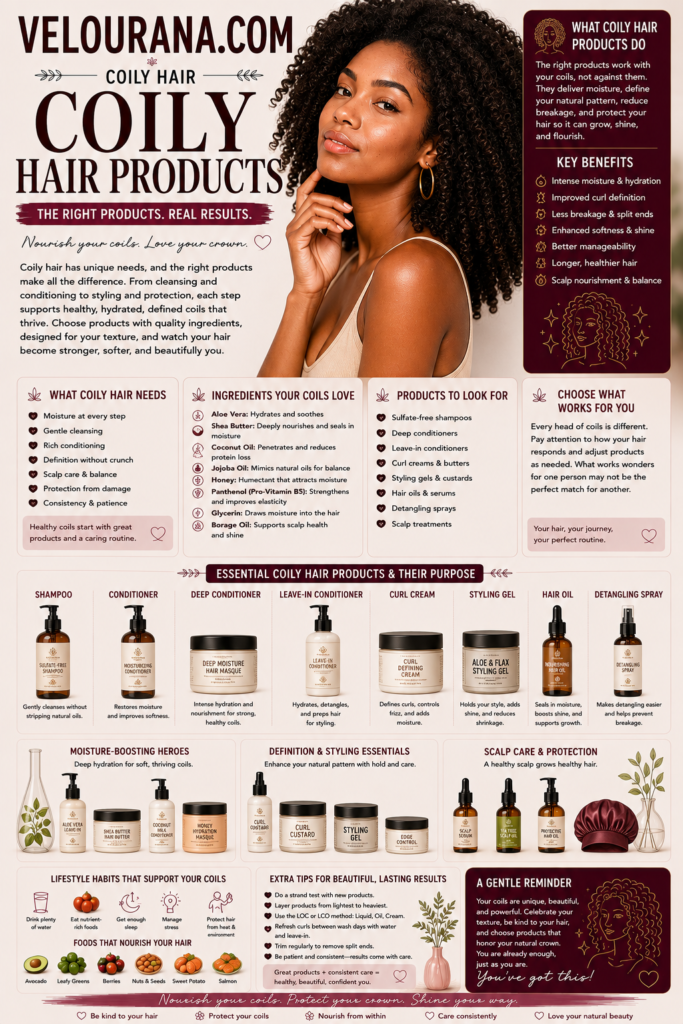
CATEGORY: Coily Hair Products
Coily hair does not need more products simply because its texture is complex. It needs products that understand complexity.
That distinction matters. Shelves devoted to textured hair have expanded dramatically, bringing oils, creams, butters, gels, custards, milks, masks, sprays, foams, puddings, serums and leave-in treatments into routines that can quickly become crowded. More choice has undoubtedly created opportunities for people with coily hair to find formulas designed with their texture in mind. Yet abundance has also created a new difficulty: deciding what genuinely deserves a place in the routine.
A successful coily-hair regimen is rarely defined by the number of bottles involved. It is defined by whether each formula performs a useful function while respecting the physical characteristics of the hair. Cleansing should remove what needs to be removed without leaving the hair unnecessarily depleted. Conditioning should improve softness and manageability rather than merely coating the surface. Leave-in products should support flexibility and moisture retention. Styling products should help create the desired finish without demanding excessive manipulation. Treatments should address an identifiable need rather than becoming rituals performed simply because they are fashionable.
Understanding products therefore begins with understanding the hair itself. Coily strands behave differently from straighter strands not because they are inherently difficult, but because their geometry changes how natural oils travel, how strands interact with one another, how easily knots form and how mechanical stress is distributed.
Once those realities become the foundation of product selection, shopping for coily hair becomes considerably less mysterious. Instead of searching for a mythical collection of “best products,” it becomes possible to build a smaller, more deliberate system around cleansing, conditioning, moisture, strength, definition and protection.
The Architecture of a Coil Changes the Product Conversation
Coily hair encompasses an enormous range of appearances. Some coils are tiny and clearly visible; others form compact zigzags, irregular bends or patterns that become easier to see when the hair is wet or stretched. Density, strand diameter, porosity, length, environmental conditions and previous chemical or heat exposure further influence how any individual head of hair behaves.
What these textures commonly share is curvature.
Every bend along a strand creates another point at which the hair can interact with neighbouring strands and experience friction. Sebum produced by the scalp also has a more complicated journey along a tightly curved fibre than along relatively straight hair. This helps explain why the scalp may feel comfortable or even oily while the lengths and ends remain comparatively dry.
The ends deserve particular attention because they are the oldest portion of the hair. They have experienced more washing, detangling, styling, weather, friction and general handling than newer growth closer to the scalp. When tightly textured hair is repeatedly manipulated without adequate lubrication or conditioning, these older sections may become increasingly vulnerable to knots and breakage.
This is why the language of coily-hair products so often revolves around slip, lubrication, conditioning, flexibility and moisture retention. These are not merely marketing themes. They correspond to practical challenges created by the structure and behaviour of the hair.
At the same time, “coily” is not a complete product prescription. Two people whose curl patterns look remarkably similar may need very different formulas. Fine, low-density coils may become overwhelmed by a butter that another person's coarse, dense hair loves. Hair with substantial damage may respond differently from healthy untreated hair. A humid Mediterranean summer may alter the usefulness of a styling formula that performed beautifully during a dry winter.
Texture establishes the territory. The individual characteristics of the hair determine the route through it.
Cleansing Products Establish the Conditions for Everything That Follows
A surprising number of product problems begin before styling products ever touch the hair.
When the scalp and strands carry accumulated oils, styling polymers, butters, silicones, environmental particles and residues from previous wash days, subsequent products may behave differently. Hair can feel dull, coated or strangely dry despite receiving generous quantities of conditioner. Styling products may flake when layered. Definition can become inconsistent. The natural movement of the hair may disappear beneath accumulated material.
This makes shampoo one of the most consequential products in a coily-hair routine.
The old assumption that textured hair should avoid thorough cleansing at almost any cost can be counterproductive. Coily hair certainly benefits from avoiding unnecessarily harsh treatment, but gentle care and inadequate cleansing are not the same thing.
The appropriate cleanser depends partly on what must be removed.
A relatively mild shampoo may work well for regular wash days when the hair carries modest amounts of water-soluble styling products. A stronger cleansing or clarifying formula can occasionally become useful when there is substantial buildup, heavy oil use, persistent residue or exposure to materials that ordinary washing is not removing effectively.
Scalp condition matters equally. The scalp is skin, and its needs should not disappear beneath concerns about preserving moisture in the hair. Persistent itching, scaling, inflammation or other scalp problems deserve appropriate attention rather than endless layers of oils intended to conceal discomfort.
The technique surrounding the cleanser also influences the result. Shampoo is primarily needed where oil and buildup accumulate, particularly around the scalp, while the lengths can often be cleansed by the lather and water moving through them. Aggressively rubbing coily lengths against one another creates unnecessary friction.
A good cleansing product should leave the hair prepared for conditioning rather than forcing the rest of the routine to compensate for what happened during washing.
Conditioner Is Less About Luxury Than Manageability
If shampoo establishes a clean foundation, conditioner changes how manageable that foundation feels.
For coily hair, manageability is not a superficial benefit. Reducing friction and improving slip can make the difference between detangling that respects the strand and detangling that slowly erodes length through repeated breakage.
A rinse-out conditioner generally performs several interconnected jobs. It helps the hair feel smoother, reduces friction between neighbouring fibres and improves the ease with which fingers or tools can move through the hair. Depending on its formulation, it may also help reduce static and temporarily improve the feel of damaged areas.
This is where ingredient lists can provide clues but should not become a substitute for observing performance. Fatty alcohols such as cetyl alcohol and cetearyl alcohol, for example, are common conditioning ingredients and should not be confused with drying alcohols simply because the word “alcohol” appears in their names. Cationic conditioning agents can help improve softness and manageability. Silicones may provide useful lubrication and smoothness for some people, despite the simplistic reputation they sometimes receive in natural-hair discussions.
The practical question is not whether an ingredient belongs to an internet-approved category. It is whether the complete formulation helps the hair behave better and whether it can be removed appropriately during cleansing.
Slip is especially valuable during detangling. Coily strands naturally intersect and wrap around one another, and shed hairs may remain trapped within the surrounding texture instead of simply falling away. Conditioner creates a more forgiving environment in which these strands can be separated.
This is one reason an impressive conditioner can have greater practical value than several elaborate styling products. If wash day becomes easier, gentler and more predictable, the benefits extend far beyond the few minutes during which the conditioner remains on the hair.
Deep Conditioners Should Have a Purpose, Not a Mythology
Deep conditioning occupies an almost ceremonial position in many textured-hair routines. Masks are associated with restoration, rescue and intensive nourishment, sometimes with claims that imply damaged hair can be returned permanently to an untouched state.
Hair products cannot reverse time.
The visible hair fibre is not living tissue capable of healing itself in the biological sense. What conditioning treatments can do is improve how the fibre feels and behaves. They can enhance softness, reduce friction, improve manageability and temporarily modify the sensory characteristics of damaged areas.
That is valuable. It simply deserves accurate language.
A richer treatment may be particularly appealing when hair feels rough after repeated manipulation, environmental exposure, colouring or heat styling. Some people find that regular conditioning is entirely sufficient, while others prefer the additional richness or extended contact time of a mask.
The important question is whether the treatment produces a noticeable improvement.
Leaving a product on the hair for extraordinary lengths of time is not automatically superior to following its intended directions. Nor does heat need to become an obligatory part of every conditioning session. Product formulation, hair characteristics and individual response matter more than elaborate rituals.
There is also little advantage in owning several masks that essentially perform the same function. A routine becomes easier to evaluate when products have distinct roles.
If the regular conditioner provides excellent slip and softness while an occasional richer treatment noticeably improves hair after demanding styling periods, both products have a clear reason to exist. If three masks produce indistinguishable results, the collection may be more impressive than the routine.
Leave-In Conditioner Creates the Bridge Between Washing and Styling
The transition from wet, conditioned hair to finished style is particularly important for coils because this is when the hair begins losing water and returning toward its natural contracted shape.
Leave-in conditioner can create a useful bridge.
Unlike rinse-out conditioner, it is designed to remain on the hair. Depending on the formula, it may provide lubrication, softness, easier manipulation and a conditioned base beneath styling products. For hair that tangles readily during styling, this additional slip can be especially useful.
The quantity matters.
Applying more leave-in does not necessarily create more moisture. Excessive product can leave the hair coated, reduce volume, interfere with styling-product performance or contribute to buildup. Fine strands and lower-density hair may need surprisingly little, whereas dense or coarse hair may tolerate richer application.
Distribution is often more important than quantity. Sectioning the hair can help ensure that product reaches the areas that need it instead of accumulating on the outermost layer.
A leave-in should also cooperate with the products placed above it.
Some combinations produce smooth, flexible results; others form visible residue or flakes when rubbed together. A simple compatibility check between products can sometimes prevent an entire styling session from ending in white particles across dark hair.
The role of leave-in conditioner is ultimately supportive. It should make the next stage easier. When it becomes so heavy that every subsequent product struggles to perform, it has exceeded that role.
Creams and Butters: Richness Is Useful Only When the Hair Benefits From It
Few categories are as closely associated with coily hair as creams and butters.
Their appeal is understandable. Dense textures often feel luxurious, provide substantial lubrication and can help hair feel softer and more pliable. Rich formulas may be particularly enjoyable on coarse strands, highly textured lengths or styles in which flexibility and softness matter more than weightless volume.
Yet the assumption that tighter coils automatically require heavier products is unreliable.
Coil pattern and strand thickness are different characteristics. A person can have extremely tight coils composed of very fine strands. Saturating those strands with thick butter may collapse volume and leave the hair feeling coated. Another person with coarse, dense coils may find that the same formula disappears into the hair and produces exactly the desired softness.
Porosity and climate further complicate the picture.
Rich occlusive ingredients can help reduce moisture loss, but they do not create water. Applying increasingly heavy oils and butters to hair that feels dry may therefore produce the peculiar combination of greasy surface and stiff interior. Hydration begins with water; conditioning and styling products help manage what happens afterward.
Creams can be particularly useful for twists, braids, stretched styles and other looks where softness and pliability are priorities. Some curl creams also provide modest definition on their own. But when strong, long-lasting hold is required, cream frequently works better as a supporting product beneath a dedicated styler than as the entire styling system.
The correct amount is the smallest amount that reliably produces the desired result. That principle is less glamorous than coating every section generously, but it makes product performance much easier to understand.
Oils Are Tools, Not Moisture in a Bottle
Oil occupies an unusual position in coily-hair culture. It can be a useful cosmetic tool, yet it is frequently assigned capabilities that no ordinary hair oil possesses.
Oil is not water.
If dry hair needs hydration, coating it with oil does not replace the water that is absent. What oils can do depends on the particular oil, formulation and method of use. They may provide lubrication, improve shine, reduce friction and help modify the feel of the hair. Certain oils can interact with the fibre differently from others, while oil-containing finished products may behave very differently from a bottle of pure oil.
The practical mistake occurs when oil becomes the automatic answer to every sign of dryness.
Repeatedly adding oil can eventually create buildup while the underlying problem remains unchanged. The hair becomes shiny yet still feels rigid, rough or difficult to manipulate. More oil then seems necessary, beginning a cycle in which the product intended to solve dryness obscures the actual condition of the strand.
A small quantity applied strategically can be entirely different.
Oil may help during separation of twists, contribute shine to a finished style or provide additional lubrication to ends. Some people enjoy pre-shampoo oiling as part of their routine. Others find little benefit from standalone oils and prefer conditioners or creams that already contain emollient ingredients.
Neither approach is inherently more authentic or appropriate for coily hair.
The useful question is simple: what is the oil doing?
When that answer is clear, oil becomes one tool among many rather than a compulsory symbol of textured-hair care.
Gels, Custards and Foams Translate Product Choice Into Definition
Definition is where product selection becomes highly dependent on the desired appearance.
A person seeking elongated, highly defined coils with several days of hold may need a very different styler from someone who prefers a soft, expansive wash-and-go with substantial movement. Neither result is a more correct expression of coily hair.
Gels are valuable because film-forming ingredients can help hold strands in the arrangement created while the hair is wet. As the product dries, a cast may form around the hair. This can initially feel firm or crunchy, but the cast often serves a useful purpose: it protects definition while the style sets.
Once completely dry, the hair can sometimes be gently manipulated to soften that cast while preserving much of the definition underneath.
Custards occupy a broad territory between creams and gels. Some are rich and conditioning with moderate hold; others behave much more like strong gels. Product names therefore reveal less than performance.
Foams and mousses can provide a lighter alternative. They may work particularly well for styles where speed of drying, movement and reduced product weight are priorities. Their lighter texture can also appeal to fine hair that becomes overwhelmed by dense creams.
The strongest product is not automatically the best product.
Strong hold can increase longevity but may produce a finish that feels too firm for someone who prioritises touchable softness. Light hold can feel beautiful on the first day but may not survive humidity, exercise or several nights of sleeping. Product choice therefore involves an exchange between definition, flexibility, volume, drying time and longevity.
Recognising that exchange is more useful than searching for one styler expected to provide maximum performance in every category simultaneously.
Shrinkage Should Influence Styling Choices Without Becoming an Enemy
One of the most visible characteristics of coily hair is shrinkage.
A strand that appears relatively short in its natural dry state may extend dramatically when stretched. This occurs because the fibre is returning toward its inherent pattern rather than because something has gone wrong.
Products can influence the appearance of shrinkage, but no cosmetic product changes the fundamental geometry of healthy coily hair permanently.
Heavier creams, gels and stretching techniques may encourage a more elongated appearance. Twists, braids, banding or other low-tension methods can also alter how the hair dries. Yet treating maximum elongation as the universal objective can turn a natural property of coily hair into a perpetual problem to be corrected.
Shrinkage can actually provide useful information. Hair that readily contracts after being stretched or wet often demonstrates elasticity, although elasticity cannot be judged from shrinkage alone.
The relevant styling question is therefore not “How do I eliminate shrinkage?” but “How much elongation do I want for this particular style?”
A wash-and-go may deliberately celebrate compact definition. A twist-out may create more stretched texture. A bun or other gathered style may require still greater elongation for ease of handling.
Once the goal changes, the products can change with it.
Protein and Strengthening Products Require More Precision Than Fear
Protein has become one of the most confusing subjects in textured-hair care.
Some people credit protein treatments with transforming damaged hair. Others avoid them entirely because they fear that a single use will make their hair brittle. Both extremes can obscure a more practical reality.
Hair is primarily composed of keratin, a protein, and damage can alter the structure of the fibre. Certain protein-containing or strengthening formulations may temporarily improve the feel and behaviour of damaged hair. They can be particularly relevant after chemical processing, colouring, repeated heat exposure or other sources of structural stress.
But “protein” describes an enormous category rather than one uniform ingredient.
Different proteins, hydrolysed proteins, amino acids and strengthening technologies behave differently within different formulations. Concentration matters. The rest of the formula matters. The condition of the hair matters.
This is why diagnosing every unpleasant sensation as “protein overload” can be misleading. Hair can feel stiff because of buildup, excessive styling product, insufficient conditioning, environmental conditions or damage itself.
The response should be observational rather than ideological.
If a strengthening treatment consistently improves elasticity, manageability or breakage-prone hair, it may deserve a place in the regimen. If the hair feels noticeably worse after use, the formula or frequency may not suit it.
Coily hair does not automatically require intensive protein simply because it is coily. Healthy untreated coils and heavily bleached coils should not be expected to have identical treatment requirements.
Edge Products Reveal the Importance of Where Products Are Used
Edge controls illustrate an important principle that applies throughout coily-hair care: location matters as much as formula.
A strong waxy product used on a small area to create a polished finish is very different from coating the entire head in the same material. Edge products are usually designed for concentrated control and hold. Used selectively, they can support particular styling preferences.
Problems arise when the desire for sleekness encourages repeated aggressive brushing and tension.
The hairline contains strands that can be relatively fine and vulnerable. Product cannot protect them from unlimited mechanical stress. A formula marketed as nourishing or strengthening does not make tight pulling harmless.
This distinction extends to other products. Heavy oils may be useful on ends but undesirable on the scalp. Strong gel may work beautifully for a wash-and-go but feel excessive in a loose twist-out. Clarifying shampoo may be invaluable periodically but unnecessary at every wash.
Products do not exist in isolation from technique.
The same bottle can be helpful or disappointing depending on quantity, placement, frequency and the manipulation accompanying it.
Porosity Is Useful When It Describes Behaviour, Not When It Becomes a Rulebook
Porosity has become central to online discussions of coily-hair products. The concept describes the ease with which hair interacts with and takes up water and other substances, influenced in part by the condition of the cuticle and internal fibre.
In practice, however, porosity is often converted into a rigid identity.
People perform floating-hair tests, assign themselves a permanent category and then purchase or reject entire ingredient families according to the result. Such simplified testing cannot capture all the variables affecting how hair behaves.
Porosity can also vary along a single strand. Older ends may be more weathered than newer growth. Chemical treatment can increase damage. Heat and environmental exposure can alter condition over time.
A more productive approach is to observe behaviour directly.
Does the hair become saturated quickly in the shower or require time and deliberate wetting? Does it dry rapidly or remain damp for many hours? Do rich products seem to sit on the surface? Does the hair become coated easily? Are certain damaged areas consistently rougher or more difficult to manage?
These observations provide actionable information without requiring the hair to fit perfectly into a label.
Product selection becomes an experiment based on response rather than an attempt to obey a porosity chart.
Product Layering Works Best When Every Layer Earns Its Place
The popularity of named layering systems has helped many people create order in their routines. Applying liquid, cream and oil in a prescribed sequence can provide a useful starting structure, particularly for someone learning how different product categories behave.
But a memorable acronym is not a law of hair science.
A leave-in followed by gel may be enough for one person. Another may prefer leave-in, cream and gel. Someone else may obtain excellent results from a single styling cream on soaking-wet hair. Adding oil as a final layer may improve one routine and make another heavy and dull.
The more products layered together, the harder it becomes to identify which one created the result.
This is particularly important when troubleshooting. If a style flakes, five overlapping formulas create five possible sources of incompatibility. If hair feels coated, it becomes difficult to know which layer is responsible.
Simplification can therefore become a diagnostic tool.
Begin with the essential functions. Cleanse. Condition. Add leave-in if it provides a noticeable benefit. Choose a styling product suited to the desired finish. Introduce additional products only when there is a clear reason.
This does not mean minimalism is morally superior. Some people genuinely enjoy elaborate routines and achieve excellent results from them. The point is that complexity should be intentional.
A seven-product routine that performs seven distinct useful functions is coherent. A seven-product routine in which four products merely duplicate one another is expensive uncertainty.
The Best Coily-Hair Product Is Often the One That Reduces Manipulation
Product performance is usually judged by immediate appearance: shine, definition, softness and volume. For coily hair, another measure deserves equal attention.
How much handling does the product require?
A conditioner with exceptional slip may shorten detangling. A styler that maintains definition for several days may reduce the need to restyle each morning. A leave-in that keeps twists flexible may make the next wash day easier. A gel that allows the hair to remain undisturbed throughout drying may reduce repeated touching.
These benefits are easy to overlook because they are not visible in a product photograph.
Mechanical damage accumulates gradually. Repeated pulling, brushing, detangling, restyling and friction can contribute to breakage even when every individual session seems harmless. Products that allow the hair to remain manageable with less intervention may therefore provide value beyond their cosmetic finish.
This is also why protective styling cannot be judged by the hairstyle name alone. A style is not protective when installation creates excessive tension, maintenance requires constant manipulation or removal causes substantial tangling and breakage.
The products surrounding the style should support comfortable handling rather than merely produce temporary polish.
Climate Can Transform a Product That Seemed Perfect
A coily-hair routine does not exist in a laboratory. It exists in weather.
Humidity, heat, cold, wind, indoor heating and air conditioning can all influence how hair feels and how styling products perform. A formula that creates excellent definition during one season may behave differently several months later.
Humidity is especially noticeable because many styling formulas contain humectants and film-forming ingredients that interact with environmental moisture in complex ways. The complete formulation matters far more than judging one ingredient in isolation, but seasonal changes can still alter the final appearance of a style.
Hot weather may also increase scalp perspiration and encourage more frequent cleansing. Winter conditions may create greater concern about dryness and friction from clothing. Travel can introduce changes in water quality and climate simultaneously.
This is why building a routine around observation is more resilient than building one around fixed rules.
Products are tools for conditions. When the conditions change, changing the tool is not evidence that the original product failed.
A Product Wardrobe Can Be Small and Still Be Complete
The beauty industry naturally benefits when consumers believe every concern requires another purchase. Coily hair is particularly vulnerable to this because its routines can involve many stages.
A complete routine can nevertheless remain remarkably focused.
There needs to be an effective way to cleanse the scalp and hair. There needs to be sufficient conditioning for comfortable detangling and manipulation. There should be a method of maintaining softness appropriate to the individual's hair. Styling products should correspond to the styles actually worn. Occasional treatments should address genuine needs.
Everything beyond those functions is optional.
Someone who wears wash-and-go styles most of the time may invest more heavily in a dependable gel and leave-in combination. Someone who primarily wears twists may care more about a cream that provides lasting flexibility. A person who regularly swims may prioritise cleansing and conditioning differently. Chemically coloured hair may require more attention to damage management.
The ideal product wardrobe therefore reflects behaviour rather than aspiration.
Buying products for hairstyles that are rarely worn or problems the hair does not actually have creates clutter rather than capability.
There is freedom in recognising this. Coily-hair care does not require participation in every trend.
Learning to Read Your Hair Is More Valuable Than Memorising Ingredients
Ingredient knowledge can be useful. Understanding the general roles of surfactants, conditioning agents, humectants, emollients, occlusives, polymers and proteins can make product labels less mysterious.
Yet cosmetic formulas are systems.
An ingredient appearing near the top of one formula may behave differently from the same ingredient surrounded by a different combination of materials. Concentrations are not always disclosed. Manufacturing processes influence texture and performance. The finished product is more informative than isolated ingredient reputation.
This makes real-world observation indispensable.
After cleansing, does the scalp feel comfortable? During conditioning, can the hair be detangled with less resistance? Once dry, does the style have the desired balance between definition and softness? How does the hair feel on the second and third day? Is there visible residue? Does the product require more frequent cleansing? Are the ends remaining manageable?
These questions gradually create a personal evidence base.
Over time, patterns emerge. Perhaps lightweight leave-ins consistently outperform thick ones. Perhaps strong-hold gels work best during humid months. Perhaps a richer cream makes winter twists noticeably easier to maintain. Perhaps standalone oils add nothing meaningful.
That knowledge is more valuable than a viral list of supposedly essential ingredients because it belongs to the hair actually being cared for.
When the Problem Is Bigger Than Product Selection
Hair products can improve cleansing, conditioning, styling and manageability, but they cannot solve every hair or scalp concern.
Persistent scalp inflammation, significant scaling, sores, sudden or unexplained shedding, patchy hair loss and substantial changes in density deserve appropriate professional assessment rather than repeated experimentation with cosmetic products.
This distinction matters because textured-hair consumers are often encouraged to treat almost every concern through oils, masks or “growth” products.
Hair growth occurs from follicles beneath the skin. A cosmetic applied to the visible length can help protect that length from breakage, which may improve length retention, but that is different from making follicles produce hair dramatically faster.
Protecting retained length can still create a striking difference over time. If fewer strands break before reaching their potential length, the hair can appear to grow more successfully even when the biological growth rate has not changed.
Accurate expectations make it easier to judge products fairly.
A conditioner should be evaluated for conditioning. A gel should be evaluated for styling. An oil should be evaluated for the cosmetic functions it can reasonably perform. Products should not need exaggerated promises to be valuable.
Building a Routine That Belongs to Your Coils
The most mature approach to coily-hair products is not finding the largest collection or mastering the most elaborate sequence. It is developing enough understanding to know why each product is being used.
Begin with the hair in front of you rather than the hair portrayed in advertising.
Notice whether the strands are fine or coarse, dense or sparse, easily coated or persistently dry-feeling. Consider whether the hair is untreated, coloured, relaxed, heat-altered or recovering from damage. Think about the styles actually worn, the amount of time available for wash day and the climate in which the hair spends most of its life.
Then allow products to answer those realities.
A cleanser creates a reliable foundation. Conditioner makes manipulation safer and easier. Leave-in support can extend that conditioned feeling into styling. Creams and butters provide richness when richness is useful. Oils can offer lubrication and shine without being mistaken for hydration. Gels, custards and foams shape the final style according to the desired balance of definition, movement and longevity. Treatments become occasional interventions rather than compulsory ceremonies.
Above all, products should make coily hair easier to live with without asking it to become something else.
The remarkable characteristic of coily hair is not simply that it can be transformed. It is that it contains so many possibilities in its natural structure: compact or stretched, sculpted or expansive, highly defined or deliberately cloudlike, intricate or uncomplicated.
A thoughtful product routine protects those possibilities.
When every bottle has a purpose, the bathroom shelf becomes quieter. Wash day becomes easier to interpret. Failed styles become easier to diagnose. Successful combinations become easier to repeat. And attention moves away from chasing the next supposedly miraculous formula and toward understanding the relationship between water, conditioning, hold, technique, environment and the individual fibre.
That is ultimately what good coily-hair products should provide: not dependence on more products, but greater confidence in knowing what the hair needs, what it does not need and how to recognise the difference.
The End Velourana.
 Discover More From Our Family of Websites
 ZodiacBearing (Astrology, Tarot, Numerology, Angel Numbers & Spiritual Guidance)
 Velourana (Beauty, Makeup, Hair Care, Skincare & Beauty Tips)
 HavenBearing (Home, Living, Organization, Décor & Everyday Inspiration)
 PawBearing (Pet Care, Dog Breeds, Animal Health, Training & Pet Products)
 PsyCatherine (Notes From the Journal of a Psychologist on Real Life)

