
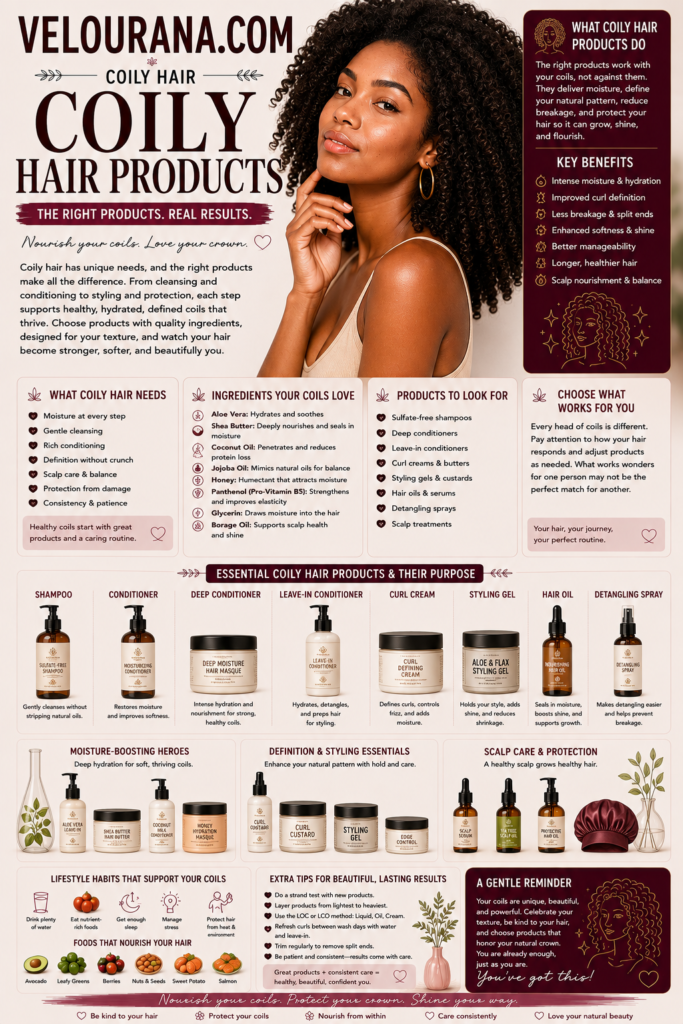
CATEGORY: Coily Hair Products
Coily hair products are often judged by a handful of familiar words printed on the front of a bottle: moisturising, strengthening, defining, nourishing, repairing, hydrating, smoothing. These claims can be useful, but they rarely explain why a formula behaves the way it does.
That understanding comes from the formulation itself.
For coily hair, where dryness, friction, tangling, shrinkage, styling longevity and mechanical stress can all influence the daily experience of the hair, the interaction between ingredients matters considerably. A conditioner is not useful simply because it contains an impressive oil. A gel is not automatically effective because it contains aloe. A cream does not become moisturising because shea butter appears prominently in its marketing. What matters is how the complete product is constructed and how that construction affects the hair during use.
This is an important distinction because ingredient discussions around textured hair can become highly simplified. Individual materials are often divided into heroes and villains. One ingredient is praised as essential for moisture. Another is blamed for dryness. Silicones are sometimes rejected categorically. Sulfates may be treated as universally harsh. Protein can be described either as indispensable or dangerous. Alcohols are grouped together despite behaving very differently.
Real cosmetic formulation is more complicated.
A hair product is a system. Surfactants cleanse. Conditioning agents reduce friction. Humectants influence interactions with water. Emollients modify surface feel. Occlusive ingredients can reduce moisture loss. Film-forming polymers help create styling hold. Proteins and amino acids may temporarily alter the feel of damaged fibres. Preservatives keep water-containing products microbiologically safe. Chelating agents can improve performance in certain water conditions. Fragrance, texture modifiers and stabilisers affect the experience and integrity of the formula.
For coily hair, understanding these functions is more valuable than memorising lists of supposedly approved ingredients.
The goal is not to become a cosmetic chemist before purchasing shampoo. It is to understand enough about formulation logic to recognise why a product may work, why another may fail, and why one ingredient should rarely determine the entire verdict.
Coily Hair Benefits From Formulas That Reduce Friction
The physical geometry of coily hair creates repeated opportunities for strands to contact one another.
Each bend changes the way the fibre moves against neighbouring fibres. Shed hairs can become trapped within the surrounding texture. Ends can wrap around one another and form single-strand knots. Detangling requires separating fibres that may have spent days moving, shrinking and intertwining.
This makes friction one of the most important concepts in coily-hair product design.
Products that improve lubrication and slip can reduce the amount of force needed to separate strands. This is particularly valuable during conditioning and detangling, when the hair is being manipulated extensively.
The importance of slip helps explain why a conditioner with an unremarkable marketing story can outperform a fashionable mask filled with exotic botanical extracts. If the conditioner allows fingers or tools to pass through the hair with significantly less resistance, it is performing an important protective function.
The complete formula creates that performance.
Fatty alcohols, cationic conditioning agents, silicones, oils and other emollient materials can contribute to smoothness and lubrication in different ways. None needs to appear alone as the hero of the product.
For coily hair, a formula that consistently makes handling easier may ultimately contribute more to length retention than a product making dramatic claims about growth.
Water Is Usually the Foundation of Moisturising Formulas
Many coily-hair creams, conditioners, leave-ins and lotions list water as their first ingredient.
This is not a sign that the product has been diluted or made cheaply. Water is an extremely useful cosmetic vehicle and an essential component of many formulations designed to hydrate and condition hair.
Hair described as dry is often seeking a combination of water and improved conditioning rather than merely more oil.
Once water enters the fibre, the challenge becomes managing how the hair feels as that water eventually evaporates. No leave-in can keep hair permanently hydrated because exposed hair naturally exchanges moisture with the surrounding environment.
This is where the rest of the formula becomes important.
Humectants may influence water retention. Conditioning agents can improve surface feel. Emollients can reduce roughness and friction. Film-forming ingredients can create a flexible layer around the fibre. Occlusive materials can slow water loss to varying degrees.
The sensory result is what consumers often describe as moisturised hair: softer, more flexible, easier to manipulate and less rough.
This helps explain why applying pure oil to dry hair can sometimes disappoint. Oil may create shine and lubrication, but it does not replace water.
A water-based leave-in followed by an appropriate styling product may therefore feel more effective than repeated oiling, especially when the problem is loss of flexibility rather than lack of shine.
Humectants Are More Nuanced Than Their Reputation
Humectants are ingredients that interact strongly with water. Glycerin is one of the most familiar examples, but propylene glycol, sorbitol, panthenol and several other ingredients may perform related functions within cosmetic formulations.
In textured-hair discussions, humectants sometimes receive extreme treatment.
They may be described as miraculous moisture magnets or blamed for frizz whenever humidity changes. Neither view captures the complete picture.
A finished product containing glycerin does not behave exactly like glycerin by itself. Its performance depends on concentration, surrounding ingredients, film-formers, oils, conditioning agents and the structure of the formula.
Climate can affect results, but individual formulation still matters enormously.
A gel containing humectants may perform beautifully in humid weather if its polymer system creates sufficient hold. Another product may produce excessive swelling and loss of definition. A leave-in may feel excellent during winter despite containing the same ingredient blamed by someone else for dryness.
The practical approach is to observe the complete product under the conditions in which it will actually be used.
Ingredient lists provide clues. They should not be treated as fortune-telling devices.
Fatty Alcohols Are Often Friends of Coily Hair
The word alcohol causes immediate concern for many people shopping for hair products.
That concern usually comes from experience with volatile alcohols that can contribute to a lightweight, fast-drying feel and may be drying in some contexts.
But not all alcohols are chemically or functionally alike.
Cetyl alcohol, stearyl alcohol and cetearyl alcohol are fatty alcohols commonly used in conditioners, creams and masks. They can help create richness, improve texture and contribute to a smoother, more conditioned feel.
Seeing “alcohol” in these names is therefore not a reason to reject the product.
This is a useful example of why ingredient literacy is more valuable than ingredient fear.
Words that sound similar can describe materials with very different functions.
For coily hair, fatty alcohols can be particularly useful because they help create the creamy slip associated with effective conditioners and styling creams.
Conditioning Agents Do Much of the Invisible Work
Conditioners work partly because damaged and weathered hair carries electrical characteristics that allow certain positively charged conditioning agents to interact with the fibre.
These cationic ingredients can help reduce static, improve softness and decrease friction.
Behentrimonium chloride, behentrimonium methosulfate and cetrimonium chloride are examples commonly found in conditioning formulas.
The chemistry may sound technical, but the practical effect is familiar: hair that feels smoother and easier to detangle after conditioning.
This is one reason judging a conditioner primarily by its featured oil can be misleading.
The bottle may advertise coconut oil, avocado oil or shea butter while the ingredients responsible for much of the immediate conditioning experience receive no attention on the label.
For coily hair, these less glamorous ingredients can be exceptionally important because they directly support manageability.
A product does not need an exotic story to perform sophisticated work.
Silicones Are Tools, Not Automatic Enemies
Few ingredient families have generated as much debate in textured-hair communities as silicones.
They are often accused of suffocating the hair, blocking moisture or creating unavoidable buildup. At the opposite extreme, some people dismiss all concerns and treat every silicone as interchangeable.
The more useful position lies between those extremes.
Silicones are a broad family of ingredients used for benefits such as lubrication, shine, smoothness, heat protection and improved combability. Different silicones have different properties, and formulations use them at different concentrations.
For coily hair, reduced friction can be valuable.
A silicone-containing conditioner may create exceptional slip. A serum may reduce roughness on weathered ends. A heat-protective product may use silicones as part of a system designed to reduce thermal damage.
Buildup can occur with many cosmetic materials, not only silicones. Oils, butters, waxes, polymers and conditioning agents can all accumulate depending on usage and cleansing.
The practical question is whether the routine includes sufficient cleansing to remove what is being deposited.
If a silicone-containing product makes the hair easier to detangle, improves shine and washes out effectively with the chosen cleanser, there is little reason to reject it solely because of ideology.
If it creates persistent coating or interferes with styling, another formula may be preferable.
Performance should decide.
Oils Differ More Than Their Shared Name Suggests
Oil is a category, not a single substance.
Coconut oil, olive oil, sunflower oil, argan oil, jojoba oil and mineral oil have different chemical compositions and cosmetic behaviours.
Some oils have greater affinity for the hair fibre than others. Coconut oil, for example, has been studied for its ability to reduce protein loss in certain conditions. Other oils are valued mainly for lubrication, shine or sensory properties.
This does not mean every head of coily hair needs coconut oil.
A product can contain a theoretically beneficial ingredient and still feel unpleasant. Some people find coconut-heavy formulas leave their hair feeling stiff. Others enjoy them.
Mineral oil is another ingredient that receives unnecessary stigma. It can provide effective lubrication and occlusive properties, and its cosmetic usefulness should not be confused with marketing debates around whether an ingredient is natural.
The important issue is function.
Does the oil improve softness? Does it reduce friction? Does it make the finished style excessively heavy? Does it cause buildup faster than the user prefers?
These questions matter more than whether the ingredient belongs to a fashionable category.
Butters Can Provide Richness Without Being Universal Solutions
Shea butter, cocoa butter, mango butter and related materials appear frequently in products marketed for coily hair.
Their thick, emollient character can be valuable in creams designed for twists, braids, protective styles and very dry-feeling lengths.
Butters can improve lubrication and reduce the sensation of roughness. They may also help create a substantial, long-lasting feel.
The disadvantage is weight.
Fine or lower-density coily hair may become flat when exposed to multiple butter-rich layers. Very dense hair can become difficult to dry when heavy creams are applied over soaking-wet sections. Repeated butter use without adequate cleansing can contribute to coating.
This does not make butter good or bad.
It means richness should be matched to the hair's capacity and the desired style.
A person who wants a soft, stretched twist-out may love a dense butter cream. Someone seeking maximum volume in a wash-and-go may prefer a lightweight lotion.
Formula suitability is always contextual.
Surfactants Determine How Cleansers Behave
Shampoo ingredients known as surfactants allow oils, dirt and other residues to be dispersed into water and rinsed away.
The word sulfate has become a shorthand for aggressive cleansing, but the reality is more nuanced.
Sodium lauryl sulfate and sodium laureth sulfate are not identical. Concentration matters. Supporting ingredients influence mildness. Surfactant blends can behave differently from individual ingredients in isolation.
Sulfate-free shampoos also vary widely. Some are extremely mild. Others cleanse very effectively.
For coily hair, the goal is not necessarily to find the weakest possible shampoo.
The goal is to clean effectively without creating unnecessary discomfort or roughness.
A routine involving heavy gels, creams, oils and edge products may periodically require more powerful cleansing than a routine based on lightweight water-soluble products.
Scalp needs matter too.
An inadequately cleansed scalp should not be considered healthy simply because the shampoo is gentle.
The best cleanser is the one that removes what needs to be removed at the appropriate frequency while leaving the hair manageable enough for the next stage.
Clarifying Ingredients Can Reset a Product-Heavy Routine
Clarifying shampoos are designed to remove more persistent buildup than ordinary gentle shampoos.
They can be particularly useful when hair has accumulated oils, butters, silicones, polymers, waxes or environmental residues.
Signs that clarifying may be useful include hair that feels coated immediately after washing, products that stop behaving as expected, reduced volume, persistent dullness or difficulty getting the hair fully wet.
Clarification should not automatically become a weekly ritual for everyone.
Frequency depends on the products used, water conditions, scalp behaviour and personal preference.
After stronger cleansing, adequate conditioning becomes important because the hair may feel less lubricated once surface coatings have been removed.
This reset can also reveal whether a supposedly moisturising routine had actually become overloaded with residue.
Sometimes the hair does not need another product.
It needs a cleaner starting point.
Chelating Ingredients Matter in Hard-Water Areas
Water itself can influence hair behaviour.
Hard water contains elevated levels of minerals such as calcium and magnesium. Over time, mineral deposits can affect how the hair feels and how products perform.
In these situations, chelating ingredients can be useful because they bind certain metal ions and help them rinse away.
Ingredients such as EDTA, phytic acid and specific chelating systems may appear in shampoos designed for mineral removal.
Not every clarifying shampoo is strongly chelating, and not everyone requires a chelating routine.
But when hair consistently feels rough, dull or coated despite effective product cleansing, water quality becomes another factor worth considering.
This is especially relevant for coily hair because increased roughness can make detangling more difficult.
Product performance is influenced not only by what comes out of the bottle but also by what comes out of the shower.
Proteins Can Temporarily Improve Damaged Hair
Protein treatments occupy a complicated place in coily-hair care.
Hair is primarily composed of keratin, and damage can alter the structure and mechanical properties of the fibre. Hydrolysed proteins and amino acids are used in some products to improve feel, strengthen temporarily or reduce the perception of damage.
Hydrolysed wheat protein, hydrolysed silk, keratin derivatives and various amino acids may appear in strengthening formulations.
The important word is temporary.
A cosmetic product cannot restore damaged hair to its original biological condition. It can improve how the fibre behaves and make damage easier to manage.
This can still be extremely useful.
Bleached, coloured, relaxed or heat-damaged coily hair may respond well to appropriately formulated strengthening products.
Healthy untreated hair may need them less frequently.
The mistake is treating protein either as an absolute necessity or an ingredient to fear.
Some hair responds beautifully. Some becomes stiff when certain formulas are used too frequently. The complete product and the condition of the fibre determine the outcome.
Bond-Building Language Requires Realistic Expectations
Modern hair care increasingly uses terms such as bond repair, bond building and molecular repair.
These technologies vary considerably, and not every product using similar language contains the same chemistry.
Certain treatments are designed to interact with structural bonds or damaged areas within the fibre. They can improve the performance and feel of compromised hair.
But marketing language can create unrealistic expectations.
No cosmetic treatment makes severely bleached hair identical to virgin hair. It cannot reverse every structural change. Split ends cannot permanently fuse back into untouched fibres.
For coily hair that has experienced chemical or thermal damage, these products may still be valuable.
The appropriate expectation is improved manageability and reduced manifestations of damage, not complete biological restoration.
Film-Forming Polymers Create the Architecture of Hold
Styling gels, mousses and custards rely heavily on film-forming polymers.
These materials create a thin layer around or between hair fibres as the product dries, helping preserve the arrangement created during styling.
Common examples include PVP, VP/VA copolymers, acrylates copolymers and various modern styling polymers.
For coily hair, these ingredients can support definition, elongation, frizz control and style longevity.
The familiar hard cast produced by some gels is evidence of the film forming as water evaporates.
Once the hair is completely dry, the cast can often be gently softened without completely destroying the underlying structure.
Different polymers create different balances of firmness and flexibility.
This is why one gel may produce a glass-like cast while another remains soft. It is also why ingredient comparisons based only on botanical additives often miss the most important part of the styling formula.
If the purpose is hold, the polymer system deserves attention.
Botanical Gels Can Still Depend on Modern Cosmetic Chemistry
Aloe vera, flaxseed, marshmallow root and other botanical ingredients frequently appear in products for coily hair.
These materials can contribute texture, film formation, slip or marketing appeal.
But a commercial gel containing aloe is rarely simply aloe in a jar.
It still requires preservation, stabilisation, viscosity control and often synthetic polymers to achieve reliable performance.
This is not a disadvantage.
Modern cosmetic formulation allows natural-derived and synthetic ingredients to work together.
The useful distinction is not natural versus chemical. Everything in the formula is chemical in the scientific sense.
The meaningful question is whether the formula performs safely, consistently and pleasantly.
Preservatives Protect Water-Based Products
Preservatives rarely appear in glamorous advertising, but they are essential in products containing water.
Water creates an environment in which microorganisms can grow if the formula is not appropriately protected.
Preservative systems prevent shampoos, conditioners, creams and gels from becoming contaminated during normal use.
This is particularly important for products that spend months in warm, humid bathrooms while users repeatedly open containers or touch the product.
The widespread fear of preservatives has encouraged some consumers to believe that preservative-free products are inherently safer.
In water-based cosmetics, inadequate preservation can create far more serious problems than the presence of a properly selected preservative system.
For coily hair consumers who make homemade flaxseed gels or botanical sprays, this issue deserves attention. Fresh mixtures containing water may have very short safe storage periods unless they are professionally preserved.
A product designed to remain on the shelf requires microbial safety, not merely appealing ingredients.
Fragrance Affects Experience but Not Hair Performance
Fragrance is one of the most subjective elements of hair care.
A beautiful scent can make wash day more enjoyable and contribute significantly to brand identity. For some people, fragrance is part of the pleasure of styling.
Others experience irritation or simply dislike persistent fragrance.
Fragrance does not make a conditioner more effective.
A strongly scented product may perform wonderfully or poorly. A fragrance-free formula may be technically excellent.
People with sensitive scalps or known fragrance reactions may prefer formulas designed accordingly.
This is another reminder to separate sensory enjoyment from functional performance.
Both matter, but they are not the same thing.
pH Matters, but Consumers Rarely Need to Obsess Over It
Hair products are formulated within pH ranges appropriate to their purpose.
Conditioners are often mildly acidic, which can support a smoother cuticle feel. Chemical treatments may use very different pH conditions to alter hair structure.
Online discussions sometimes encourage consumers to measure every shampoo and conditioner with test strips.
For ordinary commercial products from reputable manufacturers, this level of monitoring is usually unnecessary.
The more practical question is how the product performs and whether it causes irritation or excessive roughness.
DIY chemical experiments, by contrast, deserve much greater caution.
Attempting to alter product pH at home can compromise stability, preservation and safety.
Coily hair benefits from understanding chemistry, not from turning every wash day into a laboratory.
Ingredient Order Provides Clues but Not Exact Percentages
Cosmetic ingredient lists generally appear in descending order of concentration until the low-concentration portion of the formula, where ordering rules can become less informative.
This means ingredients near the top are usually present in greater amounts than ingredients near the end.
But the list does not reveal exact percentages.
A product containing an expensive oil near the bottom may still use enough for its intended cosmetic effect. Conversely, seeing aloe or coconut oil near the top does not guarantee the product will suit a particular head of hair.
Styling polymers can work effectively at relatively low concentrations. Preservatives are intentionally used in small amounts. Fragrance should not dominate the formula.
Ingredient order should therefore be interpreted in context rather than used as a simple quality ranking.
Marketing Ingredients Are Not Always the Functional Core
Beauty packaging often highlights the most emotionally appealing ingredients.
Argan oil. Honey. Aloe. Shea butter. Rice water. Rosemary. Coconut milk.
These can be legitimate components, but the ingredient chosen for the front label may not be the ingredient doing most of the practical work.
A conditioner marketed around honey may owe much of its detangling performance to cationic conditioning agents and fatty alcohols.
A curl gel featuring aloe may depend mainly on synthetic film-forming polymers for hold.
A strengthening treatment advertised with rice water may derive much of its performance from hydrolysed proteins, conditioning agents and polymers.
Understanding this does not make marketing dishonest by definition.
It simply allows the consumer to distinguish the story of the product from the mechanics of the product.
Natural Does Not Automatically Mean Gentler
The natural-hair movement understandably encouraged many people to question aggressive chemical processing and seek products aligned with a more natural aesthetic.
But “natural” is not a scientific synonym for safe, mild or effective.
Essential oils can irritate skin. Botanical extracts can trigger sensitivities. Raw ingredients can vary. Poorly preserved natural products can become contaminated.
Synthetic ingredients can be exceptionally gentle and well studied.
For coily hair, the most useful question is not whether the ingredient came directly from a plant.
It is whether the final formula performs its intended function without creating unacceptable problems.
Ingredient Avoidance Can Become More Complicated Than Hair Care Itself
There is a difference between avoiding an ingredient because of a known sensitivity and avoiding an ever-expanding list because internet rules declare each new material unacceptable.
One week sulfates are forbidden.
Then silicones.
Then mineral oil.
Then petrolatum.
Then glycerin.
Then protein.
Eventually, the routine becomes defined more by fear than by results.
Coily hair care becomes easier when avoidance is evidence-based.
If a particular fragrance irritates the scalp, avoid it.
If a butter-heavy product consistently causes buildup, choose lighter formulas.
If a protein treatment leaves the hair unusually stiff after repeated use, reduce frequency or switch formulas.
The response follows observation.
Rigid ingredient ideology can unnecessarily eliminate products that might otherwise perform extremely well.
Product Compatibility Matters When Formulas Are Layered
Two excellent products can create a poor result when combined.
A leave-in may work beautifully alone. A gel may create excellent hold over clean hair. Yet when the two are layered together, the mixture may form white residue, clumps or flakes.
This can occur because ingredients within the formulas interact unfavourably.
The simplest solution is often to test the combination before committing to the entire head.
Mix a small amount of the products together between the hands. If they immediately form curds, balls or obvious residue, the pairing may be problematic.
This test is not perfect because hair, water and application technique alter performance, but it can provide an early warning.
For coily hair, where section-by-section styling can require considerable time, compatibility testing can prevent frustrating wash days.
Quantity Can Change the Behaviour of the Same Formula
Product reviews rarely mention dosage with enough precision.
One person applies a coin-sized amount of cream. Another applies several handfuls. Their reviews may describe completely different products despite using the same jar.
Coily hair can encourage generous application because dense textures make distribution difficult.
But more product does not always produce more benefit.
Too much conditioner may become difficult to rinse. Excess leave-in can weaken styling hold. Heavy cream beneath gel can extend drying time and increase flaking. Too much oil can eliminate volume.
Ingredient quality cannot compensate for excessive application.
Sometimes the most effective change is not purchasing a different product but reducing the quantity of the existing one.
Application on Wet Versus Damp Hair Changes Performance
The amount of water present in the hair affects how products spread and behave.
Applying leave-in or gel to soaking-wet coily hair can encourage clumping and make relatively small amounts distribute across larger sections.
Applying the same products to damp hair may produce stronger concentration, less dilution and sometimes more volume.
Creams used for twists may perform better on damp rather than dripping hair because excessive water can prolong drying.
There is no universal method.
The relevant point is that the same formula can produce different outcomes depending on the amount of water present during application.
This is one reason product reviews that ignore technique can be misleading.
Ingredient Literacy Should Make the Routine Simpler
The purpose of understanding ingredients is not to create more anxiety.
It is to reduce confusion.
Once the functions become familiar, product shelves become easier to interpret.
A conditioner containing fatty alcohols, conditioning agents and emollients makes sense as a detangling tool.
A gel containing strong film-forming polymers makes sense for definition and hold.
A cream containing water, conditioning agents, oils and butters makes sense for softness and lubrication.
A clarifying shampoo containing effective surfactants makes sense for buildup.
A strengthening treatment containing hydrolysed proteins or bond-focused technology makes sense when the hair is genuinely damaged.
The formula becomes readable as a system rather than a collection of fashionable ingredients.
The Hair Still Has the Final Vote
Ingredient knowledge can predict possibilities.
It cannot guarantee results.
Coily hair varies too much in strand diameter, density, porosity, damage, styling history and climate for any ingredient list to provide certainty.
A formula that looks perfect on paper may be disappointing.
A product containing an ingredient someone was taught to avoid may produce the best results they have experienced.
This is not a contradiction.
Formulation science explains tendencies. Personal use reveals suitability.
The most useful approach combines both.
Understand what ingredients generally do. Observe how the complete product behaves. Cleanse effectively enough to prevent residue from obscuring performance. Change one variable at a time when troubleshooting. Judge the product according to the function it was purchased to perform.
For coily hair, that function should ultimately support easier handling, reduced unnecessary friction, appropriate conditioning and styling that lasts long enough to reduce constant manipulation.
Building a Coily Hair Routine Around Formula Logic
A thoughtful coily-hair routine does not need dozens of specialised ingredients.
It needs complementary functions.
The cleanser needs surfactants capable of removing the actual level of buildup present.
The conditioner needs enough lubrication and conditioning power to make detangling manageable.
The leave-in should support softness without interfering with the styler.
The cream, if used, should provide the degree of richness appropriate to the strand.
The gel or foam should provide the desired level of hold.
An oil should have a specific purpose rather than appearing automatically because the hair is coily.
Strengthening products should correspond to actual damage.
Clarifying or chelating products should be used when buildup or mineral deposits justify them.
When viewed this way, product selection becomes a sequence of practical decisions instead of an endless search for miracle ingredients.
What Good Formulation Looks Like in Everyday Life
The most sophisticated formula is not necessarily the one with the longest ingredient list.
It is the one that delivers its intended result reliably.
A good shampoo cleans effectively and rinses without leaving the scalp uncomfortable.
A good conditioner allows tangled sections to separate with less effort.
A good leave-in keeps the hair manageable through styling.
A good gel creates the desired definition and holds it without unacceptable residue.
A good cream gives softness without unnecessary buildup.
A good treatment makes damaged hair easier to handle even though it cannot erase the damage completely.
These outcomes are more meaningful than the presence or absence of fashionable ingredients.
Reading Products Without Becoming Controlled by Labels
Marketing will always simplify.
A bottle has limited space. A brand needs a clear message. “With avocado oil and honey” is more attractive than an explanation of surfactant systems, polymer interactions and cationic conditioning chemistry.
There is nothing wrong with enjoying that story.
The problem begins only when the story replaces understanding.
Coily hair deserves products selected for their actual performance, not because one ingredient has been transformed into a symbol of textured-hair authenticity.
A beautifully formulated conditioner can contain silicones.
A gentle cleanser can contain sulfates.
A rich cream can contain mineral oil.
A natural formula can still be irritating.
A protein treatment can be helpful.
A protein treatment can also be unnecessary.
Context changes the answer.
From Ingredient Lists to Better Decisions
The real advantage of ingredient literacy is not the ability to recite chemical names.
It is the ability to ask better questions.
Does this shampoo contain a cleansing system strong enough for the products I use?
Does this conditioner contain ingredients likely to provide good lubrication?
Is this cream mostly a rich emollient product or a lightweight water-based lotion?
Does this gel have a credible film-forming system?
Is this treatment actually formulated for strengthening, or does it merely advertise a fashionable botanical extract?
Do I need this additional product, or does something already in my routine perform the same function?
Questions like these move purchasing away from impulse and toward purpose.
They also make disappointment easier to interpret.
The Most Important Ingredient Is the Complete Formula
No single ingredient determines whether a coily-hair product is good.
Water alone does not guarantee moisture.
Oil alone does not guarantee softness.
Protein alone does not guarantee strength.
Aloe alone does not guarantee hydration.
Silicone alone does not guarantee buildup.
Sulfate alone does not guarantee harshness.
The formula determines how these materials are delivered, balanced and experienced.
Then the hair determines whether that formula belongs in the routine.
This is why coily-hair product selection becomes more sophisticated when the focus moves away from ingredient mythology and toward formulation logic.
A person who understands functions can evaluate products more calmly. They do not need to panic when unfamiliar ingredients appear. They do not need to buy every product containing the latest botanical trend. They can distinguish between ingredients included for marketing appeal and those likely to contribute meaningfully to cleansing, conditioning or styling.
Most importantly, they can judge products according to what the hair actually needs.
Coily hair is already structurally complex. Its product routine does not need unnecessary complexity layered on top.
The most useful formulas are those that respect the fibre, reduce friction, support flexibility, create the desired style and fit naturally into an effective cleansing cycle.
That is the real value of ingredient knowledge.
It turns the back of the bottle from an intimidating wall of chemical names into a map of possible functions.
And once those functions are understood, product choice becomes less about following rules and more about making informed decisions for the texture, condition and life of the hair itself.
The End Velourana.
 Discover More From Our Family of Websites
 ZodiacBearing (Astrology, Tarot, Numerology, Angel Numbers & Spiritual Guidance)
 Velourana (Beauty, Makeup, Hair Care, Skincare & Beauty Tips)
 HavenBearing (Home, Living, Organization, Décor & Everyday Inspiration)
 PawBearing (Pet Care, Dog Breeds, Animal Health, Training & Pet Products)
 PsyCatherine (Notes From the Journal of a Psychologist on Real Life)

