
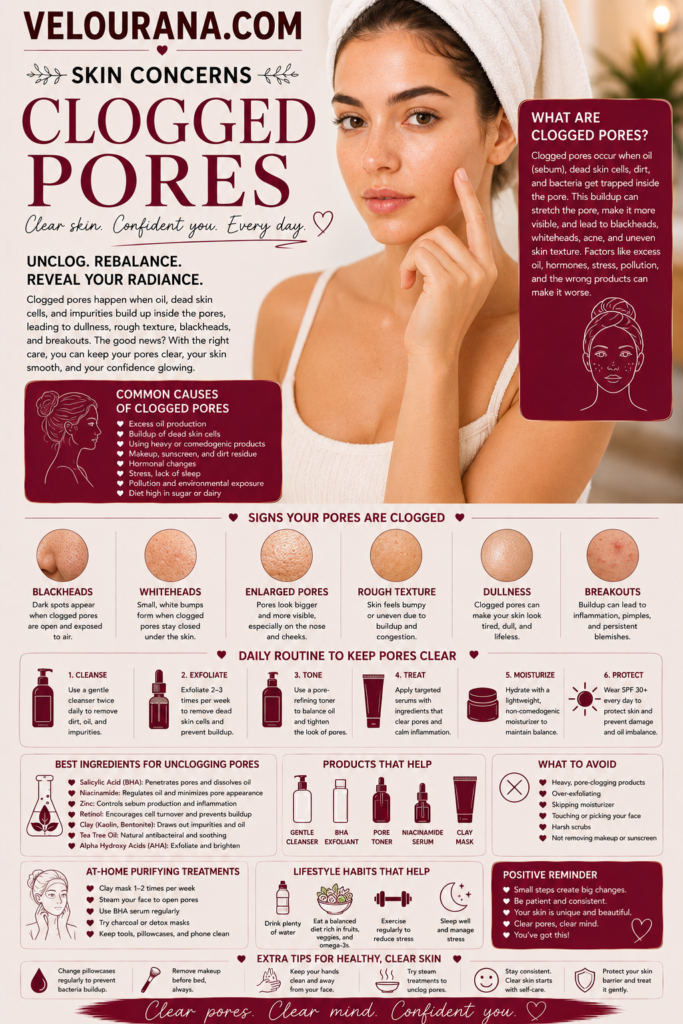
CATEGORY: Clogged Pores
Clogged pores are not always dark, obvious or easy to identify.
Sometimes they appear as blackheads, creating the familiar impression of tiny dark plugs across the nose or chin. In other cases, the obstruction remains beneath the surface and produces something subtler: small flesh-coloured bumps, roughness that catches the light unevenly, or a texture that feels congested even when the skin does not look dramatically blemished.
These closed comedones can be particularly frustrating because they are less visually obvious than blackheads but often more persistent.
They may cluster across the forehead, collect along the chin, appear near the hairline or create a fine, uneven texture that becomes especially visible beneath makeup or under side lighting.
Because there is no open central plug, they do not provide the same obvious target for extraction.
This changes the entire experience of the problem.
A blackhead seems removable.
A closed comedo feels buried.
The temptation is therefore to become more aggressive: stronger exfoliation, more frequent peeling, repeated squeezing, pore vacuums, scrubs and anything else that promises to bring the blockage "to the surface."
But closed comedones are not simply deeper dirt.
They are follicular obstructions occurring beneath an intact surface.
Treating them successfully requires understanding how they form, why they can linger, how they differ from other small bumps and why the most effective strategy usually involves gradual normalization rather than physical force.
What Makes a Closed Comedone Different From a Blackhead
Both blackheads and closed comedones begin with follicular obstruction.
Sebum and keratinous material accumulate within the follicular canal.
The difference lies largely in what happens at the opening.
In an open comedo, the follicular opening remains exposed.
The material at the surface becomes visible and darkens, producing the characteristic blackhead.
In a closed comedo, the surface remains covered.
The trapped material pushes upward beneath the skin, creating a small bump.
Because there is no open point, the lesion often appears pale or the same colour as the surrounding skin.
This distinction explains why squeezing a closed comedo is usually more difficult.
There is no obvious channel through which the material can easily escape.
Pressure is therefore more likely to compress the surrounding tissue than to produce clean extraction.
This is one reason closed comedones can become inflamed after repeated manipulation.
A lesion that began as a relatively calm obstruction can be converted into a red, irritated blemish.
The attempt to make the skin smoother has created a more obvious problem.
Why Closed Comedones Can Make Skin Look Rough Without Looking "Acneic"
Closed comedones often create a very specific kind of texture.
The skin may look relatively clear from a distance.
There may be little redness.
No large pimples are present.
Yet under natural side lighting, the surface looks uneven.
When foundation is applied, the bumps become more noticeable because pigment and light settle differently across the raised areas.
This can be especially frustrating because the skin appears smooth in some conditions and congested in others.
The problem is structural rather than primarily colour-based.
Each small comedone slightly lifts the surface.
When many are clustered together, the face develops a fine-grained unevenness.
This is why people sometimes describe the forehead as "bumpy" even when they cannot identify individual lesions easily.
The visual subtlety can lead to over-treatment.
Because the condition does not look severe enough to justify medical care yet remains cosmetically persistent, people often spend months rotating through exfoliating products.
The skin becomes increasingly sensitive.
The texture remains.
At that point, the condition is no longer simply comedonal congestion.
It is congestion layered with irritation.
The Forehead Is a Common Territory for Hidden Congestion
Closed comedones frequently appear across the forehead.
Several factors can contribute to this pattern.
The forehead contains active sebaceous structures.
Hair products can also contact the area.
Sweat, bangs, hats and occlusive headwear may create additional exposure.
A heavy styling cream or oil that repeatedly touches the forehead can become relevant even when the facial skincare routine itself appears well designed.
This is why distribution matters.
A cluster of small bumps around the hairline may provide a different clue from similar bumps concentrated on the chin.
The correct response is not to assume every forehead bump has the same cause.
It is to look at the context.
What touches the area?
When did the pattern begin?
Did a new hair product coincide with it?
Does it worsen during hot weather?
Does the texture persist despite exfoliation?
These questions can reveal more than simply adding another acid.
The Chin Can Behave Differently From the Rest of the Face
The chin is another common area for closed comedones.
It can be particularly difficult because the region may also experience hormonal breakouts, friction, repeated touching and product accumulation.
Closed bumps on the chin can therefore exist alongside inflammatory pimples.
This mixed pattern often leads to treatment confusion.
The person may use a strong spot treatment for inflamed lesions and spread it across the entire chin.
Meanwhile, the closed comedones require a different long-term strategy.
The result can be excessive dryness without meaningful improvement in texture.
This is another reason blemish type matters.
A red inflammatory lesion and a closed comedo may appear next to each other, but they should not automatically be treated identically.
Closed Comedones Are Often Easier to Prevent Than to Extract
Physical extraction seems logical because the problem is literally an obstruction.
But closed comedones have no open surface.
Forcing them out requires creating or finding a route through the skin.
This is why professional extraction techniques differ from casual squeezing.
A trained professional can determine whether a lesion is suitable for extraction and use controlled methods where appropriate.
At home, the process often becomes blunt.
Fingers press from both sides.
Nothing emerges.
More pressure is applied.
The surface breaks.
Redness develops.
The original flesh-coloured bump becomes a visible inflamed mark.
This is a poor trade.
Closed comedones therefore reward preventive and keratinization-focused treatment more than repeated mechanical removal.
Why Salicylic Acid Can Help but May Not Be Enough on Its Own
Salicylic acid is frequently useful for clogged pores because of its ability to exfoliate within oily, congested environments.
For mild closed comedones, consistent use may help reduce accumulation and improve texture.
But not every case responds fully.
Persistent closed comedones can reflect a stronger tendency toward abnormal follicular keratinization.
In those cases, retinoids may become more relevant because they influence the processes involved in comedone formation more broadly.
This distinction matters because people often respond to incomplete improvement by increasing the strength or frequency of the same ingredient indefinitely.
Sometimes the issue is not that the existing product is too weak.
It may be that the treatment mechanism needs to change.
Retinoids Are Particularly Relevant to Closed Comedones
Topical retinoids have an important role in comedonal acne because they help normalize follicular turnover and reduce the formation of microcomedones.
This makes them especially useful for hidden congestion.
The benefit is preventive and gradual.
The skin does not immediately become smooth.
Existing comedones need time to resolve.
New microcomedones may continue becoming visible during the early stages of treatment.
This is why patience is essential.
The routine needs to be stable enough for the pattern to change over weeks and months.
Retinoids can also cause irritation, particularly when introduced too aggressively.
A slow introduction, suitable moisturizer and reduction of unnecessary exfoliation can improve tolerability.
Pregnancy and plans for pregnancy require particular caution because certain retinoids should not be used.
Professional guidance is appropriate when the condition is extensive or persistent.
Why More Exfoliation Can Make the Texture Look Worse
Closed comedones create roughness.
Roughness invites exfoliation.
This seems logical.
But the visual effect of irritation can resemble worsening congestion.
When the barrier becomes compromised, the skin can develop redness, dryness, flaking and fine bumps.
The surface becomes uneven.
The person sees more texture.
Another exfoliating treatment is added.
The cycle continues.
At this point, it becomes difficult to distinguish comedones from irritation-related roughness.
This is why sensation matters.
If the skin is stinging, burning or persistently tight, the routine may be over-treating.
A face can be both congested and over-exfoliated at the same time.
The answer is not automatically stronger treatment.
Sometimes the first priority is restoring enough barrier comfort that the real congestion can be assessed accurately.
Glycolic Acid Can Improve Surface Texture but Has Limits
Alpha hydroxy acids such as glycolic acid can improve surface smoothness and support exfoliation.
This can make closed-comedone-prone skin look more refined.
But a smoother surface does not necessarily mean the follicular process has been fully corrected.
If the underlying tendency toward comedone formation remains strong, texture can return.
This is why glycolic acid may be useful as part of a broader strategy without being the entire solution.
The mistake is treating immediate smoothness as proof that the condition has been permanently controlled.
Surface refinement and follicular prevention are related but not identical goals.
Product Formulation Can Matter More Than One Famous Ingredient
When closed comedones appear, attention usually turns toward ingredients.
But formulation matters enormously.
A moisturizer containing excellent ingredients may still feel too heavy for a particular person.
A sunscreen may be protective yet coincide with congestion on susceptible skin.
A primer may create a smooth cosmetic finish while feeling occlusive after prolonged use.
The label alone cannot predict individual response perfectly.
This is why troubleshooting works best through pattern recognition.
When did the texture appear?
Which products were introduced beforehand?
Where are they applied?
Did stopping one change the pattern?
These questions create more useful information than simply searching for a universally "non-comedogenic" ingredient list.
Non-Comedogenic Is Helpful but Not Absolute
The term non-comedogenic is useful as a general guide.
It indicates that a product has been formulated or tested with pore clogging in mind.
But it is not a guarantee that every person will tolerate the product perfectly.
Skin varies.
Climate varies.
Application amount varies.
Layering varies.
A lightweight non-comedogenic moisturizer may still feel too heavy under a rich sunscreen in humid weather.
A richer product may work perfectly in winter.
This is why formulation should be evaluated in context rather than treated as universally safe or unsafe.
Hair Oils and Styling Products Can Create Persistent Forehead Texture
Hair products are particularly important when closed comedones cluster near the hairline.
Oils, pomades, leave-in conditioners and styling creams can migrate onto the forehead.
Because these products are often designed to coat hair, they may feel heavy on facial skin.
The person may repeatedly exfoliate the forehead without realizing the same occlusive exposure is happening every day.
This creates a frustrating cycle.
The treatment is working against a continuing trigger.
Sometimes changing the hair product or keeping it away from the skin produces more improvement than adding another facial treatment.
Sweat and Occlusion Can Intensify the Appearance of Congestion
Hot weather can make closed-comedone-prone skin feel significantly worse.
Sebum becomes more noticeable.
Sweat increases.
Products may feel heavier.
Hats, helmets and headbands create occlusion.
This does not mean sweat itself is dirty or that every workout causes acne.
The issue is the environment created by prolonged heat, moisture, friction and occlusion.
For some skin, this combination can contribute to follicular problems.
Practical adjustments can help.
Cleanse appropriately after prolonged sweating.
Avoid leaving occlusive equipment against the skin longer than necessary.
Use lighter product textures when the climate becomes humid.
The routine does not need to become more aggressive simply because the season changes.
Makeup Can Reveal Texture More Than It Causes It
Closed comedones often become most obvious after makeup is applied.
Foundation catches on the raised surface.
Powder settles unevenly.
Light reflects from each small bump.
This can create the impression that makeup has caused the texture.
Sometimes a formulation may contribute to congestion.
But makeup can also simply reveal what was already present.
This distinction is important.
Removing makeup entirely may not solve the underlying condition if the comedones developed independently.
The better approach is to evaluate whether the product coincided with the onset of congestion rather than assuming causation from visibility alone.
The Skin Barrier Changes How Texture Is Perceived
Hydration can alter the appearance of uneven skin.
When the barrier is dry, the surface becomes rougher.
Fine flaking emphasizes bumps.
Pores look deeper.
Closed comedones appear more obvious because the surrounding skin is no longer smooth.
Improving hydration does not remove the obstruction itself.
But it can make the overall texture look significantly better while active treatment works.
This is another reason moisturizer should not be treated as the enemy of congested skin.
Supporting the surrounding surface can improve both comfort and appearance.
Why Picking at Closed Comedones Creates Long-Term Problems
Closed comedones are tempting because they often feel like small seeds beneath the skin.
A finger runs across the forehead and detects them immediately.
Once noticed, they become difficult to ignore.
Picking can become habitual.
The problem is that these lesions often resist extraction.
Repeated pressure damages the surface.
Small scabs form.
Pigmentation develops.
What was originally a skin-coloured bump becomes a visible red or dark mark.
This trade is particularly poor because the new mark may remain visible long after the original comedone would have resolved.
The best intervention for hidden congestion is often the one that does not create a second visible problem.
Why Steam Does Not Bring Closed Comedones to the Surface Permanently
Steam is often used before extraction because warmth can soften surface material.
But it does not literally open pores or dissolve closed comedones.
The follicular obstruction remains.
Repeated steaming may make the skin feel softer and can be pleasant, but it should not be treated as a primary comedonal treatment.
Its role is supportive at most.
The underlying process still requires appropriate topical or professional management.
Clay Masks Have Limited Value for Hidden Congestion
Clay masks can absorb surface oil.
This can make the skin feel cleaner and look more matte.
But a closed comedone exists beneath an intact surface.
A mask cannot simply pull the entire obstruction through the skin.
This is why clay masks may improve the overall feel of oily skin without meaningfully eliminating persistent bumps.
They are optional adjuncts, not foundational treatment.
Pore Vacuums Are Poorly Matched to Closed Comedones
Suction devices work best on material that is already accessible at the surface.
Closed comedones are not.
This makes pore vacuums particularly ill-suited to the problem.
The suction acts on the skin while the obstruction remains covered.
The result may be redness or bruising without successful extraction.
This is a clear example of why matching the treatment to the lesion matters.
A tool can be powerful and still be biologically inappropriate.
Hydrocolloid Patches Cannot Pull Out an Intact Closed Comedone
Hydrocolloid patches can be useful for superficial lesions that release fluid.
They are excellent at creating a physical barrier against picking.
But an intact closed comedone has no open channel.
The patch cannot magically extract material through unbroken skin.
This is why the patch may sit on the bump for hours without changing it significantly.
Again, the product did not necessarily fail.
It was simply being asked to perform a job outside its mechanism.
When "Purging" Can Make Closed Comedones More Visible
Treatments that increase cell turnover, particularly retinoids, can sometimes make existing microcomedones become visible more quickly during the early stages of use.
This can create the impression that the skin is suddenly developing many more closed comedones.
In some cases, this represents a temporary transition.
But not every new bump should automatically be labelled a purge.
If the reaction is occurring in unusual areas, accompanied by burning, itching or significant redness, irritation or intolerance may be more likely.
The location and sensation matter.
Skincare language should not be used to explain away every negative reaction.
Closed Comedones Can Become Inflamed
A closed comedo does not necessarily remain quiet forever.
The follicular obstruction can progress.
Inflammation may develop.
The small skin-coloured bump becomes red and tender.
This is one reason preventive treatment is valuable.
Reducing the number of closed comedones does not merely improve texture.
It may also reduce the number of lesions available to become inflammatory.
The effect is therefore larger than the surface appearance alone.
Hormonal Acne Can Include Closed Comedones
Hormonal influence is often associated with deep lower-face lesions.
But hormonal changes can also affect sebaceous activity and comedonal formation.
This is why persistent lower-face congestion sometimes appears alongside inflammatory hormonal breakouts.
The pattern may require a broader treatment strategy than exfoliation alone.
Professional assessment can be valuable when topical skincare produces only partial improvement.
Closed Comedones Can Be Mistaken for Milia
Not every small pale bump is a closed comedone.
Milia are tiny keratin-filled cysts that can resemble whiteheads.
They often occur around the eyes and upper cheeks but can appear elsewhere.
Milia do not behave exactly like acne.
Attempting to squeeze them at home can damage the skin without removing the lesion.
This is one reason diagnosis matters.
If small bumps remain completely unchanged despite appropriate acne treatment, the assumption that they are clogged pores should be reconsidered.
Folliculitis Can Also Mimic Congested Texture
Folliculitis can create clusters of small bumps that resemble acne.
Certain forms can be associated with bacteria or yeast and may require a different treatment approach.
This becomes particularly relevant when bumps are uniform, itchy or distributed in a pattern that does not resemble ordinary comedonal acne.
Repeated exfoliation may not help.
In some cases, it can worsen irritation.
Persistent or unusual texture deserves professional assessment rather than endless pore treatments.
When a Dermatologist Can Clarify the Entire Picture
Closed comedones can often be managed with over-the-counter skincare.
But persistent, widespread or confusing cases benefit from professional evaluation.
A dermatologist can determine whether the lesions are truly comedonal acne, milia, folliculitis or another condition.
Prescription retinoids may be appropriate.
Professional extraction may be useful for selected lesions.
The most valuable part of the appointment may simply be diagnostic clarity.
Once the condition is correctly identified, the routine becomes much easier to design.
Scar Prevention Is Another Reason Not to Manipulate Hidden Congestion
Closed comedones themselves are usually not deeply scarring lesions.
But aggressive picking can create inflammation.
Inflamed acne can then increase the risk of marks and, in some cases, scarring.
This is particularly important when someone repeatedly attempts to extract dozens of small forehead bumps.
The original condition may have been relatively mild.
The treatment creates the visible aftermath.
Restraint protects the skin from turning texture into pigmentation.
The Best Routine Often Contains One Main Comedonal Treatment
People with closed comedones often assume they need several exfoliating products.
In reality, one appropriately chosen comedonal treatment may be the foundation.
That could be salicylic acid in a mild case.
It could be a retinoid in a more persistent case.
Other products should support that treatment rather than compete with it.
A gentle cleanser.
A suitable moisturizer.
Sunscreen.
Optional products can be added when they solve distinct problems.
The routine becomes stronger through coherence, not quantity.
How to Judge Whether the Treatment Is Working
Closed comedones resolve slowly.
Daily inspection makes progress difficult to see.
A more useful approach is to assess the pattern every several weeks.
Is the forehead becoming smoother?
Are fewer new bumps appearing?
Are old comedones flattening?
Is the skin less irritated?
Is makeup sitting more evenly?
These changes matter.
The goal is not immediate disappearance of every bump.
It is gradual reduction of the congestion pattern.
Why Normal Texture Should Not Be Mistaken for Persistent Comedones
Even after significant improvement, skin will still have texture.
Pores remain.
Fine hairs remain.
Tiny variations in the surface remain.
This becomes especially obvious under magnification.
The danger is continuing treatment after the actual comedonal problem has largely improved because the skin still does not look perfectly smooth at close range.
No topical routine can turn living skin into polished glass.
The final stage of treatment sometimes involves recognizing when the remaining texture is normal.
A Smoother Surface Comes From Changing the Follicle, Not Sanding Down the Skin
Closed comedones create the illusion that the surface needs to be polished.
But the lesion begins beneath the surface.
This is why repeated scrubbing is such a poor long-term strategy.
The goal is not to sand away the bump.
It is to reduce the process creating it.
Salicylic acid can help address congestion.
Retinoids can help normalize comedone formation.
Supporting products preserve tolerance.
Potential triggers can be identified.
Professional care can clarify resistant cases.
This is slower than mechanical force.
It is also more biologically coherent.
Hidden Congestion Requires a Different Kind of Patience
Blackheads at least provide visible evidence.
Closed comedones are subtler.
They can remain for weeks.
They may improve so gradually that change is difficult to notice.
This makes patience particularly important.
The temptation to escalate treatment appears strongest precisely when the skin may simply need more time.
That does not mean continuing indefinitely with something ineffective.
It means distinguishing between slow improvement and genuine failure.
A stable routine makes that distinction possible.
The Real Goal Is Not Perfectly Flat Skin
When closed comedones are extensive, improvement can be dramatic.
The forehead becomes smoother.
The chin feels less bumpy.
Makeup applies more evenly.
The skin catches light more consistently.
But even successful treatment leaves normal follicular texture behind.
This is important because the final few percent of perceived imperfection can provoke more treatment than the original condition ever required.
Once pathological congestion has improved, the routine should not continue escalating in pursuit of an impossible surface.
The goal is healthier, clearer skin.
Not textureless skin.
When Hidden Congestion Is Finally Under Control
Closed comedones rarely disappear with a single dramatic event.
There is no satisfying extraction that empties the entire forehead.
Improvement is quieter.
One month, the bumps are slightly smaller.
The next, fewer new ones appear.
Makeup begins sitting better.
The skin feels smoother when washed.
The person realizes they have stopped touching the forehead constantly.
This is what successful management looks like.
The follicles have not disappeared.
Their behaviour has changed.
Congestion is forming less readily.
The surrounding skin is calmer.
The routine is stable enough to continue.
That is a far more useful result than repeatedly forcing individual bumps out of the skin.
Because hidden congestion is not really a surface problem.
It is a follicular pattern.
And once treatment begins addressing the pattern rather than attacking the bumps one by one, smoother skin becomes possible without turning the entire face into a permanent exfoliation project.
The End Velourana
 Discover More From Our Family of Websites
 ZodiacBearing (Astrology, Tarot, Numerology, Angel Numbers & Spiritual Guidance)
 Velourana (Beauty, Makeup, Hair Care, Skincare & Beauty Tips)
 HavenBearing (Home, Living, Organization, Décor & Everyday Inspiration)
 PawBearing (Pet Care, Dog Breeds, Animal Health, Training & Pet Products)
 PsyCatherine (Notes From the Journal of a Psychologist on Real Life)

