
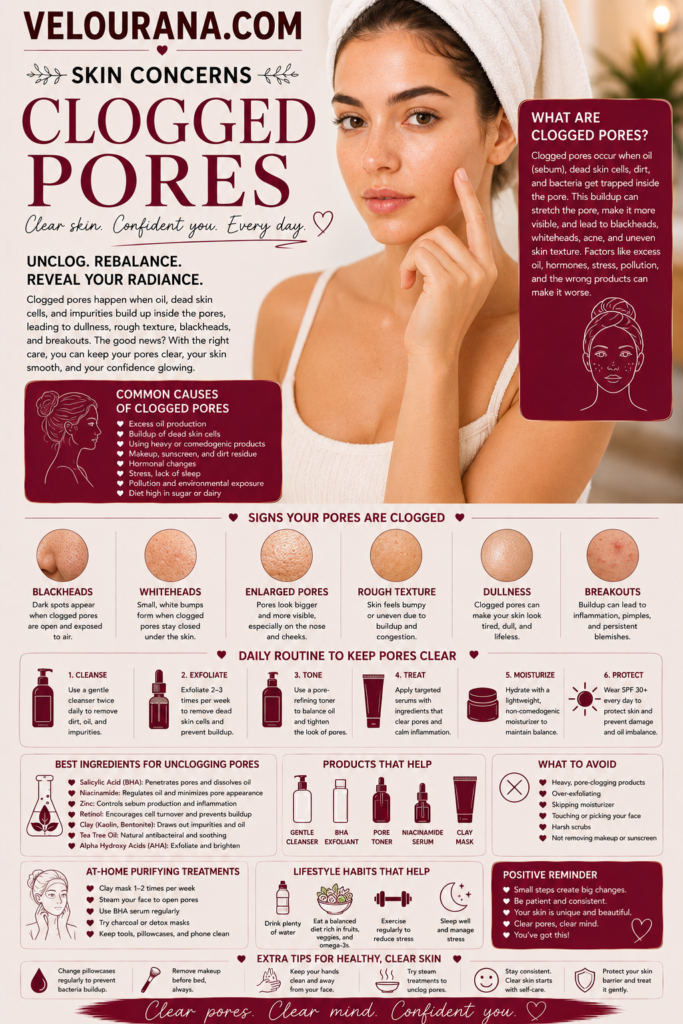
CATEGORY: Clogged Pores
Clogged pores are often described as though they are miniature containers that have simply become filled with something undesirable. Oil, dirt, dead skin cells, makeup and environmental residue are imagined gathering inside an empty opening until the pore becomes blocked. From that picture, the solution seems obvious: cleanse more thoroughly, exfoliate more aggressively, extract more completely and somehow keep the pore empty afterward.
The biology is less mechanical.
A pore is not an unused cavity waiting to become dirty. It is the visible opening of a functioning follicular structure. Sebum is continually produced. Cells are continually renewed. Material is continually moving through the follicular canal toward the surface. Congestion develops when this process becomes disrupted and keratinous material mixes with sebum in a way that obstructs the follicle.
That difference matters because it changes the entire philosophy of pore care.
If clogged pores were simply dirty holes, increasingly powerful cleansing would solve the problem. If they are the visible result of an ongoing biological process, then successful treatment has to influence that process over time.
This is why someone can cleanse carefully every morning and evening yet still develop congestion. It is why a pore can appear perfectly clear after extraction and become visibly filled again weeks later. It is why oily skin can remain congested despite being repeatedly stripped of surface oil. It is also why some of the most aggressive pore routines produce the least stable skin.
The goal is not to empty every follicle and somehow prevent it from functioning again.
The goal is to reduce the tendency toward obstruction while keeping the surrounding skin healthy enough to tolerate consistent treatment.
Once clogged pores are understood in this way, they stop looking like evidence that the face is unclean. They become something much more useful: a visible clue about the way particular follicles are behaving.
What a Clogged Pore Actually Is
The structures commonly referred to as pores are associated with hair follicles and sebaceous glands.
Sebaceous glands produce sebum, an oily substance that contributes to lubrication and the surface environment of the skin. At the same time, cells associated with the follicular lining are continually undergoing renewal.
Under ordinary conditions, these materials move outward.
Congestion develops when keratinous material accumulates within the follicular canal together with sebum.
The earliest stage may be microscopic.
Nothing necessarily looks unusual from the outside.
As the obstruction becomes more developed, it can appear as a comedone.
If the opening remains closed beneath the surface, the result may be a small flesh-coloured or whitish bump commonly called a whitehead.
If the opening is exposed, the lesion can become an open comedo, commonly called a blackhead.
Both begin with the same fundamental problem: follicular obstruction.
This is why the phrase clogged pores describes a process more accurately than it describes one particular appearance.
Congestion may look dark.
It may look pale.
It may appear as small bumps.
It may create a rough, uneven texture before individual lesions become visually obvious.
Understanding these different presentations prevents pore care from becoming focused exclusively on the nose or on anything visibly dark.
The problem is not the colour.
It is the obstruction.
Why Clogged Pores Are Not Simply Dirt
The dark appearance of a blackhead has created one of skincare's most persistent misconceptions.
It looks dirty.
Therefore, the natural conclusion is that the pore contains dirt.
The assumption feels so intuitive that people often respond by increasing cleansing.
But the dark colour of an open comedo is not evidence that the person has failed to wash their face.
The material exposed at the follicular opening undergoes oxidation and contains pigment, giving the surface its darker appearance.
This distinction matters practically.
A cleanser can remove surface residue, oil, makeup and sunscreen.
It cannot simply wash away a deeply formed comedonal plug every time the face is cleaned.
This is why the person with clogged pores should not automatically ask, "How can I cleanse harder?"
A better question is, "Why is material accumulating inside these follicles?"
That shift directs attention toward the mechanisms that actually matter.
Sebum Is Necessary, Even When It Contributes to Congestion
Oil is often treated as the enemy of clear pores.
This makes sense visually.
Congested skin is frequently oily, and sebaceous material forms part of the follicular plug.
But sebum is not contamination.
It is a normal biological secretion.
The problem is not simply that sebum exists.
The problem is how sebum interacts with keratinous material inside follicles that are susceptible to becoming obstructed.
This distinction prevents one of the most common mistakes in clogged-pore skincare: trying to eliminate every trace of oil.
Strong cleansers, repeated washing, alcohol-heavy toners, mattifying products and clay masks may temporarily reduce surface shine.
The skin looks less oily.
The underlying tendency toward congestion may remain almost unchanged.
Sebaceous glands continue functioning.
Oil returns.
The person concludes that the treatment was not strong enough.
Another stripping product is added.
The cycle continues.
The face can eventually become simultaneously oily and irritated.
This is not unusual.
Surface oil production and barrier hydration are different processes.
A face can continue producing sebum while also becoming dehydrated and uncomfortable.
That combination can make pore care significantly more difficult because the person sees the oil and responds to it, while the skin is already signaling that the routine has become too harsh.
Why Some Areas Clog More Easily Than Others
Clogged pores rarely appear evenly across the face.
The nose is often the most obvious area.
The forehead and chin can also become congested.
The outer cheeks may remain relatively clear.
This distribution reflects differences in sebaceous activity and follicular characteristics.
The central face tends to contain more active sebaceous structures, which helps explain why the so-called T-zone often becomes oilier.
This regional variation is important because the entire face does not always need to be treated identically.
A salicylic-acid product may be comfortable on an oily forehead while the cheeks become irritated from the same frequency.
A rich moisturizer may feel appropriate on the outer face but unnecessarily heavy around the nose.
This does not mean everyone needs an elaborate zoning routine.
It simply means skin type can vary across one face.
Clogged-pore care becomes more intelligent when it respects that reality.
Genetics Helps Explain Why Some Skin Congests So Easily
Two people can use similar products, live in the same climate and maintain comparable hygiene while experiencing completely different levels of congestion.
This is because pore behaviour is not determined by skincare alone.
Genetic differences influence sebaceous activity, follicular characteristics and acne susceptibility.
Some skin simply has a stronger tendency toward comedone formation.
This can be frustrating because skincare culture often implies that clear pores are a reward for doing everything correctly.
When congestion remains, the person assumes they must have made a mistake.
But biology creates different baselines.
One person may tolerate rich products without developing significant congestion.
Another may develop closed comedones after relatively small changes in formulation.
The second person has not necessarily failed at skincare.
Their follicles behave differently.
This is why copying another person's routine product for product often produces disappointing results.
The products may be identical.
The skin is not.
Hormones Can Change the Way Pores Behave
The skin does not exist independently from the body.
Hormonal signals influence sebaceous glands and acne-related processes.
This becomes especially obvious during puberty, but hormonal influence can remain relevant throughout adulthood.
Some people experience periods when congestion suddenly becomes more noticeable despite no obvious change in skincare.
The routine is the same.
The skin is not.
Hormonal fluctuations can alter oil production and the tendency toward acne.
This is particularly important when clogged pores occur alongside other forms of acne.
A routine aimed solely at cleaning the surface may fail because the underlying driver is partly internal.
This does not mean every clogged pore should be diagnosed as hormonal.
It means persistent or suddenly changing acne patterns deserve a broader perspective than cosmetics alone.
The Nose Is Often Misunderstood Because of Sebaceous Filaments
One of the most important distinctions in pore care concerns sebaceous filaments.
These are normal structures associated with follicles that help channel sebum toward the skin surface.
They are particularly visible on the nose.
Under bright lighting or magnification, they can appear as tiny grey, yellowish or darker dots.
Because they resemble miniature blackheads, they are frequently treated as though they are clogged pores requiring extraction.
This creates a frustrating cycle.
The material is squeezed out.
The nose looks clearer.
Several days later, the dots reappear.
The person assumes the pores have become clogged again.
More extraction follows.
But if the structures were sebaceous filaments, their return is simply evidence that the follicles continue functioning.
This distinction changes expectations dramatically.
A nose with visible sebaceous filaments is not necessarily congested.
It may simply be a nose.
True blackheads can coexist with them, which makes visual diagnosis imperfect.
But learning that not every dot requires removal can prevent a great deal of unnecessary trauma.
Why Pores Cannot Be Permanently Emptied
The fantasy behind many pore treatments is the permanently empty follicle.
No oil.
No keratin.
No visible filament.
Nothing at the opening.
But an active sebaceous follicle does not remain empty.
Sebum continues to be produced.
Cells continue to turn over.
Material continues to move.
This is normal physiology.
A successful clogged-pore routine therefore does not create permanent emptiness.
It changes the probability of obstruction.
That is a subtler goal.
Fewer comedones form.
Existing congestion resolves more gradually.
The skin texture becomes more even.
Extraction becomes less necessary.
The pores remain because they belong there.
Once this becomes the definition of success, pore care becomes far more realistic.
Cleansing Matters, but Only Within Its Proper Role
A good cleanser is important for congested skin.
It removes surface oil, sweat, sunscreen, cosmetics and environmental residue.
This prevents unnecessary accumulation on the surface and prepares the skin for other treatments.
But cleansing has a limited biological reach.
A cleanser cannot permanently regulate follicular keratinization.
It cannot stop sebaceous glands from producing oil.
It cannot guarantee that a microscopic comedo will never form.
This is why stronger cleansing eventually reaches a point of diminishing returns.
The face may feel cleaner.
The pores may not actually become less prone to clogging.
The ideal cleanser should therefore be effective enough to remove what belongs on the surface without leaving the skin chronically tight or irritated.
A feeling of squeaky cleanliness is not evidence that deeper congestion has been solved.
Double Cleansing Can Be Useful When There Is Something to Remove
Double cleansing is often presented as an essential ritual for clogged pores.
It is not universally necessary.
But it can be useful when someone wears long-wear makeup, heavy sunscreen or products that are difficult to remove with one cleanser.
An oil-based or balm cleanser can dissolve these materials, followed by a water-based cleanser to remove remaining residue.
The goal is complete removal.
It is not to cleanse twice for the sake of intensity.
Someone wearing little on the skin may find a single cleanser entirely sufficient.
Again, the routine should respond to reality rather than ritual.
Salicylic Acid Fits the Biology of Congested Skin
Among the ingredients associated with clogged pores, salicylic acid is particularly relevant.
Its exfoliating action makes it useful for comedonal acne, including blackheads and whiteheads.
This is why it appears in so many pore-focused products.
But popularity creates duplication.
A person may unknowingly use salicylic acid in the cleanser, toner, serum and mask.
The routine becomes saturated with one mechanism.
The skin becomes irritated.
Congestion remains.
The conclusion is that salicylic acid "does not work."
The real problem may be how it was used.
A well-formulated salicylic-acid product used at a tolerable frequency may be enough.
More is not automatically better.
The goal is gradual reduction of obstruction, not maximal exfoliation.
Retinoids Address the Tendency to Clog Rather Than Just the Visible Plug
Retinoids are especially important when clogged pores are persistent because they influence processes involved in comedone formation.
This shifts the strategy upstream.
Instead of waiting until a pore becomes visibly blocked, treatment aims to reduce the tendency toward abnormal follicular accumulation.
This is prevention rather than extraction.
The change is gradual.
Existing clogged pores do not vanish immediately.
The value becomes apparent over time as fewer new lesions develop and the overall texture becomes more stable.
Retinoids can cause dryness and irritation, especially during introduction.
This is why frequency, formulation and barrier support matter.
Pregnancy and plans for pregnancy require particular caution because certain retinoids should not be used.
Professional guidance becomes important when stronger treatment is needed or when the skin is difficult to manage.
Alpha Hydroxy Acids Can Support Texture but Should Not Be Confused With Deeper Pore Control
Glycolic acid and other alpha hydroxy acids are widely used to smooth surface texture and support exfoliation.
They can contribute to a clearer-looking complexion.
But surface smoothness and follicular congestion are not identical concerns.
Someone may use a strong glycolic-acid product and see immediate improvement in roughness while blackheads remain.
This does not necessarily mean the acid failed.
It may simply be performing a different function.
The danger arises when the person increases exfoliation repeatedly in an attempt to force a deeper result.
The skin becomes irritated.
The pores remain visible.
A useful product has been pushed beyond the role it was suited to perform.
The Problem With Stacking Exfoliants
Modern skincare makes it easy to use multiple exfoliating products without thinking of them as one combined system.
A salicylic cleanser.
A glycolic toner.
A retinoid.
An exfoliating mask.
A scrub.
Each product is marketed differently.
The skin experiences cumulative stress.
This is why ingredient combinations need strategy.
The question is not simply whether each product is effective.
The question is whether the routine as a whole remains tolerable.
A clogged pore does not clear faster because the surrounding skin has become inflamed.
Barrier Health Determines How Long Treatment Can Continue
The skin barrier is sometimes treated as a separate concern from clogged pores.
In practice, the two are connected through treatment tolerance.
A damaged barrier can make salicylic acid sting.
Retinoids become harder to use.
Sunscreen becomes uncomfortable.
Moisturizer burns.
The routine becomes unstable.
Products are stopped and restarted.
New products are introduced before old ones have been evaluated.
Consistency disappears.
Barrier support therefore contributes indirectly to clearer pores.
It allows the treatment that actually addresses congestion to remain part of the routine.
Moisturizer Does Not Automatically Clog Pores
People with congested skin often become suspicious of moisturizer.
If pores contain oil, adding a cream seems contradictory.
But moisturizer and sebum are not the same thing.
A moisturizer is a formulation designed to support hydration and barrier function.
Some formulations are heavier.
Others are lightweight.
Some people tolerate rich creams perfectly well.
Others prefer gels or fluid lotions.
The relevant question is not whether moisturizer as a category causes clogged pores.
It is whether a particular formulation suits the particular skin using it.
Fear of moisturizer can lead to chronic dryness and irritation, which makes active treatment harder to sustain.
Sunscreen Can Be Part of the Congestion Problem or Part of the Solution Depending on Formulation
Sunscreen is essential for protecting the skin from ultraviolet exposure, but people with congested skin sometimes struggle with its texture.
Heavy formulations can feel occlusive.
This can lead to the conclusion that sunscreen causes clogged pores universally.
The better approach is formulation matching.
Lightweight fluids, gels and oil-control formulas may feel more comfortable for oily skin.
Drier skin may prefer richer textures.
The goal is to find effective protection that integrates into the routine without creating a heavy, uncomfortable layer.
Avoiding sunscreen entirely is not a good long-term solution.
Makeup Is Not Automatically the Cause
Foundation often becomes the first suspect when pores clog.
Sometimes the suspicion is justified.
A particular formulation may feel too heavy or coincide with increased congestion.
But makeup does not automatically create comedones in every person.
The complete formulation matters.
Removal matters.
Individual susceptibility matters.
Someone can use makeup daily without significant congestion if the products suit the skin and are removed adequately.
The intelligent approach is observation rather than blanket blame.
Hair Products Can Create Congestion Outside the Skincare Routine
Clogged pores around the forehead or temples sometimes have little to do with facial skincare.
Hair oils, pomades, leave-in treatments and styling creams can repeatedly contact nearby skin.
This can create a distinct pattern of bumps or comedones in susceptible people.
The clue is distribution.
If congestion clusters near the hairline, review what touches that area.
Sometimes the solution is not another facial serum.
It is keeping a heavy hair product away from the face.
Occlusion and Friction Can Change Follicular Behaviour
Helmets, masks, chin straps and other equipment can create a combination of friction, heat, sweat and occlusion.
For some skin, this contributes to follicular congestion or acne-like breakouts.
The response should be practical rather than obsessive.
Keep equipment reasonably clean.
Avoid leaving sweaty, occlusive material pressed against the skin longer than necessary.
Cleanse appropriately afterward.
The skin does not need sterilization.
It needs less repeated stress.
Clay Masks Can Reduce Oiliness Without Permanently Clearing Pores
Clay masks are popular because they create an immediate visual effect.
Oil is absorbed.
The skin looks matte.
The surface feels cleaner.
This can be useful cosmetically.
But a clay mask does not permanently alter the biological processes responsible for comedone formation.
The skin resumes producing sebum afterward.
Congestion can return.
This does not mean the mask is useless.
It means its role should be described honestly.
It is an optional treatment for temporary oil control and surface feel, not a permanent cure for clogged follicles.
Pore Strips Are Visually Satisfying but Temporarily Effective
Pore strips produce one of the most dramatic forms of skincare evidence.
The strip is removed, and material appears attached to it.
This creates the impression that the pores have been deeply cleaned.
Some superficial material may indeed be removed.
But the follicle remains active.
Sebum continues to move.
Sebaceous filaments re-form.
Comedonal tendencies remain.
The result can therefore be temporary.
The danger lies not in using a pore strip occasionally but in expecting it to provide permanent pore control.
Extraction Is Reactive, Not Preventive
Comedone extraction physically removes existing material from a pore.
When performed appropriately, it can provide immediate improvement.
But extraction does not change the long-term tendency toward obstruction.
This is why the same pore can clog again.
Repeated home extraction also carries risks.
Excessive pressure can damage the skin.
Fingernails can create small injuries.
Redness and pigmentation may last longer than the original comedone.
Professional extraction differs because the lesion is assessed before it is treated.
Judgment is as important as the tool.
Pore Vacuums Can Create More Trauma Than Their Results Justify
Suction devices promise to pull material from pores.
They can indeed remove some surface oil and debris.
But they also apply mechanical force to the skin.
Too much suction can create redness, bruising or visible vascular damage.
The device also cannot distinguish a blackhead from a sebaceous filament.
It acts wherever it is placed.
This is why dramatic visual results should not automatically be interpreted as better skincare.
Steaming Does Not Literally Open Pores
The idea that heat opens pores and cold closes them is deeply embedded in beauty culture.
Pores do not function like doors.
Heat can soften surface material and make extraction feel easier.
It can also increase blood flow and make the skin look flushed.
But the pore itself is not opening through a muscular mechanism.
Likewise, cold water may temporarily change skin sensation and vascular appearance, but it does not seal the follicle shut.
Understanding this prevents unnecessary rituals designed around a structure the pore does not possess.
Enlarged Pores and Clogged Pores Are Not the Same Concern
A pore can be visible without being clogged.
This is particularly important because products often market themselves toward both concerns as though they were identical.
Congestion involves obstruction.
Pore visibility can be influenced by sebaceous activity, skin texture, genetics, age and structural changes around the follicle.
A person may successfully reduce blackheads and still see visible pores.
This does not mean the treatment failed.
The follicle has been cleared.
The opening remains because it is anatomical.
Age Can Change the Appearance of Pores Even When Congestion Improves
As skin ages, changes in collagen, elasticity and overall texture can make pores appear more noticeable.
This is different from acne-related obstruction.
A person may therefore believe clogged pores are worsening when the actual issue is changing pore visibility.
This distinction is important because the treatment strategy differs.
More exfoliation is not always the answer.
Broader skincare goals such as sun protection, retinoid use where appropriate and professional treatments for texture may become more relevant.
Climate Can Alter How Congested Skin Feels
Heat and humidity can make oily skin feel heavier.
Sweat increases.
Products may feel more occlusive.
A moisturizer that worked well in winter suddenly feels excessive.
This can make congestion seem worse.
Seasonal adjustment is often useful.
A lighter moisturizer or sunscreen texture may feel better in summer.
Exfoliation frequency may need to change if the skin becomes more sensitive in winter.
The core strategy can remain stable while the supporting products adapt.
Product Hopping Makes Clogged Pores Harder to Understand
Congestion often encourages frequent changes because improvement is slow.
A serum is used for one week.
The pores remain visible.
Another treatment is added.
Two weeks later, a third replaces both.
This makes it almost impossible to determine what is working.
It also exposes the skin to a constant stream of new variables.
A stable routine provides better information.
Clogged pores develop gradually.
Treatment needs enough time to influence that pattern.
Introducing One Active at a Time Creates Cleaner Feedback
When several treatments are introduced simultaneously, any reaction becomes difficult to interpret.
Did the salicylic acid help?
Did the retinoid cause irritation?
Did the moisturizer cause congestion?
Did the sunscreen simply feel heavy?
Changing one major variable at a time creates clearer answers.
This is especially important for congestion-prone skin because irritation and acne can sometimes look similar at first glance.
The Difference Between Purging and Irritation Matters
Some acne treatments can temporarily make existing microcomedones more visible as turnover changes.
This is often called purging.
But the term is frequently overused.
Not every breakout after a new product is a purge.
Burning, itching, swelling and widespread redness suggest irritation rather than healthy adjustment.
New bumps in areas where congestion rarely occurs also deserve caution.
A product should not be defended automatically simply because the skin worsened after it was introduced.
Hydrocolloid Patches Have Limited Relevance to True Clogged Pores
Hydrocolloid patches can be useful for superficial inflammatory lesions that contain fluid.
They are less useful for deeply formed closed comedones or ordinary sebaceous filaments.
This distinction matters because product categories often expand beyond the problems they can realistically address.
A clogged pore needs a treatment appropriate to follicular obstruction.
A patch cannot physically transform every type of lesion simply by covering it.
When Congestion Is Really Acne
Persistent clogged pores often fall within the spectrum of comedonal acne.
This matters because the problem is no longer purely cosmetic.
It becomes a condition that may benefit from established acne treatments.
If blackheads and closed comedones are extensive, persistent or combined with inflammatory lesions, dermatological assessment can be useful.
A professional can identify the acne pattern and recommend appropriate treatment rather than relying on an endless cycle of pore products.
When Congestion Is Not Acne
Not every small bump is a clogged pore.
Milia, folliculitis and other dermatological conditions can resemble comedonal acne.
This is another reason aggressive home extraction is risky.
A person may spend months squeezing something that cannot be removed safely because it was never an ordinary comedo.
Persistent or unusual bumps deserve assessment when the diagnosis is uncertain.
Good skincare begins with knowing what is actually being treated.
Deep or Painful Lesions Require a Different Level of Attention
Clogged pores can progress into inflammatory acne.
When lesions become deep, painful or nodular, home pore care has reached its limit.
The concern is no longer simply surface congestion.
Deeper inflammation increases the risk of scarring.
Professional treatment becomes more important.
There is little value in trying increasingly strong cosmetic products while permanent tissue change develops.
The Best Routine Is Usually Less Dramatic Than Expected
A sustainable clogged-pore routine may be surprisingly simple.
A gentle cleanser.
One appropriate treatment addressing comedonal formation.
Moisturizer according to need.
Sunscreen during the day.
Optional products can be added for specific reasons.
But the routine does not need to become a catalogue of pore-focused treatments.
In fact, simplicity can make the active treatment more effective because the skin remains comfortable enough to use it consistently.
Clearer Pores Require Patience More Than Force
The visual nature of clogged pores makes patience difficult.
A blackhead can be extracted immediately.
A closed comedo may take weeks to resolve with topical treatment.
The fast method feels more satisfying.
The slower method may be more preventive.
This is why successful pore care often involves learning to value changes that are not dramatic.
Fewer new bumps.
Less visible congestion.
Less frequent extraction.
More even texture.
Calmer skin.
These are meaningful outcomes.
A Better Definition of Clear Pores
Clear pores are not empty pores.
They are follicles functioning without significant obstruction.
Sebum is still present.
Cell turnover continues.
Sebaceous filaments remain.
Pores remain visible.
The face still has texture.
The improvement is that abnormal accumulation is reduced.
This definition is biologically realistic.
It also protects the skin from endless attempts to eliminate structures that belong there.
The Most Effective Pore Care Begins With Understanding What Not to Fight
Clogged pores are frustrating because they look like something that should be physically removable.
Sometimes they are.
But their recurrence reveals the deeper truth.
The pore is not an object.
It is part of a living system.
Sebum is being produced.
Cells are being renewed.
Hormonal signals are influencing the follicle.
Products are interacting with the surface.
Climate changes the environment.
Genetics influences susceptibility.
A pore can be emptied today and become congested again later because the biological conditions surrounding it remain active.
This is why the most effective long-term strategy is not permanent extraction.
It is prevention.
Gentle cleansing removes what belongs on the surface.
Salicylic acid, retinoids or other appropriate treatments can address comedonal formation.
Moisturizer keeps the surrounding skin comfortable.
Sunscreen protects the complexion.
Heavy or problematic formulations can be reconsidered when they genuinely coincide with congestion.
Hair products and friction can be evaluated when distribution patterns suggest them.
And professional care becomes appropriate when congestion is persistent, inflammatory or difficult to diagnose.
The routine becomes quieter.
There is less squeezing.
Less scrubbing.
Less obsession with making the nose poreless.
Less temptation to use several exfoliating products simultaneously.
The skin has time to respond.
Gradually, the complexion becomes smoother.
Blackheads become less prominent.
Closed comedones become less frequent.
The surrounding skin becomes calmer.
The pores remain visible because pores are supposed to remain visible.
What changes is their behaviour.
That is the more useful definition of clear skin.
Not skin from which every follicle has disappeared, but skin in which those follicles are functioning with less obstruction and less inflammation.
Once clogged pores are understood this way, skincare becomes less about fighting the existence of the pore and more about helping it function normally.
And that is ultimately the difference between temporarily emptying a follicle and genuinely improving congestion.
The End Velourana
 Discover More From Our Family of Websites
 ZodiacBearing (Astrology, Tarot, Numerology, Angel Numbers & Spiritual Guidance)
 Velourana (Beauty, Makeup, Hair Care, Skincare & Beauty Tips)
 HavenBearing (Home, Living, Organization, Décor & Everyday Inspiration)
 PawBearing (Pet Care, Dog Breeds, Animal Health, Training & Pet Products)
 PsyCatherine (Notes From the Journal of a Psychologist on Real Life)

