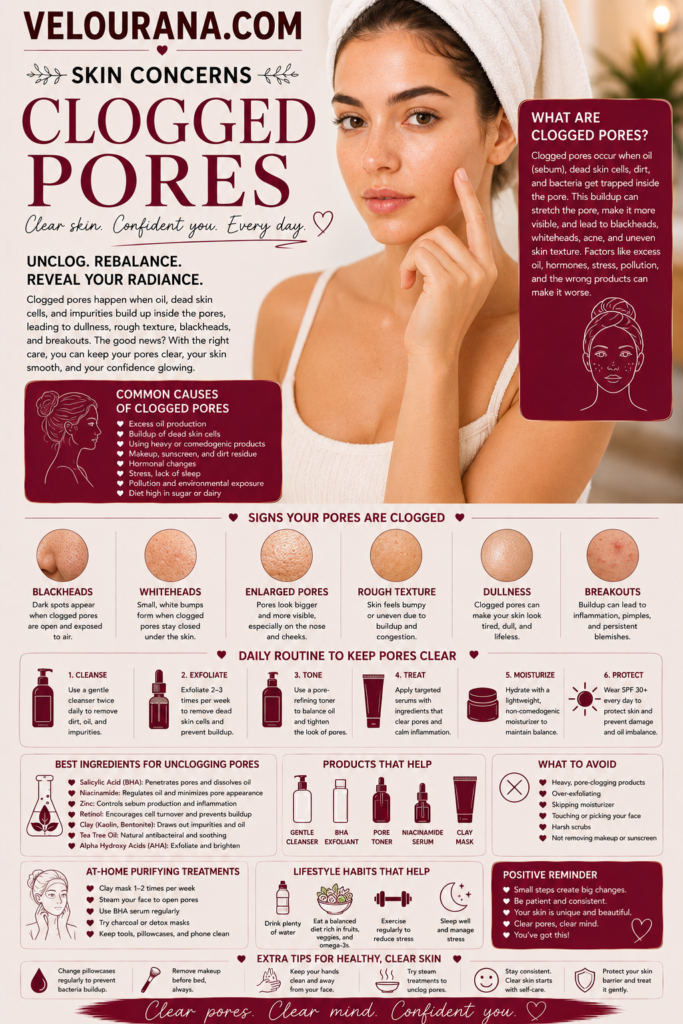
CATEGORY: Clogged Pores
Clogged pores are often approached as though they belong entirely within the world of cosmetics.
A person notices blackheads, flesh-coloured bumps or uneven texture and begins adjusting the skincare routine. A salicylic-acid product is introduced. A stronger cleanser follows. Retinoids are considered. Masks, pore strips and extraction tools appear. Sometimes the skin improves. Sometimes it improves only partially. And sometimes the routine becomes increasingly complex while the congestion remains almost exactly where it started.
This is the point at which clogged pores become more than a product-selection problem.
Persistent congestion can reflect comedonal acne, a stronger tendency toward abnormal follicular keratinization, hormonal influences, occlusive exposures or conditions that resemble clogged pores without actually being ordinary comedones. Home skincare can influence many of these problems, but it also has limits.
Those limits are easy to miss because clogged pores rarely look dramatic.
A blackhead is small.
A cluster of closed comedones is usually painless.
The skin may not be inflamed enough to feel medically important.
So the person keeps experimenting.
But there is no requirement for acne to become severe before professional care becomes reasonable.
In many cases, a dermatologist becomes valuable precisely because the skin has reached a plateau: the diagnosis is uncertain, the treatment is not producing enough improvement, or the routine is causing more irritation than clarity.
Professional treatment does not replace sensible skincare.
It clarifies it.
And sometimes that is the most important change of all.
Persistent Congestion Is Not Always a Sign That the Products Are Too Weak
When clogged pores remain, the most common assumption is that treatment needs to become stronger.
A higher acid concentration.
A stronger retinoid.
More frequent exfoliation.
A more aggressive cleanser.
The problem is that persistence does not reveal the cause.
The pores may be genuinely resistant to the current treatment.
Or the bumps may not be comedones.
Or the routine may be inconsistent.
Or the skin may be too irritated for the active treatment to be used effectively.
Or an external factor may continue recreating the problem.
Without diagnosis, stronger treatment is only one possibility among several.
This is why professional assessment can be more useful than simply increasing intensity.
A dermatologist can determine whether the pattern is truly comedonal acne and whether the treatment mechanism is appropriate.
Strength should come after understanding.
Comedonal Acne Exists on a Spectrum
Clogged pores can be mild.
A few blackheads around the nose.
Several closed comedones on the chin.
Minimal inflammation.
This may respond well to a simple routine.
But comedonal acne can also become widespread.
The forehead may be covered with hundreds of small bumps.
The cheeks may develop persistent closed comedones.
Blackheads may cluster across multiple areas.
Inflammatory lesions may develop from the same underlying follicular process.
At that point, the problem becomes more than occasional congestion.
It becomes a pattern.
This is where prescription treatment may become more efficient than adding more over-the-counter products.
The severity of acne is not determined only by how dramatic one individual lesion looks.
Distribution, persistence and response to treatment matter too.
When Closed Comedones Refuse to Improve
Closed comedones are particularly resistant to casual home treatment because the obstruction remains beneath an intact surface.
They cannot be easily extracted.
Pore strips do little.
Suction devices are poorly matched to them.
Clay masks affect surface oil more than the obstruction itself.
Exfoliating acids may help, but some cases improve only partially.
Retinoids often become especially relevant because they address comedone formation at the follicular level.
Over-the-counter retinoid options can be useful in some countries and circumstances.
Prescription retinoids can provide stronger treatment when appropriate.
The important point is not that every closed comedone requires prescription medication.
It is that persistent closed comedones may require a treatment strategy different from repeated superficial exfoliation.
Why Prescription Retinoids Can Change the Pattern
Prescription retinoids are among the most important treatments for comedonal acne because they influence follicular keratinization and reduce microcomedone formation.
This is important conceptually.
The target is not only the bump visible today.
It is the process that creates tomorrow's bump.
This is why the improvement is gradual.
Existing comedones need time to resolve.
The early weeks may include dryness or irritation.
But when the treatment is appropriate and tolerated, the long-term effect can be much more meaningful than periodic extraction.
The goal is fewer lesions forming in the first place.
Professional guidance becomes particularly valuable for managing strength, frequency and tolerability.
Pregnancy and plans for pregnancy require special caution because certain retinoids should not be used.
This is one area where medical advice should replace self-experimentation.
Stronger Treatment Requires Better Barrier Management
Prescription treatment is not automatically better simply because it is stronger.
A stronger active ingredient can also create more irritation if the surrounding routine is poorly designed.
This is why dermatological treatment often includes instructions about cleanser choice, moisturizer use and gradual introduction.
The objective is not to create maximum dryness.
It is to create a treatment the skin can continue using.
This is a recurring principle in clogged-pore care.
The strongest possible routine is rarely the most useful routine.
The best routine is the one that changes the comedonal pattern without repeatedly destroying the tolerance needed to maintain it.
Professional Extraction Has a Different Purpose From Home Squeezing
Comedone extraction can be useful when performed professionally.
The value is not simply that the professional owns a metal tool.
The value is lesion selection.
A trained practitioner can identify which comedones are suitable for extraction, prepare the skin appropriately and use controlled technique.
This matters especially for closed comedones.
Some may require careful opening before material can be removed.
Attempting this at home increases the risk of injury, bleeding, inflammation and pigmentation.
Professional extraction is not a cure.
It is a way to remove selected existing lesions while a preventive routine addresses the underlying tendency.
Used this way, extraction becomes a bridge rather than a cycle.
When Home Extraction Becomes a Sign That the Routine Needs Reassessment
If someone feels compelled to extract the same areas every week, the problem may no longer be individual clogged pores.
The preventive strategy may be inadequate.
This is an important clue.
Occasional blackhead removal is one thing.
A routine that depends on frequent squeezing, pore strips or tools to remain clear suggests that the underlying follicular process is still active.
The response should not necessarily be more extraction.
It may be time to reconsider the treatment plan itself.
A Dermatologist Can Distinguish Comedones From Milia
Milia are a common source of confusion.
They appear as small, firm, pale bumps and can resemble closed comedones.
But they are tiny keratin-filled cysts rather than ordinary acne lesions.
They often occur around the eyes and upper cheeks.
They do not respond to acne treatment in the same way as comedones.
Aggressive squeezing is especially unhelpful because the material is trapped beneath the surface.
Professional removal may be appropriate in selected cases.
This is a perfect example of why diagnosis matters.
If a bump has been treated as a clogged pore for six months without changing, the problem may not be stubborn congestion.
It may be a different lesion entirely.
Folliculitis Can Masquerade as Clogged Pores
Folliculitis can create clusters of small bumps that resemble acne.
Some forms involve bacteria.
Others may be associated with yeast.
The lesions can sometimes be itchy or unusually uniform.
This pattern differs from classic comedonal acne.
If someone repeatedly exfoliates presumed clogged pores but the bumps remain, diagnosis should be reconsidered.
The treatment for folliculitis can differ substantially from the treatment for comedones.
More salicylic acid is not always the answer.
Fungal Acne Is a Popular Phrase but Often Misused
The phrase fungal acne has become widespread online.
In many cases, what people mean is Malassezia folliculitis, a condition involving yeast within hair follicles.
It can resemble acne but is not identical to ordinary comedonal acne.
This distinction matters because self-diagnosis based on photographs or social-media checklists can be unreliable.
A person may eliminate dozens of products or begin antifungal treatment unnecessarily.
Professional assessment is more useful when the pattern is unusual, itchy, monomorphic or resistant to ordinary acne treatment.
Sebaceous Hyperplasia Can Be Mistaken for Persistent Clogged Pores
Sebaceous hyperplasia produces small, often yellowish or skin-coloured bumps caused by enlarged sebaceous glands.
They can appear on the forehead, cheeks and other areas of the face.
To an untrained eye, they may resemble clogged pores.
But they do not behave like ordinary comedones.
Repeated squeezing usually does not solve them.
Professional treatments such as electrocautery, laser or other procedures may be considered depending on the case.
Again, the lesson is the same.
Not every bump should be forced into the category of clogged pores.
Persistent Texture Around the Eyes Needs Special Caution
The eye area is delicate.
Small bumps there are frequently assumed to be clogged pores and treated with strong acids or retinoids.
This can create irritation.
Milia are common around the eyes.
Other benign lesions can also appear there.
Because the skin is thin and sensitive, aggressive self-treatment is particularly risky.
Professional identification is preferable when the diagnosis is uncertain.
When Congestion Becomes Inflamed
Comedones do not always remain non-inflammatory.
A closed pore can progress into a red papule or pustule.
This changes the treatment priorities.
Once inflammation becomes significant, the goal is no longer only to clear the obstruction.
The inflammatory component needs to be controlled as well.
This may involve benzoyl peroxide, topical antibiotics in appropriate combinations, prescription retinoids or other therapies depending on severity.
A dermatologist can determine which combination makes sense.
This is another reason persistent clogged pores should not be viewed in isolation when inflammatory acne is developing around them.
Deep Lesions Change the Risk Profile
Blackheads and closed comedones can be cosmetically frustrating.
Deep nodules are different.
They are more painful.
They involve deeper inflammation.
They carry a greater risk of permanent scarring.
When a clogged-pore pattern begins progressing into deeper lesions, the threshold for professional care should become lower.
Continuing to experiment with cosmetic exfoliants while scarring develops is inefficient.
The objective should shift from texture refinement to disease control.
Scarring Is One of the Clearest Signals to Seek Help
Once acne is leaving permanent textural changes, home skincare has reached an important limit.
Topical products can help prevent future acne.
They may improve overall tone and texture.
But established deep acne scars often require procedures.
Preventing further scars is easier than trying to correct them later.
This makes early treatment of significant inflammatory acne particularly important.
A small comedonal problem should not be allowed to evolve into a structural one simply because the original lesions looked minor.
Pigmentation Can Also Justify Earlier Intervention
Even when scarring is not occurring, clogged pores that repeatedly become inflamed can leave persistent dark marks.
For people prone to post-inflammatory hyperpigmentation, the visible burden can accumulate quickly.
A single pimple resolves.
The mark remains.
Another lesion appears nearby.
Another mark forms.
The active acne may be moderate, but the complexion begins to look persistently uneven.
Preventing new inflammatory lesions becomes one of the most effective pigment strategies.
This is another reason professional acne control can improve more than the acne itself.
Hormonal Patterns Often Need More Than Surface Treatment
Some persistent acne patterns have a hormonal component.
This is particularly relevant in adults with recurring lower-face breakouts, changes associated with the menstrual cycle or other hormonal symptoms.
Topical skincare can still help.
But it may not fully control the pattern.
Professional assessment can open additional treatment options depending on the individual's circumstances.
This is where clogged-pore care clearly exceeds the limits of cosmetics alone.
The follicle is responding partly to internal signals.
The treatment may need to do the same.
Sudden-Onset Congestion Should Not Automatically Be Treated as Ordinary Acne
A person who has had clear skin for years and suddenly develops widespread bumps deserves a different level of curiosity.
Medication changes can affect the skin.
Hormonal shifts can alter sebaceous activity.
New occupational exposures can contribute.
Cosmetics may be relevant.
Underlying dermatological conditions may mimic acne.
The important point is not to assume that sudden texture change always means the pores simply need stronger exfoliation.
A new pattern deserves assessment, especially when it is extensive or persistent.
Medication-Related Acneiform Eruptions Need Diagnosis
Certain medications can produce acne-like eruptions.
These may look similar to ordinary acne but have a different cause.
If a sudden breakout coincides with a new medication, the prescribing clinician should be informed.
The medication should not be stopped without professional guidance.
This is another area where home skincare has obvious limits.
A serum cannot solve a systemic trigger without addressing the trigger itself.
Occupational Exposure Can Create Persistent Follicular Problems
Some work environments involve oils, greases, occlusive equipment, heat or repeated friction.
These exposures can contribute to acneiform eruptions or follicular congestion.
If the pattern consistently follows areas of occupational contact, product treatment alone may not be enough.
Protective strategies and changes in exposure may be needed where possible.
The skin often reveals the environment it repeatedly encounters.
Professional Chemical Peels Can Offer More Controlled Exfoliation
Chemical peels performed professionally can be useful in selected cases of comedonal acne and uneven texture.
They differ from casual home exfoliation in concentration, technique and supervision.
The practitioner can choose the appropriate acid and strength according to skin type and condition.
This matters particularly for people prone to pigmentation.
Aggressive peeling can cause inflammation and post-inflammatory hyperpigmentation when poorly chosen.
Professional treatment should therefore be individualized rather than simply stronger.
Microneedling Is Not a Primary Treatment for Active Clogged Pores
Microneedling is commonly associated with acne because it can help improve certain types of acne scarring.
But it is not a primary treatment for active comedonal acne.
Performing procedures on actively inflamed or poorly controlled acne can be inappropriate.
The acne should generally be addressed first.
Then residual textural changes can be evaluated separately.
This distinction prevents people from jumping too quickly from pore care to procedures without controlling the underlying condition.
Laser Treatments Are Usually About Texture, Redness or Scarring Rather Than Ordinary Comedones
Laser technology has many dermatological uses.
But ordinary clogged pores generally do not require laser treatment simply because they are visible.
Lasers may be used for acne scarring, redness, pigmentation or broader skin rejuvenation depending on the technology and case.
The correct procedure depends on the problem.
A person with persistent comedones needs acne treatment.
A person with scarring needs scar treatment.
These categories can overlap, but they should not be confused.
Professional Facials Can Help but Should Not Replace a Treatment Plan
Facials can provide cleansing, extraction and cosmetic refinement.
For mild congestion, this can be useful.
But recurring comedonal acne requires ongoing management.
A facial performed once every month cannot permanently override follicular biology.
If the skin clears after every facial and becomes congested again before the next one, the preventive routine deserves attention.
Professional cosmetic care works best when it complements a stable home strategy.
The Difference Between an Aesthetician and a Dermatologist Matters
Both professionals can play useful roles.
An experienced aesthetician may perform facials, extraction and cosmetic treatments.
A dermatologist is a medical doctor who can diagnose skin disease and prescribe medication.
When the concern is mild cosmetic congestion, aesthetic care may be sufficient.
When the diagnosis is uncertain, the acne is persistent, inflammatory or scarring, dermatological assessment becomes more important.
Choosing the right professional is part of choosing the right treatment.
Patch Testing Becomes More Important as Treatments Become Stronger
Professional procedures and prescription treatments can be powerful.
They also require greater respect for irritation risk.
Skin tone, sensitivity and history of pigmentation matter.
A treatment suitable for one person may be inappropriate for another.
This is why professional care should be individualized rather than simply intensified.
Strength without context is not sophistication.
The Best Dermatological Plan May Be Simpler Than the Existing Routine
People often expect a dermatologist to prescribe a complicated regimen.
Sometimes the opposite happens.
A single prescription retinoid replaces several exfoliating serums.
A gentle cleanser replaces two active cleansers.
A basic moisturizer supports treatment.
Sunscreen becomes consistent.
The routine becomes shorter.
The treatment becomes stronger in the one place that matters.
This is an important lesson.
Professional care can reduce product overload rather than adding to it.
Consistency Still Matters Even With Prescription Treatment
Prescription treatment does not remove the need for patience.
Retinoids still take time.
Irritation still needs management.
Comedones still resolve gradually.
The difference is that the treatment is more specifically matched to the condition.
This is why expectations should remain realistic.
A dermatologist can improve the strategy.
They cannot make follicular biology operate overnight.
Professional Care Can Help Set a Realistic Endpoint
One of the hidden benefits of expert assessment is learning what does not need treatment.
A dermatologist may explain that some visible dots are sebaceous filaments.
Some pores are simply anatomically prominent.
Some texture is normal.
This can prevent endless escalation.
The person learns where pathology ends and normal skin begins.
That distinction is invaluable.
When the Goal Should Shift From Eradication to Maintenance
Once congestion is well controlled, treatment often moves into maintenance.
This may involve continued retinoid use.
Salicylic acid may remain part of the routine.
Extraction becomes less frequent.
The focus changes from clearing existing lesions to preventing recurrence.
This is an important transition.
A maintenance routine is not evidence that the condition remains uncontrolled.
It is how control is preserved.
Maintenance Is Especially Important for Naturally Comedone-Prone Skin
Some people remain naturally susceptible to clogged pores.
Genetics and sebaceous activity do not disappear after treatment.
This means maintenance may need to continue long term.
The routine can become gentler once the skin is stable.
But abandoning everything immediately after improvement may allow the previous pattern to return.
Long-term management should therefore be judged by sustainability.
The best plan is one the person can realistically continue.
A Dermatologist Can Also Help With the Aftermath
Once active congestion is controlled, residual problems may remain.
Pigmentation.
Redness.
Scars.
Uneven texture.
These concerns require different treatments from the clogged pores themselves.
Professional assessment can help sequence the priorities.
Control the acne first.
Then address what remains.
This order is more efficient than performing procedures while new lesions continue forming.
The Cost of Endless Experimentation Can Exceed the Cost of One Good Consultation
There is a practical side to professional care.
Months of product experimentation can become expensive.
Multiple serums.
Masks.
Extraction devices.
Peels.
Pore tools.
New moisturizers.
New sunscreens.
If the diagnosis remains uncertain, the spending continues without a clear endpoint.
A professional consultation can sometimes reduce that uncertainty quickly.
This does not guarantee that treatment will be inexpensive.
But it can make the spending more purposeful.
When Home Skincare Is Still Enough
Professional care is not necessary for every clogged pore.
Mild blackheads and occasional closed comedones often respond well to a consistent over-the-counter routine.
A gentle cleanser.
An appropriate comedonal treatment.
Moisturizer.
Sunscreen.
Reduced picking.
Enough time.
The threshold for professional care should be based on persistence, severity, uncertainty and impact rather than fear.
Home skincare remains valuable.
The goal is simply to recognize when it has reached its useful limit.
The Most Important Question Is Whether the Pattern Is Changing
Whether treatment is home-based or professional, the outcome should be judged over time.
Are fewer comedones forming?
Is the forehead smoother?
Are blackheads less obvious?
Is extraction needed less often?
Are inflammatory lesions decreasing?
Is the skin tolerating treatment better?
These questions reveal whether the strategy is working.
One bad week does not define the outcome.
Neither does one good facial.
The pattern matters.
Professional Treatment Should Reduce Confusion, Not Add More
The ideal result of professional care is not simply a prescription.
It is clarity.
What are the lesions?
What is causing them?
Which treatment addresses the mechanism?
Which products are unnecessary?
Which symptoms indicate irritation?
How long should improvement reasonably take?
What should happen if the condition does not respond?
These answers transform skincare from experimentation into management.
That is often the greatest value of expert care.
Knowing When Home Care Has Reached Its Limit Is Part of Good Skincare
There is a tendency to view professional treatment as the final stage, something reserved for severe skin disease after every cosmetic option has failed.
Clogged pores do not need to reach that point.
If the congestion is persistent, widespread or difficult to identify, professional evaluation can be useful early.
If inflammatory acne is developing, earlier treatment can reduce the risk of marks and scars.
If the routine has become so complicated that the skin is chronically irritated, simplification under guidance may be more effective than another product.
If the bumps are not behaving like comedones, diagnosis becomes more important than exfoliation.
These are not failures of home care.
They are the natural boundaries of what home care can reasonably do.
Clearer Pores Sometimes Begin With a Better Diagnosis
The greatest mistake in clogged-pore care is not always choosing the wrong product.
Sometimes it is treating the wrong problem.
A bump called a clogged pore may be a comedone.
It may be milia.
It may be folliculitis.
It may be sebaceous hyperplasia.
A dark dot may be a blackhead.
It may be a sebaceous filament.
A rough surface may be congestion.
It may be irritation.
These distinctions change everything.
They change the treatment.
They change the timeline.
They change what should be extracted and what should be left alone.
They change whether a cosmetic product is appropriate or whether medical care is more useful.
This is why professional treatment matters most not when it is simply stronger, but when it is more accurate.
The ultimate goal remains the same as it is in good home skincare: fewer true obstructions, calmer surrounding skin, less inflammation, less picking and a routine that can be maintained without constant intervention.
Sometimes that can be achieved entirely at home.
Sometimes the follicles need more targeted treatment.
And sometimes what looked like a clogged pore was never a clogged pore at all.
Knowing the difference is what turns endless pore management into an actual strategy.
The End Velourana
 Discover More From Our Family of Websites
 ZodiacBearing (Astrology, Tarot, Numerology, Angel Numbers & Spiritual Guidance)
 Velourana (Beauty, Makeup, Hair Care, Skincare & Beauty Tips)
 HavenBearing (Home, Living, Organization, Décor & Everyday Inspiration)
 PawBearing (Pet Care, Dog Breeds, Animal Health, Training & Pet Products)
 PsyCatherine (Notes From the Journal of a Psychologist on Real Life)