
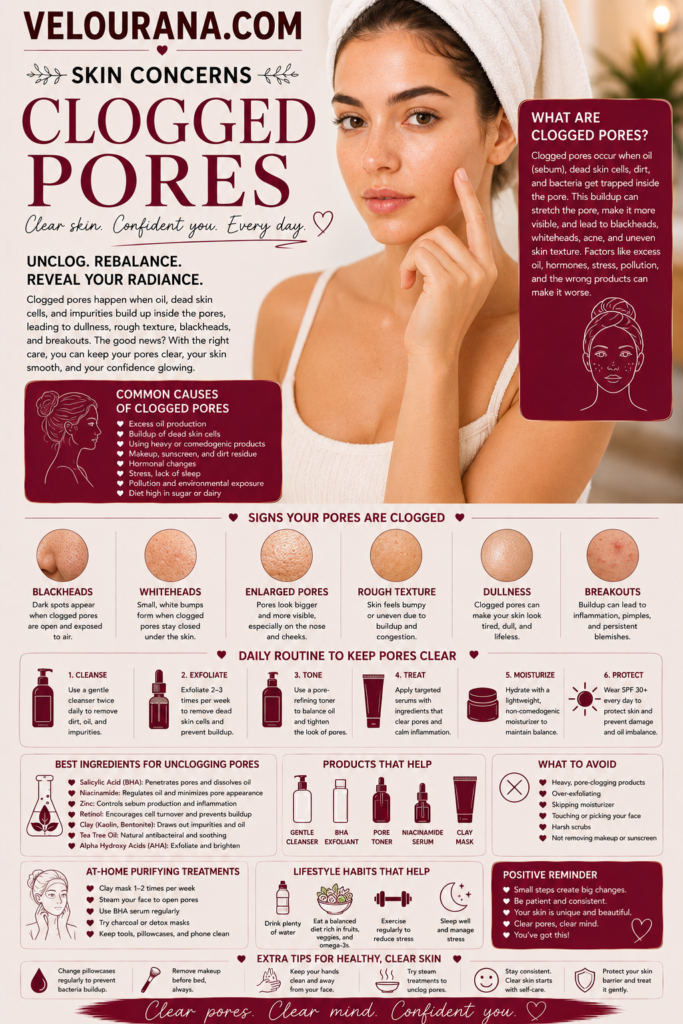
CATEGORY: Clogged Pores
Clogged pores are often treated as a shortage problem.
Not enough exfoliation.
Not enough cleansing.
Not enough active ingredients.
Not enough detoxifying masks.
Not enough pore-refining serums.
The natural response is to add.
A second cleanser joins the first. A salicylic-acid toner follows. Then comes niacinamide, glycolic acid, retinoid, clay mask, pore strip, charcoal treatment and perhaps an oil-control moisturizer or primer. Each product seems to solve a slightly different piece of the same problem.
The result is a routine that feels impressively targeted.
But the skin experiences something else.
It experiences layers.
It experiences repeated exfoliation.
It experiences changing pH, surfactants, occlusives, humectants, emollients, solvents, film-formers, active ingredients and mechanical treatments.
A product can be excellent and still become unnecessary when three other products are already doing the same job.
This is where clogged-pore care becomes unexpectedly complicated. The instinct to treat congestion can create so much activity that the original follicular problem becomes harder to evaluate. Irritation may develop. New bumps appear. The skin becomes rougher. Products begin stinging. Oiliness seems more noticeable. The person assumes congestion is worsening and adds another treatment.
The routine grows.
Clarity declines.
A better approach begins with a simple principle: clogged pores do not require the largest possible number of pore-focused products. They require a coherent strategy in which each product has a distinct role, the barrier remains functional and the treatment is stable enough to reveal whether it is actually working.
The Problem With Treating Every Sign of Congestion Separately
Congestion can create several visual features at once.
Blackheads.
Closed comedones.
Visible pores.
Oiliness.
Uneven texture.
Roughness.
Shine.
Because these features look different, it is tempting to assign a separate product to each one.
A blackhead serum.
A pore-tightening toner.
An oil-control cleanser.
A resurfacing acid.
A texture treatment.
A clay mask.
A mattifying moisturizer.
But these concerns are often interconnected.
The same comedonal process can contribute to blackheads, bumps and roughness.
The same excess exfoliation can create redness, flaking and texture that makes pores look larger.
The same heavy layering can alter how the skin feels without necessarily being the sole cause of true comedones.
When each visual symptom is treated in isolation, the routine can become redundant very quickly.
The smarter question is not, "Which product fixes each appearance?"
It is, "Which biological processes are driving most of what I see?"
Once that question is answered, several products may become unnecessary.
Cleansing Can Become Excessive Before Anyone Notices
Product overload often begins at the cleansing stage because cleansing feels fundamentally safe.
A cleansing balm removes sunscreen.
A gel cleanser follows.
A salicylic-acid cleanser is then used because the skin is congested.
Perhaps a scrub or cleansing brush is added several times a week.
Each step seems reasonable.
Together, they may remove more than the skin comfortably tolerates.
The first warning sign is often tightness.
The face feels exceptionally clean.
Then moisturizer begins to sting.
The skin produces visible flakes around the nose.
Exfoliating treatments become harder to tolerate.
The person interprets the discomfort as evidence that the cleanser is penetrating deeply.
In reality, cleansing has simply become another active treatment.
A routine for clogged pores works better when cleansing has a narrow job description.
Remove what needs to be removed.
Then stop.
Double Cleansing Should Solve a Removal Problem, Not Create a Ritual
Double cleansing can be useful.
Someone wearing long-wear foundation, water-resistant sunscreen or heavy cosmetics may benefit from an oil-based first cleanse followed by a gentle water-based cleanser.
But the method should respond to what is actually on the face.
If very little needs removing, double cleansing may add little.
The mistake is assuming that two cleansers must always be better than one because clogged pores seem to demand extra cleanliness.
The follicle does not care how many cleansing steps were performed.
It responds to the internal processes that influence obstruction.
A cleansing routine should therefore be judged by efficacy and comfort, not by number of stages.
Exfoliating Cleansers Can Quietly Duplicate Leave-On Treatments
Salicylic-acid cleansers are popular for congested skin.
So are salicylic-acid toners and serums.
Used thoughtfully, either format can be useful.
Used together without attention to total exposure, they may become redundant.
The same applies to glycolic-acid cleansers followed by leave-on alpha hydroxy acids.
Because wash-off products feel gentler, people often forget to count them as part of the total exfoliation load.
The skin does not forget.
If irritation develops, every exfoliating source matters.
This is why routine analysis should include all active ingredients rather than only the strongest serum.
More Acids Do Not Mean More Complete Pore Clearing
The logic behind acid layering is seductive.
Salicylic acid works on oily, congested follicles.
Glycolic acid smooths surface texture.
Lactic acid hydrates while exfoliating.
Mandelic acid is gentler.
Why not use several?
The problem is that the skin has a finite tolerance.
Combining multiple acids can increase irritation without proportionally improving congestion.
Once the barrier becomes inflamed, the face may look rougher and more textured.
Pores can appear larger.
Small bumps may develop.
The person may interpret this as proof that the acids are bringing congestion to the surface.
Sometimes they are simply over-exfoliating.
A targeted exfoliant used consistently often produces clearer information than several used intermittently.
Retinoids Can Become Difficult to Evaluate in an Overloaded Routine
Retinoids are important for persistent comedonal acne because they influence follicular turnover and comedone formation.
But they require time.
If a retinoid is introduced into a routine already filled with acids, scrubs and drying cleansers, the skin may become irritated before the retinoid has a fair chance to demonstrate benefit.
The treatment is then stopped.
The retinoid is blamed.
Another serum is purchased.
This is a common pattern because the newest product is often assumed to be responsible for whatever happens next.
But skincare effects are cumulative.
A retinoid may simply expose the fact that the rest of the routine was already operating near the skin's tolerance limit.
The more important question is not whether the retinoid is harsh.
It is whether the entire routine is designed to accommodate it.
A Strong Treatment Often Requires a Quiet Supporting Routine
The more powerful the primary active ingredient, the simpler the supporting routine often needs to become.
This is counterintuitive.
People assume that persistent congestion requires several strong products working together.
In reality, one effective treatment can perform better when surrounded by products that do not compete with it.
A gentle cleanser.
A non-irritating moisturizer.
A sunscreen the skin tolerates.
Perhaps one additional active for a distinct concern.
This gives the skin enough stability to use the main treatment consistently.
The supporting products may look boring.
That is often their strength.
Niacinamide Is Useful, but It Does Not Need to Be Everywhere
Niacinamide appears in an enormous number of modern skincare products.
It can support barrier function, improve the appearance of oiliness and contribute to a more even complexion.
For congested skin, these benefits can be useful.
But once niacinamide is already present in a cleanser, moisturizer and sunscreen, adding a high-concentration serum may not provide a proportionate benefit.
This is another form of duplication.
The problem is not that niacinamide is harmful.
It is that every popular ingredient does not need its own dedicated step.
A routine can contain an ingredient without needing to revolve around it.
The Same Principle Applies to Hyaluronic Acid and Hydrating Serums
Hydration is important.
But multiple hydrating serums can become unnecessary if the moisturizer already provides sufficient support.
This matters because every additional layer changes the feel of the routine.
On oily or congestion-prone skin, excessive layering may create a heavy, sticky surface even when the individual products are non-comedogenic.
That heaviness does not automatically mean pores will clog.
But it can make the routine uncomfortable and encourage inconsistent use.
The goal is adequate hydration.
Not maximum number of hydrating products.
Heavy Layering Can Make Good Products Feel Bad
A product may work beautifully on its own and become unpleasant when layered with four others.
A lightweight serum plus another serum plus moisturizer plus sunscreen plus primer can create a dense film on the skin.
In humid weather, this may feel especially heavy.
The person may blame the final product in the sequence.
But the problem is the combined system.
This is why products should be evaluated not only individually but also in context.
A good routine is more than a collection of good products.
Sunscreen Often Gets Blamed for Congestion Created by the Whole Morning Routine
Sunscreen is frequently accused of clogging pores.
Sometimes a particular formulation may indeed be unsuitable for an individual.
But the sunscreen often sits on top of several other layers.
Essence.
Hydrating serum.
Niacinamide serum.
Moisturizer.
Oil-control primer.
Then sunscreen.
If the face feels occluded, the final layer receives the blame.
A simpler morning routine can sometimes make the same sunscreen feel completely different.
This is why troubleshooting should begin by reducing variables rather than immediately replacing the product most recently applied.
Moisturizer Can Be Too Heavy Without Being "Bad"
Some moisturizers are simply richer than a particular skin needs.
This is especially relevant in humid climates or on very oily skin.
A heavy cream can feel occlusive and may contribute to congestion in susceptible individuals.
But that does not make rich moisturizers inherently poor products.
They may be excellent for dry skin.
The issue is compatibility.
A clogged-pore routine should match texture to current skin conditions.
This may change seasonally.
A moisturizer that feels perfect in winter may feel excessive in summer.
Skincare does not need permanent loyalty to one texture.
The Fear of Heavy Products Can Also Become Excessive
The opposite mistake is assuming every rich texture causes clogged pores.
This can lead to under-moisturizing.
The skin becomes dry.
Active treatments become difficult to tolerate.
Flaking makes texture look worse.
The person adds more exfoliation.
The routine becomes trapped between fear of heaviness and intolerance of treatment.
The better approach is to evaluate the actual skin response.
Not the texture category alone.
Non-Comedogenic Labels Are Helpful but Not a Complete Strategy
Products labelled non-comedogenic can be useful starting points for congestion-prone skin.
But the term should not create false certainty.
Individual responses vary.
A non-comedogenic sunscreen may still feel too heavy in combination with several other layers.
A richer product not marketed specifically toward acne may be tolerated perfectly well.
The label provides guidance.
The skin provides the final answer.
Pore-Refining Products Often Target Appearance More Than Obstruction
Many serums and toners promise to reduce the appearance of pores.
Some can help.
They may reduce oiliness, improve surface texture or create a temporary tightening sensation.
But pore visibility and pore obstruction are not identical.
A product can make pores look smaller without removing comedones.
Another can reduce blackheads while the pore itself remains visibly large.
This distinction matters because it prevents people from stacking two products for what appears to be one problem but is actually two different cosmetic goals.
Astringency Can Feel Effective While Creating More Irritation
Astringent toners create an immediate sensation of tightness.
The face feels less oily.
Pores may appear temporarily less obvious.
This sensory feedback is compelling.
But astringency is not the same as long-term comedonal control.
If the product repeatedly dries or irritates the skin, the temporary effect may not justify the long-term discomfort.
The best pore routine should not depend on dramatic sensations to prove that something is happening.
Clay Masks Can Become Another Exfoliating Event Without Being Treated as One
Clay masks are usually categorized as oil-control products rather than exfoliants.
But many formulations contain acids, botanical extracts, fragrance or other active ingredients.
When used on top of an already intense routine, they can add another source of dryness or irritation.
The person thinks they are simply absorbing oil.
The skin experiences an additional treatment.
This is why optional products need to be counted as part of the total routine rather than considered separate entertainment.
Scrubs Can Push an Already Active Routine Over the Edge
Physical exfoliation often gets added because the skin still feels rough despite chemical exfoliation.
This is a warning sign.
If salicylic acid, glycolic acid and a retinoid are already present, adding a scrub to smooth the remaining texture may be too much.
The roughness may not even be congestion.
It may be irritation.
Scrubbing irritated skin can make the surface even more uneven.
The solution begins with identifying the cause of the texture rather than assuming every rough area contains dead skin that needs removal.
Pore Strips Add Drama but Not Strategy
Pore strips can temporarily remove superficial material and create a satisfying result.
In an overloaded routine, however, they often become one more intervention applied to skin that is already being heavily treated.
The immediate smoothness may be followed by redness or dryness.
Several days later, sebaceous filaments and oil return.
The person adds another exfoliating treatment.
This cycle creates activity without necessarily improving long-term control.
Pore strips are best understood as optional cosmetic tools, not required stages of pore management.
Extraction Tools Can Become the Final Layer of Over-Treatment
Once chemical and mechanical products have been used, extraction often follows because some pores remain visibly clogged.
This is where the cumulative stress can become particularly obvious.
The skin has already been softened, exfoliated and perhaps dried.
Then pressure is applied.
Redness develops quickly.
Small marks remain.
The user concludes the pores are especially stubborn.
But the skin may simply have been asked to tolerate too much in one session.
Product Overload Can Make It Impossible to Identify the Actual Trigger
Suppose congestion increases.
There are twelve products in the routine.
Which one caused it?
Perhaps none.
Perhaps one.
Perhaps the problem is hormonal.
Perhaps the weather changed.
Perhaps a hair product is responsible.
Perhaps the texture is irritation rather than acne.
The more products involved, the more difficult it becomes to know.
This is why simplification is not merely gentle.
It is diagnostic.
Reducing variables creates information.
The Best Way to Troubleshoot Is to Return to Functions
When a routine becomes confusing, think in functions rather than brands.
What is cleansing?
What is treating comedones?
What is supporting the barrier?
What is protecting from ultraviolet exposure?
What else has a distinct purpose?
This method often reveals redundancy immediately.
Three products may be exfoliating.
Two may be controlling oil.
Several may be hydrating.
The routine can often be simplified without losing a single essential function.
A Core Routine Makes It Easier to Test New Products
A stable core routine provides a reference point.
Gentle cleanser.
Main treatment.
Moisturizer.
Sunscreen.
Once the skin is stable, one new product can be introduced.
If congestion changes, the effect is easier to evaluate.
This is far more informative than changing five products simultaneously.
A stable baseline is one of the most useful tools in skincare.
One New Product at a Time Is Slower but More Efficient
Introducing products individually feels slow.
But it prevents months of confusion.
If four new products are introduced and the skin develops bumps, all four may need to be stopped.
Then they have to be reintroduced separately anyway.
The supposedly faster method becomes slower.
Patience at the beginning saves troubleshooting later.
Product Overload Can Be Expensive Without Improving Results
There is also a financial side to complexity.
A routine with multiple serums, exfoliants, masks and pore treatments can become expensive quickly.
Yet several of those products may be duplicating the same function.
A simpler routine can reduce cost without reducing effectiveness.
In some cases, it improves effectiveness because consistency increases.
The best skincare investment is not necessarily the largest collection.
It is the smallest number of products that reliably perform the necessary jobs.
The Skin Barrier Is Often the First Thing to Improve After Simplification
When an overloaded routine is reduced, one of the first changes may be comfort rather than congestion.
The skin stings less.
Flaking decreases.
Tightness improves.
Moisturizer feels comfortable again.
This can happen before blackheads or closed comedones change dramatically.
That early improvement is important.
It means the skin has more tolerance available for the treatment that needs to continue working.
Congestion Should Be Reassessed After Irritation Settles
Once the barrier is calmer, the actual clogged-pore pattern becomes easier to see.
Some bumps may disappear because they were irritation.
Some roughness may smooth because hydration improved.
The remaining comedones can then be treated more precisely.
This is why simplifying an overactive routine can sometimes appear to "clear pores" even though no new pore treatment was added.
The skin was not only congested.
It was confused by too much treatment.
Sometimes the Correct Next Product Is No Product
This is one of the hardest decisions in skincare.
A new concern appears.
Everything in beauty culture encourages adding something.
But if the routine already contains appropriate treatment and the skin is irritated, another product may be the wrong answer.
The more strategic choice can be to hold the routine steady.
Observe.
Allow time.
This can feel passive.
It is actually controlled experimentation.
Stable Routines Make Slow Improvement Visible
Comedonal congestion changes gradually.
If the routine is constantly changing, that gradual improvement becomes impossible to see.
A stable routine reveals trends.
Fewer new blackheads.
Fewer closed comedones.
Smoother forehead.
Less need for extraction.
Reduced irritation.
These changes may not be dramatic week to week.
Over several months, they can be substantial.
Overloaded Routines Encourage Microscopic Standards
The more products someone uses, the more closely they may inspect the results.
If ten products are being applied daily, the expectation of perfect skin becomes stronger.
Every pore is examined.
Every filament becomes evidence that something is still missing.
Another product is added.
This creates a psychological cycle in which the routine grows as the standard becomes increasingly unrealistic.
The end point is impossible because pores cannot be erased.
Simplification often requires redefining success as well as reducing products.
Pore Visibility Is Not Proof That the Routine Needs Another Treatment
A visible pore can be healthy and clear.
This is crucial.
If the blackhead is gone but the opening remains visible, the treatment may have succeeded.
Adding stronger exfoliation in an attempt to make the anatomical structure disappear can create irritation without changing the fundamental pore size.
The routine should stop solving a problem once the problem is solved.
Not Every Rough Patch Needs Exfoliation
Dryness can feel rough.
Irritation can feel rough.
Dehydration can create uneven texture.
Healing acne can create roughness.
Closed comedones can also feel rough.
The sensation alone does not identify the cause.
This is why automatic exfoliation can be misleading.
Sometimes moisturizer is the more appropriate response.
Sometimes time is.
Sometimes professional assessment is needed.
Hair and Body Products Should Be Included in the Product Audit
When congestion persists, facial skincare is often audited obsessively while hair products are ignored.
But styling creams, oils and conditioners can contact the forehead and temples.
Body products can matter around the neck, shoulders or chest.
A complete product audit looks at everything touching the affected area.
This can reveal triggers that facial serums were never going to solve.
Climate Should Be Considered Before Blaming a Product
A routine may suddenly feel too heavy because humidity increased.
The same products that worked perfectly in winter can feel occlusive in summer.
This does not necessarily mean the products have become comedogenic.
The context changed.
Adjusting one texture may solve the problem.
Replacing the entire routine may be unnecessary.
Hormonal Changes Can Be Mistaken for Product Failure
If congestion worsens without any meaningful product change, internal factors deserve consideration.
Hormones can alter sebaceous activity and acne patterns.
This is particularly relevant when new comedones appear alongside inflammatory breakouts.
No amount of routine simplification can completely control every hormonal influence.
Professional care may be needed when topical management reaches its limit.
Persistent Congestion Deserves Diagnosis Before More Shopping
There is a point where product experimentation stops being efficient.
If closed comedones remain widespread after an appropriate routine has been used consistently, dermatological assessment can clarify the problem.
Prescription retinoids may be appropriate.
The bumps may not even be comedones.
Milia, folliculitis and other conditions can mimic clogged pores.
A correct diagnosis can save months of unnecessary purchases.
The More Serious the Acne, the Less Useful Cosmetic Experimentation Becomes
When congestion is accompanied by painful inflammatory lesions, nodules or scarring, the focus should shift.
The problem is no longer simply cosmetic pore management.
It is acne that may require medical treatment.
Continuing to add cosmetic exfoliants while deeper inflammation progresses is not efficient.
Professional intervention can reduce the risk of lasting damage.
A Simplified Routine Can Still Be Highly Active
Simplification should not be confused with doing nothing.
A simple routine can contain a potent, evidence-based treatment.
The difference is that the surrounding products support rather than compete with it.
This is often more sophisticated than a long routine.
The active ingredient has space to work.
The skin has enough support to tolerate it.
The results become easier to interpret.
The Ideal Number of Products Is the Number That Has a Purpose
There is no correct universal number.
Some people thrive with three products.
Others need six.
Someone treating multiple concerns may reasonably use more.
The important thing is purpose.
If removing a product would leave no missing function, it may not be essential.
This is a useful test for crowded routines.
Product Overload Is Often a Sign of Impatience Rather Than Necessity
Congestion changes slowly.
The marketplace changes quickly.
A new product appears every week promising faster results.
This creates a mismatch.
Biology needs time.
Marketing demands action.
The result is product accumulation.
Recognizing this tension helps explain why simplifying can feel uncomfortable.
The person is not merely removing products.
They are resisting the idea that every week should produce a new intervention.
Clearer Skin Often Comes From Creating Less Noise
When too many products are involved, the skin produces noisy information.
Redness.
Flaking.
Oiliness.
Bumps.
Stinging.
Temporary smoothness.
Sudden reactions.
It becomes difficult to identify what matters.
A simpler routine reduces that noise.
The genuine pattern becomes clearer.
Then treatment can become more precise.
A Better Pore Routine Is Built Around Restraint, Not Deprivation
Restraint does not mean refusing useful skincare.
It means using the appropriate amount of it.
Cleanse enough.
Treat enough.
Moisturize enough.
Protect enough.
Then stop adding unless there is a distinct reason.
This is a difficult balance because the beauty industry rewards abundance.
The skin often rewards consistency.
When the Routine Finally Becomes Clear
The transformation from product overload to coherent pore care is rarely dramatic at first.
The shelf becomes smaller.
The morning routine takes less time.
The evening routine feels almost too simple.
Then the skin begins to settle.
Tightness improves.
Redness decreases.
The main treatment can be used consistently.
The person can finally see which bumps are true comedones and which were irritation.
Weeks pass.
Congestion begins to reduce.
Not every pore disappears.
Not every blackhead is eliminated forever.
But the pattern becomes easier to control.
This is the real advantage of simplifying clogged-pore care.
It creates clarity in two places at once.
The routine becomes clearer.
The skin becomes clearer.
And once that happens, the person no longer needs to keep searching for the missing product that will finally solve everything.
The solution was never an infinite number of treatments.
It was understanding which few treatments actually mattered.
The End Velourana
 Discover More From Our Family of Websites
 ZodiacBearing (Astrology, Tarot, Numerology, Angel Numbers & Spiritual Guidance)
 Velourana (Beauty, Makeup, Hair Care, Skincare & Beauty Tips)
 HavenBearing (Home, Living, Organization, Décor & Everyday Inspiration)
 PawBearing (Pet Care, Dog Breeds, Animal Health, Training & Pet Products)
 PsyCatherine (Notes From the Journal of a Psychologist on Real Life)

