CATEGORY: Cleansing Balms
Cleansing is often treated as the least glamorous part of skincare. Serums promise transformation, moisturizers invite conversations about barrier support, and sunscreens occupy an increasingly sophisticated place in daily routines. Cleansing, by comparison, can sound purely functional: remove what has accumulated on the face and move on. Yet the way skin is cleansed can influence everything that follows. A routine that begins by leaving behind stubborn sunscreen and makeup is compromised before treatment products are applied, while one that repeatedly leaves the face tight, dry, or irritated may create problems that later steps are expected to repair.
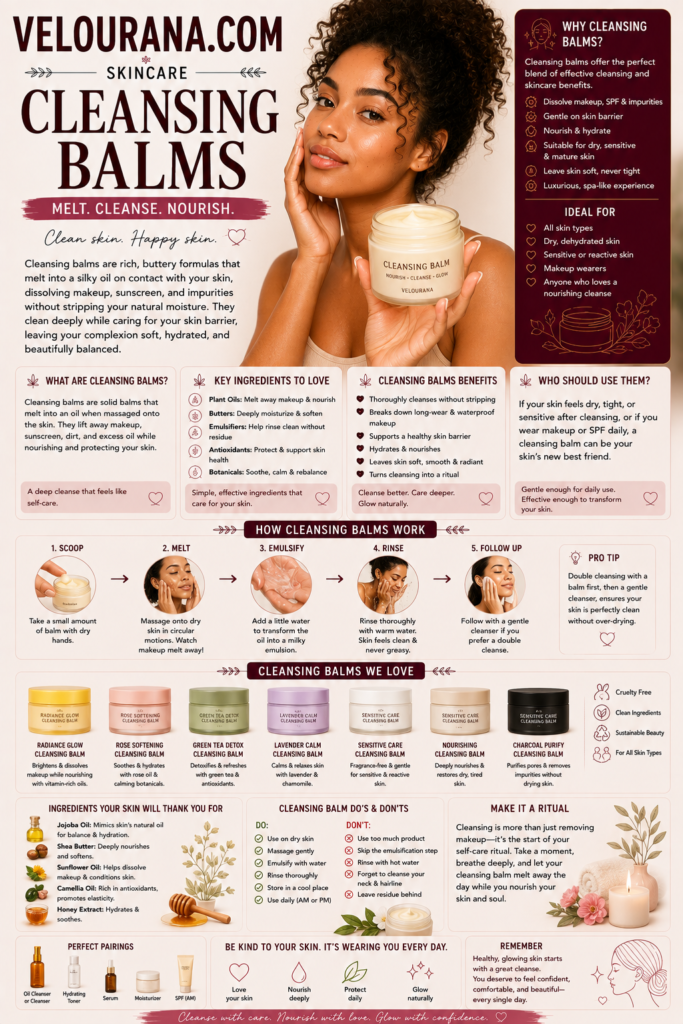
Cleansing balms offer a particularly interesting answer to this dilemma because they approach cleansing through transformation rather than aggressive removal. They begin as dense, often solid or semi-solid formulas. Warmed between the fingers and spread across dry skin, they soften into an oil-like layer capable of loosening many of the substances that ordinary water cannot efficiently remove. Introduce water, however, and a well-formulated balm changes again, emulsifying into a milky fluid that can be rinsed away.
That sequence—balm to oil to emulsion—is more than a pleasing sensory ritual. It explains why cleansing balms occupy a distinctive position between makeup removers, cleansing oils, traditional creams, and conventional water-based facial cleansers. Their usefulness comes from matching the chemistry of the cleanser to the material that needs to be removed while still allowing the resulting mixture to leave the skin with water.
Understanding cleansing balms therefore requires looking beyond their luxurious texture. Their real story concerns solubility, emulsification, the skin barrier, formulation, technique, and the increasingly complicated collection of materials that modern skincare leaves on the face by the end of the day.
Modern Skin Is Not Covered in Water-Soluble Material
At the end of an ordinary day, the surface of the face may carry considerably more than visible dirt. Natural sebum is present alongside sunscreen films, pigments, foundation, concealer, mascara, brow products, environmental particles, skincare residues, silicones, waxes, and oils. Depending on the routine, several layers may have been deliberately designed to resist water, sweat, movement, or transfer.
This is where the apparent simplicity of washing becomes chemically complicated.
Water is excellent at carrying away substances that readily mix with it. Many materials sitting on modern skin, however, have substantial oil-soluble or water-resistant components. Merely splashing the face with water cannot reliably detach everything present on its surface. Cleansing systems therefore use ingredients capable of helping oily material disperse into water so that it can ultimately be removed.
Traditional cleansers usually accomplish this primarily through surfactant systems dispersed in a water-based formula. Surfactants possess both water-compatible and oil-compatible characteristics, allowing oily debris to be incorporated into structures that can be carried away during rinsing. This mechanism is fundamental to effective cleansing.
The complication is that cleansing is never completely selective. A cleanser is supposed to remove unwanted material without unnecessarily disturbing the structures that skin needs. Research into cleanser–skin interactions has shown that surfactants can interact not only with external debris but also with components of the stratum corneum, including lipids and proteins. The degree to which this matters depends heavily on the particular formulation rather than on the simplistic idea that all surfactants behave identically.
This distinction helps explain the appeal of balm cleansing. Instead of asking a predominantly aqueous cleanser to immediately deal with a complex layer of oily and water-resistant material, the balm first creates an oil-rich environment in which much of that material can be loosened and dissolved.
The objective is not to make cleansing weaker. It is to make the removal process more compatible with the nature of what is being removed.
The Chemistry Behind the Melt
The most memorable characteristic of a cleansing balm is its physical transformation.
Inside its container, the product may resemble a soft wax, butter, sorbet, or dense cream. That texture is created through a carefully balanced mixture of oils, esters, waxes, fatty materials, structuring agents, and emulsifying ingredients. The precise composition varies enormously between formulas, which is why two products sold under the same category can feel completely different.
Once the balm meets the warmth of the fingers and face, its structure softens. Mechanical pressure from massage spreads the formula into a thin oil-rich film.
This stage is crucial.
Oil-soluble cosmetic materials can mingle with the balm's oily phase. Pigments suspended in waxes and oils begin to disperse. Long-wearing complexion products loosen. Sebum becomes incorporated into the cleanser. Sunscreen films can be broken apart. Mascara and other resistant makeup may gradually release as the balm is worked across the surface.
The familiar expression “like dissolves like” is useful as an introductory explanation, although real cosmetic formulations are considerably more complicated than the phrase suggests. The important practical principle is that an oil-rich cleansing medium is particularly useful for mobilizing lipophilic material that does not readily leave the skin with water alone.
A cleansing balm, however, would be considerably less convenient if this were the end of the process. Pure oil can dissolve oily debris, but then the combined oil and debris must itself be removed.
That is where emulsification becomes central.
Emulsification Is What Turns Oil Cleansing Into Rinse-Off Cleansing
A successful cleansing balm is not simply a jar of attractive oils.
Its defining functional feature is usually an emulsifying system that allows the oily phase to interact with water during rinsing. Cleansing balms commonly combine their solid or semi-solid oily base with surfactants or emulsifiers specifically to create this transition. When water is introduced, the oily material can disperse into the water phase, often producing the characteristic cloudy or milky appearance associated with balm cleansing.
This moment is sometimes treated as a cosmetic flourish, but it is actually central to performance.
Before emulsification, the balm is carrying dissolved makeup, sebum, sunscreen, and other oily residues. Adding a small amount of water and continuing to massage allows the formula to reorganize. Instead of remaining as one greasy layer clinging to the skin, the oil becomes dispersed into an emulsion that is much easier to rinse away.
The quality of this transition can distinguish an elegant cleansing balm from a frustrating one.
Some formulas emulsify almost instantly and rinse with surprisingly little residue. Others create a richer milk and leave a soft film behind. Certain balms require considerably more water or massage before they release completely. Formulation choices involving the emulsifier system, oils, esters, and structural ingredients influence all of these differences.
Neither an extremely rich finish nor an exceptionally clean rinse is automatically superior. They represent different sensory and formulation choices. Someone who dislikes any detectable film may prefer a balm engineered for rapid, complete rinsing, while someone with dry-feeling skin may enjoy a formula that leaves the surface feeling more conditioned.
What matters is recognizing that residue and gentleness are not synonyms. A heavy residue is not proof that a balm is nourishing, just as a clean rinse is not proof that it is stripping.
Cleansing Without Turning “Clean” Into a Sensation
One of the most persistent habits in skincare is judging cleansing effectiveness by sensation.
A face that feels extremely tight after washing may be interpreted as exceptionally clean. Strong foam can create the psychological impression of superior cleansing. A squeaky surface may feel reassuring because it signals that something has unquestionably been removed.
But skin does not need to feel uncomfortable in order to be clean.
The outermost layer of the epidermis, the stratum corneum, is a highly organized barrier containing corneocytes surrounded by a lipid matrix. Its integrity helps regulate water loss and protects the underlying tissue from the external environment. Cleansing inevitably interacts with this surface, but the goal of a well-designed routine is to remove unwanted material without causing unnecessary disruption.
Scientific literature on cleansing has documented how aggressive surfactant interactions can contribute to lipid and protein disturbance, dryness, tightness, irritation, and impaired barrier properties. Modern cleanser formulation therefore increasingly focuses not merely on cleansing capacity but on balancing cleansing with mildness.
Cleansing balms can fit naturally into that philosophy because the user does not have to rely on abundant foam or an aggressively degreased sensation as evidence that cleansing has occurred.
This does not mean that every cleansing balm is inherently gentle.
A fragranced balm may irritate someone sensitive to fragrance. Botanical extracts or essential oils may be unsuitable for particular users. Excessive rubbing can irritate skin regardless of how mild the formula itself may be. A balm that does not rinse adequately may cause problems for someone who reacts poorly to persistent residue.
The category provides a useful format, not a universal guarantee.
That distinction is important throughout skincare. Texture can suggest how a product might behave, but formulation determines how it actually behaves.
The First Cleanse Has Changed Because Sunscreen and Makeup Have Changed
The rise of cleansing balms makes particular sense when viewed alongside the evolution of modern cosmetics.
Long-wear foundation is expected to survive hours of movement. Waterproof mascara is designed to resist moisture. Lip products may be formulated specifically to minimize transfer. Primers and complexion products frequently use silicones and film-forming ingredients to increase durability. Sunscreens must maintain reasonably even protective films despite heat, movement, and exposure.
The qualities that make these products perform well during the day can make them more demanding to remove at night.
A cleanser therefore faces an unusual task: it must dismantle deliberately persistent films without requiring equally persistent scrubbing.
This is where balm cleansing becomes especially logical. The user can spread the cleanser across the entire dry face, allowing the oil-rich phase to interact directly with resistant cosmetic material. Gentle massage increases contact between the cleanser and the film being removed. Rather than repeatedly wiping at makeup with cotton pads or attempting to force everything away with one rapid wash, the removal process can happen progressively across the surface.
The difference is especially noticeable with heavily layered routines.
Imagine skin carrying moisturizer, sunscreen, primer, foundation, cream blush, powder, bronzer, brow products, eyeliner, and mascara. That is not one homogeneous layer. It is a complex stack of waxes, pigments, oils, powders, silicones, polymers, and other cosmetic materials.
A cleansing balm does not magically identify each ingredient. Instead, it provides a broad oil-rich cleansing environment capable of loosening many components simultaneously before the emulsification step allows the mixture to be washed away.
This explains why balm cleansing can feel dramatically easier even when the amount of makeup has not changed. The cleanser is doing more of the dissolving work, leaving less work to mechanical friction.
Technique Matters More Than the Ritual Suggests
The popularity of cleansing balms has produced elaborate rituals around their use, but effective technique is relatively straightforward.
Most are designed to begin on dry hands and dry skin.
This is not an arbitrary instruction. Applying water too early can initiate emulsification before the balm has had sufficient opportunity to spread through oil-soluble debris. Beginning dry allows the formula to retain its oil-rich character during the stage when makeup, sunscreen, and sebum are being loosened.
A modest amount is distributed across the face using gentle movement. The objective is coverage, not pressure.
This is an important distinction because massage can easily become excessive. Longer is not automatically better. A cleansing balm does not need to be rubbed aggressively into the face for several minutes to prove that it is working. Once the surface material has loosened, continuing to manipulate the skin may offer little cleansing advantage while increasing friction.
The eye area deserves particular restraint. If a balm is intended for eye makeup removal, closed eyes and gentle movements are preferable to vigorous rubbing. Waterproof mascara may need a little time to soften. Pressing and allowing the cleanser to contact the lashes briefly can be more effective than repeatedly dragging the fingers across them.
Then comes the stage many users rush: emulsification.
Wet fingertips can be introduced gradually and massaged across the oily layer. The balm commonly becomes thinner and visibly milky. More water can then be added before the face is rinsed thoroughly.
This intermediate step often improves removal because the user is actively helping the oily phase disperse before attempting to wash everything away at once.
Some balms are designed to be removed with a damp cloth. Others rinse efficiently without one. When cloth removal is used, the cloth should not become an exfoliating instrument by accident. Soft contact is enough. Repeated hard wiping transforms a gentle cleansing method into a mechanical irritation routine.
The best technique is therefore not the most elaborate. It is the one that allows chemistry to do most of the work.
Does a Cleansing Balm Always Require a Second Cleanser?
Few skincare rules have become as widely repeated as the instruction to double cleanse.
The conventional sequence is simple: use an oil-based cleanser first, then follow with a water-based cleanser. The logic is understandable. The first product loosens makeup, sunscreen, and oily debris; the second removes remaining residue and completes cleansing.
For many routines this works extremely well.
But “works well” and “must always be done” are different statements.
A well-formulated cleansing balm may emulsify and rinse sufficiently on its own, particularly when the wearer has used relatively light sunscreen or makeup. Dermatological commentary on cleansing balms has noted that a second water-based cleanse can be reasonable when residue remains but is not necessarily required for every user.
The decision should therefore respond to what is actually happening on the skin.
Someone wearing substantial waterproof sunscreen, long-wear foundation, or several layers of cosmetics may appreciate the completeness of a second cleanse. A person with oily skin may prefer the finish. Someone whose balm deliberately leaves a noticeable emollient film may also want to follow it with a mild cleanser.
Another person with dry or easily irritated skin may discover that the balm alone removes the day's products adequately and leaves the face comfortable. Adding a second cleansing step simply because it has become a rule could expose the skin to more cleansing than it requires.
Double cleansing should be a strategy, not a commandment.
Its usefulness depends on the resistance of the material being removed, the rinsability of the balm, the characteristics of the second cleanser, and the individual's skin.
The most sensible question is not “Should everyone double cleanse?” but “Is anything important still on the skin after the first cleanse?”
Oily and Acne-Prone Skin Are Not Automatically Excluded
The word “oil” still causes understandable hesitation among people prone to breakouts.
For decades, oily skin was often treated according to a philosophy of maximum degreasing. The more oil the skin produced, the more aggressively it was cleansed. Products promising an exceptionally matte, purified surface became closely associated with acne care.
Modern understanding is more nuanced.
Sebum is not simply dirt. It is part of the skin's surface environment. Acne is also far more complicated than the presence of oil alone, involving follicular processes, keratinization, inflammation, microbial activity, hormones, and individual susceptibility.
Using an oil-rich cleanser does not therefore mean that oil is being permanently “added” to acne-prone skin. A properly emulsifying cleansing balm is designed to mobilize oily material and then leave with the rinse water.
Yet that does not make every balm ideal for every acne-prone person.
Formula selection and rinsability matter. A very rich balm that leaves substantial residue may not suit someone who repeatedly develops congestion after using it. Dermatological discussion has also noted the possibility that inadequately removed heavy balm residue could contribute to comedones or milia in susceptible users.
The appropriate response is not to declare cleansing balms either universally safe or universally unsuitable for acne. Skin does not behave according to such broad category labels.
An acne-prone user may prefer a balm that emulsifies rapidly, rinses cleanly, contains relatively few potentially irritating extras, and does not leave a persistent coating. If a second cleanse improves comfort without producing tightness, that can be incorporated. If repeated use seems to coincide with new congestion, the formula deserves reconsideration.
The lesson extends beyond cleansing balms: product categories do not predict individual compatibility as reliably as actual formulation and repeated skin response.
Dry and Sensitive-Feeling Skin May Appreciate What the Balm Does Not Do
Cleansing can become particularly difficult when the skin already feels dry, reactive, or uncomfortable.
The problem is not that such skin should never be thoroughly cleansed. Sunscreen, makeup, and environmental material still need removal. The challenge is accomplishing that without making the face feel progressively worse after every wash.
Cleansing balms can be appealing here because their sensorial profile tends to discourage the “scrub until squeaky” mentality. The rich slip of the formula reduces the temptation to use repeated dry friction, while the oil-rich phase can loosen resistant products before rinsing.
But again, the category itself should not be romanticized.
A balm containing ingredients to which someone is sensitive can still provoke discomfort. Fragrance is an obvious example for some users, but sensitivity is individual and can involve numerous ingredients. A person with compromised or highly reactive skin may find a relatively simple, fragrance-free formulation easier to tolerate than an aromatic balm loaded with extracts chosen primarily for sensory appeal.
Water temperature also matters.
Very hot water does not make a balm dramatically more effective. Lukewarm water is generally sufficient for emulsification and rinsing. Turning cleansing into a prolonged hot-water ritual can undermine the very comfort that attracted someone to balm cleansing in the first place.
Frequency deserves similar attention.
A person who uses a cleansing balm at night to remove sunscreen does not necessarily need the same intensive process the following morning. Morning cleansing requirements vary considerably according to skin type, climate, overnight products, and personal preference.
The broader principle is that sensitive-feeling skin often benefits from purposeful cleansing rather than maximum cleansing.
Remove what needs to leave. Do not keep cleansing simply because additional cleansing is possible.
Texture Is Not Just Luxury—It Changes Behavior
Skincare is sometimes discussed as though sensory qualities are superficial distractions from “real” performance.
In practice, texture can alter how a product is used, and use determines performance.
A cleansing balm provides slip. That encourages slow spreading rather than immediate rinsing. Its transformation gives the user a visible and tactile signal that the formula has moved through different stages. The melting process makes it easier to distribute a relatively small quantity across the face. The emulsification stage provides feedback that water has been incorporated.
These characteristics can improve technique without requiring the user to understand cosmetic chemistry.
They can also make an ordinary routine feel pleasurable.
There is nothing scientifically suspect about acknowledging this. A skincare product that people enjoy using consistently can have practical advantages over one they technically admire but avoid. The danger appears only when sensory pleasure is confused with therapeutic efficacy.
A balm does not improve skin merely because it smells expensive, melts beautifully, or arrives in an elegant jar.
Nor does a thick texture necessarily indicate greater nourishment.
Texture is partly a formulation architecture. Oil-gelling and structuring ingredients can create radically different levels of hardness, glide, melting behavior, and heat stability without those characteristics directly predicting the product's suitability for a particular skin concern. Cosmetic formulation literature describes how gelling systems are deliberately adjusted to engineer these sensory properties.
The best cleansing balm is therefore not necessarily the richest, softest, most fragrant, or most luxurious one.
It is the one whose sensory characteristics encourage effective use while its cleansing and rinsing behavior suits the skin.
Reading a Cleansing Balm Beyond the Front Label
Shopping for cleansing balms can become confusing because the category is surrounded by attractive vocabulary.
Products may be described as nourishing, purifying, melting, buttery, cloud-like, botanical, clean, restorative, hydrating, or detoxifying. Some of these words describe genuine sensory characteristics. Others are broad marketing concepts that tell the consumer relatively little about cleansing performance.
A more useful evaluation begins with function.
Does the balm spread easily enough to cover the face without excessive tugging? Does it loosen the kind of sunscreen or makeup normally worn? Does water turn it into a dispersible emulsion? Does it rinse without unreasonable effort? How does the skin feel ten minutes later rather than merely ten seconds later?
Ingredient lists can provide additional clues, but they should not be treated as simple scorecards.
Oils and esters create the medium in which lipophilic debris is dissolved. Waxes, fatty alcohols, butters, polymers, or other structuring materials may help create the solid or semi-solid texture. Emulsifying ingredients allow the oil phase to disperse when water is introduced. Additional ingredients may modify slip, fragrance, antioxidant stability, appearance, or the after-feel.
The presence of one recognizable plant oil does not reveal the overall quality of the formulation.
Neither does the absence of a fashionable ingredient make a cleanser inferior.
Cleansing balms are systems. Their performance emerges from the interaction between ingredients rather than from a single hero component.
This is particularly important because cleansers are rinse-off products. The primary responsibility of a cleansing balm is to cleanse effectively and comfortably. An elaborate list of skincare actives may sound impressive, but consumers should be cautious about evaluating a rinse-off cleanser as though it were a leave-on serum.
A cleanser does not need to perform every function in the routine.
Sometimes excellence comes from doing one job exceptionally well.
The Question of “Nourishing” Cleansing
The language surrounding balm cleansers frequently emphasizes nourishment.
There is a reasonable foundation for this impression. Oil-rich formulas often leave skin feeling softer than highly degreasing cleansers, and certain cleansing systems are designed to minimize the harsh after-wash sensation associated with more aggressive cleansing.
Yet the word “nourishing” can blur two different ideas.
The first is that a cleanser avoids unnecessarily stripping the skin. This is extremely valuable.
The second is that the cleanser meaningfully replaces the role of leave-on moisturizers, barrier treatments, or other skincare. That is a much larger claim.
Because cleansing balms are designed to be removed, much of the product leaves the face. Some formulas intentionally leave a degree of emollient material behind, which can contribute to softness and comfort. But this should not transform the cleanser conceptually into a treatment mask.
Its greatest contribution may be preventive rather than additive.
A cleanser that removes sunscreen and makeup without repeatedly leaving the face dry and irritated creates a better starting point for the rest of the routine. Instead of expecting moisturizer to compensate for unnecessarily aggressive washing, cleansing itself becomes compatible with maintaining comfort.
This shift in perspective is useful.
Good skincare is not only about what is added to the skin.
It is also about what we stop unnecessarily taking away.
When a Cleansing Balm Is Not the Right Choice
No skincare format deserves universal status.
Some people simply dislike the sensory experience of oil-based cleansing. They may find the melting stage messy or dislike putting fingers into a jar. Others prefer the speed of a liquid cleansing oil, micellar product, or single water-based cleanser.
Certain eye areas may react poorly to particular balm formulas. Temporary cloudiness can occur when oily cleanser migrates around the eyes, especially if too much product is used or rinsing is incomplete. Anyone experiencing persistent eye irritation should stop using the offending product around the eye area rather than assuming discomfort is part of effective makeup removal.
Residue can also be a genuine problem.
If the face consistently feels coated after thorough emulsification and rinsing, the formula may simply be too rich for that person's preference. A second cleanse can solve the problem, but needing another product to correct an unpleasant finish is not always worthwhile when a different balm could rinse more cleanly.
Jar packaging introduces another practical consideration. Fingers should be clean when entering the container, and any supplied spatula should be kept reasonably clean and dry. Water should not be deliberately introduced into the jar. Even products with little or no water in their original formulation can face contamination considerations during consumer use, particularly when repeatedly exposed to wet environments. Formulators account for product stability and microbial safety, but good handling remains sensible.
Finally, persistent skin disease, significant irritation, unexplained rashes, painful acne, or worsening dermatitis should not be treated merely as a cleanser-selection puzzle. A dermatologist or other qualified healthcare professional can evaluate problems that ordinary cosmetic experimentation cannot resolve.
Cleansing Balms and the Logic of a Better Routine
The most interesting thing about cleansing balms is not that they transformed cleansing into a luxurious ritual.
It is that they make the logic of cleansing unusually visible.
The balm begins in a form designed for controlled application. It melts into an oil-rich phase suited to interacting with oily and resistant material. It then meets water and emulsifies so that the combined cleanser and debris can be carried away.
Each stage has a purpose.
That clarity offers a useful corrective to the idea that skincare must feel aggressive to be effective. The goal of cleansing is not to produce the strongest possible sensation of cleanliness. It is to remove what should not remain while respecting what should.
For someone wearing long-lasting makeup or substantial sunscreen, that may mean using a cleansing balm followed by a mild second cleanser. For someone with dry skin and a lighter routine, the balm may be sufficient by itself. For another person, a cleansing oil may provide the same underlying logic in a texture they prefer.
There is no virtue in complexity for its own sake.
The value of the cleansing balm lies in matching method to material. Modern faces often carry sophisticated, deliberately persistent cosmetic films. A cleanser capable of loosening those films before asking water to carry them away is not merely indulgent; it is a rational response to how contemporary skincare and makeup are formulated.
And perhaps that is why the category has endured beyond the novelty of its texture.
The pleasure of watching a balm melt is immediate, but its deeper appeal comes from something quieter: cleansing no longer has to feel like an assault on the skin in order to feel complete.
When the formula is appropriate and the technique is sound, the first step of skincare stops being something the rest of the routine must recover from.
It becomes the foundation that allows everything after it to begin well.
The End Velourana
 Discover More From Our Family of Websites
 ZodiacBearing (Astrology, Tarot, Numerology, Angel Numbers & Spiritual Guidance)
 Velourana (Beauty, Makeup, Hair Care, Skincare & Beauty Tips)
 HavenBearing (Home, Living, Organization, Décor & Everyday Inspiration)
 PawBearing (Pet Care, Dog Breeds, Animal Health, Training & Pet Products)
 PsyCatherine (Notes From the Journal of a Psychologist on Real Life)