
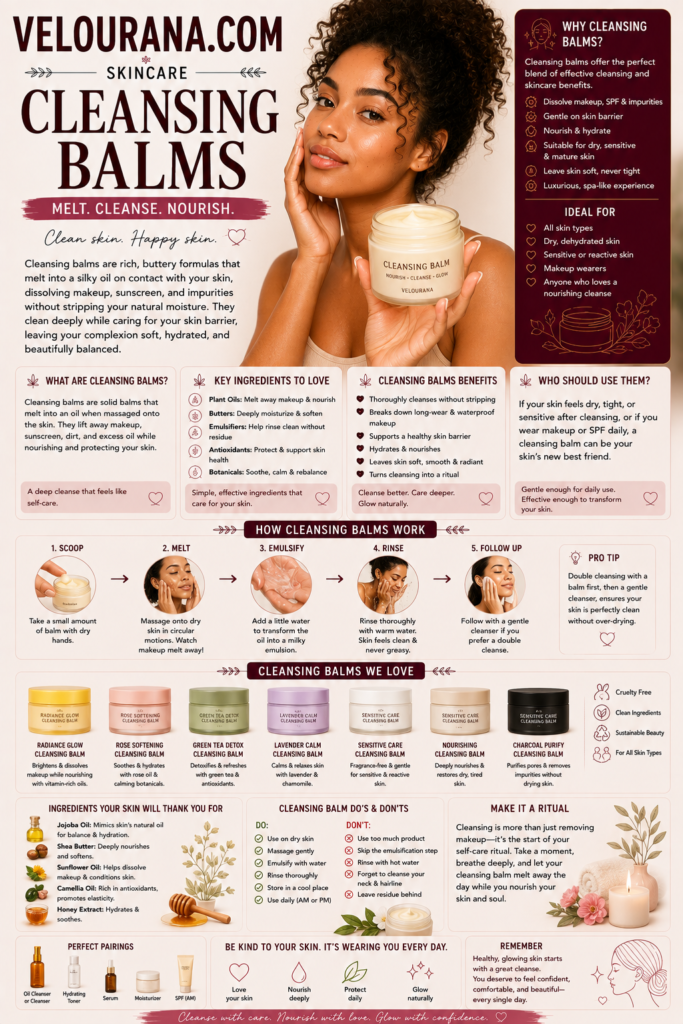
CATEGORY: Cleansing Balms
For anyone with oily or acne-prone skin, the phrase “oil-based cleanser” can sound almost contradictory. If the skin already produces excess sebum, why introduce more oil? If pores clog easily, why deliberately massage a rich balm across the face? For years, skincare culture reinforced the idea that oily skin should be stripped as thoroughly as possible, often with strong foaming cleansers, alcohol-heavy toners, and products designed to leave the face feeling completely matte.
That approach is increasingly being replaced by a more nuanced understanding.
Oiliness is not dirtiness. Sebum is part of normal skin physiology. Acne is not simply the result of “too much oil” sitting on the surface. Breakouts develop through a more complex interaction involving sebum production, follicular keratinization, inflammation, microbial activity, hormones, genetics, and individual susceptibility.
This distinction matters because cleansing balms are not intended to coat the face permanently in oil.
Their purpose is temporary.
A cleansing balm uses an oil-rich phase to dissolve and mobilize sunscreen, makeup, sebum, and other lipophilic material. Water is then introduced, allowing the balm to emulsify and rinse away.
In other words, oil is not necessarily being added to oily skin as a leave-on treatment. It is being used as part of a removal system.
For some people with oily or acne-prone skin, this approach can make evening cleansing more effective and less aggressive. For others, a particular balm may feel too rich, leave too much residue, or contribute to congestion.
The category itself is neither automatically ideal nor automatically unsuitable.
The real question is whether the formula, rinsing behavior, and cleansing technique match the individual skin.
Oily Skin Does Not Need to Be Punished Into Submission
The old logic of oily-skin care was straightforward.
If the skin produces oil, remove as much oil as possible.
The immediate result can feel satisfying. A strong cleanser removes sebum rapidly. The face feels tight, matte, and completely free of surface oil.
But the sensation of extreme cleanliness is not the same thing as optimal cleansing.
Skin naturally produces sebum because it serves physiological functions at the surface. The goal of cleansing is not to permanently eliminate this system. It is to remove excess oil, environmental debris, sunscreen, makeup, and other material without unnecessarily disrupting the barrier.
This distinction becomes particularly important in acne routines.
People with acne often use active treatments that can already challenge skin tolerance. Retinoids, benzoyl peroxide, salicylic acid, azelaic acid, and other treatments may produce dryness or irritation, particularly during early use or when combined too aggressively.
If the cleansing step is also harsh, the cumulative burden can become difficult to tolerate.
The result may be an uncomfortable paradox.
A person attempts to control acne by increasing cleansing strength, but the increasingly irritated skin becomes less able to tolerate the treatments that are actually intended to manage the acne.
A cleansing balm can sometimes help break this cycle by making the removal of sunscreen and makeup more efficient without relying on aggressive degreasing.
This does not mean oily skin should never use a foaming cleanser.
It means cleansing intensity should serve a purpose.
There is a difference between removing excess sebum and repeatedly stripping the surface until discomfort becomes part of the routine.
Why Oil Can Remove Oil
The principle behind balm cleansing is easier to understand once the distinction between water-soluble and oil-soluble material becomes clear.
Sebum is oily.
Many makeup products contain oils, waxes, silicones, and other hydrophobic ingredients.
Sunscreens may contain oil-soluble filters and water-resistant film-forming materials.
These substances do not always leave the skin efficiently with plain water.
An oil-rich cleansing phase can interact with them more readily.
When a cleansing balm melts across dry skin, it creates a medium in which sebum and oily cosmetic materials can disperse.
The balm is not “feeding” the oiliness.
It is temporarily incorporating that oil into a cleanser that is designed to be removed.
This is why an oil cleanser can sometimes feel surprisingly effective on very oily skin.
The product can loosen the dense mixture of sebum, sunscreen, foundation, and environmental material that accumulates by evening.
The crucial step comes afterward.
If the balm emulsifies properly, water can disperse the oily mixture and carry it away during rinsing.
Without good emulsification, an oil-based cleanser may simply replace one oily layer with another.
That difference is especially important for acne-prone users.
The Emulsifier Is as Important as the Oil
When people compare cleansing balms, they often focus on the oils.
They look for jojoba oil, sunflower oil, squalane, shea butter, or other familiar ingredients.
But for oily and acne-prone skin, the emulsifying system may matter just as much as the oils themselves.
A cleansing balm needs to perform two contradictory tasks.
First, it must behave like an oil cleanser so that it can dissolve oily debris.
Then it must stop behaving like a persistent oil layer once water is introduced.
That transformation depends on emulsifying ingredients.
A good formula becomes thinner and more dispersible as water is added.
It may turn milky.
It should rinse with reasonable efficiency.
A balm that remains stubbornly greasy can be frustrating for anyone, but it may be especially problematic for someone who dislikes residual film or tends to develop congestion.
This is why the richest-looking balm is not necessarily the best choice for oily skin.
A lighter-feeling balm with excellent emulsification may provide a better experience than a dense buttery formula that requires repeated cloth removal.
Performance after water is introduced matters more than appearance in the jar.
Acne Is More Complicated Than Surface Grease
The assumption that oil cleansers cause acne often rests on an oversimplified model.
Oil touches acne-prone skin.
Therefore pores clog.
Therefore breakouts occur.
Real acne biology is more complicated.
A comedone develops within a follicle through abnormal accumulation of keratinized cells and sebum.
Inflammation can follow.
Hormonal signaling influences sebaceous activity.
Genetic predisposition plays a role.
The microbiome participates in the process.
A cleanser interacts with this system mainly at the surface and for a relatively short period.
That does not mean cleanser choice is irrelevant.
A product that leaves a heavy residue, irritates the skin, or consistently coincides with worsening breakouts may clearly be unsuitable.
But the presence of oil in a rinse-off cleanser does not automatically determine acne outcome.
This is one reason individual testing matters more than simplistic rules.
One acne-prone person may use a cleansing balm every evening for years without difficulty.
Another may find that a particular balm produces closed comedones after repeated use.
A third may tolerate the balm perfectly but react to fragrance.
The category provides a method.
The individual formula determines the details.
Residue Is the Main Practical Concern
For oily and congestion-prone skin, residue deserves particular attention.
Some cleansing balms are deliberately designed to leave the skin feeling soft and conditioned.
This can be pleasant.
But a substantial emollient film may not suit everyone.
If the face still feels coated after careful emulsification and rinsing, the user has several options.
A mild second cleanse may remove the residue.
A different balm may rinse more cleanly.
Less product may be needed.
More deliberate emulsification may solve the issue.
What is not useful is assuming that a heavy film must be beneficial because the product is described as nourishing.
The skin's response matters more than the marketing language.
A balm should ideally leave oily or acne-prone skin feeling clean without producing the stripped tightness associated with aggressive cleansers.
That middle ground is the target.
Not greasy.
Not squeaky.
Simply clean.
Double Cleansing Can Be Particularly Useful for Oily Skin
Double cleansing often makes practical sense for people with oily skin, especially when sunscreen or makeup is worn daily.
The first step loosens oil-soluble material.
The second removes remaining residue and provides a clean finish.
This sequence can be especially helpful after long days, humid weather, exercise, heavy sunscreen, or full makeup.
But the second cleanser should still be selected carefully.
Using a balm followed by an extremely harsh cleanser can defeat the purpose.
The first step efficiently dissolves the day's layers.
The second then strips the skin aggressively.
A mild gel or low-foaming cleanser may be enough.
The goal is completeness, not punishment.
If the face feels tight for twenty minutes after double cleansing, the routine is probably more aggressive than necessary.
If the skin feels fresh, clean, and comfortable, the balance may be appropriate.
Oily skin can tolerate a clean finish without requiring an uncomfortable one.
A Balm Can Make Sunscreen Removal More Reliable
Sunscreen is one of the strongest reasons oily and acne-prone skin may benefit from a cleansing balm.
Many people with acne already dislike heavy textures.
When sunscreen is added to naturally oily skin, the face may feel increasingly layered as the day progresses.
Reapplication can intensify this sensation.
By evening, the skin may carry natural sebum, moisturizer, sunscreen, makeup, and environmental material.
Trying to remove everything in one rapid water-based cleanse may work with some products.
With others, it can leave behind resistant films.
A cleansing balm allows the user to begin with the material that is hardest for water to handle.
The balm spreads across dry skin and loosens sunscreen before water enters the process.
This can be particularly useful around the hairline, jaw, sides of the nose, and eyebrows, where sunscreen often accumulates.
For acne-prone skin, complete sunscreen removal is important because sunscreen itself is an essential part of many acne routines.
Post-inflammatory marks can darken with UV exposure.
Retinoids and exfoliating treatments also make consistent sun protection especially important.
A cleansing system that makes daily sunscreen easier to remove can therefore support the rest of the routine indirectly.
The morning and evening routines become connected.
Good sunscreen encourages good cleansing.
Good cleansing makes consistent sunscreen use easier to sustain.
Makeup and Acne-Prone Skin Create a Different Cleansing Challenge
Makeup does not inherently cause acne, but poorly tolerated products, incomplete removal, or repeated occlusive layering can complicate acne-prone skin.
Long-wear foundation is particularly relevant.
It is designed to adhere.
If removal requires repeated rubbing, the cleansing process can become irritating around active blemishes.
A balm can help by dissolving the cosmetic film before physical force is applied.
This matters because inflamed acne lesions are already sensitive.
Aggressive scrubbing across them can increase discomfort.
The goal should be to move the cleanser over the skin rather than grind it into individual spots.
Once the makeup has dissolved, emulsification and rinsing should remove the mixture with minimal manipulation.
This is a more sensible approach than treating acne-prone skin as though it needs to be scrubbed cleaner than everyone else's skin.
The Myth of “Purging” From a Cleanser
When breakouts appear after introducing a cleansing balm, some users assume the skin is “purging.”
That explanation should be treated cautiously.
Purging is usually associated with ingredients that accelerate cell turnover or influence comedonal processes, such as retinoids or certain exfoliating acids.
A basic cleansing balm does not typically create the same biological mechanism.
If new breakouts begin after switching cleansers, it is more reasonable to consider whether the formula is leaving residue, whether another product changed at the same time, whether irritation is occurring, or whether the timing is coincidental.
Not every breakout after a new product means the product caused it.
But neither should repeated worsening be dismissed as a necessary adjustment period.
A cleanser should make the routine easier to tolerate.
If it repeatedly seems to create problems, there is little reason to force continued use simply because oil cleansing is fashionable.
The Temptation to Massage Out “Grits”
Oil cleansing has developed its own internet mythology.
One of the most persistent ideas is that prolonged massage can pull hardened plugs, sebaceous filaments, or “grits” from pores.
People sometimes massage cleansing balm for ten or fifteen minutes, looking for tiny particles beneath the fingertips.
Some of these particles may indeed be loosened surface material.
Others may be product pilling, flakes, or residue from the cleanser itself.
The larger problem is that prolonged massage can encourage unnecessary friction.
Sebaceous filaments are normal structures associated with follicles.
They are not dirt that must be extracted every evening.
Blackheads also involve more than surface oil.
A cleansing balm can help remove sebum at the surface, but it is not a substitute for treatments that act within the follicle.
Trying to force pore-clearing results through extended rubbing can turn a mild cleanser into a mechanical irritant.
For acne-prone skin, this is particularly unhelpful.
Inflamed skin generally benefits from less manipulation, not more.
Salicylic Acid and Cleansing Balms Serve Different Roles
People with oily or acne-prone skin often compare oil cleansing with salicylic acid cleansing as though one must replace the other.
They do different jobs.
A cleansing balm excels at dissolving makeup, sunscreen, and oily surface debris.
Salicylic acid is valued in acne care because it is lipophilic and can help address comedonal processes within follicles.
A rinse-off balm should not be expected to replace this function.
Likewise, a salicylic acid cleanser may not dissolve waterproof mascara as elegantly as an oil-rich balm.
The routine can therefore separate tasks.
The balm removes resistant external layers.
A second cleanser or leave-on treatment can address acne if needed.
This division of labor is often more rational than expecting one cleanser to remove makeup, unclog pores, exfoliate, treat acne, calm inflammation, hydrate, and repair the barrier simultaneously.
A cleanser does not need to solve every problem.
It needs to do its particular job well.
Fragrance Can Matter More When Acne Is Inflamed
Oily skin is often assumed to be resilient.
That assumption can be misleading.
Acne-prone skin may also be sensitive.
Active lesions can sting.
Retinoids can increase reactivity.
Benzoyl peroxide can contribute to dryness.
Exfoliating routines may reduce tolerance.
In this context, a heavily fragranced cleansing balm may feel less comfortable than expected.
Fragrance does not automatically cause acne.
But it can be an irritant for susceptible individuals.
The same applies to aromatic essential oils and some botanical extracts.
An acne-prone user who is primarily interested in efficient cleansing may prefer a relatively simple formula with fewer unnecessary sensory ingredients.
The most luxurious-smelling balm is not necessarily the most appropriate one.
For reactive acne, boring can be excellent.
How Much Balm Is Enough?
Using too little balm can create drag.
Using too much can make rinsing more difficult.
The appropriate amount is enough to spread smoothly across the entire face without tugging.
The exact quantity depends on the formula.
A firm balm may require a slightly different amount from a soft sorbet texture.
Heavy makeup may require more than sunscreen alone.
The useful measure is functional rather than numerical.
Once the fingers glide easily and the face is evenly covered, there is usually little benefit in adding more.
This matters for oily skin because an oversized amount of balm creates a larger oily mixture that must later be emulsified.
More cleanser is not automatically more cleansing.
Efficiency is the goal.
Dry Hands and Dry Skin Usually Give the Balm Its Best Chance
Cleansing balms are generally designed to begin on dry skin.
This allows the oil-rich phase to contact sunscreen, sebum, and makeup directly.
If significant water is introduced immediately, the balm may begin emulsifying before it has had time to dissolve resistant material.
The process still works, but less efficiently.
Starting dry gives the balm time to perform the function for which it was designed.
The formula can move across the oily layer.
Makeup begins to dissolve.
Sunscreen loosens.
Sebum mixes into the cleanser.
Then water is added.
This sequence is simple, but it is one of the most important parts of technique.
Emulsification Is Where Many Problems Are Prevented
For acne-prone skin, the emulsification stage deserves more attention than it usually receives.
After the balm has dissolved the day's layers, a small amount of water should be introduced.
The fingers continue moving gently.
The balm begins to thin and turn milky or cloudy.
More water follows.
Then the face is rinsed thoroughly.
This staged transition allows the oily mixture to disperse rather than simply sitting on the surface.
Rushing this stage can leave more residue behind.
Some users immediately splash the face several times and wonder why the balm still feels greasy.
Others rely on a cloth to remove the remaining film.
A cloth can work, but repeated wiping may be unnecessary if emulsification is done properly.
The better the balm disperses into water, the less physical removal is required.
For acne-prone skin, that is a useful advantage.
A Clean Rinse Does Not Mean a Harsh Rinse
People with oily skin often prefer cleansers that leave little residue.
That preference is reasonable.
But a clean rinse should not be confused with stripping.
A well-formulated balm can rinse thoroughly without leaving the face squeaky.
This distinction can take time to appreciate if someone is accustomed to strong foaming cleansers.
Comfortable skin may initially feel “not clean enough” simply because the familiar tightness is missing.
The best test is not sensation alone.
Look for actual residue.
Check whether foundation remains around the nose.
Check the hairline.
Feel whether sunscreen is still present.
If the face is clean but comfortable, the cleanser has succeeded.
Tightness is not additional evidence of cleanliness.
Cleansing Balms During Hot and Humid Weather
Oily skin often behaves differently with changing climate.
Heat and humidity can increase the sensation of greasiness.
Sweat mixes with sunscreen.
Sebum becomes more noticeable.
Makeup may feel heavier by the end of the day.
This can make cleansing balms particularly useful in summer because the evening skin contains more layered material.
At the same time, very rich balm textures may feel less appealing in hot weather.
A faster-rinsing formula can be easier to tolerate.
Some people use cleansing balms only during periods of heavy sunscreen use.
Others prefer them year-round.
The routine does not have to remain identical across seasons.
Product texture can change while the underlying cleansing principle remains the same.
Cleansing After Exercise
Exercise adds sweat, sebum, sunscreen, and sometimes makeup to the skin.
The appropriate cleansing approach depends on timing.
If exercise occurs in the evening and the face carries sunscreen or makeup, a balm can be an efficient first step.
If exercise occurs in the middle of the day and sunscreen must be reapplied afterward, a full balm cleanse may be inconvenient or unnecessary.
The broader principle is avoiding repeated aggressive washing.
Acne-prone skin is often cleansed more frequently because of workouts, heat, or occupational exposure.
Each individual wash may seem mild, but cumulative cleansing can still create irritation.
A balm can be useful when there is something substantial to remove.
It does not need to be used simply because the skin produced sweat.
Hormonal Oiliness Cannot Be Cleansed Away
One of the most important limitations of any cleanser is that it cannot change the hormonal signals driving sebum production.
Someone with hormonally influenced oily skin may cleanse thoroughly and still become shiny a few hours later.
That does not mean the cleanser failed.
It means cleansing is temporary surface maintenance rather than regulation of sebaceous gland biology.
Trying to compensate with stronger and stronger cleansing is therefore unlikely to solve the underlying problem.
The same is true for many forms of acne.
A cleansing balm can improve removal.
It can reduce friction.
It can support sunscreen use.
It can improve comfort.
But it is not an acne medication.
Keeping expectations realistic prevents the cleanser from being asked to perform a job it cannot perform.
When a Balm May Not Suit You
Some oily or acne-prone users simply do not enjoy cleansing balms.
They may dislike the texture.
They may prefer liquid cleansing oils.
They may find micellar water more convenient.
A gentle gel cleanser may remove their sunscreen perfectly well without a separate first cleanse.
There is no requirement to use a balm simply because the skincare community praises double cleansing.
A balm may also be inappropriate if it repeatedly seems to contribute to congestion despite careful emulsification.
Individual formulas behave differently.
There is no reason to persist with a product that consistently produces an undesirable result.
A cleansing method should reduce problems, not become another problem to troubleshoot.
How to Evaluate a Balm Over Time
The first use reveals texture.
Repeated use reveals compatibility.
This distinction matters.
A cleansing balm may feel wonderful on night one.
The skin may feel soft.
Makeup may disappear beautifully.
But acne-prone skin should be evaluated over a longer period.
Does congestion increase?
Do closed comedones appear?
Does the jawline become more irritated?
Does the balm rinse consistently?
Do the eyes tolerate it?
Does the skin feel comfortable after the second cleanse?
These observations are more useful than judging the product solely by its first impression.
It is also important not to change several products simultaneously.
If a new balm, serum, moisturizer, and sunscreen are introduced within the same week, identifying the cause of a new breakout becomes difficult.
Consistency makes evaluation easier.
The Best Balm for Acne-Prone Skin May Look Surprisingly Simple
Beauty marketing often rewards complexity.
Long ingredient lists sound sophisticated.
Exotic oils feel premium.
Botanical extracts create compelling narratives.
But acne-prone skin does not necessarily benefit from a dramatic formula.
A simple balm that melts smoothly, dissolves sunscreen, emulsifies quickly, and rinses cleanly may be more useful than one filled with ingredients included primarily for storytelling.
This does not mean botanical ingredients are bad.
It means they are not automatically necessary.
The core functions of a cleansing balm are already demanding enough.
It must remain stable in the jar.
It must melt appropriately.
It must dissolve oily debris.
It must emulsify.
It must rinse.
It must feel acceptable on the skin.
A formula that performs these tasks elegantly has already achieved a great deal.
Oily Skin Still Needs Barrier Respect
Perhaps the most persistent misconception in oily skincare is that barrier care belongs primarily to dry skin.
It does not.
Oily skin has a barrier too.
Acne-prone skin has a barrier too.
Sebum production and barrier quality are related but not identical.
A person can have visibly oily skin while simultaneously experiencing irritation, dehydration, and impaired tolerance from aggressive treatment.
This is common in acne routines.
The forehead shines, but the corners of the nose flake.
The chin is oily, but retinoid-treated areas sting.
The person responds to oiliness by cleansing more aggressively, increasing the contrast.
A well-chosen cleansing balm can help because it allows the removal stage to become less abrasive.
The goal is not to preserve every trace of sebum.
It is to avoid treating the entire surface as though it must be stripped bare.
Cleansing Balms Can Support Better Acne Treatment Indirectly
The strongest argument for cleansing balms in acne-prone skin may not be that they treat acne.
They do not.
The strongest argument is that they can make the rest of the acne routine easier to sustain.
Daily sunscreen is easier to wear when it can be removed reliably.
Retinoids may be easier to tolerate when cleansing is mild.
Inflamed blemishes are less disturbed when makeup is dissolved instead of scrubbed away.
A calmer cleansing stage leaves more tolerance for treatments that actually need to remain on the skin.
This is an indirect benefit, but an important one.
A routine succeeds not because every product is aggressive.
It succeeds because the products work together.
When Professional Guidance Matters
Persistent or severe acne should not be treated as a cleansing problem alone.
Painful nodules, cysts, scarring, sudden changes in acne pattern, or breakouts that do not respond to reasonable over-the-counter care may require professional assessment.
A dermatologist can evaluate the type and severity of acne and discuss appropriate treatment options.
Changing cleansing balms repeatedly cannot substitute for medical care when acne is significant.
Likewise, persistent burning, dermatitis, swelling, or rash deserves attention.
Cosmetic experimentation has limits.
Knowing those limits is part of good skincare.
The Better Question Is Not “Can Oily Skin Use a Balm?”
The question is too broad.
Oily skin is not one skin.
Acne-prone skin is not one skin.
Cleansing balms are not one formula.
A better set of questions is more specific.
Does the balm remove the products this person actually wears?
Does it emulsify well?
Does it rinse without leaving an uncomfortable film?
Does the skin remain comfortable?
Does repeated use coincide with increased congestion?
Does a second cleanser improve the finish without causing tightness?
These are practical questions.
They lead to practical answers.
Oil-Based Cleansing Makes Sense When It Is Used as Cleansing
The contradiction disappears once the role of the balm is understood.
A cleansing balm is not a jar of oil being applied to oily skin and left there indefinitely.
It is a removal system.
Its oil-rich phase dissolves oil-compatible material.
Its emulsifying phase allows that material to disperse into water.
Its final purpose is to leave the face cleaner than it began.
For oily and acne-prone skin, this can be especially useful when modern sunscreens, long-wear makeup, and heavy daily layering make ordinary cleansing difficult.
The format can reduce rubbing.
It can improve sunscreen removal.
It can help preserve comfort in routines already containing acne treatments.
It can make cleansing more thorough without automatically making it harsher.
But the success of the method depends on formulation and individual response.
A balm that leaves persistent residue may be wrong for one person.
A fragrance-heavy formula may irritate another.
A beautifully emulsifying balm may become a permanent part of someone else's acne routine.
There is no contradiction in any of these outcomes.
Skincare is rarely decided by category labels alone.
The most useful cleansing balm for oily or acne-prone skin is not the one that promises to eliminate oil.
It is the one that removes what needs to leave, rinses cleanly, preserves comfort, and allows the rest of the routine to do its work.
That is a more realistic—and ultimately more effective—definition of cleansing.
The End Velourana
 Discover More From Our Family of Websites
 ZodiacBearing (Astrology, Tarot, Numerology, Angel Numbers & Spiritual Guidance)
 Velourana (Beauty, Makeup, Hair Care, Skincare & Beauty Tips)
 HavenBearing (Home, Living, Organization, Décor & Everyday Inspiration)
 PawBearing (Pet Care, Dog Breeds, Animal Health, Training & Pet Products)
 PsyCatherine (Notes From the Journal of a Psychologist on Real Life)

