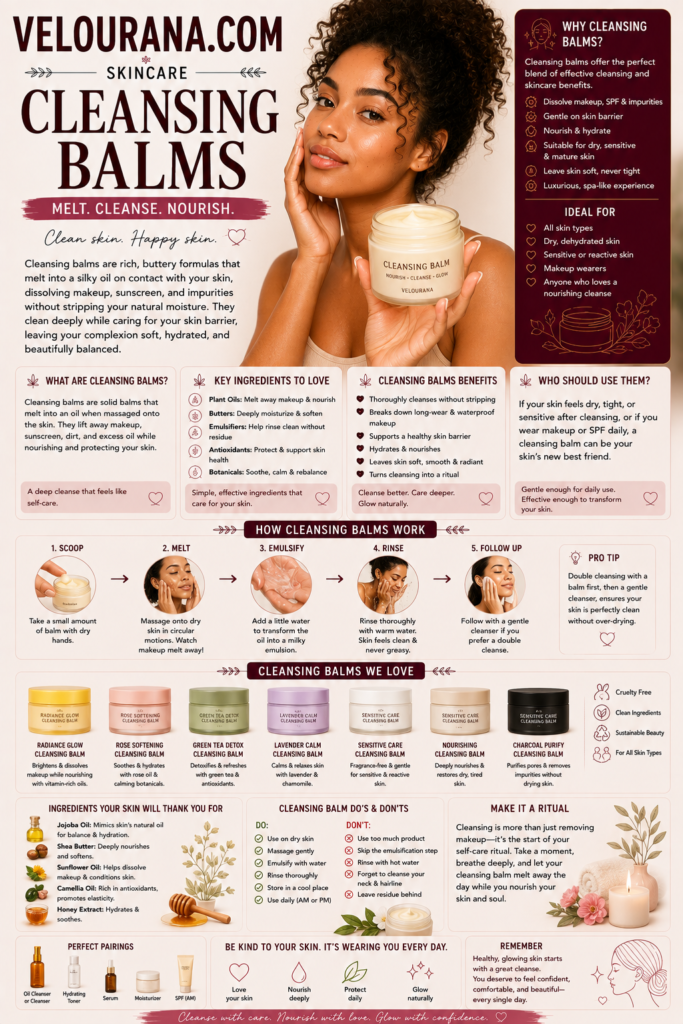
CATEGORY: Cleansing Balms
Dry and sensitive-feeling skin often creates a peculiar contradiction around cleansing. The skin still needs to be cleaned. Sunscreen has to come off. Makeup has to be removed. Sweat, sebum, environmental particles, and the residues of the day cannot simply be ignored. Yet the very act of cleansing can become one of the most uncomfortable parts of the routine.
For some people, the problem appears immediately. The face feels tight before it has even been dried. Others notice stinging, roughness, flaking, or a sensation that moisturizer is urgently required the moment cleansing ends. Sometimes the skin looks calm while still feeling uncomfortable. In other cases, repeated cleansing gradually produces visible redness and a sense that almost every subsequent product suddenly feels stronger.
This is where cleansing balms can be particularly useful.
Their value does not come from the fact that they are rich, luxurious, or fashionable. It comes from the way they approach removal. Rather than relying primarily on a water-based cleansing environment from the first moment of contact, cleansing balms begin with an oil-rich phase capable of loosening sunscreen, makeup, sebum, and other lipophilic material before water is introduced.
For dry or easily irritated skin, this can change the entire character of cleansing.
The goal becomes less about stripping the surface until nothing remains and more about selectively removing what needs to leave while minimizing unnecessary disturbance to the skin beneath.
That distinction is especially important for anyone whose skin already struggles to retain comfort.
Dry Skin Is Not Simply Skin That Needs More Moisturizer
Dry skin is often treated as though it were merely a shortage of cream.
Apply more moisturizer and the problem should disappear.
The reality is more complicated.
The outermost layer of skin, the stratum corneum, functions as a barrier. It contains corneocytes embedded within an organized lipid environment that helps control water movement and protect the deeper skin from external exposure.
When this barrier is functioning well, skin can maintain water more efficiently and tolerate ordinary environmental challenges with relatively little discomfort.
When barrier function is compromised, water can escape more easily and irritants may penetrate more readily. The surface can become rough, flaky, tight, and reactive.
Cleansing interacts directly with this structure.
Every cleansing step is deliberately designed to remove material from the surface, but the difference between a well-tolerated cleanse and an excessively aggressive one lies partly in how selectively that removal occurs.
The cleanser should remove sunscreen, makeup, excess sebum, environmental debris, and other unwanted material.
It should not treat the skin's entire lipid environment as contamination.
This is one reason why people with dry skin can become trapped in a cycle of over-cleansing followed by over-compensation.
The face is washed until it feels extremely clean. That sensation is actually tightness. Rich moisturizer is then applied to repair the discomfort created minutes earlier. The routine appears logical because the moisturizer temporarily restores softness, but the cleansing step continues recreating the same problem every evening.
A gentler cleansing strategy can interrupt that cycle before moisturizer even enters the picture.
Sensitive Skin Changes the Threshold for What Feels Acceptable
Sensitivity adds another layer.
People use the word “sensitive” to describe many different experiences: easy redness, stinging, burning, itching, intolerance to fragrance, reactions to environmental conditions, discomfort after cleansing, or unpredictable responses to otherwise ordinary cosmetics.
Not all of these experiences have the same cause.
But they share one practical consequence: the margin for unnecessary irritation becomes smaller.
A cleansing method that feels perfectly acceptable on resilient skin may feel harsh on skin that is already reactive.
This makes technique just as important as formulation.
Hot water, excessive rubbing, rough washcloths, repeated cleansing, long massage, strong fragrance, and overly aggressive second cleansers can all turn an otherwise reasonable routine into an uncomfortable one.
The instinctive response is sometimes to cleanse less effectively.
Someone with reactive skin may avoid cleansing thoroughly because previous attempts have caused discomfort. Sunscreen is then incompletely removed. Makeup residue remains near the eyes or hairline. The person is forced to choose between feeling dirty and feeling irritated.
A well-formulated cleansing balm can offer a third option.
It can help make thorough cleansing gentler by allowing resistant products to dissolve before significant friction is required.
The Difference Between Dissolving and Scrubbing
This is perhaps the most important reason cleansing balms suit dry and sensitive-feeling skin.
They can reduce the amount of physical force needed to remove persistent material.
Consider long-wearing foundation around the nose.
If the cleanser cannot efficiently loosen it, the fingers or cloth have to compensate. The same area may be rubbed repeatedly until the pigment disappears.
Now consider waterproof mascara.
If it resists the cleansing medium, lashes may be pulled, eyelids rubbed, and the delicate surrounding skin repeatedly stretched.
The cleanser has failed to do enough of the work, so the user's hands are forced to do more.
A cleansing balm changes the sequence.
The balm is spread across dry skin and allowed to interact with the cosmetic film. Makeup begins to dissolve into the oily cleanser. Sunscreen loosens. Sebum disperses.
Only gentle movement is needed to distribute the product and encourage contact.
The difference can be profound.
Instead of friction being the primary mechanism of removal, chemistry takes a larger share of the burden.
For skin that becomes irritated easily, that shift is not merely more comfortable.
It is strategically important.
Why Balm Texture Can Help Reduce Tugging
The texture of a cleansing balm is often discussed in sensory terms.
It feels buttery.
It melts beautifully.
It creates a spa-like ritual.
Those observations are not wrong, but they can make texture sound purely decorative.
In reality, slip changes how the hands interact with the face.
Once warmed, a well-designed balm should spread with relatively little resistance. The fingers glide rather than drag.
That matters because dry skin often lacks the naturally lubricated feel of oilier skin. Attempting to massage a thin cleanser across a dry-feeling surface can create noticeable friction.
A balm supplies temporary slip during the exact stage when resistant sunscreen and makeup are being loosened.
This does not mean vigorous massage becomes harmless.
Pressure still matters. Duration still matters. A cleansing balm should not be used as permission to knead irritated skin for ten minutes.
But a product that spreads smoothly makes gentle movement easier.
That is a practical formulation advantage rather than merely a luxury characteristic.
A Cleansing Balm Should Not Need Aggressive Heat
Another common assumption is that balm cleansing requires very warm water.
The reasoning seems intuitive.
Heat melts oil, so hotter water must make the cleanser work better.
But the balm has already been designed to soften with body temperature and mechanical movement.
There is rarely a need to subject the face to very hot water.
For dry and sensitive-feeling skin, excessive heat can be particularly unpleasant. Hot water may intensify redness, increase the sensation of dryness, and turn an otherwise mild routine into a stressful one.
Lukewarm water is generally enough.
The balm should melt through contact with the hands and face. The emulsifying stage should occur when water is introduced. The rinse should remove the cleanser without requiring heat as an additional cleansing force.
A useful rule is simple.
If the water feels dramatically hot, it is probably hotter than the cleansing process requires.
The Emulsification Stage Matters Even More for Sensitive Skin
A cleansing balm can feel extremely gentle while it is being massaged.
The real test, however, comes during removal.
If the product refuses to emulsify effectively, the user may end up compensating with prolonged rinsing or repeated wiping.
That defeats much of the purpose.
A balm that suits sensitive-feeling skin should ideally transform efficiently when water is introduced.
The process usually begins by wetting the fingertips and gently moving them across the oily surface.
The balm thins.
It may become cloudy or milky.
The previously oil-rich layer starts dispersing into water.
More water can then be incorporated before thorough rinsing.
This stage is important because the balm is no longer carrying only its own ingredients.
It is also carrying dissolved sunscreen, makeup, sebum, and other debris.
Effective emulsification allows the entire mixture to leave the skin more easily.
A product that remains stubbornly waxy or greasy may require a cloth for removal.
Some people enjoy this.
Others, particularly those with reactive skin, may find that repeated cloth contact becomes unnecessary mechanical stress.
Rinsability is therefore a meaningful consideration when choosing a balm for sensitive skin.
The richest texture is not automatically the gentlest option.
Sometimes the more elegant formula is the one that leaves with the least persuasion.
Rich Does Not Automatically Mean Barrier-Friendly
The visual and tactile language of cleansing balms strongly encourages one assumption.
Thick equals nourishing.
This is not necessarily true.
A balm can be dense because of waxes, butters, fatty materials, polymers, or structural ingredients used primarily to create texture.
Another balm can feel lighter while still containing an effective emollient system.
The finished behavior of the formula matters more than the apparent richness in the jar.
The same applies to the after-feel.
A balm that leaves a noticeable film may feel comforting on dry skin.
But residue should not automatically be interpreted as repaired barrier function.
Some formulas are intentionally designed to leave emollient material behind.
Others rinse more completely.
Both approaches can work.
The question is whether the finish supports the user's skin and routine.
If the residue feels soothing and does not contribute to congestion, irritation, or discomfort, there may be no problem.
If the face feels coated, the eyes become blurry, or subsequent skincare sits poorly, the formula may simply be too persistent.
A cleanser does not become better merely because more of it remains on the skin.
Fragrance Can Complicate an Otherwise Beautiful Formula
Cleansing balms are often among the most fragranced products in skincare.
This makes commercial sense.
The format is strongly associated with ritual and sensory pleasure. Citrus, floral, herbal, and spa-like aromas can make the act of cleansing feel deliberate and indulgent.
For some users, fragrance presents no difficulty at all.
For others, particularly those with reactive or sensitized skin, it can complicate an otherwise excellent formula.
This does not mean fragrance is universally harmful.
It means tolerance varies.
Someone who repeatedly experiences stinging, redness, itching, or discomfort with fragranced skincare may prefer a cleansing balm without added fragrance.
Essential oils deserve similar caution.
The fact that an ingredient is botanical does not guarantee that it will be gentle.
Plant-derived aromatic compounds can still irritate susceptible skin.
The ideal formula for sensitive-feeling skin is often not the one with the most botanical drama.
It may be the one that simply cleans, emulsifies, rinses, and leaves the skin comfortable.
The Eye Area Often Reveals Whether a Balm Is Truly Gentle Enough
A cleansing balm may seem perfectly mild until it reaches the eyelids.
The eye area is less forgiving.
The skin is delicate, the eyes themselves are vulnerable to migrating cleanser, and makeup can be particularly resistant.
For someone with sensitive skin, this is where patience becomes more important than pressure.
If the balm is approved for use around the eyes, it can be gently spread over closed lids and lashes.
Rather than rubbing immediately, allowing brief contact can help the formula soften waterproof mascara and long-wearing liner.
Small, controlled movements are usually more appropriate than vigorous circular massage.
The goal is not to create dramatic black streaks across the face.
The goal is to loosen makeup while minimizing unnecessary manipulation.
If the product repeatedly causes burning, prolonged cloudiness, or irritation, it is not the right eye cleanser for that person.
The fact that it works beautifully on the cheeks does not change that.
Different areas of the face can have different tolerances.
Double Cleansing Should Not Become Automatic
Dry and sensitive skin are particularly vulnerable to skincare rules that are followed without questioning whether they are necessary.
Double cleansing is a good example.
Using a cleansing balm followed by a water-based cleanser can be an excellent method.
The balm removes sunscreen, makeup, and oily debris.
The second cleanser removes remaining residue and produces a fresh finish.
But the usefulness of the second cleanse depends on whether the first cleanse actually leaves something behind that needs removal.
If the balm emulsifies well, removes the day's products completely, and leaves the skin comfortable, automatically adding another cleanser may contribute little.
For dry skin, it may simply increase the cumulative cleansing load.
The appropriate strategy is observational.
After rinsing the balm, look at the hairline.
Check around the nose.
Look beneath the jaw.
Observe the eye area.
Notice whether the surface feels coated.
If makeup remains or the balm leaves residue that feels unpleasant, a second gentle cleanse makes sense.
If everything is clean and comfortable, stopping may be perfectly reasonable.
Skincare routines should respond to the skin and the products being used.
They should not exist solely to satisfy ritual.
When a Second Cleanser Is Useful, Mildness Matters
There are situations where a second cleanser is desirable even for dry skin.
Heavy makeup is one.
Water-resistant sunscreen is another.
A balm with a particularly emollient finish may also leave more residue than desired.
In these cases, the second cleanser should complement the balm rather than undo its gentleness.
A very harsh foaming cleanser can turn the sequence into an odd contradiction.
The first step carefully dissolves makeup while minimizing friction.
The second then leaves the skin tight and uncomfortable.
A mild water-based cleanser is often more logical.
The objective is simply to remove what remains.
There is no need to create an aggressively degreased finish.
This is especially important for anyone using retinoids, exfoliating acids, benzoyl peroxide, or other potentially irritating treatments.
The skin may already be managing significant active ingredients.
A calm cleansing stage can improve the overall tolerability of the routine.
More Product Does Not Necessarily Mean Gentler Cleansing
People often use more cleansing balm than necessary because the product feels pleasant.
A generous scoop can create an exceptionally slippery massage.
But excessive product creates a larger oily phase that must eventually be emulsified and rinsed.
This can make removal more difficult.
The correct amount varies with the formula and with how much makeup is being worn.
A person removing full-coverage foundation and waterproof eye makeup may need more than someone wearing only sunscreen.
The useful amount is enough to create smooth glide across the entire face without dragging.
Once that threshold is reached, additional product may offer little advantage.
Using enormous quantities can even lead to more prolonged rinsing or more dependence on a cloth.
Gentleness is not measured by how thickly the balm is applied.
It is measured by how efficiently the whole process works.
The Cloth Question
Some cleansing balms are traditionally associated with a warm muslin cloth or soft flannel.
This can be pleasant and effective.
It can also introduce mechanical exfoliation whether the user intends it or not.
For resilient skin, gentle cloth removal may present no difficulty.
For dry, irritated, or sensitized skin, repeated rubbing can become excessive.
If a cloth is used, softness matters.
Pressure matters more.
The cloth should lift away residue rather than polish the face.
Repeated scrubbing across flaky skin can be especially tempting because it temporarily removes visible flakes.
But those flakes are often a sign that the barrier is already struggling.
Aggressively rubbing them away may make the underlying irritation worse.
Sometimes the gentlest choice is simply to emulsify thoroughly and rinse with the hands.
A cloth is a tool.
It is not a mandatory component of balm cleansing.
Dryness Around the Nose and Mouth Deserves Special Attention
People with dry or sensitive skin often experience uneven comfort across the face.
The cheeks may tolerate cleansing well while the corners of the nose sting.
The area around the mouth may become rough.
The eyelids may react while the forehead remains perfectly comfortable.
This makes uniform technique less useful than responsive technique.
Areas wearing substantial sunscreen or makeup still need cleansing.
But they may not all need the same massage duration or pressure.
Around the nose, gentle contact is preferable to repeated rubbing into the creases.
Around the lips, persistent long-wear color should be given time to dissolve rather than scraped away.
Around the eyes, patience matters even more.
The balm format is useful precisely because it allows this variation.
It remains workable long enough to adapt the technique to different regions.
Cleansing After Retinoids and Exfoliating Treatments
Dryness and sensitivity can be particularly noticeable in routines containing retinoids or chemical exfoliants.
These products are often introduced specifically because someone wants meaningful changes in acne, pigmentation, texture, or visible aging.
But they can also increase irritation when used too aggressively.
One of the easiest ways to make such a routine harder to tolerate is to begin every evening with harsh cleansing.
The cleanser is not the treatment.
It should not compete with the treatment by creating additional irritation.
A cleansing balm can be useful here because it allows sunscreen and makeup to be removed efficiently without demanding force.
If a second cleanser is used, keeping it mild becomes especially important.
The entire routine should be viewed cumulatively.
A product that is “gentle” in isolation can still become part of an irritating routine if several other steps are simultaneously aggressive.
Skincare tolerance depends on the whole system.
When Skin Is Actively Irritated
There is a difference between naturally dry skin and skin that is actively inflamed.
If the face is burning, cracked, severely red, weeping, or experiencing a significant dermatitis flare, routine cosmetic experimentation may be inappropriate.
Even normally well-tolerated products can sting compromised skin.
In these situations, simplicity is usually more sensible than trying multiple new cleansing balms in search of the perfect one.
Professional medical guidance may also be appropriate when irritation is persistent, severe, unexplained, or recurrent.
A cleanser can support a healthy routine.
It cannot diagnose or treat every condition that causes sensitivity.
The Morning Cleanse May Need to Be Different
Someone who benefits from a cleansing balm at night does not automatically need the same degree of cleansing in the morning.
The evening routine has a specific burden.
It needs to remove the day's sunscreen, makeup, environmental exposure, and accumulated products.
The morning face has a different history.
It may contain overnight moisturizer, natural sebum, and perspiration, but not necessarily long-wear cosmetics or sunscreen films.
Dry skin may tolerate a very mild morning cleanser better than a full double cleanse.
Some people prefer simply rinsing with water.
Others need a gentle cleanser because of overnight products or personal comfort.
There is no universal morning rule.
The useful principle is proportionality.
Cleansing intensity should match what actually needs to be removed.
Cleansing Balms and Seasonal Dryness
Skin behavior changes with environment.
Winter air, indoor heating, cold wind, and lower humidity can make cleansing feel harsher than it did during summer.
A cleanser that felt perfectly acceptable in humid weather may suddenly leave the face tight.
Cleansing balms can become particularly appealing in colder months because they offer a richer cleansing experience without necessarily requiring stronger surfactant action.
But seasonal adjustment does not always require changing products completely.
Using less second cleanser, reducing water temperature, shortening cleansing time, or temporarily avoiding a washcloth may be enough.
The routine can adapt.
Skincare does not need to remain identical twelve months a year.
Sensitive Skin Benefits From Consistency More Than Constant Experimentation
The beauty market rewards novelty.
New textures, botanical blends, fragrance profiles, and cleansing technologies constantly appear.
For someone with sensitive skin, the temptation to test everything can become counterproductive.
A cleanser that works reliably is valuable.
If a cleansing balm removes sunscreen, does not sting, rinses well, and leaves the skin comfortable, there may be little reason to replace it simply because another product has a more fashionable ingredient list.
Sensitive skin often benefits from reducing variables.
This makes it easier to understand what is helping and what is causing problems.
Consistency is not boring when it protects skin stability.
How to Judge the Skin After Cleansing
The moments after rinsing reveal more than the texture of the balm inside the jar.
A good result should feel unremarkable in the best possible way.
The face should feel clean.
There should be no visible makeup residue.
Sunscreen should no longer feel present.
The hairline and jaw should not remain coated.
At the same time, the skin should not feel painfully tight.
It should not burn.
It should not become progressively red from the cleansing process.
The eyes should not remain irritated.
A slight emollient after-feel may be perfectly acceptable depending on preference.
The key question is whether the skin feels comfortable enough to proceed with the rest of the routine without needing immediate rescue.
That is a much more meaningful standard than whether the face squeaks when touched.
The Most Effective Balm May Be the Least Dramatic One
There is a tendency to celebrate skincare products that create obvious sensations.
Cooling.
Warming.
Tingling.
Foaming.
Polishing.
Deep cleansing.
Dry and sensitive skin often benefits from the opposite.
The best cleansing balm may be the one that creates very little drama.
It melts.
It spreads.
It dissolves sunscreen and makeup.
It emulsifies.
It rinses.
The face remains calm.
Nothing spectacular happens.
And that can be exactly the point.
Cleansing Should Preserve the Possibility of Comfort
For dry and sensitive-feeling skin, cleansing is often treated as an unavoidable compromise.
Either remove everything thoroughly and accept discomfort, or cleanse gently and worry that sunscreen and makeup remain behind.
Cleansing balms challenge that assumption.
Their oil-rich structure allows them to approach resistant material in a way that reduces the need for physical force.
Their emulsifying systems make it possible to convert that oily mixture into something water can carry away.
Their slip can reduce tugging.
Their slower working time can encourage deliberate rather than frantic cleansing.
But none of these advantages are automatic.
A balm can still contain irritating fragrance.
It can still leave too much residue.
It can still be used with excessively hot water.
It can still become part of an over-cleansing routine.
The format creates the possibility of gentleness.
Good formulation and thoughtful technique determine whether that possibility becomes reality.
The Real Luxury Is Skin That Feels Normal Afterwards
Cleansing balms are often sold through the language of luxury.
Silky textures.
Botanical oils.
Spa-inspired aromas.
Elegant jars.
There is pleasure in all of that.
But for someone whose skin is dry, tight, or easily irritated, the most meaningful luxury is far less theatrical.
It is washing the face and feeling comfortable afterward.
It is removing sunscreen without burning.
It is dissolving mascara without rubbing the eyelids raw.
It is finishing cleansing without immediately feeling that the skin has been stripped of everything protective.
This is where the cleansing balm earns its place.
Not because it is inherently superior to every other cleanser, but because its structure offers an intelligent way to separate thorough cleansing from aggressive cleansing.
For dry and sensitive-feeling skin, that separation can transform the beginning of the skincare routine.
The cleanser stops being something the moisturizer must compensate for.
Instead, it becomes part of maintaining the comfort that every later step is trying to support.
The End Velourana
 Discover More From Our Family of Websites
 ZodiacBearing (Astrology, Tarot, Numerology, Angel Numbers & Spiritual Guidance)
 Velourana (Beauty, Makeup, Hair Care, Skincare & Beauty Tips)
 HavenBearing (Home, Living, Organization, Décor & Everyday Inspiration)
 PawBearing (Pet Care, Dog Breeds, Animal Health, Training & Pet Products)
 PsyCatherine (Notes From the Journal of a Psychologist on Real Life)