
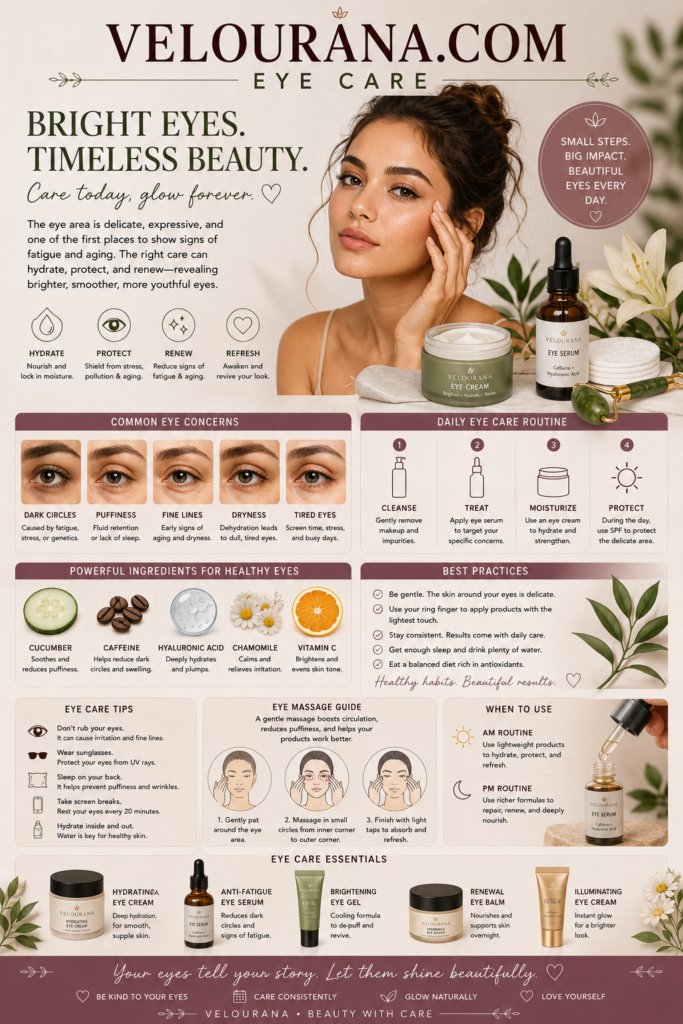
CATEGORY: Eye Serums
Eye serum is one of those beauty categories that appears deceptively simple on the shelf. The bottles are small, the textures are often featherlight, and the application area occupies only a fraction of the face. Yet choosing one intelligently can demand more thought than selecting an ordinary moisturizer because the eye contour combines several characteristics that make cosmetic treatment unusually nuanced.
Darkness beneath the eyes may have little to do with pigmentation. Puffiness may be temporary fluid accumulation or persistent anatomy. Fine lines can reflect age, sun exposure, facial movement, or simple dehydration. Dryness may improve dramatically with barrier support, while the same rich formula can feel unnecessarily heavy on another person. An ingredient celebrated for facial skincare may become uncomfortable when placed too close to the eyes.
The modern eye serum attempts to navigate this territory through targeted formulation. Some products concentrate on water-binding ingredients. Others are built around peptides, caffeine, antioxidants, niacinamide, or carefully formulated retinoid systems. Increasingly, formulas combine several approaches in an effort to address the fact that real eye concerns rarely occur in isolation.
Selecting among them becomes easier once eye serum is understood not as a miniature miracle treatment but as a precision layer within a larger skincare routine.
Begin With What the Eye Area Is Actually Showing
Beauty marketing often begins with product categories. Effective skincare begins with observation.
Someone looking into the mirror and seeing "dark circles" may actually be seeing several different phenomena. Brown discoloration can reflect increased pigment. Blue or purple tones may be influenced by vascular visibility through thin skin. A deep tear trough can cast a shadow that changes according to lighting. Thinness, dehydration, allergies, rubbing, inflammation, and hereditary facial characteristics can contribute simultaneously.
This explains why two people who both describe themselves as having dark circles can respond very differently to the same serum.
The same principle applies to puffiness. Temporary swelling after sleep may fluctuate substantially during the day. Persistent bags caused by structural characteristics are much less responsive to topical cosmetics. A caffeine serum designed to improve the appearance of tired, temporarily puffy under-eyes should therefore not be judged against a problem it cannot anatomically correct.
Fine lines are similarly diverse. When dehydration is prominent, improving water content can soften the surface relatively quickly. Established expression lines and photoaging are different. These may benefit cosmetically from sustained use of ingredients such as retinoids or peptides, but no topical serum can prevent the skin from moving when the face expresses emotion.
Understanding the concern prevents the common mistake of choosing the strongest or most expensive eye serum instead of the most relevant one.
The Hydration-First Philosophy
Hydration deserves more respect in eye care than it sometimes receives. Because it sounds less technologically exciting than peptides or retinoids, it can be treated as a basic benefit rather than an important intervention. Yet the appearance of the eye area can change considerably when dehydrated skin becomes properly supported.
Humectants such as glycerin and hyaluronic acid are common serum ingredients because they help attract and retain water. A hydrated stratum corneum is more flexible and can reflect light more evenly, making the surface appear smoother. Fine lines caused or exaggerated by dehydration may consequently become less obvious.
The effect is cosmetic rather than architectural, but that does not make it insignificant.
A lightweight hydrating eye serum can be especially useful for people who dislike traditional creams. Gel-serum textures can supply moisture without creating a heavy film, which is valuable beneath makeup or during warm weather. They may also be easier to combine with sunscreen because there is less material competing on the skin's surface.
Very dry eye contours, however, frequently need more than humectants. Water attracted into the upper skin layers can still be lost if barrier function is compromised or the environment is exceptionally dry. A compatible cream applied after the serum can introduce emollient and occlusive support.
This illustrates the logic behind layering: each product should perform a distinct function.
A hydrating serum followed by a modest amount of cream can sometimes feel more elegant than one extremely rich eye treatment. Conversely, if a single cream already keeps the area comfortable and smooth, adding a serum simply because skincare routines are supposed to contain one may accomplish very little.
Eye serum is optional. Appropriate care is not.
When Peptides Become the Main Attraction
Peptide eye serums occupy a major portion of the contemporary market because peptides fit neatly into the desire for effective but tolerable age-supportive skincare.
Peptides are composed of amino acids and occur in many forms. In cosmetic formulations, particular peptides may be selected for signaling, conditioning, or other proposed skin-supportive functions. Scientific reviews of common eye-product ingredients describe potential roles for peptides in hydration and collagen-related support, although evidence varies according to the specific ingredient and formulation.
This variation is important. A label containing the word "peptide" tells only part of the story.
The complete formulation determines whether the product is pleasant enough to use consistently, whether its ingredients remain stable, and whether concentrations and delivery systems are appropriate. Proprietary peptide complexes can sound impressive, but marketing terminology should not replace evaluation of the product as a whole.
Peptide eye serums are often particularly attractive to users who want long-term support without immediately moving toward more irritation-prone actives. They can coexist with humectants, niacinamide, antioxidants, and soothing ingredients, allowing manufacturers to create multifunctional formulas with relatively elegant textures.
The realistic objective is gradual improvement in the appearance and condition of the skin, not dramatic tightening in minutes.
Temporary tightening can occur with certain film-forming cosmetic ingredients, but that optical effect should be distinguished from long-term biological change. A serum that creates an immediate taut sensation is not necessarily rebuilding the structure of the eye contour.
Good evaluation separates sensation from evidence.
Caffeine Works Best When the Concern Matches the Ingredient
Caffeine has almost become synonymous with de-puffing eye products. Its popularity has produced countless serums designed for morning use, often in water-light formulations that disappear rapidly beneath concealer.
There is logic behind the association, and caffeine is included among ingredients studied for periorbital concerns. Yet the word "puffiness" again needs qualification.
If the eye area is visibly fuller on waking and becomes less swollen over the following hours, a caffeine-based serum may be a reasonable cosmetic choice. Cooling the product can add a refreshing sensation, although extreme cold is unnecessary. Gentle application is preferable to vigorous massage, particularly on sensitive skin.
Persistent anatomical bags are another matter. No caffeine concentration can remove protruding fat pads or significantly remodel the structural architecture beneath the skin.
Marketing can blur this distinction by using before-and-after photographs taken under conditions that emphasize temporary change. Consumers benefit from judging a caffeine serum according to plausible endpoints: does the eye area look somewhat fresher, less temporarily puffy, or better hydrated? Does the formula sit comfortably beneath other products? Is the improvement repeatable?
Those questions are more useful than asking whether the serum has "removed eye bags."
Caffeine formulas are also often marketed for darkness. They may be most relevant when vascular appearance or transient congestion contributes, while pigment-related darkness may require a different strategy. Structural shadowing will remain largely outside the reach of topical treatment.
The eye contour is one of the clearest examples of why diagnosis matters even in cosmetic skincare.
Niacinamide and Antioxidants for a More Balanced Approach
Not every eye serum needs a dramatic hero ingredient. Some of the most useful formulations rely on ingredients that quietly address several aspects of skin function.
Niacinamide is an example. It is associated with barrier support, hydration, and improvements in uneven-looking pigmentation and texture. These characteristics make it well suited to formulations intended for people who want a brighter, healthier-looking eye area without relying entirely on aggressive exfoliation.
Antioxidants play another supporting role. The eye area, like the rest of exposed facial skin, experiences environmental oxidative stress. Vitamin C and vitamin E derivatives, green-tea components, and other antioxidant systems may be incorporated into serums to complement daily photoprotection and improve overall skin appearance.
Antioxidant claims require sensible interpretation. They do not replace sunscreen, and they do not create an invisible shield capable of neutralizing every environmental exposure. Their role is supportive.
Vitamin C also illustrates why ingredient names alone can be misleading. Pure ascorbic acid has different formulation requirements from vitamin C derivatives. Concentration, pH, packaging, stability, and accompanying ingredients influence the final experience. A dedicated eye formula may choose a derivative or delivery system designed with tolerance in mind.
The most aggressive facial brightening serum is therefore not automatically the best eye brightening serum.
This principle becomes increasingly important as routines grow more complex. A person may already use vitamin C in the morning, a retinoid at night, exfoliating acids periodically, and niacinamide within a moisturizer. Adding eye products that duplicate all these actives can turn a carefully designed routine into unnecessary chemical congestion.
Sometimes the eye area needs fewer actives than the rest of the face, not more.
Retinoid Eye Serums and the Importance of Restraint
For people primarily concerned with visible photoaging and fine lines, retinoids are difficult to ignore. Decades of dermatological research support the broader role of topical retinoids in photoaged skin, and studies of certain periorbital formulations have also reported improvements in visible lines, texture, darkness, puffiness, and dryness over periods such as twelve weeks.
But efficacy and tolerability are inseparable around the eyes.
Retinoids can cause irritation. Periorbital skin is particularly unforgiving when a treatment produces excessive dryness, scaling, or inflammation. Published medical literature includes cases of periorbital dermatitis associated with topical retinoic acid, reinforcing the need for caution.
A dedicated retinoid eye serum or treatment should therefore be approached as a long-term intervention rather than a challenge to see how much active ingredient the skin can endure.
Starting conservatively allows the skin's response to become visible. If the manufacturer's directions permit gradual introduction, that can be more sensible for a new user than immediate aggressive use. Applying an unnecessarily large quantity does not proportionally increase benefit. It mainly increases the amount available to migrate, irritate, or interfere with other products.
The surrounding routine should become gentler when necessary. Strong exfoliating acids placed near the same area, harsh cleansing, or multiple retinoid products may undermine tolerability.
Moisture support can be particularly valuable. A retinoid eye treatment does not need to exist in opposition to hydration; the two objectives can complement each other. Maintaining comfort allows consistent use, and consistency is usually more valuable than repeatedly stopping and restarting because the skin has become irritated.
Persistent burning, marked redness, swelling, or dermatitis is not an acceptable price for cosmetic improvement.
Layering Without Turning the Eye Area Into a Product Shelf
Layering is often presented as an elaborate sequence, but the underlying logic is simple. Products need to coexist comfortably on the skin while allowing the most treatment-focused formulas to reach the intended area.
A lightweight eye serum usually fits naturally after cleansing and before a richer eye cream or facial moisturizer. Exact placement can vary according to formula, and manufacturer directions should take precedence. Sunscreen remains the final essential protective stage of a daytime skincare routine on exposed skin.
The amount applied is small. More layers do not necessarily mean more results.
Problems often begin when multiple eye products are stacked without a clear purpose. A caffeine serum, peptide serum, retinoid serum, brightening serum, eye cream, balm, primer, concealer, and sunscreen can create an impressive collection but a difficult surface. Pilling, migration, irritation, heaviness, and makeup instability become increasingly likely.
A more coherent approach chooses one central treatment objective and builds around it.
A morning eye serum might emphasize hydration, caffeine, antioxidants, or cosmetic smoothness because it needs to cooperate with sunscreen and makeup. An evening formula might concentrate more strongly on long-term treatment, such as peptides or an appropriately formulated retinoid.
Even this division is optional. One well-formulated serum may work morning and evening.
The best routine is not the routine with the most stages. It is the routine that can be repeated comfortably for months.
Eye Serum Beneath Makeup
The relationship between eye skincare and makeup deserves particular attention because under-eye concealer is highly sensitive to surface preparation.
Too little hydration can cause concealer to catch on dry patches and exaggerate fine lines. Too much emollience can make concealer slide, crease, or separate. A tacky serum can interfere with blending, while excessive layers may pill when pigments are applied.
A lightweight eye serum can occupy the useful middle ground.
Hydrating formulas can create a smoother, more flexible surface without the heavy residue of a rich cream. Allowing the serum to settle before makeup reduces the likelihood of mixing wet skincare directly into concealer. If additional cream is needed, a very small quantity may be enough.
The desired finish also matters. Matte concealers tend to expose dehydration more readily, while highly emollient concealers may need less skincare beneath them. There is therefore no universal preparation ritual.
This is where cosmetic elegance becomes part of efficacy. A serum can contain excellent ingredients yet fail as a morning product because it pills beneath sunscreen or makes the eyes water. Another formula with a simpler ingredient list may become more useful because it integrates seamlessly into daily life.
Products only work when people can comfortably use them.
Upper Eyelids, Lash Lines, and Product Migration
One of the most important differences between ordinary facial serum and eye serum is placement.
The term "eye area" does not automatically mean every surface surrounding the eyeball. Some formulas are intended primarily for the orbital bone and under-eye region. Others are specifically tested or marketed for upper eyelid use. Directions vary considerably.
Unless instructions clearly permit it, applying treatment directly along the lash line or extremely close to the ocular surface is unnecessary. Facial movement and body warmth can cause products to migrate after application.
This is particularly relevant with stronger active formulas.
People sometimes believe that applying a serum closer to the eye will improve dark circles or lines more effectively. In reality, proximity beyond the intended application zone can simply increase the chance of discomfort.
Watery eyes after skincare should not be normalized. Neither should persistent stinging.
If a product repeatedly migrates into the eyes despite conservative application, it may simply be unsuitable for that person's routine, regardless of how attractive the formula appears on paper.
Contact-lens wearers and people with ocular sensitivity may need to be especially attentive to migration and residue. Significant or persistent eye symptoms belong with an appropriate healthcare professional rather than cosmetic troubleshooting.
The goal is better-looking skin around comfortable eyes, not better-looking skin at their expense.
Sensitive Skin Requires Editing Rather Than Fear
Sensitive eye areas do not necessarily need to avoid all serums. They need better selection and slower experimentation.
A formula emphasizing hydration and barrier support may be a logical beginning. Complex combinations of exfoliating acids, strong retinoids, fragrance, and numerous botanical extracts may be more difficult to troubleshoot if a reaction develops.
Yet ingredient minimalism is not a guarantee of tolerance. A person can react to a single ingredient just as readily as to one component within a long formula. Allergic contact dermatitis is individual.
Patch-testing strategies can sometimes help identify problematic cosmetics, and recurrent eyelid dermatitis may require professional patch testing because the offending substance may not be the eye serum itself. Dermatological sources note that allergens and irritants can reach the periocular area indirectly, including through transfer from the hands.
This explains some otherwise puzzling reactions. Nail products, hair products, fragrances, eye makeup, cleansers, and ophthalmic preparations can all become relevant when investigating persistent irritation.
When the eye contour suddenly becomes reactive, simplifying the entire surrounding routine can reveal more than repeatedly replacing one eye cream with another.
Sensitivity should encourage precision, not panic.
Evaluating Claims With Better Expectations
Eye skincare attracts ambitious promises because consumers care deeply about this part of the face. Terms such as lifting, tightening, erasing, filling, resurfacing, brightening, de-puffing, and rejuvenating can appear together on a package small enough to fit in the palm of a hand.
Some formulations genuinely improve the appearance of the eye contour. The difficulty lies in translating cosmetic claims into realistic expectations.
Hydration can make dehydrated lines less visible. Certain retinoid formulations can gradually improve signs of photoaging. Peptides may support smoother and firmer-looking skin. Caffeine can be useful in formulas targeting temporary puffiness. Niacinamide and antioxidant ingredients can contribute to a brighter and more even appearance.
None of these mechanisms is equivalent to surgery, injectable filler, neuromodulator treatment, laser resurfacing, or other medical aesthetic procedures.
A topical serum cannot physically remove excess eyelid skin. It cannot permanently reposition fat. It cannot rebuild lost skeletal volume. It cannot stop facial muscles from forming expressions.
Understanding these boundaries does not diminish skincare. It protects skincare from impossible expectations.
The value of a serum can be substantial when measured against the right objective: healthier-looking, more comfortable, better hydrated, smoother, brighter, and better-supported skin.
Time Is an Ingredient Too
One of the least marketable aspects of skincare is time.
Immediate hydration is possible because changes in the superficial water content of skin can occur quickly. A cooling serum can feel refreshing within minutes. Film-forming ingredients may temporarily change surface smoothness.
Long-term improvements are different.
Clinical studies of periorbital treatments frequently evaluate participants over eight, twelve, or more weeks because structural and pigment-related changes require repeated use. A product that promises meaningful long-term transformation overnight should therefore be viewed with caution.
Consistency also needs to be interpreted intelligently. Applying a product regularly is valuable when the skin tolerates it. Continuing through persistent inflammation is not.
Photographs can help evaluate progress, provided they are taken under comparable conditions. Morning versus evening, bright overhead lighting versus window light, smiling versus neutral expression, and makeup versus bare skin can make the same eye contour appear dramatically different.
A fair evaluation should therefore be almost boring in its consistency: similar lighting, similar angle, similar expression, and enough time between comparisons.
That discipline protects consumers from both exaggerated disappointment and imagined improvement.
The Eye Serum as Part of the Whole Face
Although eye serum is a specialized category, the eye contour does not exist independently from the rest of the face.
Cleansing affects it. Sunscreen protects it. Facial moisturizers may overlap with it. Makeup removers contact it. Retinoids and exfoliants applied elsewhere can migrate toward it. Allergies, rubbing, sleep, environmental dryness, and sun exposure influence it.
This means the quality of the overall routine often matters more than the sophistication of the eye serum.
A person using an expensive anti-aging eye treatment while routinely neglecting sun protection is working against one of the central objectives of the treatment. Someone repeatedly rubbing the eyes because makeup removal is difficult may undermine a carefully selected barrier serum. Someone whose cleanser leaves the eye contour tight may keep adding products when changing the cleansing step would be more useful.
Eye care is therefore best viewed as an ecosystem.
The serum is one component within that ecosystem, chosen because it contributes something specific that the rest of the routine does not provide efficiently.
A More Intelligent Standard for Eye Care
The growth of eye serums reflects a positive evolution in skincare when the category is approached critically. Consumers now have options beyond the traditional rich eye cream. They can choose lightweight hydration, peptide-focused formulas, caffeine treatments, antioxidant blends, brightening systems, or carefully designed retinoid products according to individual priorities.
Choice becomes valuable only when it is accompanied by discernment.
The most impressive eye serum is not necessarily the formula with the longest ingredient list, highest concentration, strongest sensation, or most futuristic marketing. It is the product whose formulation matches the concern, whose texture suits the routine, whose application is comfortable, and whose claims remain within the boundaries of what topical skincare can realistically accomplish.
For one person, that may be a simple hydrating serum beneath concealer. For another, it may be a peptide-rich evening treatment. Someone experiencing transient morning puffiness may appreciate caffeine, while a person concerned with photoaging may eventually choose a carefully tolerated retinoid formula.
There is no contradiction in these different choices because there is no single universal eye contour.
The eyes communicate expression before almost any other facial feature. The surrounding skin records movement, environment, genetics, time, and lifestyle with remarkable visibility. Caring for it does not require trying to erase every sign of that history.
The more sophisticated objective is preservation: maintaining hydration, supporting barrier function, limiting unnecessary irritation, protecting against ultraviolet exposure, and using targeted ingredients where they have a credible role.
Eye serum works best when it becomes part of that quieter philosophy. It does not need to promise a different face. It needs to help the skin surrounding the eyes look and feel as healthy, smooth, resilient, and comfortable as its biology reasonably allows.
That is a smaller promise than cosmetic fantasy offers, but it is also a far more useful one.
THE END VELOURANA
 Discover More From Our Family of Websites
 ZodiacBearing (Astrology, Tarot, Numerology, Angel Numbers & Spiritual Guidance)
 Velourana (Beauty, Makeup, Hair Care, Skincare & Beauty Tips)
 HavenBearing (Home, Living, Organization, Décor & Everyday Inspiration)
 PawBearing (Pet Care, Dog Breeds, Animal Health, Training & Pet Products)
 PsyCatherine (Notes From the Journal of a Psychologist on Real Life)

