CATEGORY: Buns
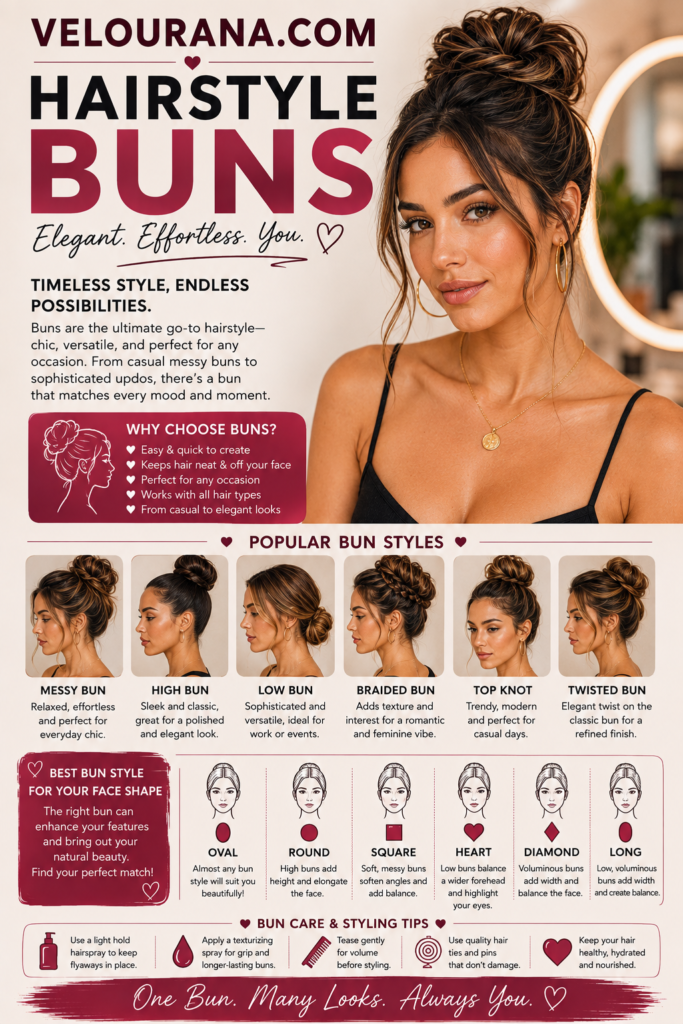
Few hairstyles demonstrate the power of placement as clearly as the bun. The basic idea could hardly be simpler: the hair is gathered, arranged around a central point and secured away from the shoulders. Yet moving that point by only a few centimeters can transform the entire appearance. A bun positioned high on the crown feels completely different from one resting quietly at the nape. A tightly controlled knot creates a different impression from a loose shape with natural texture and soft pieces around the face.
This is why the bun has never really belonged to one particular fashion period.
Its structure is too adaptable.
The same general hairstyle can be worn while exercising, working, attending an evening event or simply keeping long hair away from the face. It can look deliberately understated or become the foundation of an elaborate formal updo. It can showcase smooth, straight hair, preserve visible waves and curls, incorporate braids or twists, or allow natural texture to become the main feature of the shape.
The bun is often described as though it were one hairstyle. In reality, it is an entire family of hairstyles connected by the idea of gathering the lengths into a compact form.
What distinguishes one bun from another is not simply how the hair is wrapped.
It is where the volume sits, how tightly the roots are controlled, how much texture remains visible and how the finished shape relates to the face, neck and overall silhouette.
Placement Changes Everything
Before considering texture or technique, the position of a bun establishes much of its character.
A high bun draws the eye upward. It exposes the neck completely and can create a visually elongated silhouette. Because the bun is visible above the crown from many angles, it becomes an obvious part of the hairstyle rather than something primarily seen from behind.
A mid-height bun creates a more centered balance. It remains visible without dominating the upper silhouette as strongly.
A low bun behaves differently again. Positioned around the nape, it creates a horizontal relationship with the jaw, neck and shoulders. From the front, the bun itself may barely be visible, allowing the face and front styling to become more important.
Move the bun to one side and symmetry disappears. The hairstyle gains direction and becomes more decorative.
These differences exist before the hair has been twisted, braided or smoothed at all.
Placement is therefore not a finishing decision.
It is the beginning of the design.
The High Bun Creates Height and Presence
A high bun concentrates the hair near the crown or upper back of the head.
This naturally creates vertical emphasis.
The roots can be pulled smoothly upward for a clean, controlled finish, or they can retain some softness and volume for a more relaxed appearance.
The bun itself can remain small and compact or expand into a larger shape depending on hair length, density and construction.
Long, thick hair can create considerable volume naturally.
Fine hair produces a smaller shape unless it is deliberately loosened or constructed to occupy more space.
Neither result is inherently preferable.
A high bun should look proportionate to the hair rather than artificially oversized.
Because the entire length is lifted upward, the hairstyle can also feel physically different from a low bun. Very long or dense hair creates weight at the crown, so security and comfort become particularly important.
The Low Bun Has a Different Kind of Elegance
The low bun is one of the most adaptable versions because it can move easily between casual and formal styling.
At its simplest, the hair is gathered at the nape, twisted and secured.
Keep the roots smooth and the bun compact and the result can feel highly polished.
Allow natural volume through the crown, loosen selected sections and leave a few pieces around the face, and the same placement becomes considerably softer.
The nape provides a natural resting point for the gathered hair, which can make a low bun comfortable for many people.
It also allows the front of the hairstyle to remain independent.
A center part can create symmetry.
A side part introduces movement.
Curtain bangs can remain loose.
A full fringe can sit completely separate from the bun.
This makes the low bun particularly useful when someone wants an updo without changing the familiar appearance of the front of their haircut.
A Mid-Height Bun Creates Balance
The middle position receives less attention than the dramatic high bun or elegant low bun, but it can be extremely versatile.
The hair is gathered around the central back of the head.
The bun remains visible from the side without creating substantial height.
The neck is exposed, but the hairstyle does not pull all visual attention toward the crown.
This can make a mid-height bun feel balanced and practical.
It works especially well when the hair has enough length to form a substantial shape but the wearer does not want the weight positioned very high.
The same location can support sleek, twisted, braided or textured variations.
The Sleek Bun Depends on Surface as Much as Shape
A sleek bun is not defined only by the compact knot at the back.
The entire surface of the hair contributes to the result.
The roots are controlled.
The part, when present, is deliberate.
Flyaways are minimized.
The lengths enter the bun without obvious interruption.
This creates continuity from the hairline to the final shape.
A center-parted low sleek bun can look particularly graphic because the front is divided cleanly before both sides travel toward the same point at the nape.
Remove the visible part and direct the hair backward instead, and the hairstyle becomes more streamlined.
A high sleek bun creates another interpretation, directing every line upward.
The bun itself may be extremely simple.
It is the uninterrupted surface leading toward it that creates the polished effect.
Sleek Does Not Need to Mean Painfully Tight
A common misconception is that a smooth bun needs extreme tension.
It does not.
The visual surface and the amount of pulling at the roots are different things.
Hair can be smoothed carefully while maintaining reasonable tension.
Products and controlled brushing can help organize the surface without requiring the hairstyle to pull aggressively at the scalp.
This distinction matters particularly around the temples and hairline.
A bun can look precise without being uncomfortable.
If the scalp begins hurting because the hair has been pulled excessively, additional tension has not improved the hairstyle.
It has simply made it tighter.
The Messy Bun Is More Designed Than Its Name Suggests
The term “messy bun” makes the hairstyle sound accidental.
The most successful versions usually are not.
Their softness is controlled.
The roots may retain natural volume.
The bun may contain loops, twists and visible ends.
Some sections can be wider than others.
A few pieces may escape naturally.
But there is still an overall shape.
A genuinely random knot can collapse, become uncomfortable or create volume in awkward positions.
An intentionally relaxed bun creates irregularity while maintaining a stable foundation.
This is why the effortless appearance can sometimes require more thought than a tightly wrapped knot.
Softness Usually Works Best After Security Has Been Established
One useful approach to relaxed buns is creating the secure foundation first and softening it afterward.
The hair can be gathered at the intended position.
The main shape can be anchored.
Then selected areas can be adjusted.
The crown can be loosened slightly.
The bun can be widened.
A few face-framing pieces can be released.
This provides much more control than attempting to keep everything extremely loose from the beginning.
The hairstyle looks relaxed without actually being unstable.
The Top Knot Is the Bun at Its Most Vertical
A top knot sits very high, often close to the top of the head.
This makes it visible from the front and gives the hairstyle a strong vertical silhouette.
The length required depends on how the knot is constructed.
Long hair can wrap around itself several times.
Medium hair may create a smaller looped shape.
Dense hair produces more natural volume.
Fine hair creates a more compact knot.
A top knot can be sleek or casual.
A smooth version emphasizes height and clean lines.
A relaxed version can retain texture and visible ends.
Because the placement is high, the hairstyle can also emphasize earrings, the neck and the upper face.
The Ballerina Bun Creates a Compact, Controlled Shape
The classic ballerina-style bun is usually associated with precision.
The hair is gathered securely.
The lengths are wrapped into a compact circular form.
The silhouette remains close to the head.
There is little unnecessary volume.
This structure has practical origins because the hair needs to remain controlled during movement.
Its visual simplicity has also made it useful far beyond dance.
A compact bun can look minimal and refined precisely because it avoids excess detail.
The quality of the shape and surface becomes more important when there are fewer decorative elements.
A Larger Bun Changes the Proportions
Increasing the width of the bun changes how it relates to the head.
A large high bun creates substantial vertical presence.
A broad low bun can become the main feature from the back.
A side bun creates visible asymmetry.
Natural density plays a major role in how much volume can be achieved comfortably.
Hair accessories and bun foundations can increase size, but the finished proportions should still look intentional.
Bigger is not automatically better.
The bun should belong to the rest of the hairstyle.
Fine Hair Can Create Elegant Buns Without Enormous Volume
Fine hair often produces a smaller bun because there is simply less physical material to wrap.
That is not a flaw.
A compact bun can look extremely polished.
If greater apparent fullness is desired, the lengths can be loosened slightly rather than wrapped into the tightest possible coil.
A looped construction can occupy more space than a tightly twisted one.
Braiding the ponytail before wrapping can also introduce texture that makes the shape more visible.
The objective should be creating an attractive proportion from the available hair rather than attempting to imitate the volume of exceptionally dense hair.
Thick Hair Creates Natural Scale
Dense hair can produce a substantial bun without much manipulation.
The challenge is often controlling the volume rather than creating it.
A tightly wrapped bun may become very large and heavy.
A high position can place significant weight at the crown.
A low bun can distribute that weight differently and may feel more comfortable.
Very thick hair can also be divided into sections before being arranged into the final shape.
Instead of forcing the entire length into one twist, several sections can be wrapped or braided separately and then combined visually.
The finished hairstyle still reads as one bun, but the construction becomes easier to manage.
Straight Hair Makes a Sleek Bun Particularly Clear
Straight hair can create an exceptionally smooth route from the roots into the bun.
The surface reflects light continuously.
The part appears precise.
The wrapped sections remain easy to define.
This makes straight hair particularly suited to minimalist buns.
It can also support relaxed versions.
Loosening the crown and allowing a few sections to escape changes the appearance immediately.
The texture does not determine whether the bun must be formal.
It simply influences how clearly the structure can be seen.
Wavy Hair Creates Natural Softness
Wavy hair gives a bun texture before any additional styling begins.
The roots may retain movement.
The wrapped lengths can create irregular curves.
Loose pieces around the face naturally bend.
This makes soft buns particularly easy to integrate with the texture.
The waves do not need to be straightened before the hair is gathered.
Doing so may actually remove some of the character that makes the finished bun attractive.
A low loose bun with visible natural movement can look intentionally styled without requiring every section to become perfectly smooth.
Curly Hair Makes the Bun Three-Dimensional
Curly hair can create substantial volume and texture within a bun.
The shape does not need to be built from one smooth coil.
Individual curls can contribute to the surface.
Some may remain visible.
Others can be tucked into the structure.
The roots can stay naturally full or be controlled more closely depending on the desired result.
A few curls around the face can connect the updo with the natural texture beautifully.
The goal does not need to be hiding the curl pattern.
The bun can organize it while allowing its dimensional quality to remain part of the hairstyle.
Coily Hair Offers Enormous Possibilities for Bun Styling
Coily and tightly textured hair can create striking bun shapes because the texture naturally provides volume and structure.
A high puff can move toward bun territory when the lengths are shaped and secured.
Braids or twists can be wrapped into buns.
Natural hair can be gathered into compact or expansive forms depending on length and density.
As with all tightly gathered hairstyles, attention to the hairline is important.
Repeated high tension in the same areas is unnecessary.
The hairstyle can remain secure while respecting the scalp and edges.
The Chignon Shows How Refined a Low Bun Can Become
The word chignon is often used for low, carefully arranged updos positioned around the nape.
The hair may be twisted, rolled, folded or wrapped rather than simply wound around a ponytail.
This gives the shape a more constructed appearance.
Some chignons are smooth and compact.
Others are broad and softly textured.
The defining quality is usually the low placement and deliberate arrangement.
The hairstyle demonstrates how far the basic bun concept can evolve without losing its essential structure.
Twisting Changes the Surface of the Bun
A simple twist before wrapping creates visible directional lines.
The hair begins as a ponytail or gathered section.
The length is twisted.
That twist is then wrapped around the base.
The resulting bun has a spiraling surface.
Tighter twisting produces a more compact structure.
A looser twist creates additional volume.
The technique is simple, but it makes the direction of the hair more visible than merely gathering it into an irregular knot.
Braiding Before Wrapping Creates Another Texture
A ponytail can be braided before it becomes a bun.
Once wrapped, the woven pattern remains visible within the final shape.
A three-strand braid creates clear texture.
A fishtail produces finer detail.
A rope braid creates a spiral.
The bun becomes more decorative without requiring additional accessories.
This is particularly useful when the hairstyle is viewed from the back, where the texture can become the main feature.
Several Braids Can Build One Bun
The hair can also be divided into multiple braids before being arranged.
This works particularly well with dense hair because the total volume becomes easier to control in separate sections.
Each braid can be wrapped into the same central area.
The boundaries between them can remain visible for texture or be arranged to create one continuous form.
The final hairstyle still appears cohesive while containing considerably more internal structure.
The Braided Bun Can Begin Before the Ponytail
Braiding can also appear through the scalp before reaching the bun.
A French braid can travel toward the nape and finish in a low bun.
Dutch braids can move from the front toward a central point.
Two side braids can meet behind the head before the remaining length is wrapped.
This creates detail throughout the hairstyle rather than concentrating everything inside the bun itself.
The bun becomes the destination of the braid.
An Upside-Down Braid Creates Unexpected Detail
One particularly distinctive variation begins at the nape and travels upward toward a high bun.
Because braids usually move downward, reversing the direction creates visual surprise.
From the front, the hairstyle may appear to be a conventional high bun.
From the back, the braid becomes visible beneath it.
The technique demonstrates how changing direction can make a familiar hairstyle feel entirely different.
Side Buns Break the Symmetry
Moving the bun away from the center immediately changes the balance.
A low side bun can sit behind or below one ear.
The hair travels diagonally toward it.
The opposite side becomes visually lighter.
A side part can reinforce this direction.
Loose pieces can frame the face asymmetrically.
The style can be polished or soft, but the off-center placement ensures that it feels different from a conventional central bun.
Face-Framing Pieces Can Completely Change the Front
The bun may sit entirely behind the head, but the hairstyle is still judged heavily from the front.
Leaving selected sections around the face can transform its character.
Short pieces around the temples create softness.
Longer sections near the cheekbones or jaw provide more obvious framing.
Curtain bangs can remain separate.
Natural curls can be allowed to fall freely.
A few carefully chosen pieces often create more impact than releasing large amounts of hair indiscriminately.
A Fully Exposed Face Creates Another Kind of Strength
There is no requirement to soften a bun with loose sections.
Pulling the hair away from the face can create a clean, confident silhouette.
The forehead, cheekbones and jaw become fully visible.
The hairstyle itself becomes quieter from the front.
A center part can retain some structure, or the hair can be directed completely backward.
This approach works particularly well with sleek buns, where restraint is part of the design.
Bangs and Buns Work Naturally Together
A fringe can remain completely independent from the gathered lengths.
Full bangs create a strong front while the bun controls the back.
Curtain bangs introduce movement around the temples.
Wispy bangs soften a sleek updo.
Long side bangs can sweep toward the bun without necessarily being incorporated into it.
This independence is useful because someone can wear their usual fringe while changing the rest of the hairstyle dramatically.
The Center Part Creates Symmetry
A center-parted bun divides the front into two clear sections.
Both sides travel toward the same point at the back.
With a sleek low bun, this can create a highly controlled appearance.
With a softer bun, the center part provides structure while the rest of the hairstyle remains relaxed.
The part itself can therefore act as an organizing element.
The Side Part Creates Direction
A side part redistributes the hair unevenly.
One side carries greater visual weight.
The front may sweep across the forehead.
This can make even a centrally positioned bun feel less symmetrical.
Combined with a side bun, the directional effect becomes stronger still.
The part is not simply a small detail at the roots.
It influences how the entire hairstyle travels toward the gathered point.
No Visible Part Creates a Streamlined Shape
Brushing or directing the hair backward removes the division at the front.
The hairstyle becomes one continuous movement toward the bun.
This works especially well with high buns and sleek styles.
The absence of a visible part can also create more apparent volume at the crown when the roots are not flattened completely.
Again, the effect depends on how tightly and smoothly the hair is controlled.
The Crown Can Remain Soft
A low bun does not require flat roots.
Allowing some volume through the crown can create a more balanced side profile.
The bun sits low while the upper hair retains height.
This can prevent the hairstyle from appearing overly compressed.
The amount of volume should remain proportionate.
A small adjustment can be enough to change the silhouette.
Hair Accessories Can Alter the Bun Without Rebuilding It
A simple bun provides an ideal foundation for accessories.
A decorative pin can sit above or beside a low bun.
A ribbon can wrap around the base.
A scarf can become part of a casual high bun.
Small ornaments can be distributed through a braided version.
The hairstyle itself remains relatively simple while the accessory changes its character.
This makes buns useful when the same basic construction needs to work for different occasions.
Minimal Accessories Let the Shape Speak for Itself
A beautifully constructed bun often needs no visible decoration.
The twist, braid or smooth surface can provide enough interest.
This is particularly true with dimensional hair color.
Highlights moving through a twisted bun create their own pattern.
Natural gray strands can become visible within the wrapped sections.
The hair itself can provide the detail.
Dimensional Color Becomes More Visible When the Hair Is Wrapped
Gathering and twisting hair reorganizes color.
Highlights that normally travel vertically may curve around the bun.
Balayage ends can become concentrated within the shape.
Lighter sections cross darker ones.
Gray and silver strands can form visible lines.
This means the same hair color can look surprisingly different when moved from loose lengths into an updo.
The Bun Can Hide or Emphasize the Ends
When the ends are tucked completely inside the shape, the bun appears finished and compact.
Leaving selected ends visible creates a more relaxed effect.
A looped bun may deliberately allow the ends to project outward.
A messy bun can use them as part of the texture.
Neither approach is inherently unfinished.
The ends simply need to look as though their position belongs to the intended style.
Very Long Hair Changes the Construction
Extremely long hair can wrap around the base several times.
This can create a large bun, but repeated wrapping may also make the shape dense and heavy.
Dividing the hair before arranging it can provide more control.
One section can establish the foundation while another wraps around it.
Braiding can reduce loose movement and make the length easier to manage.
Long hair offers more possibilities, but it also requires more thought about weight distribution.
Medium Hair Can Create a Bun Earlier Than Many People Expect
Hair does not need to reach the waist to form a useful bun.
Once enough length can be gathered securely, looped and folded techniques become possible.
The bun may be smaller.
Some shorter pieces may remain free.
That can become part of the style.
A low bun is often easier at intermediate lengths because the hair does not need to travel as far upward before being secured.
Layered Hair Creates Natural Softness
Layers mean not every strand reaches the same point.
When the hair is gathered into a bun, shorter sections may escape.
Around the face, this can be attractive.
At the crown or nape, it can create texture.
A highly sleek style may require more control.
A relaxed bun can simply incorporate those differences into the design.
The haircut therefore influences how polished or soft the bun naturally wants to become.
Shorter Front Layers Can Be an Advantage
Face-framing layers that are difficult to include in the bun can remain outside intentionally.
Instead of treating them as a problem, they become part of the front styling.
This is particularly effective with low buns because the contrast between the compact back and loose front creates balance.
The hairstyle works with the haircut rather than fighting it.
Comfort Matters More Than Maximum Security
A bun that needs to remain in place should be secure, but security can be achieved through good anchoring rather than extreme tightness.
Elastics, pins and the structure of the twist can share the work.
The scalp should not carry all the tension.
This becomes especially important with heavy hair.
A hairstyle that causes persistent pulling is not simply more durable.
It may be poorly distributing its weight.
High Buns Can Feel Heavier Than Low Ones
Lifting all the hair to the crown changes where its weight is supported.
Dense, long hair may create noticeable pulling.
A lower position can feel more comfortable because the hair travels a shorter distance and the bun can rest closer to the nape.
Someone who experiences discomfort with high buns may therefore prefer lower placement rather than assuming buns in general are uncomfortable.
Repeating the Same Tight Bun Every Day Can Stress the Hair
Wearing the same hairstyle in exactly the same position repeatedly can place tension on the same strands.
Changing the height occasionally redistributes that stress.
Using reasonable tension matters as well.
The hairline deserves particular care when the hair is repeatedly pulled tightly backward.
A practical hairstyle should remain compatible with the long-term condition of the hair.
Elastics Influence the Experience
The securing method matters.
An elastic that catches or pulls individual strands can make removal unpleasant.
An extremely tight tie may create unnecessary tension.
The appropriate choice depends on hair density and the amount of security needed.
The bun itself may then require pins rather than repeated tightening of the base.
Good construction distributes the job across several elements.
Pins Should Support the Shape
Hairpins are not simply emergency tools for preventing collapse.
They can determine where the bun sits and how its volume is distributed.
One pin can secure a loose edge.
Another can anchor a twist.
Several strategically placed pins can hold a broad shape without compressing it.
The objective is support, not covering the entire head with hardware.
A Bun Can Evolve During the Day
A polished bun may gradually soften.
Small strands escape.
The roots gain movement.
The shape loosens slightly.
Whether this is a problem depends on the intended style.
A relaxed bun may actually improve as it becomes less precise.
A formal sleek bun may need stronger initial control.
Understanding how the hairstyle will evolve is part of choosing the appropriate finish.
A Five-Minute Bun and a Formal Bun Can Share the Same Foundation
The difference between an everyday bun and an elaborate one is often not the basic gathering method.
It is the refinement.
An everyday bun may be twisted once and secured.
A formal version may use the same position but add careful sectioning, controlled volume, concealed pins and deliberate face framing.
This is what makes the hairstyle so efficient.
Learning a few reliable foundations opens the door to many different results.
The Bun Can Be Rebuilt Without Washing the Hair
Because the hairstyle gathers rather than completely reshapes the lengths, it can often be adjusted during the day.
A high bun can become low.
A sleek bun can be loosened.
A bun can be released into a ponytail.
The hair can be re-gathered if the original structure becomes uncomfortable.
This flexibility makes the style useful in everyday life.
Releasing the Bun Restores the Length Immediately
Unlike a haircut, the transformation is temporary.
Hair that has been hidden inside a compact shape falls back to its full length when released.
It may retain bends or waves from being twisted.
The roots may have gained volume or changed direction.
The same hair can therefore move from contained to flowing within seconds.
This contrast is one of the bun's most satisfying qualities.
Twisting the Hair Can Leave Soft Movement
A bun worn for several hours can influence the texture afterward.
Straight hair may develop broad bends.
Wavy hair may gain additional movement.
The effect depends on how tightly the hair was twisted, whether it was completely dry and how long it remained secured.
This secondary texture can become another hairstyle rather than something that needs to be immediately removed.
A Bun Should Work With the Day Ahead
The most beautiful version is not always the most useful version for every situation.
A loosely pinned low bun may be perfect when softness matters and movement is limited.
A more secure structure may be appropriate for an active day.
A high bun may keep the neck completely free in warm weather.
A low bun may be more comfortable during long periods of wear.
The hairstyle should respond to practical needs as well as appearance.
Why the Bun Continues to Survive Every Hair Trend
The bun endures because its underlying idea is extraordinarily efficient.
It takes length and turns it into shape.
Instead of allowing the hair to travel downward, it concentrates that material into one area.
That area can then be moved, enlarged, reduced, twisted, braided, smoothed or loosened.
Few hairstyles provide so much variation from such a simple foundation.
A bun can disappear quietly at the nape or become visible above the crown. It can expose every line of the face or coexist with a full fringe and soft layers. It can be built from straight hair, waves, curls, coils, braids or twists.
The structure adapts to the person rather than demanding one specific interpretation.
When the Shape Becomes the Hairstyle
The defining beauty of a bun is that it changes the role of length.
Long hair normally announces itself by falling.
In a bun, that length disappears into volume.
Centimeters become circumference.
Density becomes shape.
Texture becomes surface.
The hair that would normally move around the shoulders becomes a compact form positioned somewhere on the head.
That transformation can be almost invisible in a small low knot or deliberately dramatic in a large high bun.
And because the foundation is so simple, the smallest choices become meaningful.
Move the bun higher and the silhouette changes.
Move it sideways and symmetry disappears.
Smooth the roots and the hairstyle becomes polished.
Release a few pieces and it softens.
Braid the length before wrapping and the surface becomes detailed.
Allow curls to remain visible and the shape becomes dimensional.
There is no single definitive bun because the bun is not really defined by one appearance.
It is defined by an idea: gathering the hair and turning its length into form.
That idea is simple enough for everyday styling and versatile enough to become one of the most enduring structures in hairstyling.
The End
Velourana.
 Discover More From Our Family of Websites
 ZodiacBearing (Astrology, Tarot, Numerology, Angel Numbers & Spiritual Guidance)
 Velourana (Beauty, Makeup, Hair Care, Skincare & Beauty Tips)
 HavenBearing (Home, Living, Organization, Décor & Everyday Inspiration)
 PawBearing (Pet Care, Dog Breeds, Animal Health, Training & Pet Products)
 PsyCatherine (Notes From the Journal of a Psychologist on Real Life)