
CATEGORY: Brunette Hair
Brunette hair is sometimes described as though it were simply the space between blonde and black, but brown hair is far too complex to be understood as a middle point on a color chart. It can be translucent and honeyed, deep and almost espresso-black, cool enough to suggest smoke or mushroom tones, or warm enough to reveal copper, amber, chestnut, caramel, and mahogany when light moves across the surface. Even apparently uniform brown hair rarely behaves as a single color. Natural variation in pigment, differences between roots and ends, individual strand thickness, previous chemical services, environmental exposure, and the direction of light all contribute to a brunette shade that changes from one setting to another.
That complexity is precisely what makes brunette hair so visually powerful. Brown provides depth without necessarily creating the severity associated with very dark black, and it can offer richness without depending on obvious brightness. Its beauty frequently comes from subtle relationships between neighboring tones rather than dramatic contrast. A brunette may appear relatively quiet indoors and suddenly reveal warm ribbons in sunlight. Another may look softly neutral in daylight yet become dramatically glossy beneath evening lighting. The most successful brunette color therefore cannot be judged only by the name written on a box or a salon formula. It has to be understood through depth, undertone, dimension, condition, complexion, and the way the hair interacts with light.
For anyone considering a brunette transformation, maintaining naturally brown hair, or refining a brown shade that no longer feels quite right, understanding these relationships is more useful than searching for one supposedly perfect brown. Brunette is not a single destination. It is an entire color landscape.
Why Brown Hair Has So Much Visual Complexity
Human hair color is largely influenced by the amount and distribution of melanin within the hair shaft. Eumelanin contributes brown and black pigmentation, while pheomelanin contributes warmer red and yellow qualities. The visible result is not determined merely by whether someone has "brown pigment." Concentration, distribution, underlying warmth, strand diameter, density, surface condition, and light reflection all influence how that pigment is perceived.
This explains why two people whose hair might both be casually described as medium brown can look remarkably different. One person's hair may have a cool, muted cast with little obvious red or gold. Another person's medium brown may flash chestnut in direct sunlight. A third may have a relatively neutral base but naturally lighter pieces around the face or through the lengths. Even when their overall depth is similar, their brunette identities are not.
Brown hair also occupies a broad tonal territory. At its deepest, brunette can sit close to black, particularly in low light. At its lightest, it can approach dark blonde closely enough that the distinction becomes subjective. Between those points lies an enormous spectrum of coffee, cocoa, walnut, chestnut, hazelnut, caramel-brown, golden brown, ash brown, chocolate, mahogany, and other descriptive shades. These names are evocative rather than scientifically standardized, but they illustrate how much variation exists within what appears to be a simple color family.
The surface of the hair adds another layer. Smooth, healthy-looking hair tends to reflect light more evenly, making brunette shades appear polished, luminous, and often deeper. Hair with a rougher surface scatters light differently and may appear duller, lighter, or less saturated. This is why improving the appearance of the hair fiber can sometimes make brown hair look richer even when no additional pigment has been deposited.
Texture changes the visual experience as well. Straight brunette hair can display long uninterrupted planes of shine, making tonal differences particularly visible along the lengths. Waves create alternating areas of illumination and shadow, emphasizing dimension. Curls and coils continually change their angle toward the light, allowing highlights, undertones, and depth to appear in a more fragmented and dynamic pattern. The same color formula can therefore produce a distinctly different impression depending on the architecture of the hair itself.
Depth and Undertone Shape the Brunette Identity
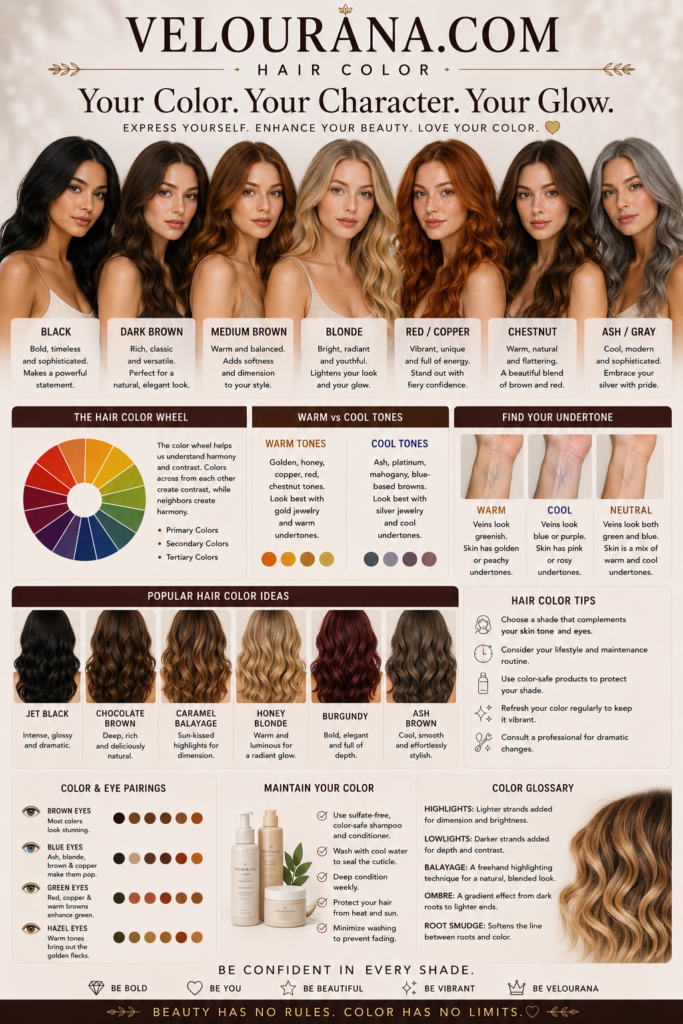
When choosing or describing brunette hair, depth and undertone should be considered separately. Depth refers broadly to how light or dark the hair appears. Undertone describes the warmer, cooler, or more neutral qualities operating within that depth. Confusing the two is one of the reasons brunette transformations can produce unexpected results.
A deep brown does not automatically have to be cool. Espresso-like brunette can contain subtle warmth and still appear extremely dark. Conversely, a lighter brown does not necessarily have to be golden. Light ash brown can remain subdued and cool while sitting relatively high on the brunette spectrum. Understanding this distinction opens far more possibilities than simply deciding whether the hair should become "lighter brown" or "darker brown."
Warm brunette shades interact strongly with golden, copper, amber, red, and orange undertones. Chestnut is a classic example because its brown foundation is animated by reddish warmth rather than replaced by it. Chocolate brunette often suggests a rich neutral-to-warm depth, while golden brown allows yellow and amber qualities to become more noticeable. Mahogany brown introduces a deeper red-violet influence that can appear restrained in shadow and much more expressive in bright light.
Cool brunette shades move in another direction. Ash brown, smoky brown, taupe brown, and some mushroom-inspired shades suppress obvious orange and red reflections. The effect can feel sophisticated and understated, particularly when the goal is to create a muted brunette rather than a visibly warm one. Yet cool brown requires balance. Excessive cool pigment on certain starting colors can appear flat, murky, or unnaturally gray, especially when the underlying warmth has not been considered correctly.
Neutral brunette occupies the territory between these extremes. It does not mean that the hair contains no undertone. Hair color always exists within a complex pigment environment. Rather, neutral brunette is perceived as balanced because no warm or cool reflection dominates strongly. This quality can make neutral brown exceptionally versatile, particularly for someone who wants richness without an obvious red, gold, or ashy cast.
Underlying pigment becomes especially important when brunette hair is chemically lightened. Brown hair does not usually travel directly from dark brown to pale yellow. As pigment is removed, warmer stages become exposed. Depending on the starting depth and degree of lift, red, red-orange, orange, and yellow-orange warmth may emerge. This warmth is not necessarily evidence that something has gone wrong. It is part of the lightening process. The challenge lies in deciding how much of that warmth should remain visible in the finished result and how much should be modified through toning.
The reverse process also demands care. Taking very light hair significantly darker is not always as simple as applying a deep brown shade. Hair that has been heavily lightened may have lost much of the warm underlying pigment that naturally supports brunette color. When darkness is deposited without restoring appropriate warmth, the result can look hollow, muddy, overly cool, or even develop undesirable greenish qualities. Professional colorists may use a filling or repigmentation process to rebuild missing warmth before establishing the final brunette depth.
This reveals something essential about brunette color: convincing brown is constructed from pigment relationships. What looks effortless on the surface may depend on carefully balanced warmth, depth, and reflect underneath.
Brunette Hair and the Relationship With Complexion
The idea that every complexion has one predetermined brunette shade is unnecessarily restrictive. Brown hair exists across enough depths and undertones to work beautifully with an enormous range of skin tones. What changes is the relationship created between hair, skin, eyes, brows, and overall contrast.
Someone with a warm or golden complexion may find that chestnut, warm chocolate, amber brown, or subtle caramel dimension creates visual continuity. The warmth in the hair can echo warmth in the skin without needing to match it exactly. Yet this does not mean warm skin must always be paired with warm hair. A slightly cooler brunette can create deliberate contrast and make the complexion appear more luminous precisely because the temperatures differ.
Cooler complexions can interact elegantly with ash, neutral, mocha, or smoky brunette shades, particularly when excessive orange warmth feels visually distracting. Again, however, rigid matching rules are rarely useful. A controlled warm brunette against cooler skin can create striking sophistication, especially when the warmth is concentrated in dimensional highlights rather than spread uniformly across the entire head.
Olive complexions demonstrate why undertone analysis must remain nuanced. Olive skin can contain combinations of green, yellow, neutral, cool, or warm qualities that do not fit comfortably into simplified warm-versus-cool categories. Some olive complexions become vibrant beside rich neutral brunette, while certain overly ashy shades can exaggerate sallowness. Other olive complexions carry cooler qualities beautifully and look particularly refined with muted brown. Observation in natural light is more valuable than forcing the complexion into a label.
Depth of complexion matters independently from undertone. Deep skin can support extraordinarily rich brunette shades ranging from warm cocoa and mahogany brown to extremely dark neutral espresso. Lighter ribbons can create dimension when desired, but they are not required to make deep brunette visible or interesting. Gloss, texture, movement, and subtle tonal variation can create enormous visual depth without high contrast.
Fair skin can produce a very different relationship with brunette hair because the contrast may become more pronounced. Deep brown beside pale skin can appear dramatic, graphic, and elegant. Medium or lighter brunette can soften that contrast. Neither effect is inherently more flattering; they communicate different aesthetics. Facial features, brow depth, eye color, makeup preferences, and personal style all influence which relationship feels most coherent.
The face-framing area deserves particular attention because color placed near the face has disproportionate visual influence. A brunette base can remain deep while slightly lighter pieces soften the transition around the complexion. Alternatively, maintaining depth around the hairline can create intensity and definition. Modern brunette design often uses these localized decisions rather than changing the entire head uniformly.
Dimension Is What Prevents Brunette From Becoming Visually Flat
One of the persistent misconceptions about brown hair is that adding dimension necessarily means adding obvious blonde highlights. Brunette dimension can be much more subtle. A difference of only a few tonal levels, or even variations within a similar depth, can create movement without changing the overall brunette identity.
Natural brunette hair often already contains this kind of variation. Hair around the face may be slightly lighter from environmental exposure. Ends may have softened over time. Individual strands can differ naturally in pigment concentration. The crown may reflect more light while underneath sections remain deeper. Successful color work can preserve or imitate this irregularity rather than covering it beneath a completely uniform deposit.
Dimensional brunette can be built through fine highlights, lowlights, balayage, carefully positioned face-framing pieces, tonal melting, glossing, or combinations of techniques. The important consideration is not the technique's fashionable name but the visual relationship it creates. If the lightest pieces become too bright or too numerous, the overall identity may shift toward bronde or blonde. If every section remains almost identical, the result may look dense and opaque. The ideal balance depends on the desired effect.
For a luxurious, understated brunette, contrast can remain low. Deep chocolate may transition into medium chocolate with barely perceptible warm ribbons. Such color tends to reveal itself gradually as the hair moves. It can appear almost solid from a distance while showing considerable complexity at close range.
Higher-contrast brunette creates a different mood. Caramel, honey-brown, or beige pieces against a deeper base can emphasize waves and layered cuts dramatically. The brightness may be concentrated around the face or distributed strategically through the lengths. Maintaining enough depth between lighter pieces is what preserves the brunette foundation.
Lowlights can restore depth when hair has gradually become too light. Repeated highlighting sometimes causes brunette hair to lose the darker negative space that originally gave the highlights their impact. Introducing deeper strands can rebuild contrast and make existing lighter pieces appear brighter without further lightening. This is an important reminder that dimension depends on darkness as much as brightness.
Root depth performs a similar role. A slightly deeper root can create visual density and make lighter mids and ends appear more intentional. When blended carefully, it can also soften regrowth and extend the visual life of dimensional color. Brunette transformations that respect the natural root often age more gracefully than highly uniform color extending from scalp to ends.
The placement should respond to haircut and texture. Brightness hidden beneath heavy layers may disappear. Strong horizontal color bands can interrupt curls awkwardly. Highlights that are too fine may become invisible in very dense or highly textured hair, while sections that are too broad may appear striped on straighter hair. Brunette dimension becomes convincing when color architecture and hair architecture work together.
The Condition of the Hair Changes the Color You See
Brunette hair depends heavily on light reflection, which means condition is inseparable from color appearance. Deep shades can look particularly luxurious when the surface is smooth enough to produce clear shine. The same pigment on highly weathered hair can appear less saturated and less dimensional.
Chemical coloring can increase porosity, particularly when lightening is involved. Porous areas may absorb artificial pigment rapidly but also release it more quickly. This can create uneven brunette results in which ends become initially darker than expected and then fade faster than healthier sections. Previous bleach, permanent color, heat damage, sun exposure, and mechanical wear can all influence this behavior.
This is why a color formula cannot be considered independently from the canvas receiving it. Virgin roots, previously colored mids, and lightened ends may all respond differently even though they belong to the same head of hair. Attempting to treat every section identically can produce uneven depth or tone.
Porosity also affects gloss. A roughened cuticle scatters light rather than reflecting it in a smooth, continuous way. Conditioning products cannot permanently reconstruct a severely damaged fiber, but appropriate cosmetic care can improve lubrication, reduce friction, smooth the surface temporarily, and enhance the way light travels across the hair. On brunette shades, these improvements are often visually dramatic because shine makes subtle tonal variation easier to perceive.
Heat styling introduces another relationship between condition and color. Excessive heat can contribute to dryness and surface damage, while repeated exposure may accelerate the appearance of fading in colored hair. Brunette shades containing delicate cool or red tones can change noticeably as deposited pigments diminish. Using heat thoughtfully therefore supports both the physical appearance of the fiber and the stability of the chosen tone.
Sunlight can alter brunette color as well. Ultraviolet exposure and environmental weathering may contribute to fading and oxidation, sometimes making brown hair appear warmer or lighter over time. This is particularly noticeable on previously colored or lightened hair. A brunette shade that looked neutral immediately after coloring may gradually reveal warmer underlying pigment as artificial tone fades.
Water quality can influence appearance too. Mineral accumulation may interfere with shine or alter how color is perceived, particularly on porous hair. Product buildup can create a similarly dull surface. When brunette suddenly seems lifeless, the problem is not always that more dye is needed. Sometimes restoring clarity and surface smoothness makes the existing color appear significantly richer.
Coloring Brunette Hair Without Losing Its Character
Changing brunette hair successfully begins with deciding what should remain rather than focusing only on what should change. Natural brown often contains depth and variation that are difficult to recreate once they have been completely erased. Preserving some natural base can therefore be aesthetically valuable as well as practical.
A person wanting a richer brunette may need only tonal refinement rather than a dramatic permanent-color transformation. Demi-permanent color or gloss services can deepen the appearance, modify undertone, enhance shine, and soften faded lengths without necessarily producing the same commitment as repeated permanent color. The appropriate choice depends on the starting condition, gray coverage requirements, desired longevity, and previous chemical history.
Moving darker can create immediate visual impact, but very dark brunette should be chosen with awareness of future plans. Artificial dark pigment can be difficult to remove cleanly, particularly after repeated applications through the lengths. Someone who frequently alternates between light and dark hair may eventually face significant lightening requirements, increased maintenance, and greater risk of damage.
Going lighter from brunette demands another kind of patience. The darker the starting point and the brighter the destination, the more underlying warmth is likely to become visible during lifting. Attempting to force a major transformation in a single session can place unnecessary stress on the hair. Gradual lightening often allows the colorist to preserve better condition while refining tone between stages.
Previously colored brunette requires particular caution. Hair color does not reliably lighten previously deposited artificial pigment in the same way that lightener can. Applying a lighter brown permanent shade over very dark artificial brown does not guarantee a lighter result. Color history matters, and corrective work may be required.
Gray hair adds another dimension to brunette coloring. The goal does not always have to be complete opaque coverage. Some people prefer full coverage for a consistent deep brunette, while others choose gray blending so that natural silver strands become part of the dimension. A softer approach can reduce the visual contrast of regrowth and create a more forgiving maintenance cycle.
The strongest brunette color strategies consider future appearance as carefully as immediate appearance. A shade can be beautiful on the day it is created but inconvenient if the regrowth line becomes severe within weeks or if the chosen tone fades into something unwanted. Designing for evolution is part of designing good color.
Living With Brunette Color Over Time
Brunette maintenance varies enormously because "brunette" can describe untouched natural hair, permanent gray coverage, dimensional balayage, high-maintenance cool brown, vivid mahogany, or a temporary deepening gloss. Each behaves differently.
Natural brunette hair may require no color maintenance at all, yet its appearance still responds to cleansing, conditioning, heat, weather, and styling. Color-treated brunette has the additional challenge of pigment loss. Frequent washing, aggressive cleansing, high temperatures, ultraviolet exposure, and the condition of the hair can influence how quickly the shade changes.
Cool brunette often demands tonal attention because underlying warmth may become more visible as cool artificial pigments fade. This does not mean that every trace of warmth should be attacked continuously with strong toning products. Excessive use of corrective pigments can make hair look dull or over-muted. Tonal maintenance should respond to what the hair actually looks like rather than being performed automatically.
Warm brunette has its own evolution. Rich copper-brown, chestnut, and mahogany reflections can lose vibrancy as color molecules wash away. Instead of becoming brassy in the same sense as an unwanted warm blonde, the shade may simply lose the particular balance that made its warmth look intentional. Refreshing tone through an appropriate gloss or color-depositing treatment can restore richness when necessary.
Root maintenance depends on contrast. Someone coloring naturally light hair deep brown may see obvious regrowth relatively quickly because the lighter roots contrast with the lengths. Someone whose natural base is already close to the chosen brunette may experience a much softer transition. Gray coverage creates another visible regrowth pattern because silver or white strands can contrast sharply with dark artificial pigment.
Dimensional brunette often offers greater flexibility. When highlights are blended away from the scalp and the natural root remains part of the design, the color can mature without developing a hard line. The brightness gradually moves downward as hair grows, but the effect may remain attractive for months before substantial lightening is needed again. Toners or glosses can be refreshed between major appointments.
Home care is most effective when it supports the actual condition and color process rather than relying on the assumption that every brunette needs the same routine. Hair that has been lightened for caramel dimension may need greater attention to structural damage and porosity than virgin dark brown. Fine brunette hair may become weighed down by very rich formulas that suit coarse, dry hair beautifully. Curly brunette may require styling practices that preserve curl formation while enhancing shine differently from straight hair.
The goal is not to accumulate products simply because the hair is brown. It is to understand what has happened to the fiber and what visual result needs to be preserved.
Brunette as an Expression of Depth Rather Than Restraint
There is a tendency in beauty culture to treat dramatic color as synonymous with brightness. Blonde transformations, vivid fashion shades, and highly contrasted highlights attract immediate attention because the change is obvious. Brunette works differently. Its drama often comes from depth.
A nearly black espresso brunette against luminous skin can be extraordinarily striking. A glossy chocolate wave can appear richer because there is no bright highlight interrupting its surface. Chestnut curls can reveal flashes of red only when they turn toward the light. A neutral medium brown can make eye color appear unexpectedly intense because the hair creates a quieter frame around the face.
This subtlety should not be mistaken for simplicity. Brunette can be minimalist, romantic, dramatic, naturalistic, polished, earthy, luxurious, or unconventional depending on tone and styling. Deep brown cut into a sharp geometric bob communicates something entirely different from long chestnut waves, even when both technically belong to the same hair-color family.
Makeup and clothing can alter the perception further. A warm brown may appear richer beside cream, camel, bronze, or warm red, while cooler surroundings can emphasize its temperature through contrast. Deep brunette can provide a strong visual anchor for bright makeup, yet it can also complement an understated palette beautifully. Because brown itself contains such complex relationships between red, yellow, and dark pigment, its apparent character changes alongside neighboring colors.
The emotional appeal of brunette may also lie in its connection to natural depth. Even heavily designed brunette can retain an impression of plausibility when tonal transitions are subtle. A sophisticated colorist can create extensive dimension while allowing the hair to appear as though sunlight and genetics rather than foils and formulas produced it.
At the opposite end of the aesthetic spectrum, brunette does not have to imitate nature. Highly reflective near-black brown, exaggerated caramel ribbons, red-infused mahogany, or deliberately smoky taupe can make brown feel stylized and fashion-conscious. The category is broad enough to support both restraint and experimentation.
What matters is intentionality. Brown hair becomes most compelling when depth, undertone, dimension, texture, and condition are treated as interconnected elements rather than when a generic brunette shade is applied simply because brown seems like the safe choice.
Brunette is not the absence of color. It is color compressed into depth, revealed through movement and light. Its richness comes from what is visible immediately and what appears only on closer inspection. That capacity for transformation without abandoning its fundamental identity is why brunette hair remains one of the most versatile and enduring territories in hair color.
THE END VELOURANA
 Discover More From Our Family of Websites
 ZodiacBearing (Astrology, Tarot, Numerology, Angel Numbers & Spiritual Guidance)
 Velourana (Beauty, Makeup, Hair Care, Skincare & Beauty Tips)
 HavenBearing (Home, Living, Organization, Décor & Everyday Inspiration)
 PawBearing (Pet Care, Dog Breeds, Animal Health, Training & Pet Products)
 PsyCatherine (Notes From the Journal of a Psychologist on Real Life)

