
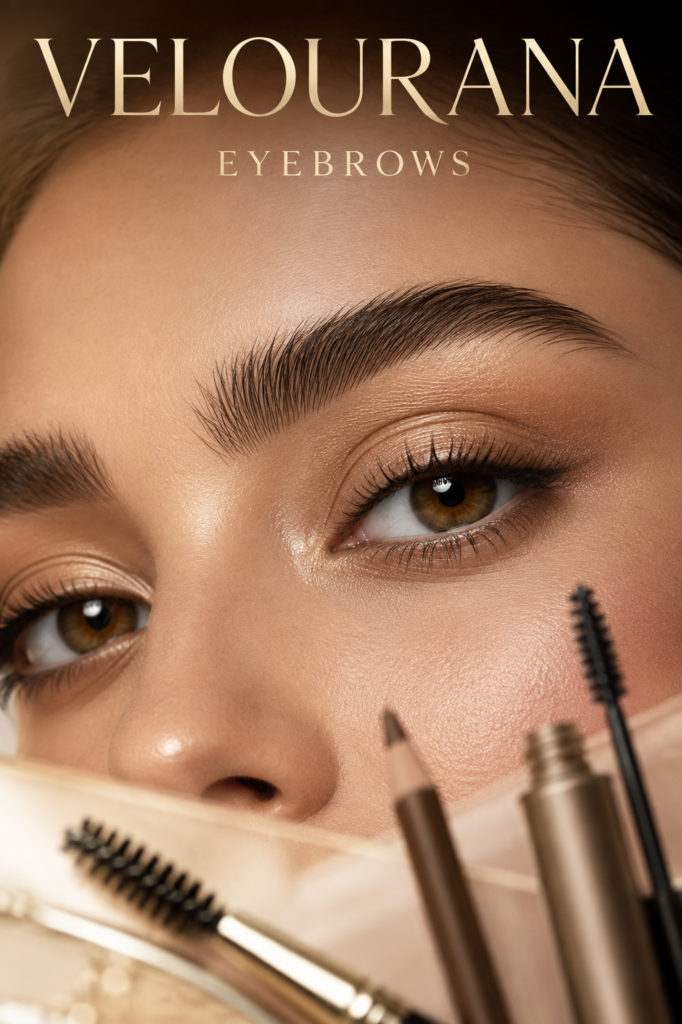
CATEGORY: Brow Powders
Brow powder occupies a distinctive place in eyebrow makeup because it creates definition without necessarily announcing the presence of makeup. While pencils can produce precise lines, pomades can deliver intensity and gels can manipulate hair direction, powder works through softness. It adds shadow rather than obvious structure, creating the impression that the brow is naturally fuller, more balanced and more evenly colored.
This subtlety is one of the reasons brow powder has remained relevant despite major changes in eyebrow trends. Fashion has moved from thin brows to sharply sculpted brows, then toward feathered and laminated styles, yet powder continues to offer something difficult to replace: diffused density. It can deepen the appearance of the eyebrow without creating the hard edges that sometimes accompany highly pigmented creams or pencils.
The product is especially useful when the goal is to fill areas of uneven density rather than completely redraw the brow. A small amount placed through the central body of the eyebrow can visually reduce gaps between hairs. A lighter application through the front maintains softness, while slightly greater concentration through the arch and tail can strengthen structure.
The result depends not only on the powder itself but also on shade, brush shape, pressure, placement and blending. Brow powder may seem simple, but its ability to create convincing brows comes from controlling these elements carefully.
Why Powder Creates a Different Effect From Pencil
The fundamental difference between powder and pencil is the way pigment sits on the brow area.
A pencil deposits color through contact with a relatively narrow tip. Depending on the formula and technique, this can produce individual hair-like strokes, defined outlines or areas of shading. Powder is distributed through many tiny particles by a brush, creating broader and softer transitions.
This means powder is particularly good at imitating the visual effect of density rather than imitating individual hairs.
When a brow contains hair but the skin beneath is visible, the contrast between the hair and skin can make the eyebrow appear sparse. Brow powder reduces that contrast by adding color underneath and between the hairs. The eye then interprets the entire area as fuller.
This effect can be surprisingly significant even when very little product is used. The brow does not necessarily become dramatically darker. Instead, it appears more consistent.
The softness also makes powder forgiving. A pencil line placed too heavily can look obvious. Powder usually blends more easily into surrounding pigment, allowing gradual correction.
This does not mean powder is incapable of definition. With a small angled brush, it can create a relatively crisp tail or lower brow edge. The difference is that the final result generally remains less graphic than a cream pomade.
For people who want polished eyebrows without an overly drawn appearance, this balance can be particularly appealing.
The Structure of a Brow Powder Formula
Brow powders often resemble matte eyeshadows in appearance, but products designed specifically for eyebrows are formulated with brow use in mind.
The texture may be slightly firmer or less creamy than some decorative eyeshadows, allowing controlled pickup and reducing excessive fallout. Pigmentation is often designed to build gradually rather than delivering maximum color in one touch.
This buildability is important because eyebrows contain varying levels of density across their length. The front may need almost no additional color, the central section may require moderate filling and the tail may benefit from stronger definition.
A product that immediately deposits intense pigment can make this variation difficult to achieve.
Brow powders are commonly matte because visible shimmer within the eyebrow can appear artificial unless a particular creative effect is intended. Natural brow hair reflects light, but it does not usually contain obvious decorative sparkle. A matte or softly satin finish therefore tends to integrate more convincingly.
Some formulas are available as single shades, while others come in duos or palettes. Two-shade combinations can be useful because the lighter color can create soft density while the deeper shade can reinforce areas that need more structure.
This also allows the brow to avoid becoming one uniform block of color.
Choosing the Right Brow Powder Shade
Shade selection strongly influences whether brow powder appears natural or artificial.
The intuitive approach is to match the eyebrow hair exactly, but this is not always necessary. In many cases, a shade that is slightly softer than the darkest brow hairs creates a more realistic result because the powder is adding background density rather than replacing the hairs.
Undertone matters as much as depth.
A brow powder that is too warm can make the eyebrows appear reddish or orange, particularly when paired with naturally cool or neutral hair. A shade that is excessively ashy can look gray against warmer hair.
For dark brunettes and black hair, very deep brown or soft black-brown shades often create more dimension than a harsh pure black. Black powder can quickly dominate the face because even a small amount produces strong contrast.
Blonde brows generally require careful control of both undertone and intensity. Taupe, neutral blonde and soft ash shades can create definition while preserving the naturally lighter character of the brow.
Red and auburn hair can require more nuanced matching. Warm brown, auburn and muted copper-brown tones may work depending on the individual's natural brow hair, which is not always identical to the hair on the head.
Gray or silver hair may suit neutral gray-brown, taupe or soft charcoal tones depending on the brow itself.
The most reliable reference is usually the actual eyebrow hair rather than assumptions based solely on scalp color.
Understanding Brow Density Before Applying Powder
Brow powder is easiest to use when the existing density pattern is understood.
Many eyebrows are not uniformly sparse or uniformly dense. The inner portion may be relatively full while the arch contains a thin area. Another brow may have a strong center but a weak tail. Some have visible gaps caused by growth patterns rather than actual lack of hair.
Examining the eyebrow before applying product helps determine where pigment is genuinely needed.
This prevents one of the most common problems with powder: applying the same amount everywhere.
If a naturally dense section receives as much pigment as a sparse area, the dense section can become excessively dark. The brow then loses dimension and may begin to resemble a solid shape.
Selective application preserves texture.
The brush can first be placed where the greatest density is required, often around the arch or tail. As the remaining pigment on the brush decreases, it can move toward softer areas.
This naturally creates a gradient without requiring multiple shades.
The front of the eyebrow usually benefits from restraint because heavy powder near the nose can make the brow appear square and artificial.
The goal is visual balance rather than uniform darkness.
The Importance of Brush Shape
Brow powder is highly dependent on the applicator.
A small angled brush is one of the most common choices because it provides both precision and flexibility. The narrow edge can define the lower boundary or tail, while the flat side can softly distribute pigment through wider areas.
Brush firmness matters.
A very soft brush can create diffused shading but may lack enough control for shaping. A firm angled brush can produce cleaner lines but may deposit more concentrated pigment.
The ideal brush depends on the intended finish.
For a soft everyday brow, a medium-firm angled brush can offer a useful balance. For more graphic definition, a thinner and firmer brush may be preferable.
Some people also use a small rounded or tapered brush to create an especially diffused result. This works well when the brow already has a strong natural shape and needs only background density.
The spoolie remains important even though the primary product is powder. Brushing through the brow before and after application redistributes hairs and helps soften concentrated pigment.
Brow powder becomes much more convincing when color is integrated with hair rather than sitting visibly on top of the brow area.
Creating a Natural Gradient
A natural eyebrow usually does not have the same visual intensity from beginning to end.
The front tends to appear lighter because fewer hairs overlap and the edges are softer. The central section develops more density. The arch may become more defined, and the tail usually tapers gradually.
Brow powder is especially effective at reproducing this natural gradient.
Instead of beginning at the inner corner, the brush can start where definition is most needed. This often means the central brow or outer half.
Once some of the pigment has been deposited, the remaining product on the brush can be carried toward the front using lighter pressure.
This technique prevents excessive concentration near the nose.
The lower edge of the brow can receive slightly more definition than the upper edge. A softly structured lower line provides shape, while leaving the upper boundary more diffused preserves natural texture.
At the tail, a smaller amount of carefully placed pigment can create tapering without requiring a sharply drawn line.
The finished brow should ideally look as though the density gradually changes rather than suddenly beginning and ending.
Filling Sparse Areas Without Creating a Block
Sparse brows present one of the best uses for powder, but they also reveal its limitations.
When hair is present but unevenly distributed, powder can reduce the contrast of visible gaps very effectively. It creates a shaded background that visually supports the existing hairs.
When an area contains almost no hair, however, powder alone may look less convincing because there is no texture sitting above the pigment.
In these situations, combining powder with a pencil or pen can produce a more realistic result.
Powder can establish the underlying density first. Then a few hair-like strokes can be added where actual hair is missing.
This combination uses each product for the task it performs best.
The powder prevents the brow from appearing composed entirely of drawn lines, while the pencil or pen adds structural details that powder cannot imitate.
The key is avoiding overcorrection. If every sparse area is completely saturated with powder, the brow may become too solid.
Small differences in density are natural and often contribute to a believable result.
Brow Powder for Naturally Thick Brows
People with thick brows may assume they have no need for powder, but even dense eyebrows can benefit from subtle shading.
A thick brow may contain areas where the skin is more visible because hairs change direction. There may also be a slight difference in density between the two eyebrows.
Using a small amount of powder in these areas can create balance without increasing the overall size of the brow.
The application should remain restrained.
Dense brows already provide texture and depth, so the powder serves primarily as a visual equalizer.
Instead of filling the entire eyebrow, pigment can be placed only beneath the arch, around a small gap or through a naturally lighter tail.
The result can look polished without appearing makeup-heavy.
Powder is also useful when dense brow hairs are naturally lighter than desired. A soft shade can deepen the overall impression without coating every hair as strongly as a tinted gel might.
This can be especially effective when the user wants the brow to remain fluffy rather than heavily styled.
Brow Powder and Brow Shape
Powder can subtly modify the apparent shape of an eyebrow.
Placing pigment along the lower edge can create the impression of greater thickness. Concentrating color beneath the arch can make the brow appear more structured. Extending the tail slightly can visually lengthen the eyebrow.
However, powder is generally better suited to modest adjustments than major reconstruction.
Because the edges remain soft, dramatic extensions may look like visible shadow rather than hair.
This is where combining products becomes useful. Powder can provide the body of the brow, while a pencil creates the outermost extension.
The brow should still relate to the person's natural growth pattern.
Trying to create a shape that is significantly taller, longer or more angular than the available hair can make the powder increasingly noticeable.
The most convincing use of brow powder usually supports the natural architecture rather than replacing it.
Powder Placement Through the Front of the Brow
The front of the eyebrow deserves special attention because mistakes in this area are highly visible.
A dense square of pigment near the bridge of the nose can create an unnatural expression.
The inner brow should usually retain some transparency.
This can be achieved by using the residual powder left on the brush after the central and outer areas have been filled.
Light upward or diagonal movements distribute a small amount of pigment while allowing individual hairs and skin to remain visible.
The exact amount depends on the natural density.
Someone with sparse inner brows may need more product than someone with dense hair, but even then, gradual buildup is generally preferable.
A spoolie can soften the transition further.
The objective is not necessarily to make the two brow fronts identical. Natural asymmetry can remain while the overall intensity is balanced.
Brow Powder Through the Arch
The arch often benefits from greater definition because it influences the perceived structure of the entire eyebrow.
Powder can enhance the arch by slightly increasing density underneath and through its highest point.
This should not necessarily involve drawing a hard triangular peak.
A subtle concentration of pigment can strengthen the curve that already exists.
For brows with a relatively straight natural shape, powder can create only limited illusion before the lack of hair becomes noticeable. Dramatic reshaping is better supported with pencils, pens or pomades.
For naturally arched brows, however, powder can make the structure look more polished without appearing sharply sculpted.
The effect is particularly sophisticated when the upper edge remains soft.
Brow Powder Through the Tail
The tail is often the most delicate section because it naturally contains fewer hairs.
Brow powder can deepen a weak tail, but excessive application can create a blunt ending.
Using the narrow edge of an angled brush can help maintain taper.
The pigment should generally become more concentrated than at the front but remain controlled.
If the natural tail is very short, powder can extend it slightly, though longer extensions often benefit from pencil support.
The ideal tail looks like a continuation of the eyebrow rather than a separate painted shape.
This requires attention to direction. The pigment should follow the angle established by the natural hairs.
Layering Powder for Greater Intensity
Although brow powder is associated with softness, it can be layered for stronger results.
The key is gradual buildup.
A first layer establishes general density. Additional pigment can then be concentrated in areas that need more structure.
This approach creates depth without losing the diffused quality that makes powder appealing.
Pressing too much product into the brow at once can make blending more difficult and may cause fallout onto the surrounding skin.
Layering also allows better control of symmetry.
After one light pass on both eyebrows, differences can be assessed before additional color is added.
This is often more reliable than fully completing one eyebrow before beginning the other.
Combining Brow Powder With Clear Gel
One of the most natural-looking brow combinations is powder followed by clear brow gel.
The powder creates background density, while the gel organizes the hairs and adds texture.
This division of roles allows both products to remain relatively subtle.
After the powder has been applied and blended, clear gel can be brushed through the brow in the desired direction.
The movement of the spoolie may soften some of the powder, which can improve the result if the initial application was slightly strong.
However, brushing too aggressively can remove pigment from sparse areas.
The final brow gains more dimension because the hairs sit visibly above the shaded background.
This effect can be particularly flattering when the goal is polished but understated makeup.
Combining Brow Powder With Tinted Gel
Tinted gel adds another layer of color by coating the hairs themselves.
When combined with powder, this can significantly increase overall brow intensity.
The combination works well when the skin beneath the brow requires shading and the hairs also need greater definition.
It should be approached carefully, especially with naturally dense brows.
If both products are strongly pigmented, the result can become darker than expected.
Using a softer powder shade beneath a tinted gel can help maintain dimension.
Alternatively, powder can be limited to obvious gaps while the gel handles the rest of the brow.
The products do not need to cover the same areas equally.
Brow Powder With Brow Soap
Powder and brow soap create an interesting contrast.
Soap emphasizes direction and hair texture, while powder creates background density.
Together, they can produce brows that look both fuller and more structured.
Product order depends heavily on formula compatibility.
Some brow soaps create a film that makes powder difficult to apply evenly afterward. In other cases, applying powder first and then brushing soap through can disturb the pigment.
A careful routine may involve placing powder selectively in sparse areas and then using brow soap with controlled brushing.
Alternatively, the brow can be styled first and powder added only where the skin remains visible, provided the surface accepts it.
There is no universal order because formulations vary considerably.
The final appearance should retain visible hair texture. If the powder becomes too strong, the dimensional effect created by the soap can be lost.
Avoiding Excessive Darkness
Brow powder can become darker than expected because pigment accumulates gradually.
What initially looks subtle may intensify after several passes.
This is particularly noticeable under different lighting.
A brow that appears balanced in dim indoor light may look much stronger near a window or outdoors.
Checking the brow from a slight distance can help.
Close-up application encourages focus on every small gap, which can lead to overfilling.
From normal conversational distance, many tiny irregularities disappear.
A softer shade and lighter pressure also provide greater margin for error.
It is generally easier to add pigment than remove an excessive layer without disturbing the surrounding makeup.
Correcting Brow Powder
Powder is relatively forgiving when mistakes occur.
A clean spoolie can diffuse excessive pigment through the hairs.
A clean angled brush can soften an edge without adding more product.
A small amount of translucent face powder or concealer around the outer boundary can refine the shape if necessary, although heavy correction can make the eyebrow appear overly carved.
Sometimes the best correction is simply blending.
Because the defining quality of powder is softness, an imperfect line can often be transformed into a natural shadow with gentle diffusion.
Brow Powder for Mature Brows
Changes in brow density are common over time, and powder can be particularly effective when the goal is to restore visual fullness without creating harshness.
A soft powder shade can reduce contrast between sparse areas and remaining hairs.
The diffused finish can look elegant because it avoids overly sharp boundaries.
However, areas with very little hair may still benefit from fine pencil strokes for texture.
Combining subtle powder with selective precision often produces a more convincing result than relying on one product alone.
Shade selection becomes particularly important when brow hairs include gray or white strands.
A softer neutral or taupe tone may harmonize more naturally than a very dark brown.
The objective is definition that supports the face rather than dominating it.
Brow Powder for Minimal Makeup
Brow powder works especially well in minimal makeup because it can add structure without introducing a visibly cosmetic texture.
A small amount through sparse areas can make the entire face appear more balanced.
When paired with lightly groomed hairs and little or no complexion makeup, the soft finish remains believable.
This is one reason powder can be useful for people who dislike the sensation or appearance of heavy brow products.
The product can almost disappear once properly blended.
The visible result is not "powder" but improved density.
Brow Powder for More Glamorous Makeup
Softness does not mean brow powder belongs only in natural makeup.
It can also form the foundation of a more dramatic eyebrow.
The brow can be built gradually, with stronger pigment through the arch and tail while maintaining a softer front.
A pencil or pomade can then refine selected edges.
This layered approach creates greater dimension than using a single intensely pigmented product across the entire brow.
The powder provides depth, while precision products provide structure.
The result can remain polished under stronger eye makeup without becoming flat.
The Role of Light in Evaluating Brow Powder
Lighting dramatically influences the perceived intensity of brow makeup.
Warm indoor lighting can soften contrast, while cool daylight may reveal excess pigment.
A brow powder shade can also appear warmer or cooler depending on surrounding light.
Whenever possible, assessing the finished brows in natural or neutral light can provide a more realistic impression.
This is particularly useful when choosing a new shade.
A powder that looks perfectly neutral in the compact may shift once placed against the skin and hair.
The interaction between brow color, skin tone and lighting is part of why shade testing is valuable.
Keeping Brow Powder Clean and Controlled
Because powder products are repeatedly touched with brushes, tool cleanliness contributes to both performance and hygiene.
A brush coated with old pigment, foundation or brow gel may pick up powder unevenly.
Regular cleaning helps maintain the intended color and application.
The powder itself should also be protected from unnecessary moisture.
Using a wet brush in a formula not designed for damp application can alter the surface texture.
Some users intentionally apply certain powders wet for greater intensity, but this should not be assumed suitable for every product.
Brow-specific instructions remain relevant.
Why Brow Powder Continues to Matter
Brow trends change, but the desire for believable fullness remains constant.
Powder addresses that need through one of the simplest optical strategies in makeup: reducing the contrast between hair and skin.
It does not need to imitate every hair individually. It creates the visual environment in which the existing hairs appear denser.
This makes it remarkably versatile.
It can soften a sparse brow, balance asymmetry, deepen a pale tail, complement a pencil, support a tinted gel or create a complete brow on its own.
Its greatest strength is restraint.
Where other brow products can create unmistakable lines, brow powder creates atmosphere. The eyebrow appears fuller because the eye sees less empty space, yet individual hairs can still remain visible.
When shade, placement and pressure are carefully controlled, the product becomes difficult to detect.
That invisibility is often the mark of successful brow powder application.
The brow looks improved without looking covered.
For anyone seeking natural density, soft definition and flexible intensity, brow powder remains one of the most adaptable products in the brow category.
THE END VELOURANA
 Discover More From Our Family of Websites
 ZodiacBearing (Astrology, Tarot, Numerology, Angel Numbers & Spiritual Guidance)
 Velourana (Beauty, Makeup, Hair Care, Skincare & Beauty Tips)
 HavenBearing (Home, Living, Organization, Décor & Everyday Inspiration)
 PawBearing (Pet Care, Dog Breeds, Animal Health, Training & Pet Products)
 PsyCatherine (Notes From the Journal of a Psychologist on Real Life)

