
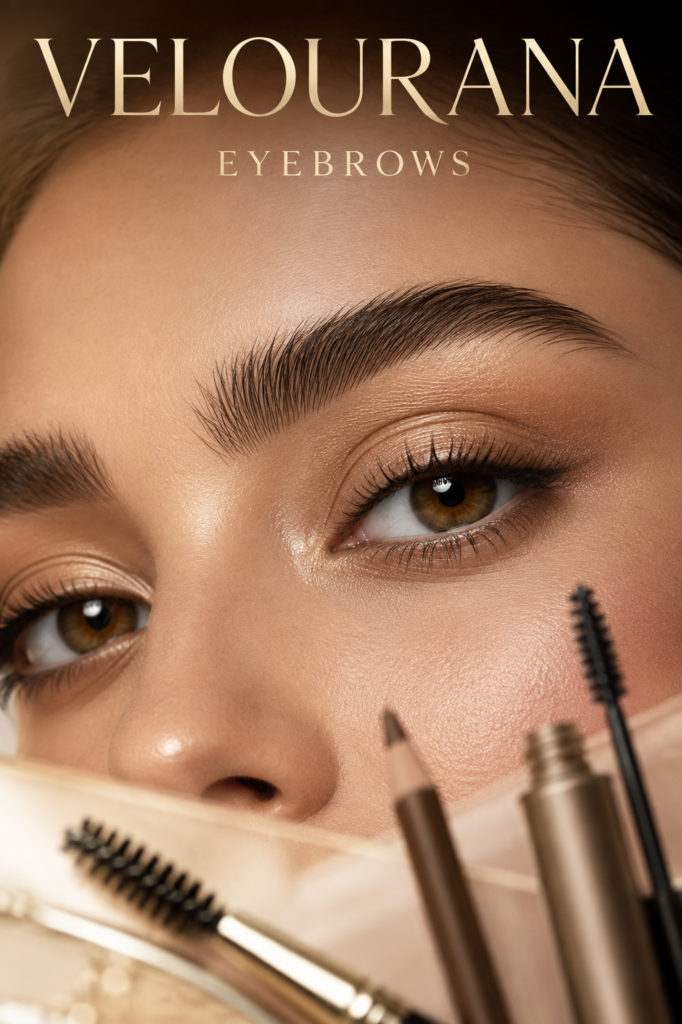
CATEGORY: Brow Pomades
Brow pomade occupies a distinctive place in eyebrow makeup. It offers considerably more control and intensity than many pencils, powders, and lightweight gels, yet the most sophisticated results are rarely those that display the product most obviously. The real appeal of pomade lies in its ability to create structure while preserving the impression that the brow belongs naturally to the face.
Usually presented as a creamy or waxy pigmented formula, brow pomade is designed to fill areas of reduced density, strengthen the visible outline of the eyebrow, deepen color, and create a more deliberate shape. Many formulas are applied with a small angled brush, giving the wearer considerable control over where pigment is deposited and how strongly it appears. Depending on technique, the same pot of pomade can produce anything from subtle background shading to an intensely sculpted brow.
That versatility is also what makes pomade more demanding than simpler brow products. A pencil limits the amount of pigment transferred with each movement. A powder naturally diffuses as it is applied. Pomade places much more responsibility in the hands of the person applying it. Pressure, brush angle, product quantity, placement, and blending all influence the finished result.
Understanding brow pomade therefore involves more than learning how to draw an eyebrow. It means understanding how color, density, proportion, texture, and facial architecture interact. When those elements are considered together, pomade becomes less about creating a predetermined brow shape and more about selectively strengthening what is already there.
Why Brow Pomade Creates Such a Distinctive Effect
The visual power of pomade comes primarily from pigment concentration and texture. Unlike dry brow powder, which generally produces a diffused veil of color, pomade can establish a relatively clean edge. Unlike a fine pencil, which often concentrates on individual marks, pomade can cover broader areas efficiently while still allowing detailed work when paired with a sufficiently narrow brush.
This combination makes it particularly useful when the natural brow has visible gaps, uneven density, a poorly defined tail, or an outline that seems to disappear in certain areas.
Yet density should not be confused with darkness. A beautifully defined brow does not necessarily need to be dark. Definition comes from contrast between the brow and surrounding skin, from the continuity of its shape, and from the relationship between individual areas of greater and lesser density.
One of the most important characteristics of natural eyebrows is that they are rarely visually uniform. The beginning of the brow generally appears softer because individual hairs can be seen against the skin. Density tends to increase through the body, while the tail becomes narrower and more concentrated.
When pomade replaces these natural variations with one uninterrupted block of identical color, the eyebrow can appear artificial even if its outline is technically perfect.
Sophisticated pomade application respects variation. Pigment can remain sheer at the inner brow, become gradually more substantial through the middle, and provide greater definition where the arch transitions into the tail. This creates visual rhythm rather than uniformity.
The result is an eyebrow that appears deliberately groomed without looking painted onto the skin.
Texture, Pigment and the Importance of Product Control
Pomades vary considerably in texture. Some are exceptionally creamy when first opened, while others are deliberately firmer and slightly waxier. Texture influences not only how easily the product moves across the skin but also how quickly pigment builds.
A very creamy formula can distribute rapidly and may feel effortless to blend. However, it can also deposit more color than expected if the brush is heavily loaded. A firmer pomade may require more deliberate movement but can offer excellent control for narrow edges and small areas.
The condition of the product matters as well. Because many pomades are stored in pots, repeated exposure to air can gradually alter their texture. A formula that once moved smoothly may eventually become firmer. Keeping the container securely closed when it is not being used helps preserve the intended consistency.
The brush is equally important. Pomade is frequently associated with angled brushes because their geometry suits the architecture of an eyebrow. A narrow angled edge can define the lower boundary, create a tapered tail, and place short marks through sparse areas.
The amount of product loaded onto that brush is one of the greatest determinants of success.
Pomade is usually easier to add than to remove. Beginning with a heavily saturated brush can immediately create an opaque mark that then has to be softened. Beginning with very little product allows color to develop gradually.
This principle changes the entire character of the application.
Instead of treating the brow as an empty shape that needs to be colored in, the wearer can examine where additional density is actually necessary. Some areas may need virtually nothing. Others may benefit from a translucent trace of pigment, while a genuinely sparse section may require considerably more.
Pomade becomes more convincing when its intensity responds to the brow rather than being applied according to a fixed formula.
Brow Architecture and the Balance of the Face
Eyebrows influence how facial proportions are perceived. Their length, thickness, curvature, position, and direction all contribute to expression.
Pomade makes these architectural qualities easier to manipulate because it can strengthen edges and visually alter density. That ability is useful, but excessive correction can quickly produce a brow that competes with the rest of the face.
Natural brows are not mathematical diagrams. Their arches are not perfectly identical, their hairs do not grow at identical angles, and the two brows rarely mirror one another precisely. Attempting to force absolute symmetry can therefore create more artificiality rather than greater harmony.
A more useful objective is visual balance.
One brow may naturally sit slightly higher. One tail may contain fewer hairs. The arch on one side may be somewhat sharper. Pomade can reduce distracting differences without erasing every sign of natural variation.
The lower edge deserves particular attention because defining it can instantly make the brow appear more polished. A controlled amount of pigment beneath the body of the brow can establish shape without requiring an equally strong upper boundary.
If both borders are outlined heavily and the space between them is filled uniformly, the result may resemble a graphic shape rather than eyebrow hair.
Leaving certain transitions less exact allows the brow to retain dimension.
The tail can usually tolerate greater precision because natural brow hairs already converge into a narrower form there. The front typically benefits from restraint. This contrast between softness and precision is one of the fundamental visual principles behind successful pomade work.
Creating Fullness Without Creating a Block of Color
Sparse eyebrows are one of the situations in which pomade can be especially effective. Missing density can make the overall brow shape difficult to perceive, particularly when gaps occur through the arch or tail.
The temptation is to cover the entire sparse region with solid pigment.
Although this certainly hides visible skin, it can also remove the texture that makes eyebrows believable.
A more nuanced approach treats the skin between hairs as part of the finished design. Some skin can remain visible. Pigment can be distributed irregularly enough to suggest depth rather than complete coverage.
Short directional marks can be incorporated where greater definition is needed, while softer shading provides an underlying sense of fullness.
The direction of those marks matters. Brow hairs generally change orientation as they travel from the inner corner toward the tail. Near the front, hairs may grow more vertically or diagonally upward. Through the body they gradually turn outward, while hairs near the tail tend to follow the narrowing direction of the brow.
Ignoring these directional changes can make even fine marks look unnatural.
Pomade does not have to imitate every individual hair. Instead, it can create the visual environment in which existing hairs appear denser. This distinction is important. The most convincing brow makeup often works partly in the background.
From conversational distance, the viewer should perceive a fuller eyebrow rather than immediately identifying exactly where makeup begins.
Choosing a Brow Pomade Shade
Shade selection affects realism just as strongly as application technique.
Brow color exists in relation to hair color, skin tone, undertone, eye color, and the natural depth of the eyebrow itself. Choosing a shade solely because it appears to match the hair on the head can sometimes produce unexpected results.
Very dark pomade, for example, may look dramatically stronger on the skin than it appears in the container. Warm brown shades can become noticeably reddish or orange against cooler brow hairs. Extremely cool shades can appear gray when used heavily.
The goal is usually harmony rather than literal duplication.
Blonde and light-brown brows often benefit from nuanced taupe, neutral brown, or softly ashy tones depending on the individual coloring. Medium and dark brunette brows may require deeper neutral or cool browns rather than automatically moving directly to black.
People with naturally black eyebrow hair can still find that a very deep brown or soft black creates greater dimension than an intensely opaque jet-black application.
Red and auburn hair introduces additional complexity because the relationship between scalp hair and brow hair varies considerably. Some people have warm eyebrows that coordinate closely with their hair, while others naturally possess more neutral brow coloring.
Gray and silver hair can also pair beautifully with softly neutral or cool brow shades rather than overly warm brown.
The amount of product changes the perceived shade as well. A lightly applied deep brown can appear softer than an opaque application of a supposedly lighter shade.
For this reason, color cannot be separated entirely from technique.
The Relationship Between Pomade and Natural Brow Hair
Brow makeup sits partly on skin and partly around or over existing hairs. These two surfaces interact with pigment differently.
Color applied directly to skin can appear relatively smooth and continuous. Product caught on brow hairs introduces texture and dimensional variation. A successful application balances these surfaces so that neither dominates unnecessarily.
Brushing the brows before applying pomade reveals their actual density and growth pattern. Areas that initially seemed empty may simply contain hairs lying in an unhelpful direction. Once those hairs are arranged, considerably less pigment may be required.
This is one reason grooming and makeup cannot be entirely separated.
The existing hairs establish the framework. Pomade should ideally complement that framework rather than conceal it.
After pigment has been placed, brushing through the brow again can redistribute excess color and expose individual hairs that may have become coated. This softening stage can transform an application that initially looks severe into something much more integrated.
The effect is particularly important near the front, where visible individual hairs contribute strongly to realism.
A brow does not need to look untouched to look natural. It simply needs to retain enough variation that the eye interprets it as hair rather than as a continuous painted surface.
Soft Brows, Sculpted Brows and Everything Between
Pomade is frequently associated with bold makeup, but intensity is a stylistic choice rather than an unavoidable property of the product.
A soft pomade brow uses minimal pigment and relies heavily on the existing eyebrow. The product may primarily strengthen sparse regions and refine the tail. Edges remain relatively diffused, and the front retains visible transparency.
A more polished everyday brow can introduce additional definition through the lower boundary and arch while preserving gradual changes in density.
A sculpted brow moves further toward deliberate geometry. The arch may become sharper, the tail cleaner, and the overall silhouette more distinct. This can complement full-coverage complexion makeup, strong eye makeup, evening looks, photography, or other situations in which facial features are intentionally emphasized.
Even a dramatic brow benefits from dimensional variation.
Intensity and harshness are not synonymous. A brow can be dark and highly defined while still containing softer transitions. Conversely, a relatively light brow can appear harsh if its edges are excessively rigid.
The artistry lies in deciding where precision adds beauty and where softness creates credibility.
How Skin Characteristics Influence Pomade Performance
The skin beneath and surrounding the eyebrows affects how brow makeup behaves throughout the day.
On skin that produces considerable oil, creamy products may interact with surface oils over time. Depending on the formulation, this can soften edges or reduce the crispness of the original application. Long-wearing and water-resistant pomades are often chosen when durability is a priority, but individual performance varies among formulas.
Very dry skin presents a different challenge. If the brow area contains visible flaking or uneven texture, strongly pigmented product can emphasize that surface irregularity.
The condition of the skin therefore contributes directly to the appearance of the brow.
A smooth, comfortable brow area generally provides a more predictable canvas. However, applying excessive skincare immediately before brow makeup may create unnecessary slip. Allowing skincare and complexion products to settle can help the brow product behave more consistently.
Foundation and concealer also change the canvas. Pomade placed over a substantial layer of emollient complexion product may behave differently from pomade applied to relatively clean skin.
These interactions explain why a technique that performs beautifully on one person may require adjustment on another.
Rather than assuming that pomade itself is difficult, it is useful to consider the entire surface on which it is being used.
Precision Without Excess
Pomade rewards precision, but precision should serve the face rather than become the objective in itself.
Extremely sharp brows can be visually striking in photographs or highly stylized makeup. In everyday contexts, however, a little softness often creates greater sophistication.
The distinction is particularly noticeable at the inner brow.
A sharply squared front with opaque pigment can visually shorten the space between the eyebrows and make the expression appear heavier. A softer beginning allows the brows to transition more naturally into the center of the face.
The arch is another area where excessive correction can alter expression. Raising or sharpening it dramatically can make the face appear more intense. Flattening it too much can change the perceived proportions of the eye area.
Working with the existing arch usually creates a more harmonious result than imposing an entirely new one.
The tail similarly benefits from proportion. Extending it can visually elongate the eye area, but an excessively long or downward-pointing tail may create a heavier impression.
Pomade offers enough control to make these changes easily, which is precisely why restraint becomes important.
Why Brow Pomade Has Enduring Appeal
Beauty trends continually redefine the fashionable eyebrow. Some eras celebrate extremely thin brows, others dramatic arches, and others fluffy, minimally structured fullness.
Pomade remains relevant because it is not limited to one aesthetic.
Its fundamental function is controlled pigment placement.
When trends favor strong brows, it can create unmistakable definition. When softer brows dominate, the same formula can be used sparingly as targeted reinforcement. When natural texture is preferred, pomade can remain almost invisible beneath existing hairs.
The product's reputation for dramatic brows reflects how it has often been used rather than everything it is capable of doing.
Modern brow aesthetics increasingly emphasize personalization. Rather than prescribing one ideal eyebrow for every face, makeup can respond to natural density, facial structure, personal style, age, coloring, and desired level of polish.
Pomade is particularly compatible with this approach because its intensity is adjustable.
A single formula can support very different interpretations.
The Most Refined Pomade Brows Preserve Individuality
A successful eyebrow should ultimately look connected to the person wearing it.
That does not mean makeup must always be invisible. Brow makeup can be polished, glamorous, editorial, dramatic, or intentionally graphic. What matters is that the choices feel deliberate.
Pomade provides the tools for substantial transformation, but transformation is not always necessary.
Sometimes the most effective use of the product is a tiny amount through a sparse arch. Sometimes it is a softly strengthened tail. Sometimes it is a full sculpted brow designed to balance dramatic eye makeup.
The sophistication comes from recognizing the difference.
Brows are composed of individual hairs, changing density, subtle asymmetry, and irregular boundaries. Preserving some of these characteristics prevents definition from becoming rigidity.
Pomade is therefore best understood not simply as a strong brow filler but as a medium for controlling contrast.
Used thoughtfully, it can deepen without overwhelming, sharpen without hardening, and create fullness without eliminating texture.
That balance is what gives a pomade brow its most compelling quality: the eyebrow looks finished, yet it still looks alive.
THE END VELOURANA
 Discover More From Our Family of Websites
 ZodiacBearing (Astrology, Tarot, Numerology, Angel Numbers & Spiritual Guidance)
 Velourana (Beauty, Makeup, Hair Care, Skincare & Beauty Tips)
 HavenBearing (Home, Living, Organization, Décor & Everyday Inspiration)
 PawBearing (Pet Care, Dog Breeds, Animal Health, Training & Pet Products)
 PsyCatherine (Notes From the Journal of a Psychologist on Real Life)

