
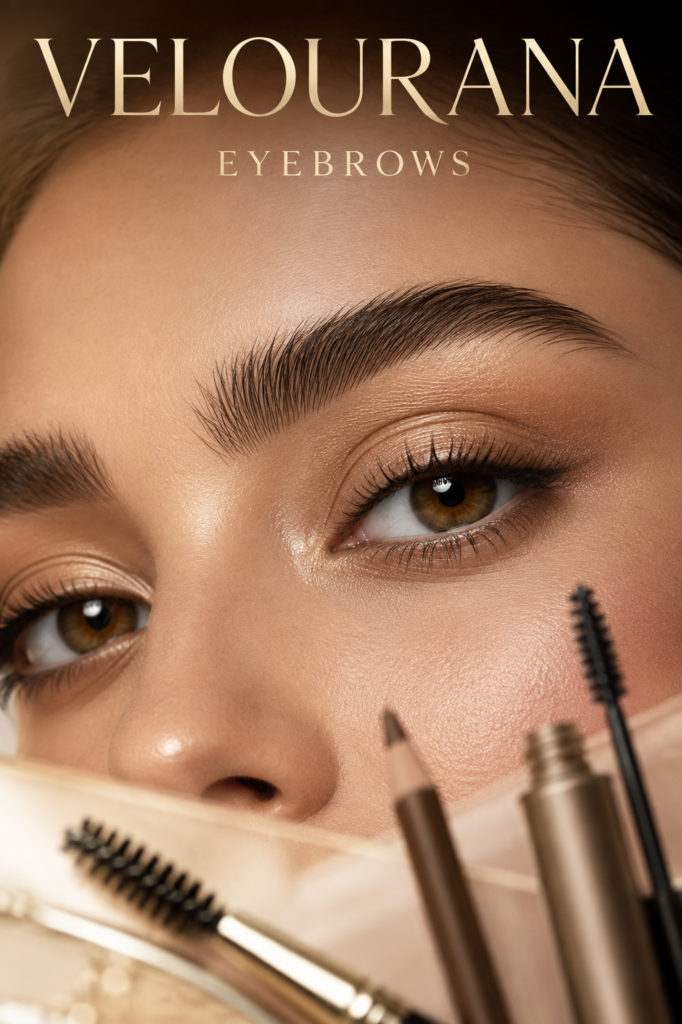
CATEGORY: Brow Pencils
Few makeup products combine simplicity and precision as effectively as the brow pencil. A slim line of pigment may seem modest beside elaborate eyeshadow palettes, sculpting products and high-impact lip colors, yet the eyebrow pencil can influence the entire balance of the face. Used thoughtfully, it can restore definition where hairs are sparse, extend a shortened tail, subtly strengthen an arch and create the impression of greater density without overwhelming the natural brow.
The enduring appeal of brow pencils comes partly from this control. Unlike products that distribute color broadly through the eyebrow, a pencil allows pigment to be placed exactly where it is needed. A small gap can receive two or three delicate marks while a naturally dense section can remain almost untouched. The result does not have to resemble a brow that has been “filled in.” At its most refined, pencil work becomes difficult to distinguish from the eyebrow itself.
Modern brow makeup has increasingly moved away from the heavily outlined, uniformly saturated eyebrows that once dominated beauty imagery. Texture, individual hairs and slight variations in density are now often preserved rather than concealed. This makes the brow pencil particularly relevant because its strength lies not simply in adding color but in adding controlled detail.
Why Brow Pencils Remain a Makeup Essential
Eyebrows are naturally irregular. Even a relatively full eyebrow may contain small gaps, differences in density or an area where hairs grow in a different direction. The two brows are also rarely identical. Their arches may sit at slightly different heights, their tails may differ in length and one brow may naturally contain more hair than the other.
A pencil makes it possible to respond to these differences rather than covering them with the same amount of product everywhere.
This distinguishes pencils from many broader brow products. Powder can create beautiful diffused fullness, pomade can deliver substantial definition and gel can introduce hold, color and texture. A pencil occupies a particularly versatile position because it can provide both structure and detail. Depending on the formula and tip, it can softly shade an area or produce individual marks intended to resemble hairs.
The amount of pressure used also changes the result dramatically. A light touch can leave a barely visible deposit of color, while firmer pressure creates a stronger line. This means one pencil can potentially move from almost imperceptible correction to clearly defined evening makeup simply through application technique.
Control is especially useful when the brow is already reasonably full. There is little reason to cover healthy natural density merely because one small section is sparse. A pencil can address that section alone.
The same principle applies to thin brows. Rather than drawing a completely new eyebrow over the existing one, pencil can gradually build around the hairs that remain, using them as the foundation of the finished shape.
Understanding Pencil Shapes and Formulas
Although brow pencils belong to one product category, their design varies considerably.
Traditional sharpenable pencils remain familiar because their points can be renewed whenever necessary. Sharpening can create a very precise tip, although the exact shape changes as the pencil wears down. Their formulas range from relatively firm and waxy to softer, more powder-like textures.
Retractable pencils eliminate sharpening. The product is advanced by twisting the component, and many retractable designs use extremely narrow tips. These microfine pencils are particularly suited to detailed work because they can produce small marks between existing hairs.
A broader angled or triangular pencil behaves differently. Its narrow edge may provide definition while its wider surface can shade larger areas efficiently. This can make it useful for brows requiring substantial filling, although the broader shape may demand more restraint when working near the inner brow.
Formula matters just as much as geometry.
A very creamy pencil transfers pigment quickly. This can be helpful on dry skin or when a stronger makeup effect is desired, but excessive pressure may deposit too much color. A firmer pencil generally requires more deliberate strokes and may therefore make subtle application easier.
Some formulas emphasize longevity or water resistance. Others prioritize blendability and a softer powder-like finish. Neither approach is universally superior. The useful formula is the one that matches the desired effect, skin conditions and amount of natural brow hair.
A spoolie is frequently incorporated into the opposite end of a brow pencil. This apparently simple brush is central to polished pencil application because it redistributes pigment, separates hairs and softens marks that appear too obvious.
Shade Is More Complex Than Light or Dark
Choosing brow pencil color is not merely a question of finding brown, blonde or black. Undertone, depth and the natural variation within the eyebrow all influence whether the result appears convincing.
Natural brow hairs rarely look like a single flat color. Light reflects differently across individual hairs, roots may appear deeper than ends, and surrounding skin changes the way pigment is perceived. Hair on the head may also differ substantially from eyebrow hair.
For this reason, an exact match to the darkest visible hair can sometimes produce an unnecessarily severe result. Softer taupe, ash, neutral brown and cool brunette tones can provide definition without making every pencil stroke immediately visible.
Very dark hair presents a particularly interesting challenge. Automatically selecting pure black can make the eyebrow appear dense and graphic even when that is not the intention. Deep neutral or cool brown may sometimes create enough definition while preserving greater dimensionality.
Blonde brows often benefit from attention to undertone. A pencil that is too golden may look distinctly warm against an ash blonde eyebrow, while an excessively gray shade may appear dull against warmer coloring.
Red hair introduces another spectrum entirely, from muted auburn and soft warm brown to copper-inspired tones. The objective does not necessarily have to be matching the hair on the head precisely. Brow color should ultimately harmonize with the overall coloring of the face.
Gray and silver hair can also change the relationship between brow color and facial definition. Taupe, gray-brown and other restrained neutral tones can often create structure without producing an abrupt dark frame.
Shade should therefore be judged on the face whenever possible. A pencil that appears perfect when viewed on the hand may behave differently among actual eyebrow hairs.
The Importance of Preserving Natural Brow Architecture
Before adding pigment, it helps to understand what is already present.
Every natural eyebrow contains its own architecture: an inner section, a developing body, an arch or highest area and a tapering tail. These proportions differ from person to person. Attempting to impose exactly the same fashionable shape on every face can erase much of what makes individual brows harmonious.
Pencil application is often most convincing when it strengthens existing architecture rather than replacing it.
Brushing the eyebrow upward and outward reveals this structure clearly. Areas that initially appear sparse may simply contain hairs lying flat. Conversely, gaps that are difficult to notice when hairs are uncombed can become obvious once the eyebrow is arranged.
The front of the eyebrow deserves particular restraint. Natural brows generally contain visible separation between hairs in this region. Filling the inner brow with the same density used through the arch can create a square, stamped appearance.
Moving toward the middle and outer sections, slightly greater definition can usually be carried without appearing unnatural. The tail may need the greatest precision because relatively few hairs determine its final shape.
This gradual transition from softness to definition is one of the most important visual principles in pencil application.
Creating the Illusion of Brow Hair
A pencil becomes most sophisticated when it stops behaving like a coloring instrument and begins behaving like a drawing instrument.
Natural eyebrow hairs have direction. Near the inner brow they frequently rise more vertically. Through the body they begin to angle outward. Toward the arch and tail they generally lie progressively more horizontally or diagonally.
Pencil marks that follow these changing directions integrate more naturally than identical strokes repeated across the entire eyebrow.
Length matters as well. Extremely long lines are difficult to mistake for individual hairs. Shorter marks allow surrounding skin to remain visible, preserving the broken texture associated with a real eyebrow.
Pressure should remain controlled. A pencil pressed firmly against the skin can produce a dark, solid mark with hard edges. Light contact creates a finer deposit that can be reinforced later if necessary.
This is why gradual construction tends to produce more convincing results than attempting full intensity immediately.
Existing hairs provide useful reference points. Instead of drawing through them indiscriminately, pencil can be introduced between them. The eye then interprets natural hairs and cosmetic marks together as a more continuous brow.
The objective is not necessarily to fool someone examining the eyebrow from centimeters away. Rather, it is to maintain believable texture at normal conversational distance.
Working With Sparse, Thin and Uneven Brows
Sparse eyebrows demonstrate the precision advantage of pencils particularly well.
A gap does not always require broad shading. Sometimes a few carefully positioned marks can visually connect two denser sections. Maintaining tiny areas of visible skin prevents the filled section from becoming noticeably flatter than the rest of the brow.
Thin brows require a slightly different strategy. Increasing thickness exclusively along one edge can change the apparent position of the eyebrow. Adding too much beneath the brow may visually lower it, while excessive expansion above the brow can distort the natural arch.
Gradual adjustment around the existing shape is generally more harmonious.
Where the tail is sparse, it can be tempting to extend it substantially. Length should be considered alongside the direction of the brow. A tail that descends too far can visually pull the outer eye downward, whereas an abruptly short tail may leave the eyebrow looking unfinished.
Uneven brows require observation rather than automatic correction. Human faces are asymmetrical, and eyebrows participate in that asymmetry. Trying to force perfect duplication may require so much additional pigment that both brows become less natural.
A more refined goal is visual balance.
One brow might need a small amount of pencil beneath the arch, while the other needs slightly greater definition through the tail. They can look harmonious without becoming geometrically identical.
Blending Changes Everything
One of the easiest ways to identify poorly blended brow pencil is to notice the pigment before noticing the eyebrow.
Blending changes that relationship.
A spoolie passed through the brow can soften concentrated pigment and distribute a small amount of color onto surrounding hairs. It can also expose places where additional pencil is actually necessary.
The direction of brushing matters. Randomly scrubbing backward and forward may blur carefully created strokes into a broad stain. Brushing generally in the direction of hair growth maintains structure while reducing excessive intensity.
Blending is particularly valuable at the inner brow. Even when pencil has been applied lightly, a spoolie can diffuse the beginning of the eyebrow so that it emerges gradually rather than beginning with a hard vertical boundary.
The process can be repeated during application rather than reserved exclusively for the end. Pencil can be added, brushed through, examined and then selectively reinforced.
This alternating relationship between drawing and blending offers far more control than applying a large amount of product and attempting to correct it afterward.
Brow Pencil and Other Brow Products
Pencil does not need to work alone.
Combining products can produce dimension because each formula performs a different function. Pencil can supply missing detail while gel controls hair position. Powder can provide diffuse density while pencil adds definition in selected gaps. Wax can establish shape while pencil refines areas that remain visually sparse.
The sequence depends on the products involved and the desired finish.
When strong wax or styling products are used first, the skin beneath the eyebrow may become more difficult for certain pencils to grip. In other routines, establishing hair position first makes it easier to see precisely where pencil is required.
There is therefore no need to treat brow makeup as a rigid formula. Product compatibility and individual technique matter.
What remains important is avoiding unnecessary accumulation. If pencil has already created sufficient density, additional powder may flatten the texture. If the brow hairs naturally remain in place, heavy setting products may add little.
Sophisticated brow makeup often involves knowing when to stop.
Different Finishes From the Same Pencil
The association between brow pencils and natural makeup can obscure how versatile the category actually is.
For a minimal finish, pigment can be restricted almost entirely to visible gaps. Natural borders remain untouched, and the spoolie softens whatever has been added.
For a polished everyday brow, pencil can subtly strengthen the lower line, restore density through the body and clarify the tail while keeping the inner section diffused.
More sculpted makeup may involve greater attention to the upper and lower boundaries, a cleaner arch and increased saturation through the outer brow. Even then, maintaining some variation in density prevents the eyebrow from appearing completely flat.
A fuller, feathered aesthetic uses pencil differently again. Instead of constructing strong borders, individual strokes can be placed between upward-brushed hairs to increase the impression of abundance.
Mature brows may benefit from especially restrained definition. As eyebrow density changes over time, an intensely dark block of pigment can become visually dominant. Fine, softly colored marks can restore structure while maintaining a lighter overall impression.
The pencil itself has not changed. Pressure, placement, shade and blending create these different outcomes.
Common Sources of an Artificial Finish
Most brow pencil problems come not from the product category itself but from excessive uniformity.
Uniform color is one example. When every part of the eyebrow has exactly the same depth, natural variation disappears.
Uniform edges create another issue. A continuous dark outline surrounding the entire eyebrow can separate it visually from the face.
Uniform stroke direction can be equally revealing. Real eyebrow hairs change orientation as they travel from the inner brow toward the tail.
Overextension is another common source of imbalance. Increasing the tail dramatically or drawing the inner brow too close toward the center of the face can change facial proportions rather than simply enhancing the existing eyebrow.
Incorrect undertone can remain visible even when technique is excellent. A noticeably reddish brown pencil among cool ash hairs, for example, may reveal the cosmetic work immediately.
Perhaps the most frequent issue, however, is simply too much pressure.
Brow pencils reward restraint because pigment can always be added. Removing a heavy mark without disturbing surrounding makeup is more difficult.
Longevity and the Skin Beneath the Brow
Brow pencil does not exist independently of the skin on which it is applied.
Excess skincare, facial oil or foundation around the eyebrow can influence how some formulas adhere. A pencil may glide beautifully at first but lose definition as oils accumulate.
Very dry skin presents the opposite challenge. A particularly hard pencil may skip across dry texture instead of depositing an even mark.
Preparation therefore affects performance. The eyebrow area does not necessarily need complicated treatment, but understanding whether the surface is oily, dry or heavily coated with other cosmetics can explain why the same pencil behaves differently from one day to another.
Long-wear and water-resistant formulas can be useful in humid conditions or whenever makeup must remain intact for extended periods. Their stronger adherence, however, may leave less opportunity for extensive blending once the formula settles.
Softer formulas can provide greater flexibility but may require additional setting depending on skin type and conditions.
Again, there is no single universally ideal texture. Performance should be considered in relation to the wearer.
The Modern Brow Is About Individuality
Perhaps the most important development in contemporary brow makeup is the gradual rejection of one compulsory eyebrow shape.
Some people naturally have straight brows. Others have pronounced arches. Some brows are dense and dark, others fine and pale. Tails may be long, short, elevated or gently descending. These differences influence facial identity.
A brow pencil can either suppress these distinctions or celebrate them.
When makeup is used primarily to correct perceived deviations from a fashionable template, increasingly more product may be required. When the natural eyebrow becomes the reference instead, much less intervention is often necessary.
This approach also makes trends easier to interpret. Feathered brows, softly defined brows, thin brows and fuller brows may move in and out of fashion, but a pencil can adapt without demanding permanent changes to natural hair.
Someone with naturally full brows may use it only to repair a tiny gap. Someone with sparse brows may rely on it to reconstruct substantial portions of the eyebrow. Neither application is inherently more correct.
Success is determined by whether the finished eyebrow feels integrated with the face.
Precision Without Perfection
The brow pencil remains one of beauty's most useful examples of controlled transformation. It can change an eyebrow considerably while leaving very little visible evidence of the process.
Its effectiveness comes from understanding that definition does not require drawing every boundary and fullness does not require filling every millimeter of skin.
The finest pencil work respects spaces as much as marks. Tiny gaps between simulated hairs preserve texture. Softer pigment at the front creates dimension. Slight differences between the two brows maintain individuality. Blending allows cosmetic color to become visually entangled with natural hair.
A pencil is therefore less about drawing an eyebrow than editing one.
The natural brow provides the composition. The pencil restores missing information, strengthens selected lines and subtly adjusts proportion. When those additions are made with restraint, the result can appear simultaneously polished and effortless.
That balance explains why the brow pencil continues to survive changing beauty trends. Techniques evolve and preferred brow shapes shift, yet the desire for precise, adjustable definition remains.
A good brow pencil offers exactly that: pigment where it is wanted, control where it is needed and the freedom to leave everything else alone.
THE END VELOURANA
 Discover More From Our Family of Websites
 ZodiacBearing (Astrology, Tarot, Numerology, Angel Numbers & Spiritual Guidance)
 Velourana (Beauty, Makeup, Hair Care, Skincare & Beauty Tips)
 HavenBearing (Home, Living, Organization, Décor & Everyday Inspiration)
 PawBearing (Pet Care, Dog Breeds, Animal Health, Training & Pet Products)
 PsyCatherine (Notes From the Journal of a Psychologist on Real Life)

