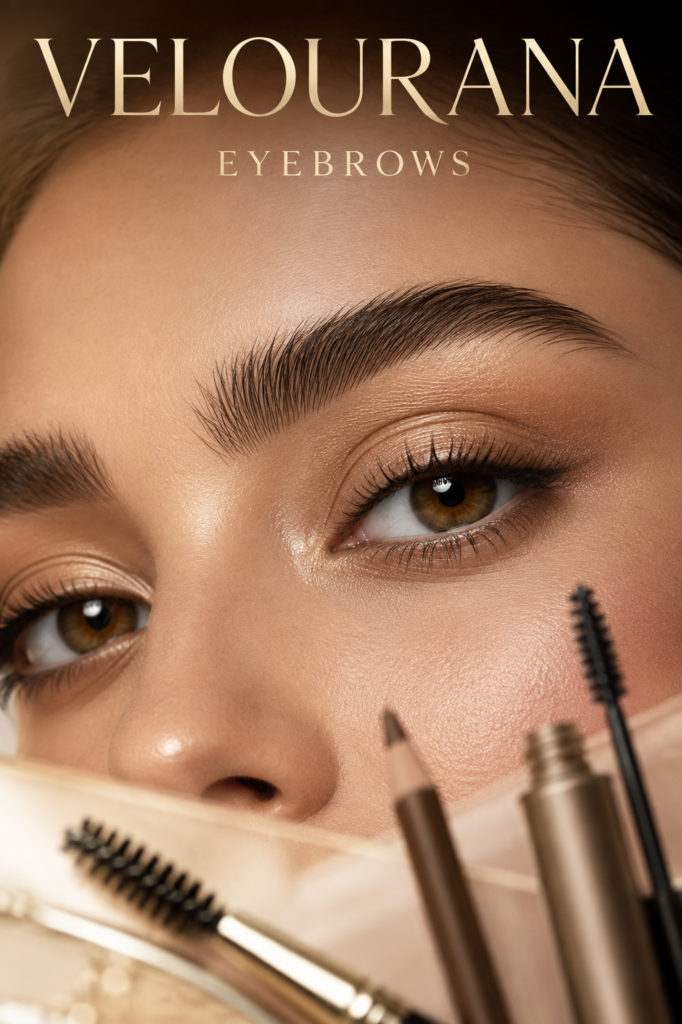
CATEGORY: Brow Mapping
Brow mapping is the process of studying the relationship between the eyebrows and the surrounding facial features so that shaping, filling, tinting, or other brow work can be approached with greater precision. It is often described as a way of identifying where an eyebrow should begin, where its highest point may sit, and where the tail can naturally end, but a thoughtful mapping process involves considerably more than locating three isolated points.
Eyebrows are not independent decorative lines. They exist within a complex structure formed by the forehead, orbital bones, eyes, nose, temples, and cheekbones. Their placement influences how the upper face is perceived, while their thickness, direction, and spacing affect apparent symmetry and expression. Brow mapping attempts to interpret these relationships before any permanent or semi-permanent changes are made.
The technique is useful precisely because natural eyebrows are rarely identical. One may sit slightly higher than the other, contain a stronger arch, begin closer to the nose, or extend farther toward the temple. These differences are normal. Mapping is not meant to erase all of them. Instead, it provides a visual framework for deciding which asymmetries should remain and which can be softened through grooming or cosmetics.
This distinction is essential. When mapping becomes an exercise in forcing both brows into mathematically identical templates, the result can look disconnected from the face. A more refined approach treats symmetry as balance rather than duplication. The brows should relate convincingly to one another while remaining compatible with the anatomy beneath them.
Brow Mapping as a Study of Facial Relationships
The simplest versions of brow mapping often use the nose as an anchor. Imaginary lines are drawn upward from different points around the nostril to estimate the beginning of the brow, the position of the arch, and the endpoint of the tail.
These references can be helpful, but they are not universal laws.
Noses differ in width, shape, projection, and position. Eyes differ in size, spacing, tilt, and depth. Foreheads and temples vary significantly. Applying the same geometric formula to every face can therefore produce inconsistent results.
Professional-looking mapping requires interpretation. The reference lines provide orientation, while the natural brow and face determine the final decisions.
The brow head, for example, should interact comfortably with the bridge of the nose and the spacing of the eyes. Beginning too far inward can visually crowd the center of the face. Beginning too far outward can create excessive space between the brows and weaken their framing effect.
The arch should correspond with both natural growth and the eye area beneath it. Moving it excessively toward the center can create a rounded or surprised appearance. Placing it too far outward can make the brow look unusually flat through most of its length before changing direction suddenly.
The tail must taper into the temple area without descending excessively or extending farther than the facial proportions can support.
Each landmark therefore needs to be interpreted within the entire face rather than treated as a standalone measurement.
Establishing the Brow Head
The brow head is the inner portion nearest the nose. It plays a major role in framing the center of the face because the two brow heads create a visual relationship across the bridge of the nose.
Many mapping methods use a vertical or slightly angled reference rising from the outer edge of the nostril. This can indicate an approximate starting area, but natural hair growth remains an important consideration.
A person with closely spaced eyes may benefit visually from preserving slightly more distance between the brow heads, while someone with widely spaced eyes may prefer a stronger central frame. These adjustments should remain subtle because dramatic changes can make the brows appear artificial.
The inner edge should rarely be treated as a perfectly vertical wall. Natural brow heads contain individual hairs that grow upward, outward, or diagonally. The boundary is therefore usually softer than a mapping line initially suggests.
Mapping helps identify the structural location, but the final shaping should preserve natural texture.
The height of each brow head also matters. One brow may naturally begin slightly higher. Attempting to lower or raise one dramatically through grooming can create an unnatural shape. Cosmetic filling is often a more flexible way to improve balance.
The goal is not to position both heads at identical coordinates. It is to make their spacing, visual weight, and direction feel related.
Locating the Arch
The arch is the point where the brow reaches its highest visible elevation before tapering toward the tail.
Traditional mapping often estimates this location by drawing a line from the side of the nose through or near the outer edge of the iris while the person looks straight ahead. This can provide a useful reference, but individual anatomy may support an arch slightly before or after this point.
Natural hair direction gives valuable information. As the brow approaches the arch, hairs often change from upward or diagonal growth to more horizontal or downward direction. This shift may reveal the natural structural peak more accurately than an external formula alone.
Face shape also affects how the arch is perceived. A high, sharp arch creates more vertical movement and can visually lengthen the upper face. A lower or softer arch emphasizes horizontal direction and can create a calmer appearance.
Mapping should therefore identify not only where the arch could sit but how prominent it should become.
An eyebrow with a naturally gentle curve does not necessarily need to be converted into a dramatic peak. Similarly, a naturally angular brow may lose character if flattened excessively.
The best mapping preserves the underlying architecture while refining it.
Understanding Tail Placement
The tail completes the eyebrow and strongly influences whether the brow appears lifted, elongated, heavy, or shortened.
A commonly used mapping reference places a straight line from the outer edge of the nostril toward the outer corner of the eye. Where this line meets the natural brow area can provide an approximate endpoint.
Again, facial variation matters.
Eyes with a strong upward tilt, long horizontal shape, or deep-set structure may interact differently with the brow tail than round or downward-tilting eyes. Temple width and natural hair growth also influence the appropriate length.
A tail that extends excessively downward can make the outer eye appear visually heavier. One that ends too early may create an incomplete frame. An extremely long tail can dominate the temple area.
The angle should therefore be assessed in relation to the brow head. In many balanced shapes, the tail finishes near or slightly above the level of the brow head rather than dropping far beneath it.
This is not an absolute requirement, but it offers a useful visual reference.
The tail should also narrow gradually. Mapping may establish the endpoint, but the transition into that point determines whether the result appears natural.
Mapping Thickness Rather Than Only Length
Brow mapping is often discussed in terms of horizontal landmarks, but thickness is equally important.
A brow can be correctly positioned yet still look disproportionate if its width is unsuitable for the face or natural growth pattern.
Very thick brows create greater visual weight. They can frame large or prominent features beautifully but may overwhelm smaller facial proportions when heavily defined.
Thin brows create more open skin space around the eyes and forehead but may appear weak if the face contains strong features or dense hair elsewhere.
The ideal thickness cannot be determined by a single universal measurement.
Instead, mapping can identify a natural upper and lower boundary through the densest sections of existing growth. Sparse areas can then be evaluated to determine whether they represent genuine shape changes or simply missing density.
This prevents unnecessary removal. A sparse lower section, for example, might initially make the brow appear narrower. Filling that area may restore the intended thickness without changing the upper boundary.
Thickness should also taper. The brow head and body are usually fuller than the tail. Maintaining identical width across the entire brow produces a rigid appearance.
Mapping should therefore establish a gradual structural progression rather than one fixed measurement.
The Importance of the Lower Brow Line
The lower boundary is one of the most visually influential elements in eyebrow architecture.
It sits directly above the eyes and therefore strongly affects perceived lift, arch, and thickness.
Mapping the lower line can help determine whether a brow rises smoothly, forms a sharp angle, or appears uneven.
When one brow contains a lower section than the other, the difference may be corrected through filling rather than hair removal. Similarly, sparse areas beneath the arch can make one brow appear higher even when the actual follicle placement is similar.
The lower boundary should generally flow continuously from the brow head through the body before rising toward the arch.
Abrupt changes can create an unnatural notch.
Mapping makes these inconsistencies easier to recognize before grooming begins.
The Upper Brow Line and Natural Texture
The upper boundary is usually softer and less uniform than the lower one.
Natural hairs often extend slightly above the central brow mass, particularly near the head and arch. Removing every hair that crosses a strict mapping line can make the upper edge unnaturally precise.
The purpose of mapping is not to create a border that must be followed exactly.
Instead, the line can indicate the approximate structural limit. Hairs clearly outside the intended shape can be identified, while smaller irregularities may be preserved.
This distinction creates a more natural finished brow.
The upper line also influences arch height. Removing too much from the highest point can flatten the brow, while adding cosmetic density above a low arch can create a subtle lift.
Mapping provides a framework for making these choices intentionally.
Vertical Symmetry Between the Brows
One of the most challenging aspects of brow mapping is dealing with brows that sit at different heights.
This is extremely common because faces themselves are asymmetrical. Differences in orbital bone structure, muscle activity, eyelid position, and habitual expression can all contribute.
Trying to lower a naturally high brow or raise a low brow through aggressive shaping can result in thin or distorted eyebrows.
A more effective approach is often to create visual balance rather than physical equality.
The lower brow may be filled slightly along its upper edge, while the higher brow may receive more density below. These cosmetic adjustments reduce the perceived difference without removing substantial hair.
Mapping helps identify how much correction is realistic.
If the difference is primarily skeletal or muscular, exact equality may never look natural.
Horizontal Symmetry and Brow Length
The brows may also differ in length.
One head may begin farther inward, or one tail may extend farther toward the temple.
Mapping can compare these endpoints across the face and determine whether cosmetic extension or selective grooming would improve balance.
Short tails are usually easier to correct by adding fine strokes than by shortening the longer brow.
Similarly, a sparse brow head can often be reconstructed cosmetically rather than trimming the fuller side.
Additive correction generally preserves more flexibility than subtractive correction.
This is particularly important because brow hairs can take considerable time to regrow and may not always return with the same density after repeated removal.
Mapping Straight, Rounded, and Arched Brow Shapes
Different brow shapes require different interpretations of the same mapping landmarks.
A straight brow may have a subtle arch placed far toward the outer third. The vertical difference between the brow head and highest point remains small.
A rounded brow contains a smoother continuous curve rather than a distinct peak.
A soft-angled brow rises gradually before changing direction gently.
A strongly arched brow contains a more pronounced peak and visible transition into the tail.
Mapping should accommodate these differences rather than forcing all brows into the same geometry.
The landmarks establish proportion, while the connections between them establish style.
Two brows can begin and end at similar locations yet look completely different because one connects those points with a soft curve and another with a sharp angle.
Understanding this allows mapping to support individual preferences without abandoning facial balance.
Brow Mapping Before Tweezing or Waxing
Mapping is particularly valuable before hair removal because subtraction is less reversible than makeup.
Drawing or visually establishing the intended shape first provides a boundary around which stray hairs can be assessed.
Hairs clearly outside the mapped area may be candidates for removal. Hairs sitting close to the boundary deserve greater caution because they may contribute to density or texture.
The process helps prevent gradual over-tweezing.
Without a structural reference, repeated removal of individual hairs can slowly change the brow over weeks or months. The difference may be difficult to notice until significant density has been lost.
Mapping introduces a pause between observation and removal.
This makes grooming more deliberate.
Brow Mapping Before Filling
Mapping is equally useful for cosmetic filling.
Sparse brows may not reveal their intended architecture clearly. Establishing the approximate head, arch, tail, and boundaries helps determine where pigment should be placed.
The mapped shape should then be filled gradually rather than outlined heavily.
Hairlike strokes, powder, pencil, or other products can recreate missing density within the framework.
The mapping marks themselves should disappear into the finished brow.
The final result should look like an eyebrow rather than a diagram.
Mapping and Face Shape
Face shape can influence how different brow structures are perceived, but mapping should not become a rigid system in which one brow shape is assigned to each facial category.
An elongated face may visually benefit from greater horizontal brow movement. A rounder face may gain definition from a modest arch. Angular faces may be complemented by softer brow transitions.
These are aesthetic tendencies rather than rules.
Individual bone structure, eye placement, hair density, and personal style can be more important than broad face-shape categories.
Mapping allows these elements to be evaluated together.
Mapping and Eye Spacing
The distance between the eyes influences the way brow-head placement is perceived.
Widely spaced eyes may appear more centered when the brow heads provide a stronger inner frame.
Closely spaced eyes may benefit from preserving slightly more openness between the brows.
Any adjustment should remain subtle because dramatic manipulation of brow-head position can look unnatural.
The natural growth pattern still provides the most reliable foundation.
Mapping simply makes the relationship easier to see.
Mapping and Eye Shape
Eye shape also interacts with eyebrow architecture.
Long, almond-shaped eyes may be emphasized by elongated brows.
Round eyes can appear more extended when the brow carries horizontal movement.
Hooded eyes may benefit from careful attention to the amount of space between the eyelid and lower brow boundary.
Deep-set eyes may tolerate stronger brow definition because the orbital structure already creates pronounced shadow.
Mapping helps assess these relationships before changes are made.
The Role of Measurement Tools
Brow mapping can be performed visually, with a pencil or brush used as a straight reference, or with specialized rulers, threads, strings, and measuring devices.
Tools can improve consistency, particularly when detailed shaping is required.
However, measurement should support visual judgment rather than replace it.
A perfectly measured brow can still look inappropriate if it ignores natural anatomy.
The face should always be viewed as a complete composition after measurements are taken.
Avoiding the Trap of Mathematical Perfection
Perhaps the greatest misunderstanding about brow mapping is that accuracy requires absolute symmetry.
Human faces are not symmetrical structures.
One eye may sit slightly higher. One side of the jaw may be stronger. The nose may deviate subtly. Muscle movement can raise one eyebrow more than the other.
Perfectly mirrored brows placed on an asymmetrical face can sometimes emphasize those differences rather than conceal them.
The better objective is harmony.
Each brow should look convincing on its own side of the face, while the pair should share enough similarity in thickness, direction, and visual weight to appear balanced.
Mapping provides information. It does not eliminate the need for interpretation.
Mapping as a Foundation Rather Than a Formula
Brow mapping is most valuable when treated as a design framework.
It identifies relationships that may otherwise be difficult to judge: where the brow begins, where it rises, how it tapers, how long it extends, and how the two sides compare.
These observations make shaping and filling more intentional.
The technique also reduces unnecessary correction. Sparse areas can be identified as density issues rather than mistaken for structural flaws. Natural asymmetries can be distinguished from correctable differences.
Most importantly, mapping encourages the eyebrows to be viewed within the face rather than as isolated objects.
The strongest result is not the brow that follows a diagram most perfectly. It is the brow whose architecture appears naturally connected to the eyes, forehead, nose, and temples.
When measurement and visual judgment are combined, brow mapping becomes less about imposing a standardized ideal and more about discovering the proportions that already make sense for the individual face.
THE END VELOURANA
 Discover More From Our Family of Websites
 ZodiacBearing (Astrology, Tarot, Numerology, Angel Numbers & Spiritual Guidance)
 Velourana (Beauty, Makeup, Hair Care, Skincare & Beauty Tips)
 HavenBearing (Home, Living, Organization, Décor & Everyday Inspiration)
 PawBearing (Pet Care, Dog Breeds, Animal Health, Training & Pet Products)
 PsyCatherine (Notes From the Journal of a Psychologist on Real Life)