
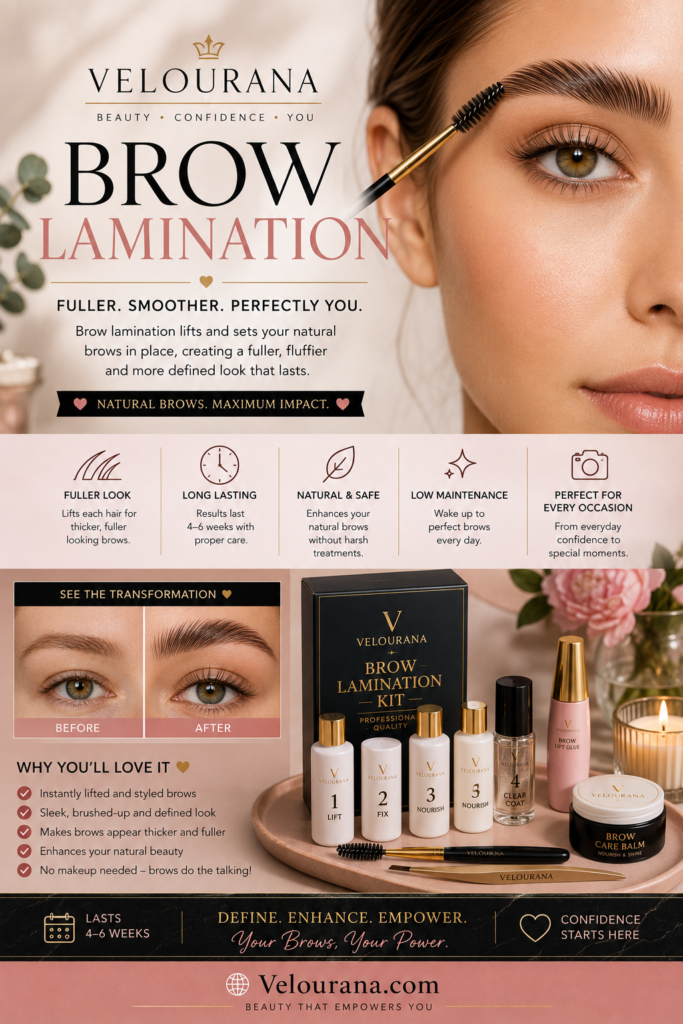
CATEGORY: Brow Lamination
Brows have an extraordinary ability to change the character of a face. A small alteration in their direction, fullness, or definition can make the eyes appear more open, soften strong facial features, or give the entire face a more polished appearance. This is one reason brow lamination has moved from a specialist salon treatment into the mainstream of modern brow grooming.
Brow lamination is sometimes described as a “perm for the eyebrows,” but that shorthand does not fully explain what the treatment is designed to accomplish. Rather than creating curls, lamination temporarily changes the way individual brow hairs can be positioned. Hairs that naturally point downward, grow sideways, overlap irregularly, or refuse to remain brushed upward can be redirected into a more controlled arrangement.
The result can be dramatically fuller-looking brows without adding additional hair.
This distinction matters. Brow lamination does not create new brow hairs, permanently change the brow, or fill genuinely hairless areas. Its visual power comes from reorganizing what is already there. When performed well, the existing hairs are separated, lifted, and arranged so that more of the brow’s natural width becomes visible.
For someone accustomed to pencils, gels, pomades, powders, and repeated brushing every morning, that can make brow grooming considerably simpler. Yet lamination is not automatically appropriate for every person or every brow. Understanding how it works, what it can realistically achieve, and how the brows should be cared for afterward is essential to getting a result that looks refined rather than overprocessed.
What Brow Lamination Actually Does
Every eyebrow has its own natural growth pattern. Some people have hairs that rise neatly from the brow line. Others have hairs growing horizontally toward the temples. Some have downward-pointing hairs, especially around the arch and tail. Individual hairs can also cross one another or grow in several different directions within the same brow.
Ordinary brow gel attempts to control these patterns mechanically. You brush the hairs where you want them and use a styling product to hold them there.
Lamination works differently.
During the professional treatment, specialized solutions temporarily make the brow hairs more flexible and manageable. The hairs can then be brushed and positioned into a chosen direction before subsequent stages of the treatment help establish the new arrangement.
This produces the characteristic groomed appearance associated with laminated brows.
The important point is that the objective does not have to be the extremely vertical, editorial-style brow sometimes seen in photographs. That is only one styling option.
A skilled treatment can be much softer.
The hairs might be gently lifted at the front, angled naturally through the centre, and directed outward toward the tail. This creates fullness while respecting the shape of the face. Someone who dislikes the dramatic “brushed straight up” appearance can therefore still be a candidate for lamination.
Modern brow lamination is best understood as directional control rather than a single brow shape.
Why Lamination Can Make Brows Look Fuller
The illusion of increased density is one of the most attractive aspects of brow lamination.
Imagine several long brow hairs lying almost horizontally on top of one another. Although the person may have a reasonable amount of eyebrow hair, much of it visually occupies the same narrow strip. The brow therefore appears thinner than the actual amount of hair would suggest.
Now imagine those same hairs being separated and angled slightly upward.
They cover a larger vertical area. The upper boundary of the brow becomes more substantial, small spaces between hairs become less noticeable, and the brow appears broader.
Nothing has been added.
The available hair has simply been distributed more effectively.
This is why people with relatively long but unruly brow hairs can sometimes experience especially noticeable results. Their brows may appear sparse before lamination even though they possess enough hair to create substantial coverage once those hairs are redirected.
The effect is different from makeup. A pencil creates the appearance of additional hairs or shadow on the skin. Lamination uses the physical hairs themselves.
The two approaches can also complement one another. After lamination, a person may discover that only a few genuinely sparse areas require pencil rather than needing to reconstruct much of the brow every morning.
The Difference Between Lamination and the “Soap Brow” Look
Brow lamination became particularly visible during the popularity of fluffy, upward-brushed brows, which has occasionally caused the treatment and the style to be treated as if they were identical.
They are not.
The “soap brow” or strongly feathered brow is a styling aesthetic. Lamination is a treatment that makes brow hairs easier to arrange.
A laminated brow can be styled dramatically, naturally, neatly, softly, or somewhere between these extremes.
This flexibility is important because facial proportions vary. Very upright hairs can look striking on one person while appearing disproportionately heavy on another. Likewise, a perfectly flattened, overly controlled brow may remove the softness that makes naturally textured brows attractive.
The best lamination should therefore not look as though every client received the same template.
Brow architecture still matters.
The beginning of the brow generally benefits from some lift because this creates openness around the eyes. Through the body of the brow, the direction can gradually become more diagonal. Near the tail, the hairs can follow the natural taper rather than standing vertically.
This progression tends to produce a more sophisticated result than forcing every hair into exactly the same direction.
Who May Benefit Most From Brow Lamination
Brow lamination is particularly useful when the primary problem is not lack of hair but lack of cooperation from the hair that already exists.
Consider someone whose brow hairs repeatedly fall downward during the day. She may brush them into position each morning and apply a strong gel, only to find that the arch has collapsed several hours later. Lamination can reduce the amount of daily manipulation required because the hairs have become easier to direct.
Another person may have several hairs that grow diagonally across sparse-looking areas. Once brushed into a more advantageous position, those hairs can provide surprisingly effective coverage.
Coarse or unruly brows can also benefit from greater directional consistency. Long hairs that twist, cross, or project away from the brow can create an untidy appearance even when the underlying shape is attractive.
However, brow lamination should not be regarded as a universal solution for thin brows.
If a brow contains extensive areas with no hair at all, lamination cannot manufacture coverage. A few surrounding hairs may be repositioned to reduce the visibility of a gap, but there are limits to how far natural hairs can be moved while still looking convincing.
This is where realistic expectations become important.
Lamination is fundamentally a treatment for the hair you possess, not a substitute for missing hair.
What Happens During a Professional Brow Lamination
Exact products, timings, and protocols vary between professional systems, so a reputable brow technician should follow the instructions associated with the products being used rather than applying one universal procedure to every client.
Generally, the treatment begins with an assessment of the brows and the condition of the surrounding skin.
The technician needs to understand the client’s desired appearance as well as the natural growth direction, density, hair texture, and overall brow shape. This consultation is more important than it may appear. “I want fuller brows” can mean very different things to different people.
One client may want maximum fluffiness.
Another may simply want downward-growing hairs to sit neatly.
The brow area is prepared and the hairs are arranged as required during the appropriate stages of the professional system. Processing solutions are used according to the manufacturer’s protocol to make the hairs sufficiently manageable for repositioning. Further treatment stages then help establish the new direction.
Depending on the service and suitability of the client, brow shaping or tinting may also be incorporated.
The transformation can appear surprisingly substantial immediately afterward because the hairs are freshly positioned and carefully groomed.
Yet the quality of the result should not be judged solely by how dramatic the before-and-after photograph appears. Hair condition matters just as much as visual impact.
A beautiful laminated brow should still look like healthy brow hair.
Brow Lamination and Brow Tinting Are Different Treatments
Because lamination and tinting are frequently offered together, it is easy to confuse their functions.
Lamination primarily changes how the hairs sit.
Tinting changes their visible colour.
When pale, fine, or partially translucent hairs become darker, the brow can appear denser because hairs that previously blended into the skin become easier to see. Combining this with lamination can therefore produce a stronger transformation than either service alone.
But stronger is not always better.
Someone with naturally dark, dense brows may need no additional colour. Adding a dark tint to already prominent brows can make them look heavier than intended. Conversely, someone with very light hairs may find that lamination alone improves the shape but does not provide the definition she expected.
The decision should depend on the starting brow and desired finish rather than assuming that every lamination needs an accompanying tint.
Natural Brow Lamination Versus Maximum Lift
One of the most useful developments in brow grooming has been the move away from treating maximum lift as the definition of a successful lamination.
Early visual trends often emphasised brows with almost every hair pointing vertically upward. The style photographed well because the transformation was obvious, but an extreme result can overwhelm delicate features and may not suit someone seeking an understated everyday appearance.
A natural lamination takes a more restrained approach.
Instead of asking, “How high can these hairs be brushed?” the better question is, “Where should these hairs sit to make this particular brow look its best?”
For a brow with a naturally attractive arch, the objective may simply be to expose and refine that shape. For a flatter brow, carefully changing the hair direction can create a suggestion of lift without inventing an artificial peak. For asymmetrical brows, strategic grooming can make the pair appear more balanced, although perfect symmetry is neither realistic nor necessary.
Brows are sisters rather than mechanical duplicates, and small differences are part of a natural face.
The most flattering result often retains some movement and individuality.
The Importance of Hair Condition
Brow hair may seem tough because it is short and relatively coarse, but it can still become dry, fragile, or damaged.
This is particularly important with lamination because the treatment chemically alters the hair sufficiently to make it more manageable. Excessive processing, inappropriate timing, or repeated treatments without adequate consideration of hair condition can leave brows looking rough rather than polished.
More treatment is not necessarily better treatment.
A person who loves the freshly laminated effect may be tempted to repeat the service as soon as the brows begin returning toward their natural growth pattern. The condition of the hair, however, should help determine when another treatment is appropriate.
This is another reason professional assessment is valuable.
Healthy-looking brow hair contributes enormously to the final appearance. Even perfectly positioned hairs will not create a luxurious result if they appear brittle, excessively dry, frizzy, or broken.
What to Expect Immediately After Lamination
Freshly laminated brows often look more intense than they will during ordinary wear.
The hairs have just been carefully arranged, and professional finishing products may contribute additional shine and definition. Someone seeing lamination for the first time should therefore avoid assuming that the brows will remain frozen in precisely that appearance.
Once the initial aftercare period has passed and normal grooming resumes according to professional instructions, laminated brows retain flexibility.
They can be brushed.
This is one of the treatment’s major advantages.
You are not permanently committing the brow hairs to a single rigid arrangement every morning. Instead, the treatment makes them easier to manipulate. You might choose a fluffier look one day and a smoother, more restrained finish another day.
The underlying benefit is manageability.
Aftercare Matters More Than Many People Realise
The professional who performs the treatment should provide aftercare instructions appropriate to the exact system used, and those instructions should take priority over generic beauty advice.
In particular, the initial period after the appointment can require specific care regarding moisture, heat, steam, cosmetics, or other exposure depending on the professional product system.
Following those instructions is part of the treatment, not an optional extra.
Longer-term grooming should also be gentle. Brow hairs do not need aggressive brushing to remain attractive. A clean spoolie and light hand are usually more appropriate than repeatedly dragging or pulling at the hairs.
The surrounding skin deserves consideration too. Brow grooming does not occur in isolation from skincare. Strong exfoliating products, professional skin treatments, irritation, or other factors affecting the brow area may influence whether and when lamination is suitable.
Clients should tell their brow professional about relevant products and recent treatments around the area rather than assuming that eyebrows are separate from facial skincare.
How Laminated Brows Change the Morning Routine
For many people, the practical value of lamination becomes apparent not at the salon but the following mornings.
Without lamination, someone with stubborn brows may spend several minutes brushing, applying gel, correcting the direction, waiting for the product to set, and then filling areas that still appear uneven.
After successful lamination, the same person may be able to brush the brows into position much more quickly.
This does not necessarily eliminate brow products.
A clear or tinted brow gel may still be useful when additional hold or definition is wanted. Pencil may still be needed where genuine gaps exist. Concealer or other makeup can still be used to sharpen the surrounding shape if that is part of the desired look.
The difference is that these products become finishing tools rather than tools fighting against the brow’s natural direction.
That can make the routine feel considerably less complicated.
Brow Lamination Does Not Replace Good Brow Shaping
Direction and shape are closely related, but they are not identical.
Lamination can reveal the potential of a brow, yet the overall outline may still benefit from thoughtful shaping. Stray hairs beneath the brow, excessive length, or an unbalanced tail can affect the finished appearance.
The danger is over-shaping.
Because laminated hairs can make the brow look larger and more defined, there may be a temptation to create extremely sharp boundaries around them. Removing too much natural hair can defeat one of the treatment’s main advantages: the impression of fullness.
A conservative approach is often more versatile.
It is easier to remove an additional stray hair later than to restore one that has been unnecessarily removed.
Likewise, trimming requires judgement. Long brow hairs contribute to the fullness that lamination creates. Cutting them too aggressively simply because they extend beyond an imaginary line when brushed vertically can reduce the brow’s ability to cover space when styled naturally.
The final shape should be evaluated in the way the brows will actually be worn.
When Brow Lamination May Not Give the Result You Expect
Beauty treatments are most satisfying when expectations correspond to what the treatment can physically accomplish.
Suppose someone has over-plucked the outer third of each eyebrow for many years and now has almost no hair from the arch to the tail. Lamination may beautifully organise the remaining hairs, but it cannot create a substantial tail from empty skin.
Likewise, someone seeking permanently fixed brows may misunderstand the nature of the treatment. Lamination improves manageability and temporarily changes the behaviour of the hairs, but the brows still require grooming as they grow and the effect gradually wears away.
Another common expectation is perfect symmetry.
Human faces are asymmetrical. Brow bones differ, muscles move differently, and hair density can vary from one side to the other. Lamination may visually improve balance by changing hair direction, but chasing mathematically identical brows can lead to unnecessary removal or unnatural styling.
Successful brow grooming aims for harmony, not engineering precision.
How Long Does the Effect Last?
There is no single duration that can be guaranteed for every person.
How long a laminated appearance remains noticeable can vary with the individual hair growth cycle, brow texture, treatment system, aftercare, grooming habits, and other factors. Professional providers commonly describe results in terms of several weeks, but an individual result should not be treated as a fixed calendar promise.
The effect also does not usually disappear overnight.
Instead, the brows gradually begin behaving more like their untreated selves as hairs grow and the treatment effect diminishes. New hairs entering the visible brow will have their natural direction and texture.
This gradual transition is useful because it gives the client time to decide whether another professional treatment is desirable rather than suddenly losing the entire effect.
Choosing a Brow Lamination Professional
The temptation with any apparently simple beauty treatment is to judge providers primarily by dramatic photographs.
Before-and-after images are useful, but they do not reveal everything.
Look at the quality of the hair as well as the degree of lift. Do the finished brows appear smooth and healthy? Does the professional show different brow styles, or does every client leave with the same exaggerated vertical shape? Are natural-looking results represented alongside dramatic ones?
Consultation should also be part of the experience.
A professional should be interested in what you actually want rather than assuming that requesting lamination automatically means requesting the strongest possible fluffy brow.
It is also reasonable to discuss the products used, relevant contraindications, patch-testing requirements where applicable, previous treatments, skin sensitivities, and aftercare.
The objective is not merely to produce an impressive photograph immediately after the service. It is to achieve an attractive result while treating the brow hair and surrounding area responsibly.
Can You Still Use Makeup on Laminated Brows?
Once any initial aftercare restrictions specified by the professional have passed, laminated brows can still be incorporated into a normal beauty routine.
In fact, many people find that they need less brow makeup.
A fine pencil can be used selectively where the natural brow genuinely lacks density. Instead of colouring the entire brow, small hair-like marks can complement the repositioned natural hairs.
Brow gel can provide additional styling control.
Powder can create softer shadow where definition is required without producing a sharply drawn appearance.
The key is to look at what the lamination has already accomplished before automatically applying the same amount of product used before the treatment.
If the brows now appear fuller, applying an old heavy makeup routine on top may make them unnecessarily dominant.
Lamination can be an opportunity to simplify.
The Most Modern Approach Is Personal, Not Extreme
Beauty trends often begin with an exaggerated visual signature. That helps a new treatment become recognisable, but the mature version of a trend usually becomes more personalised.
Brow lamination has followed this path.
The treatment does not need to announce itself.
A stranger does not have to look at your face and immediately think, “Those brows are laminated.” In many cases, the more elegant reaction is simply that the brows look unusually well groomed.
That might mean soft feathering on naturally dense brows. It might mean redirecting several stubborn downward hairs. It might mean creating greater visual width in a narrow brow. It might mean making two slightly different brows appear more harmonious.
The technique becomes more useful when it serves the person rather than the trend.
Is Brow Lamination Worth Considering?
Brow lamination can be particularly effective for people who already possess enough natural brow hair but struggle with its direction, texture, or daily manageability.
Its greatest strength is not that it creates a completely different eyebrow. It reveals possibilities within the existing one.
Hairs that previously overlapped can be separated. Downward growth can be lifted. Natural width can become more visible. Small areas of apparent sparseness may become less obvious. Daily styling can become easier.
But good results depend on restraint as much as transformation.
The healthiest-looking, most flattering laminated brows are not necessarily the biggest, darkest, or most vertical. They are the brows in which the hair direction, density, facial proportions, and personal style have been considered together.
For someone interested in brow lamination, the most useful starting point is therefore not a photograph of somebody else’s eyebrows. It is an honest examination of your own.
Look at where your hairs naturally grow. Notice which areas refuse to stay in place. Identify whether apparent thinness comes from genuinely missing hair or from hairs lying in an unhelpful direction. Decide whether you want a fluffy fashion-forward effect or simply a neater version of your natural brow.
Those observations make it much easier to communicate with a brow professional and much more likely that the final result will feel like an enhancement rather than a disguise.
Brow lamination is ultimately a form of intelligent grooming: working with existing hair, changing its behaviour temporarily, and using direction to create shape.
When approached thoughtfully, it can make brows appear fuller, smoother, more balanced, and considerably easier to manage while still allowing them to look unmistakably like your own.
The End
Velourana
 Discover More From Our Family of Websites
 ZodiacBearing (Astrology, Tarot, Numerology, Angel Numbers & Spiritual Guidance)
 Velourana (Beauty, Makeup, Hair Care, Skincare & Beauty Tips)
 HavenBearing (Home, Living, Organization, Décor & Everyday Inspiration)
 PawBearing (Pet Care, Dog Breeds, Animal Health, Training & Pet Products)
 PsyCatherine (Notes From the Journal of a Psychologist on Real Life)

