
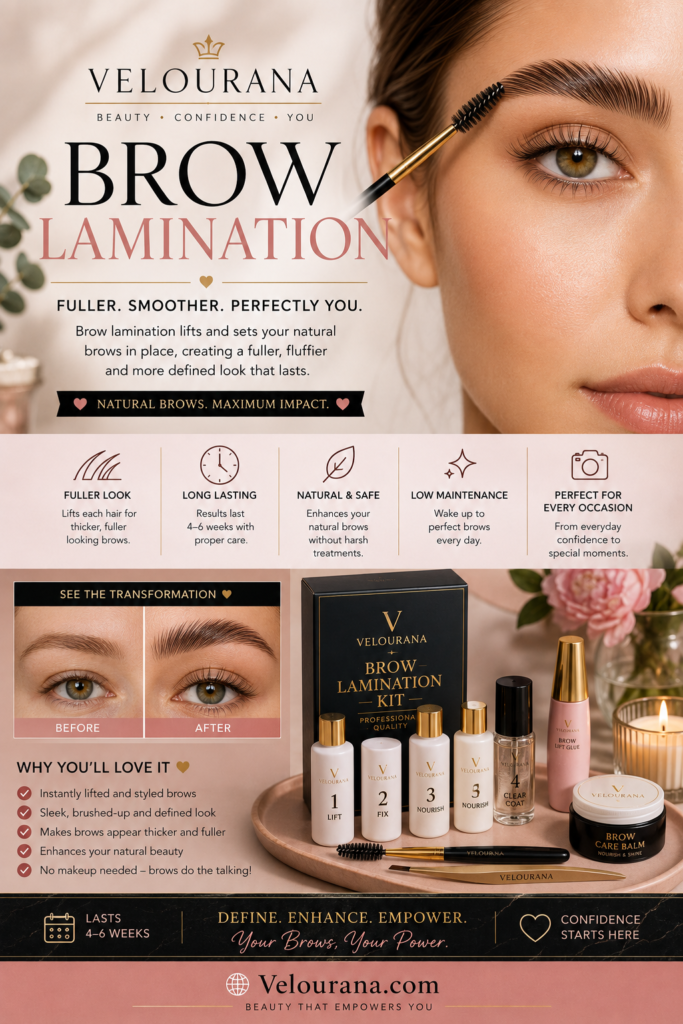
CATEGORY: Brow Lamination
Brow lamination can make eyebrows look fuller, softer, more symmetrical, and considerably easier to style. It can also produce results that appear too tall, too flat, too dark, over-trimmed, rigid, or disconnected from the rest of the face.
The difference is not simply whether the treatment “worked.”
A technically noticeable transformation is not automatically an aesthetically successful one.
Many disappointing laminated brows are not the result of one dramatic error. More often, several small decisions accumulate. The hairs are lifted slightly too far. The tint is stronger than necessary. Too much length is trimmed. Makeup is applied as heavily as it was before the treatment. The brows are judged individually rather than as part of the entire face.
Eventually, every element begins competing for attention.
Understanding these common mistakes is useful even if you never intend to perform brow lamination yourself. Professional lamination is a chemical service that should be carried out according to the specific product system and appropriate professional protocols, but clients still make important decisions about the result they request, the professional they choose, the way they style the brows afterward, and how quickly they seek another treatment.
The most attractive laminated brows usually come from knowing when to stop.
Mistake 1: Assuming Every Hair Should Point Straight Up
The vertical, feathered brow became one of the defining images of lamination.
It is visually striking, particularly in close-up photographs.
But it is a style, not a requirement.
Natural eyebrows contain a directional progression. Hairs near the inner brow often grow more vertically. Through the central portion they usually become increasingly diagonal, while the outer hairs tend to point toward the temple.
Forcing the entire brow into a nearly vertical position removes this natural flow.
On long-haired brows, the effect can be particularly dramatic because the eyebrow suddenly becomes much taller. On dense, dark brows, the additional visual weight can overwhelm the eyes.
A softer approach allows direction to evolve across the brow.
Lift at the front.
Angle through the centre.
Smooth toward the tail.
The brow still benefits from lamination without looking as though every hair has been instructed to obey the same rule.
Mistake 2: Confusing Maximum Lift With Maximum Fullness
If some lift makes a brow look fuller, it is tempting to assume that more lift must create an even better result.
Eventually, however, additional height stops improving the shape.
The brow simply becomes larger.
Fullness should serve facial balance.
A brow can appear denser because overlapping hairs have been separated and distributed more effectively without needing to occupy the maximum possible area.
This distinction is particularly important for people who already have substantial natural density.
Their brows may need organisation, not enlargement.
The best question is not “How big can lamination make my brows?”
It is “How much additional width improves them?”
Mistake 3: Copying Somebody Else’s Brow Shape
Reference photographs are useful.
They can communicate preferences such as soft, fluffy, sleek, natural, bold, or lightly feathered.
What they cannot do is change your natural brow anatomy.
The person in a photograph may have longer hairs, greater density, a different natural arch, a different brow bone, different colouring, and completely different facial proportions.
Trying to reproduce the exact result can therefore lead to unnecessary manipulation.
Perhaps the reference brow has a high arch while yours is naturally straight.
Perhaps the model has short inner hairs that tolerate strong upward styling while yours are much longer.
A good professional interprets the inspiration rather than copying it mechanically.
Use photographs to describe an aesthetic.
Do not use them as architectural blueprints.
Mistake 4: Over-Trimming After the Hairs Are Lifted
This is one of the easiest ways to reduce the fullness that lamination was intended to create.
When long brow hairs are brushed vertically, they can extend well above the usual brow outline. Cutting everything that protrudes may seem like the obvious solution.
But those hairs may not normally be worn vertically.
Once angled through the brow, their length can provide valuable coverage.
A long strand may soften a small gap.
It may contribute to the upper edge.
It may help create the feathered texture that makes laminated brows attractive.
Cutting too much can produce blunt ends and expose areas that previously appeared full.
Any trimming should be evaluated in relation to the intended finished direction rather than the most extreme position in which the hairs can be placed.
Mistake 5: Removing Hairs That Have Suddenly Become Useful
Before lamination, a downward-growing hair may seem inconvenient.
It sits outside the preferred arrangement and refuses to cooperate with gel.
After lamination, the same hair may become easy to redirect and contribute beautifully to the brow.
This is why aggressive tweezing can work against the treatment.
A hair should not automatically be removed because its untreated direction was problematic.
Ask where it grows.
If its position is useful and only its direction was undesirable, lamination may have solved the problem already.
This is particularly important for anyone concerned about sparse brows.
Every healthy, strategically located hair is valuable material.
Mistake 6: Making the Brow Too Dark
Lamination can already make brows look more substantial because the hairs cover a wider area.
If tinting is added, fine or pale hairs may also become more visible.
This combination can create a powerful transformation.
It can also become excessive.
Someone accustomed to a lighter, narrower brow may suddenly see a wider, darker shape dominating the face.
The answer is not that tinting and lamination should never be combined. They can complement each other beautifully.
The issue is proportionality.
If the brow has gained substantial visual density from lamination, it may not need equally substantial additional colour intensity.
Every enhancement changes the starting point for the next decision.
Mistake 7: Using the Same Heavy Makeup Routine Afterward
Imagine a person who previously needed pencil, powder, pomade, and strong gel to create visible brows.
After lamination, her natural hairs cover considerably more area.
If she automatically repeats the old routine, she is adding the same amount of makeup to a much fuller-looking foundation.
The result can become blocky.
Style the laminated hairs first.
Then reassess.
A small gap may need pencil.
The tail may need slight definition.
Perhaps nothing else is required.
Makeup should respond to the brow that exists today rather than the brow that existed before the appointment.
Mistake 8: Creating a Solid Inner Brow
The beginning of the eyebrow strongly affects whether the entire shape looks natural.
A dense, sharply defined inner block can make even beautifully laminated hairs look heavily constructed.
The front of a natural brow usually contains some softness.
Individual hairs are visible.
Skin may show between them.
Density often increases gradually toward the body of the eyebrow.
Lamination is especially good at creating this feathered transition because the inner hairs can be gently separated and lifted.
Covering that texture with heavy colour can eliminate one of the treatment’s most attractive effects.
Mistake 9: Flattening Every Hair Completely Against the Skin
Laminated brows are sometimes styled into a very sleek finish where each hair appears pressed closely against the skin.
This can be intentional and fashionable.
But it is not the only way laminated brows can look.
Natural hair has dimension.
Individual strands overlap, cast tiny shadows, and sit at slightly different heights.
Allowing some of this texture to remain can create a softer appearance.
The goal is control, not necessarily compression.
Once the appropriate professional aftercare period has passed, experimenting with gentler brushing can reveal how much dimension the brow can retain while remaining orderly.
Mistake 10: Expecting Perfect Symmetry
One brow may naturally sit higher.
One may contain more hair.
One arch may be stronger.
Growth direction may differ from side to side.
Lamination can improve visual balance because the hairs become easier to position, but it cannot make the underlying face perfectly symmetrical.
Trying to achieve identical brows can lead to unnecessary removal of hair or unnatural directional choices.
Instead, assess the pair together.
Do they feel balanced?
Do they frame the eyes similarly?
Does either brow attract attention for the wrong reason?
Harmony is a more useful goal than mathematical duplication.
Mistake 11: Ignoring the Whole Face
Close-up brow photographs are useful for evaluating individual hairs.
They are not enough for judging overall beauty.
A brow can look beautifully sculpted in isolation yet appear too large or too dark when seen with the eyes, forehead, nose, and cheekbones.
Step away from the mirror.
Look at the entire face.
The eyebrows should support the eyes, not compete with them.
This is especially important after lamination because increased width can change facial balance more than expected.
Mistake 12: Trying to Hide Every Millimetre of Skin
Full eyebrows still contain visible skin.
That is normal.
Trying to eliminate every small gap can lead to excessive hair spreading, heavy pencil work, or dense tinting.
Natural texture depends partly on variation.
Some sections are denser than others.
Individual hairs remain identifiable.
A convincing brow does not need to become an opaque band.
If a tiny gap is visible only when inspecting the eyebrow from a few centimetres away, it may not require correction at all.
Mistake 13: Expecting Lamination to Create Missing Hair
Lamination can create an impressive illusion of increased density.
It does this by reorganising existing hairs.
It cannot create new ones.
If an area is genuinely hairless, the surrounding strands may provide some coverage if they have sufficient length, but there are physical limits.
Trying to stretch a few hairs across a large empty area often looks less natural than accepting the limitation and using subtle makeup where necessary.
Realistic expectations make the final result much more satisfying.
Mistake 14: Treating Aftercare as Optional
Professional aftercare instructions are part of the treatment.
Different lamination systems can have specific guidance regarding the initial period after the service, including considerations involving moisture, heat, steam, cosmetics, skincare, or other exposure.
Follow the instructions associated with the products actually used.
Do not replace them with a generic social-media rule simply because it sounds familiar.
A professional service should come with product-appropriate aftercare guidance.
Mistake 15: Over-Manipulating the Brows
Laminated hairs are easier to move.
That does not mean they need to be brushed continuously.
Repeated pulling, rubbing, touching, and aggressive spoolie use do not make the treatment more effective.
A few gentle movements are generally enough to arrange manageable hairs.
The purpose of lamination is to simplify brow control.
Turning it into an all-day grooming exercise defeats much of the practical advantage.
Mistake 16: Assuming Messy Morning Brows Mean the Treatment Failed
Sleeping can move hair.
A pillow can push laminated brows sideways just as it can disturb scalp hair.
The meaningful question is what happens when the brows are gently groomed again after the initial professional aftercare restrictions have passed.
If they return easily to the desired direction, the practical benefit remains.
Lamination improves manageability.
It does not suspend the laws of ordinary hair movement.
Mistake 17: Panicking About New Growth
As new brow hairs emerge, they follow their natural untreated direction.
A downward-growing new hair may suddenly appear among neatly laminated neighbours.
This is not evidence that something has gone wrong.
It is part of normal brow renewal.
Do not automatically remove useful new hairs simply because they behave differently.
A little styling product may help integrate them as the lamination gradually fades.
Mistake 18: Re-Laminating Simply Because the Calendar Says So
People often prefer fixed beauty schedules.
They are convenient and easy to remember.
But brow hair condition does not operate according to an appointment diary.
The fact that a particular number of weeks has passed does not automatically mean another chemical service is appropriate.
The hairs should be considered.
Do they appear healthy?
Has the previous effect largely faded?
How much untreated growth is present?
A professional assessment is more useful than chasing a rigid schedule solely to preserve maximum lift.
Mistake 19: Ignoring Signs That the Hair Needs Attention
A brow can be perfectly positioned and still not look beautiful if the hair itself appears compromised.
Excessive dryness, roughness, frizz, brittleness, or breakage can undermine the entire effect.
The condition of the hairs should therefore remain part of the maintenance conversation.
Professional product protocols, appropriate aftercare, and sensible treatment frequency matter.
More lamination is not the solution to every lamination problem.
Mistake 20: Believing Dramatic Means Better
Before-and-after photographs reward visible transformation.
A subtle improvement may be more flattering in person but less spectacular on a small social-media screen.
This can create pressure toward increasingly dramatic brows.
Higher.
Fluffier.
Darker.
Sharper.
But everyday beauty is experienced as part of a moving face, not a static comparison photograph.
A treatment can be highly successful even if strangers cannot immediately identify what was done.
Perhaps the eyes simply appear more open.
Perhaps the brows look naturally fuller.
Perhaps the face looks more balanced.
Subtle success is still success.
Mistake 21: Not Explaining What “Natural” Means to You
Clients often request “natural brows,” but the word is highly subjective.
One person means softly feathered.
Another means almost completely unchanged except for better control.
Another considers a dramatic fluffy brow natural because individual hairs remain visible.
A better consultation uses specific descriptions.
“I want the front lifted but not vertical.”
“I want more fullness through the centre.”
“I want to keep my straight brow shape.”
“I don’t want the tail fluffy.”
Specific preferences reduce misunderstanding.
Mistake 22: Choosing a Professional Based Only on the Most Dramatic Photos
A portfolio full of spectacular transformations can be impressive.
Look more closely.
Does every client receive the same shape?
Are there soft results as well as dramatic ones?
Do the brow hairs appear smooth and healthy?
Can the professional work with different densities, textures, and facial structures?
Versatility can be a better sign of personalised brow design than one recognisable signature style repeated on everyone.
Mistake 23: Treating Lamination as a Permanent Brow Solution
Lamination is temporary.
The effect gradually softens as treated hairs move through their natural cycle and untreated hairs become visible.
This is not a flaw.
It is part of the treatment.
Expecting a permanently fixed result can lead to disappointment or unnecessarily frequent attempts to maintain the freshest possible appearance.
The middle and later stages of lamination can still look attractive.
They simply require a slightly different grooming approach.
Mistake 24: Forgetting That Preferences Can Change
Perhaps you initially request dramatic brows and later realise that you prefer less lift.
That information is useful.
A temporary treatment gives you the opportunity to adjust future choices.
Maybe the next lamination should have a softer front.
Perhaps you want to preserve more natural texture.
Maybe tinting was unnecessary.
Beauty maintenance should evolve with experience.
There is no reason to repeat exactly the same result simply because that was the first version you tried.
The Most Natural Results Depend on Restraint
Many brow lamination mistakes share the same underlying cause: taking a useful effect too far.
Lift becomes excessive height.
Fullness becomes excessive width.
Definition becomes excessive darkness.
Shaping becomes excessive removal.
Control becomes rigidity.
Maintenance becomes overprocessing.
The treatment itself is remarkably versatile precisely because none of these extremes is required.
A successful lamination can simply make stubborn hairs easier to direct. It can expose natural width that was hidden by overlapping strands. It can reveal an arch, soften a small gap, organise coarse hairs, or create a feathered beginning without transforming the entire eyebrow.
The best result is therefore not the brow that demonstrates the maximum capability of lamination.
It is the brow that demonstrates judgement.
Preserve useful hair.
Respect natural architecture.
Allow some texture.
Keep colour proportional to the new fullness.
Use makeup only where it contributes something.
Follow professional aftercare instructions.
And when the effect begins to fade, consider the condition of the brows before automatically pursuing another treatment.
Brow lamination looks most sophisticated when it does not appear to be fighting the person wearing it.
The eyebrows should still belong to the face.
They should move with its expressions, support the eyes, and retain enough individuality to look human rather than manufactured.
When those principles guide the treatment and the styling that follows, lamination becomes far more than a trend built around hairs brushed upward.
It becomes a precise form of brow grooming in which knowing what not to do can be every bit as important as knowing what to change.
The End
Velourana
 Discover More From Our Family of Websites
 ZodiacBearing (Astrology, Tarot, Numerology, Angel Numbers & Spiritual Guidance)
 Velourana (Beauty, Makeup, Hair Care, Skincare & Beauty Tips)
 HavenBearing (Home, Living, Organization, Décor & Everyday Inspiration)
 PawBearing (Pet Care, Dog Breeds, Animal Health, Training & Pet Products)
 PsyCatherine (Notes From the Journal of a Psychologist on Real Life)

