
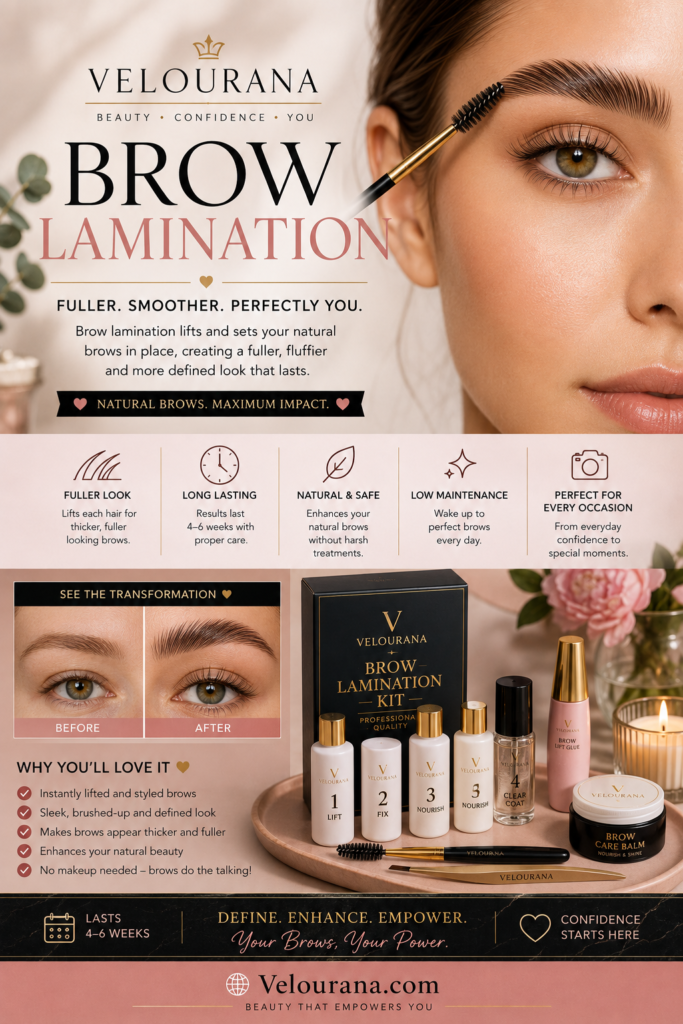
CATEGORY: Brow Lamination
Brow lamination and brow tinting are frequently mentioned together because the two treatments can create a striking transformation when combined. Lamination can make the hairs easier to position, allowing them to cover more of the brow area. Tinting can make lighter or less visible hairs easier to see. The eyebrow may consequently appear wider, denser, more defined, and more polished without requiring the same amount of daily makeup.
Yet the fact that two treatments work well together does not mean every laminated brow needs to be tinted.
For some brows, tinting is the element that turns a subtle lamination into a beautifully complete result. For others, the lamination already provides enough visual strength, and additional colour can make the brow heavier than intended.
The most useful way to think about the combination is therefore not as a standard package but as two separate tools.
Lamination changes how the hair can be arranged.
Tinting changes how visible the hair is.
Understanding what each treatment contributes makes it much easier to decide whether combining them serves your particular brows.
Why Lamination Alone Can Make Brows Look Darker
A laminated eyebrow can sometimes appear more defined even without tinting.
This happens because the hairs are redistributed.
Before treatment, several strands may overlap one another or lie flat against the skin. Once separated and positioned across a wider area, more individual hairs become visible.
The brow’s outline can therefore appear stronger.
This is particularly noticeable on naturally dark hair.
Someone with dense brown or black brow hairs may already have considerable colour intensity. Lamination can expose enough of that natural pigment to create all the definition required.
Adding tint automatically may push the finished result beyond the person’s preferred level of boldness.
What Tinting Adds
Tinting becomes especially interesting when the brow contains hairs that exist physically but contribute very little visually.
Fine hairs can be difficult to see.
Pale hairs may almost disappear against the skin.
Some eyebrows contain lighter ends, meaning the visible hair appears shorter than its actual physical length.
Appropriately selected tint can reveal more of those hairs.
This can make the brow look denser even though no new strands have appeared.
When combined with lamination, the effect can be amplified because the newly visible hairs are also distributed more effectively.
The treatment is therefore using two different forms of enhancement simultaneously: improved visibility and improved positioning.
Fine, Light Brows May Benefit Significantly
Imagine a person with numerous fine, light-brown brow hairs.
From a distance, her brows look sparse.
Close inspection reveals that she actually has a reasonable number of hairs, but many are too pale to contribute much definition.
Lamination alone can separate them and create a wider shape.
However, if the hairs remain barely visible, the visual improvement may be smaller than expected.
Tinting may reveal those strands.
Suddenly, the fuller shape created by lamination becomes much easier to see.
This is one of the clearest situations in which combining the treatments can make sense.
Dark, Dense Brows May Need Less
Now consider the opposite brow type.
The hairs are thick, naturally dark, and plentiful. The problem is not visibility. It is direction.
Several hairs point downward. Others overlap. The brow looks untidy despite having excellent natural density.
Lamination can solve much of the problem by making those hairs easier to organise.
Once separated and lifted, the brow may already look dramatically fuller and more defined.
Adding a strong tint could create unnecessary visual weight.
In this case, the better result may come from allowing lamination to do the work on its own.
Tint Should Complement the New Brow Shape
A common mistake is choosing tint intensity based on how the brow looked before lamination.
But lamination changes the visual starting point.
If the eyebrow becomes wider and more substantial after the hairs are repositioned, the same colour intensity may now appear stronger.
This is why colour and shape should be considered together.
A broad, fluffy brow can carry colour differently from a narrow untreated brow.
The objective is not simply to make every hair as dark as possible.
It is to create enough definition for the individual strands and overall shape to be visible without overwhelming the face.
Brow Colour Does Not Need to Match Head Hair Exactly
Natural-looking brow colour is more nuanced than finding an exact duplicate of scalp hair.
Hair can contain multiple tones.
Skin undertone influences how colours appear.
The density and thickness of the eyebrow also change the visual effect.
A colour that looks subtle on fine brows may look much stronger on dense ones.
The aim should be harmony rather than mechanical matching.
A qualified professional can consider the person’s natural brow colour, hair colour, complexion, density, and desired result when selecting an appropriate tint within the professional system being used.
The Inner Brow Usually Benefits From Softness
The beginning of the eyebrow is one of the easiest areas to make too strong.
Natural brows often have a softer transition near the bridge of the nose.
Individual hairs are visible, and the area may be less dense than the central portion.
Lamination can enhance this beautifully by lifting and separating the inner hairs.
If the colour effect becomes too solid or visually heavy, however, that airy transition can disappear.
The brow may begin as an obvious block rather than gradually building in density.
For someone seeking a natural laminated look, softness at the front can be particularly important.
Tinting Can Reveal Hairs You Did Not Realise You Had
One of the most satisfying effects of tinting is discovering that the brow contains more useful hair than expected.
Very fine or pale hairs around the edges can be almost invisible before treatment.
Once their colour becomes more noticeable, they can contribute to the shape.
Combined with lamination, these hairs may help broaden the upper edge or improve the appearance of a sparse-looking section.
This is not the same as creating new growth.
The hairs were already present.
The treatment simply makes better visual use of them.
But Tint Cannot Fill Truly Hairless Areas
Tinting and lamination can create powerful illusions of fullness, but both depend heavily on existing hair.
A genuinely bare section remains a limitation.
Tint cannot colour a brow hair that does not exist.
Lamination cannot reposition a nonexistent strand.
Depending on the products and technique used, tinting may temporarily influence the appearance of the skin as well as the hairs, but that should not be confused with actual hair density.
Someone with substantial missing areas may still benefit from the combination, but additional cosmetic definition may be required to create the desired complete shape.
Lamination Plus Tint Can Reduce Daily Makeup
For the right brow, combining the treatments can simplify the morning routine considerably.
The lamination handles direction.
The tint handles visibility.
This may leave relatively little for makeup to correct.
A person who previously used pencil across the entire eyebrow may discover that only the tail needs a few strokes.
Someone who relied on tinted gel for both colour and hold may find that a clear styling product—or no styling product at all during part of the treatment cycle—is sufficient once normal grooming resumes according to professional instructions.
This reduction in daily work is one of the combination’s strongest practical advantages.
Do Not Automatically Keep Using the Same Brow Pencil
If lamination and tinting make the eyebrow substantially fuller and darker, an old brow pencil may suddenly be too intense.
This does not necessarily mean the pencil colour was wrong before.
The brow around it has changed.
A product that previously supplied essential definition may now be adding definition on top of definition.
After the treatment and appropriate initial aftercare period, brush the brows into place first.
Then examine them from normal viewing distance.
Only fill areas that genuinely need additional help.
The new brow may require much less cosmetic correction than the old one.
A Softer Makeup Technique Often Works Better
Laminated and tinted brows already contain two strong structural advantages: visible hair and improved direction.
Makeup can therefore become more precise.
Instead of outlining the entire lower edge, create a few fine strokes where density is lower.
Instead of filling the whole brow with powder, add subtle shadow only where the skin appears disproportionately exposed.
Instead of applying heavily tinted gel throughout, consider whether additional colour is needed at all.
The more natural hair can remain visible, the more dimensional the brow usually appears.
Think About Contrast, Not Just Darkness
A brow does not exist in isolation.
Its visual strength depends partly on the contrast between the brow hair and surrounding skin.
A moderately dark brow can look very prominent on a light complexion.
The same colour may appear softer against a deeper complexion.
Likewise, extremely dense hair creates more visual mass than fine hair even when the individual strands are similar in colour.
This is why “make them darker” is an incomplete request.
The better question is how much contrast supports the desired facial balance.
Facial Features Matter
A strong brow can beautifully frame prominent eyes and balance substantial facial features.
On another person, the same degree of width and darkness can dominate.
Lamination may already increase the apparent size of the eyebrow.
Tinting adds another layer of emphasis.
When combining them, the professional should ideally consider the entire face rather than evaluating the brow only in close-up.
A result can look spectacular in a detailed photograph while feeling too heavy from normal conversational distance.
Step back.
The eyes should still be the centre of expression.
Dramatic Brows Can Be Intentional
None of this means dark, bold laminated brows are inherently undesirable.
Beauty is not obligated to be subtle.
Someone may deliberately want strong, editorial eyebrows with maximum feathering and substantial colour definition.
That can be an entirely successful result if it reflects the wearer’s preference and works with the available brow hair.
The important difference is intention.
A dramatic brow chosen deliberately is very different from a client requesting a soft enhancement and unexpectedly receiving one.
Consultation prevents this mismatch.
What to Discuss Before Combining the Treatments
Before the appointment, describe the desired overall effect rather than simply requesting two services by name.
Do you want the brows to look noticeably darker?
Are you primarily trying to reveal pale hairs?
Do you want a soft feathered front?
Are you worried that your naturally dense brows could become too strong?
Have you previously had brow tinting, and how did you feel about the colour?
These details give the professional useful context.
It is also important to disclose relevant sensitivities, previous reactions, recent treatments, and products used around the brow area so that the professional can follow appropriate procedures for the systems being used.
Patch Testing and Professional Protocols Matter
Tinting and lamination involve professional products that can have specific safety requirements and manufacturer instructions.
These should be taken seriously.
Where the professional product system requires patch testing or other preparation, follow the provider’s instructions within the appropriate timeframe.
Do not assume that previous use of a different product means every future formulation will behave identically.
Likewise, professional processing times and application methods should follow the relevant product system rather than generic instructions taken from unrelated treatments.
Aftercare Should Reflect the Actual Services Performed
If your appointment includes both lamination and tinting, follow the aftercare instructions given for that combined service.
The professional may provide specific guidance concerning the initial period after treatment.
This can involve how the brow area should be treated in relation to moisture, steam, heat, cosmetics, skincare, cleansing, or other factors depending on the systems used.
The exact professional instructions take priority over generic online advice.
Once normal grooming resumes, the brows should usually require relatively little effort.
A gentle spoolie may be sufficient for daily arrangement, particularly while the lamination is fresh.
Colour and Lamination May Not Fade Identically
When two temporary treatments are combined, their visible effects do not necessarily decline in perfect synchronisation.
The tint may gradually appear lighter while the brow hairs remain easy to position.
Alternatively, new untreated hairs may begin affecting the direction while the overall brow still retains noticeable colour.
This can change the appearance in stages.
A brow becoming lighter does not necessarily mean the lamination has disappeared.
Likewise, a few naturally directed new hairs do not mean the colour treatment has suddenly stopped working.
Understanding that the two effects have separate functions makes the transition easier to interpret.
Do Not Rush Into Repeating Both Automatically
If the colour appears less intense before the lamination effect has substantially faded, it does not automatically follow that the entire combined service should immediately be repeated.
Likewise, if directional control begins decreasing, the brow hair condition should be considered before another chemical lamination service.
Maintenance should respond to what has actually changed.
The treatments were combined initially because each served a purpose.
Future appointments should follow the same logic rather than assuming that they must forever be repeated as an inseparable pair.
When Lamination Alone May Be the Better Choice
Lamination without tint may be sufficient when the natural brow hairs are already clearly visible and the primary concern is direction.
This is common with dark, coarse, dense, or downward-growing brows.
It can also be preferable for someone who wants an especially soft result and is satisfied with her natural brow colour.
If the eyebrow becomes sufficiently full and defined once the hairs are rearranged, there is no requirement to add another treatment merely because it is available.
When Tinting Adds the Missing Piece
Combining tint with lamination may be particularly useful when fine or pale hairs are limiting the visible effect.
The brow may contain enough physical hair for a fuller shape, but much of that hair does not contribute visually.
Making it more noticeable can allow the lamination to show its full potential.
This can be especially effective around the edges, where fine hairs may help create a broader but still natural silhouette.
Again, the objective is not necessarily darkness.
It is visibility.
When You May Prefer to Keep the Treatments Separate
Some people simply prefer to evaluate one change at a time.
If you are uncertain how much fuller lamination alone will make your brows appear, you may prefer to discuss whether separate treatment timing is appropriate with your professional.
Seeing the effect of directional change independently can help clarify whether additional colour is actually wanted.
This is particularly relevant for anyone nervous about ending up with brows that feel too strong.
A personalised beauty routine does not need to use every available enhancement simultaneously.
The Best Combination Is the One With a Reason
Brow lamination and tinting can complement each other exceptionally well because they address different characteristics of the eyebrow.
Lamination helps answer: where should the hairs sit?
Tinting helps answer: how visible should those hairs be?
For fine, pale brows, the combination can reveal a surprising amount of natural density.
For darker, denser brows, lamination alone may already provide more than enough definition.
For sparse areas, the treatments can maximise the hairs that exist but cannot manufacture those that do not.
The most sophisticated approach is therefore selective.
Do not tint simply because lamination was booked.
Do not laminate simply because tinting is part of your usual brow appointment.
Look at the starting brow.
Identify the problem.
Decide what each treatment would contribute.
Then determine whether those contributions work together.
When lamination and tinting are combined thoughtfully, the result can be exceptionally polished: brows that look fuller because the hairs are better distributed, more defined because previously inconspicuous strands are visible, and easier to maintain because less daily correction is required.
But when the natural brow already provides sufficient colour, restraint can be just as effective.
Sometimes the perfect companion to brow lamination is tint.
Sometimes it is a few selective pencil strokes.
And sometimes the most flattering choice is simply allowing the newly organised natural hairs to speak for themselves.
The End
Velourana
 Discover More From Our Family of Websites
 ZodiacBearing (Astrology, Tarot, Numerology, Angel Numbers & Spiritual Guidance)
 Velourana (Beauty, Makeup, Hair Care, Skincare & Beauty Tips)
 HavenBearing (Home, Living, Organization, Décor & Everyday Inspiration)
 PawBearing (Pet Care, Dog Breeds, Animal Health, Training & Pet Products)
 PsyCatherine (Notes From the Journal of a Psychologist on Real Life)

